What would the great Russian novel look like as a video game? If Dostoyevsky or Gogol had lived to dabble in Unity, what would be the result? The answer might well be Pathologic 3; or, to be more precise, the series of Pathologic games, since their daunting individual thematic and narrative complexity is in part a consequence of how they stand in relation to one another.
The original Pathologic, released in 2005, told the story of a remote steppe town overcome by a mysterious plague, presented across twelve days from the points of view of three different playable characters: the Haruspex Artemy Burakh, the Bachelor Daniil Dankovsky, and the Changeling Clara. Pathologic 2 began life as a remake of the original, but grew into an expanded and refined retelling. As funds and time dwindled and the scope grew, however, it became the Haruspex’s story only, although now roughly the length of the entire original.

Each new day starts with Dankovsky being interrogated by an inspector, with the rest of the game contextualised as Dankovsky’s responses to his questions. It adds some necessary linear framing to a narrative structure that is otherwise non-linear.
Image credit: Eurogamer
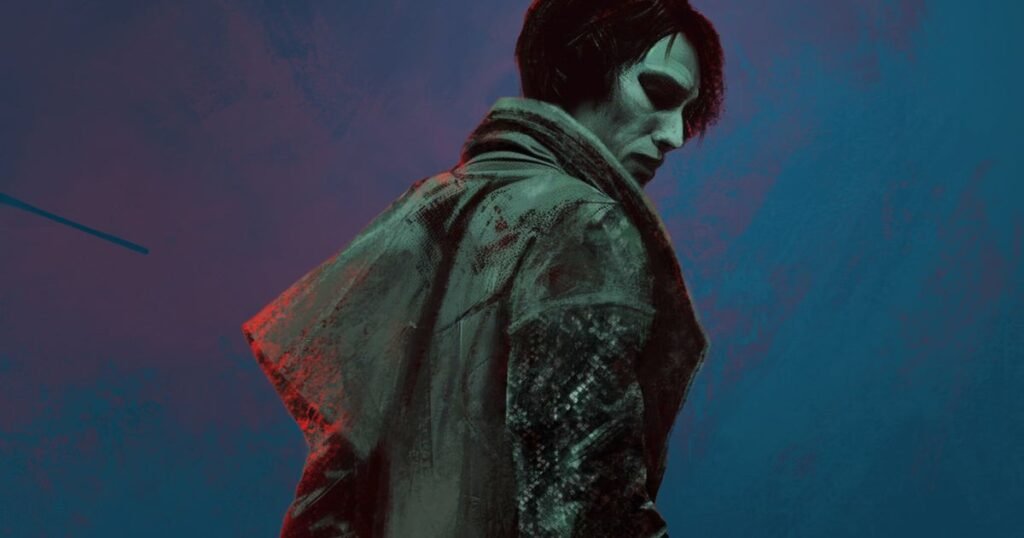
More than six years later, here we are with Pathologic 3 and the Bachelor’s story, which has itself become much more than a mere sequel to Pathologic 2. It is a retelling of a retelling, an oral tradition passed down through multiple gaming generations. And in that retelling, Dankovsky has evolved into a character study every bit as complex as Dostoyevsky’s Raskolnikov or Ivan Turgenev’s Bazarov – young men at odds with their prevailing social order, riddled with internal contradiction, acting decisively one moment and paralysed with apathy the next. Like his literary predecessors, Dankovsky is both timeless and timely: a critical look inside an intellectual at a moment when intellectualism has rarely had lower currency.
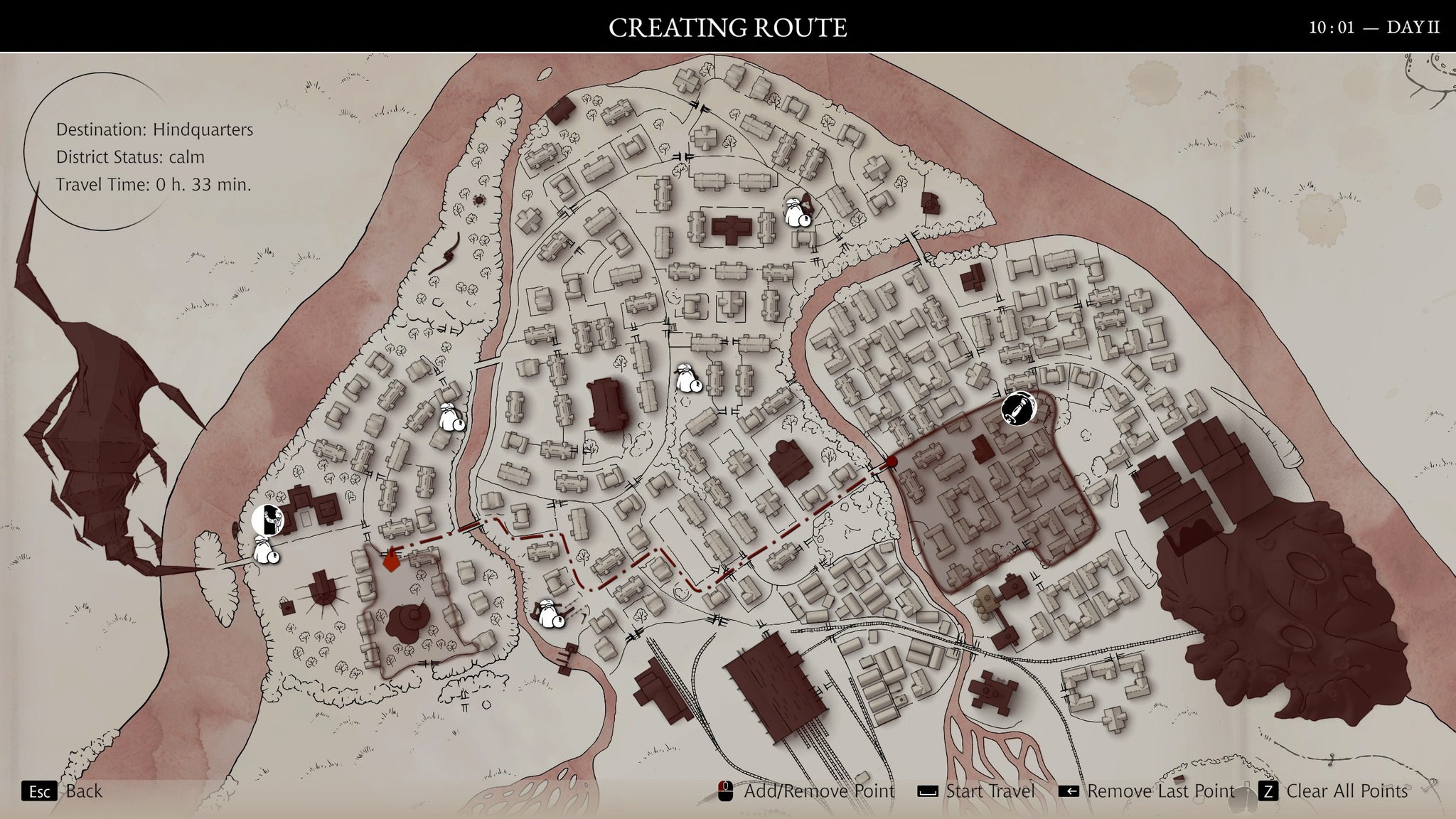
Dankovsky is the director of a medical research laboratory trying to learn how to stop death, drawn from the capital city to the remote town by rumours that one of its luminaries is immortal. When the plague breaks out, he is put in charge of containing it and finding a cure. It’s a pressured, time-constrained role, effectively conveyed through a set of overlapping gameplay systems. Each day, you will examine and interview patients, occasionally search their homes for clues, and analyse samples to identify symptoms. Successfully diagnosing all the patients enables production of a temporary vaccine, which can be distributed through a town management layer. The goal is always to keep infection rates low enough to get to the next day.

The Bachelor reflects that there is a relationship between halting the plague and finding immortality, between stopping Death and deaths, the abstract and the concrete instantiations of it. It is an unusual bit of synthesis for a man who otherwise spends most of his time on the horns of a dilemma: his desire to discover immortality versus his sense of duty to stop the plague, his condescending dismissal of the town and its traditions against the slow realisation that it may be impossible to cure the plague without a holistic – medical, ethnographic, architectural – understanding of the town, his scientific pursuit of truth versus the political and social reality that constrains that truth, the vanity of academic recognition versus the quiet honourability of doing what is required, of being able to live with oneself. The Bachelor has been trained to dissect and analyse – as he himself observes, to see things in terms of the cells that constitute them – but he is up against something that may only be comprehensible as a complex, indivisible whole. What if the town is the primitive, unanalysable concept that provides the means of analysing the phenomena within it?
The internal struggle is familiar. Raskolnikov had convinced himself intellectually that he had the right to murder to elevate himself, but could not cope with it spiritually. Bazarov dismissed love as a relic incompatible with his nihilistic rejection of the old social order, but could not help falling in love. They are the struggles of intellectual detachment against the realities of life. Pathologic 3 channels these literary classics, especially by putting its town somewhere at the turn of the 20th century, but Dankovsky’s character study has the benefit of the unique devices of the video game medium.
Besides a traditional health bar, Pathologic 3 has just two meters: time, and a continuum between apathy and mania, which is affected by almost everything you do and which must be kept in balance if Dankovsky is to remain alive. While I am a little squeamish about the apparent gamification of mental health implied by these mechanics, they are undoubtedly effective in establishing a core premise: the Bachelor is a well-to-do big city intellectual who doesn’t have to contend with trivialities like food or disease. Dankovsky’s needs are so close to the self-realisation apex of Maslow’s pyramidal hierarchy that he cannot even see its foundations. In gameplay terms, and in contrast to Pathologic 2, he does not get tired, hungry, or sick.
That all-consuming craving for intellectual fulfillment should be familiar to anyone who has ever been absorbed in a big project, when the only thing that seems to matter is that project. In that context, the idea of time as a resource should be equally familiar – if only I had more time, another day to investigate, a chance to revisit the false starts. Just so, in Pathologic 3 time is literally a resource: it can be spent to revisit any of the twelve days to remake key decisions or finish off incomplete tasks, in an effort to thread your way towards a desired ending. Aptly, time is usually collected by looking in a mirror and smashing it – an action that is supposed to represent a multiversal fracturing of different possible Bachelors, but also symbolises self-reflection and self-critique.

Appropriately, your play with time rarely works out quite the way you would like. The game does not simulate a full butterfly effect, of course, but nudging one thing tends to dislodge something else, create unintended consequences, spiral into a causal chain whose links become too difficult to isolate with any certainty, despite the game’s helpful mind map UI. Instead, the overall effect is to communicate a sense of a man consumed by his work, dashing around in manic fits and starts to try to finish everything, prone to depression when things go against him, slowly losing momentum as the days go on and things slip increasingly out of his control.
Take a step back to reflect on how the apathy-mania meter works and you also start to suspect that Dankovsky is unwell. It’s possible to stimulate apathy or mania by touching certain objects in the town, but often you are forced to use amphetamines and opioids to keep yourself balanced. In later days, it is pointed out repeatedly that Dankovsky has a reputation around town as a drug addict. Here, Pathologic 3 trades on established gaming conventions to lull you into a sense of denial: I can’t be a drug addict, because I don’t have buffs applied when I’ve taken drugs or debuffs when I suffer withdrawal, the way I might do, say, in Fallout. Yet the apathy-mania meter is dynamic, moving constantly, and the need to feed it with this or that stimulant is likewise a ceaseless struggle.

Pathologic 3 also plays with its own tropes here. Fourth wall breaks and bends are a staple of the series, usually delivered through extensive, beautifully written dialogue. The games rely heavily on a Gogol-like sense of surrealism and defamiliarisation – of ordinary things given a tinge of the extraordinary or absurd, or the extraordinary presented as everyday – to put the player into a sense of permanent ambiguity. So when Pathologic 3 introduces one of its new dialogue mechanics, where the camera suddenly switches perspectives to Dankovsky’s interlocutor and you see Dankovsky, it’s tempting to view it as another fourth wall break. What if, however, these episodes are intended to be taken literally, as out-of-body experiences that are symptomatic of Dankovsky’s general condition?
Dankovsky’s individual apathy-mania meter mirrors a grander balancing act: keeping the infection rate low typically involves sanitary measures that raise disorder in the town, leading to a riot if not kept in check. Town management, therefore, is also a matter of weaving between the extremes of physical and social sickness. Sometimes, Dankovsky has to take a literal fight to the plague in infected regions. These nightmarish sequences involve shooting a monstrous physical manifestation of the plague, even as Dankovsky grapples with whether he is witnessing genuine phenomena in a town that doesn’t comply with known natural laws, or slowly losing his sanity.

The picture that emerges, then, is of a conflicted, overly analytical, detached man, obsessed with his work to the point of sickness. It is a picture that feels sadly relevant in a time when the popular image of the intellectual, gnawed by a rising wave of populism, is somewhere between an ineffectual navel-gazer and a cold elitist. It is not the full story, however. Pathologic 3 reminds us that it is precisely Dankovsky’s intellectualism that makes him an effective antidote to the plague. His training and research supply the faculties necessary to establish a hospital, to diagnose patients and develop daily vaccines to slow the plague’s progress, to work out the appropriate quarantine and hygiene methods for the town – all nuances that are conveyed through their own gameplay systems. For all his arrogance, and the prejudice against the town’s supernatural phenomena, it is ultimately the Bachelor’s commitment to the scientific method that leaves the door open for him to consider them.
The parallels between Pathologic and the Covid pandemic are too obvious; in the case of Pathologic 2, which came out less than a year before the outbreak, they are uncanny. Nonetheless, Dankovsky’s political trajectory in Pathologic 3 is instructive. The authorities are initially all too eager to rely on his scientific expertise and status, to put trust and power in his hands, until the social and economic necessities catch up to them and turn scientific fact into an inconvenient thorn of objectivity. And if scientific facts cannot be manipulated to fit their agendas, then perhaps Dankovsky, as the fallible mouthpiece for those facts, can be. In the later stages of the game, in the increasingly dogged attacks on Dankovsky’s projects by an all-powerful special bureau, there is a sinister hint of an older breed of anti-intellectualism – the systematic persecution of allegedly bourgeois intelligentsia under the Soviet regime. The insinuation of a link between modern day populist anti-intellectualism and historic state-sanctioned persecution of thought may not be an explicit theme, but it is difficult to avoid drawing the parallel.

Then again, perhaps I am looking for a charitable reading of Dankovsky in Pathologic 3 because I am cut from the same cloth as he is. My upbringing and the training I received make me prone to even more elaborate bouts of over-analysis, so is it not natural that I would try to look on the Bachelor in a favourable light? When contextualised against Pathologic 2, in which the Haruspex solved the plague without the Bachelor’s fancy expertise, that assessment feels even more tempting. Well, maybe so, but the main strength of Pathologic 3 is a protagonist that feels real. And, just as with any real person, the best way to judge whether I am right or wrong about Dankovsky is to meet him for yourself.