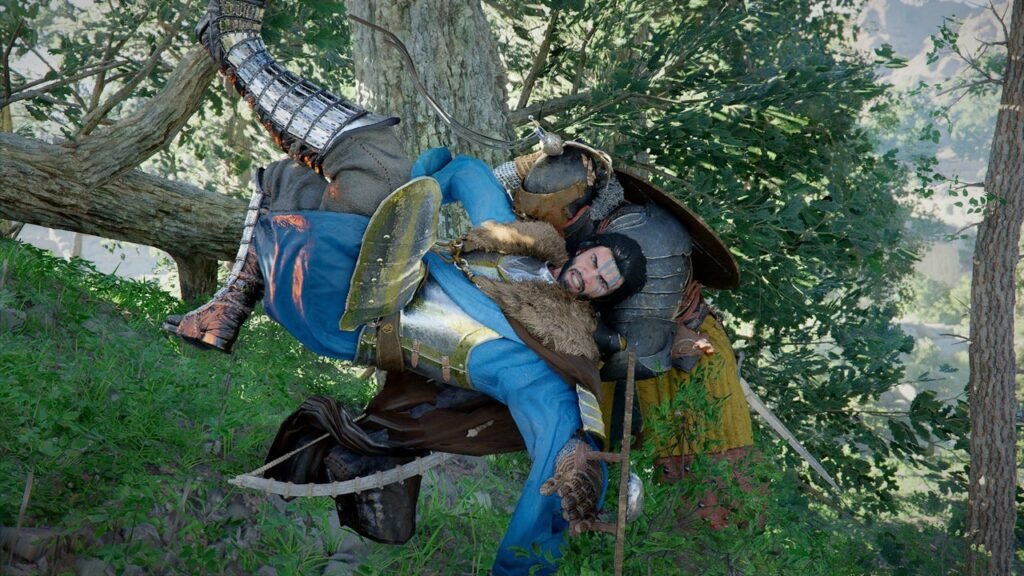
You can’t suplex a giant gorilla.
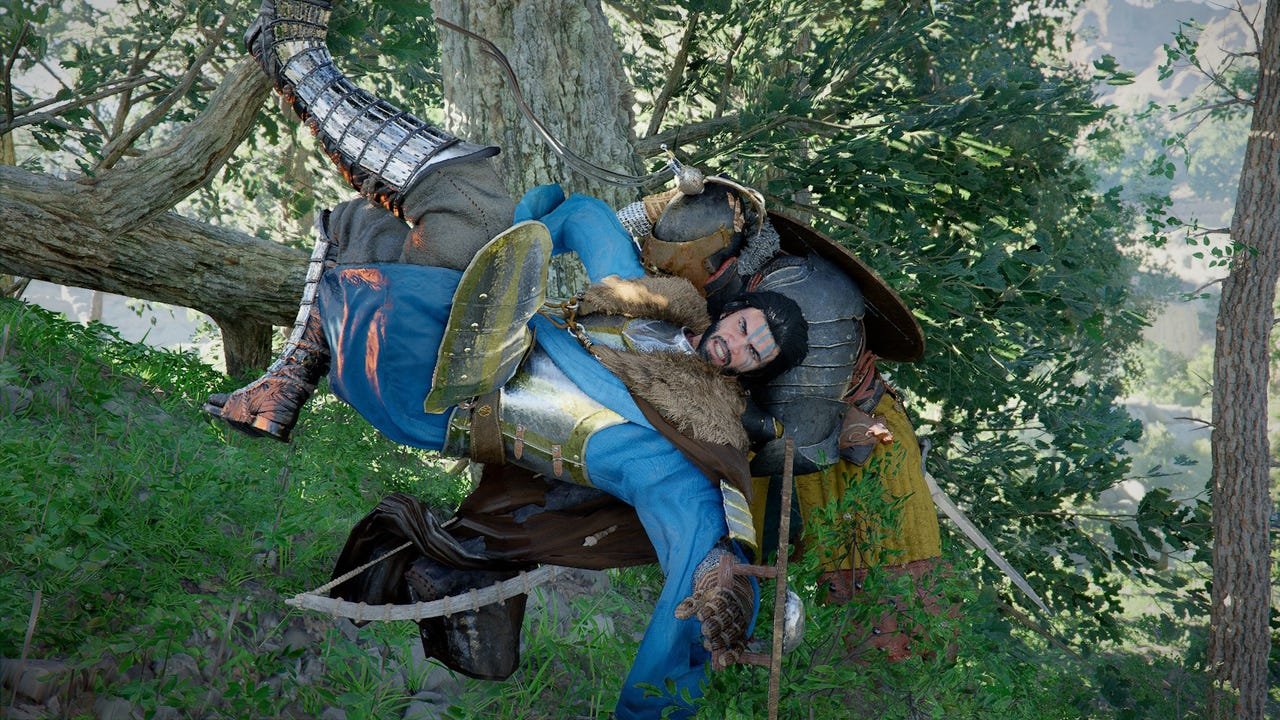
A nonsense statement in almost any game except Crimson Desert. But Pearl Abyss’ open-world romp combines one of the broadest combat systems ever – you can clothesline enemies, body slam them, punch them, kick them, shield bash and stab them, shoot them, blind them, hoist them with a magic grappling hook and call on a supernatural “echo” to replicate your attacks, all in one fight – with a parade of varied bosses, including the hairy beast Kearush the Slayer, that are often invulnerable to at least some of those moves.
I’ve tinkered with and reset the skill tree several times. Individually Crimson Desert’s abilities are nothing special but I’ve grown to love the chaos that erupts when disparate styles chain together, especially when enemies smash into each other like bowling pins. It’s generous and silly, and rewards self-expression: combat is not a barrier to break but a bloody canvas to paint on with squiggly strokes.
It’s a shame that bosses, as our review noted, lock you into one-on-one, multi-phase, often clunky duels. I know I can’t expect my beloved suplex – or Lariat, as the game calls it – to work against 18-foot-tall Kearush, but I’d hoped that Crimson Desert’s numerous boss battles would feel more connected to the fluid fights I’ve had outside them. Boss battles should build on skills you’ve honed on lesser enemies: instead, it’s as if the game is teaching me the flashiest football moves and then shoving me onto an ice rink.

It took me about 10 hours before I properly started enjoying the most basic fights. You can mindlessly button mash through bandit patrols early on, and there’s a satisfying heft to Kliff’s bashes, but it felt like a dozen other action games.
Then I started unlocking more outlandish skills. It’s really worth exploring Kliff’s entire skill tree before investing your points. Just because an ability is towards the end of a branch doesn’t mean you need to wait to unlock it and some of the best abilities, like the Lariat, only reveal themselves when you click into individual nodes.
I began prioritizing grappling and wrestling, simply for its novelty, and soon learned about Crimson Desert’s exaggerated physics systems. Most unarmed moves, including basic throws, create a shockwave that decks nearby enemies. Rather than trying to fight bandits individually it’s best to sprint towards one and pound him into the ground, catching the others in the blast. Kicks launch enemies and you can unlock a skill that chains a kick into a giant, swinging hurl that lobs enemies miles and clatters anything in their flight part – including guard towers, which collapse in splinters.
The more bandit camps you squash, the more skill points you unlock, the more chaos you can cause. I’m at a point now where I don’t have to choose between throws, spinning slashes and grappling attacks: I can have all three, all the time. Snatching an enemy with your grappling hook is especially useful in trickier fights. Whenever I see a stronger enemy, denoted by a star on the minimap, I try to pick off the weaker foes around them with my grapple first.
The button combos can be fiddly but I’ve taken that as an excuse to slow down and properly execute my attacks, knowing that I have a reliable parry and dodge if I’m overwhelmed. When you stop mashing you appreciate how these attacks flow together: a flurry of light attacks sweeps into a Lariat if you time your presses; a spinning attack that staggers multiple enemies morphs into a finishing overhead slash.
Roaming the countryside and clearing groups of bandits, I’ve been constantly reminded of Far Cry’s outposts, which have always been my favorite part of that series. Crimson Desert’s battle arenas are much simpler – usually just flat plains to fight on – but I get the same sense of unbridled joy and freedom to do things my way. I could play a 10 hour game of these fights, one after another.
The fun stops, at least for me, when boss battles begin.
The bosses certainly look cool – fighting the masked, horned Reed Devil in a field of flowing crops is an early highlight – but ultimately they feel out of place.
Part of the elegance of a game like Sekiro is that its bosses are the ultimate test of the skills you’ve used on regular enemies. Crimson Desert bosses, by contrast, squash your toolset, forcing you into specific playstyles. I had trouble wrestling with the Reed Devil boss until I paused, opened my skill tree, and dumped points into my heavy attack combo. His health bar promptly melted.

I followed the same pattern against Kearush, and then again against Crowcaller: stay out of range of their flurries, dodge their attacks from range or from the air, and hit them with your best combo when they stop for breath. These bosses aren’t terrible – save for phase two of Reed Devil, when you’re asked to sprint between totems while enemies spawn all around you – but they are certainly uninspired.
They’re at their worst when Crimson Desert forces you to switch to a specific and potentially unfamiliar character whose skill tree you’ve ignored. I’ve stuck with Kliff as much as I can for my journey and I feel like I’ve been rewarded for mastering his moves and improving equipment that matches my playstyle. It’s baffling that Chapters 7 and 8 force me to use the other two playable characters, Oongka and Damiane, to defeat bosses – especially considering there’s no prior reason to have invested any points in their unique abilities.
I genuinely think Crimson Desert would be more fun without its bosses. I get why they exist, but they’re not a culmination of what the combat does best – they’re a departure from it. I’m at least glad that Pearl Abyss’ difficulty patch has made many of them easier (I finished Kearush in a single attempt) because I feel like I can now rush through them to get to the good stuff: bashing bandits.
If you’re jumping into Crimson Desert’s huge open world, we recommend you take a look at our guide to Things to Do First in Crimson Desert, plus Things Crimson Desert Doesn’t Tell You (we’ve got 28 and counting!). We’ve also got a guide to the Best Early Weapons we recommend picking up, the Best Skills to Get First (including a handy explainer of the skills system), and 34 Essential Tips and Tricks to help you succeed in Pywel.
Matt Purslow is IGN’s Executive Editor of Features.