Thick as Thieves feels like it has a story to tell. And not just the one about talking effigies and mysterious diamonds that plays out across its relatively brisk campaign. Rather, the story of its seemingly sudden lurch away from PvP, its truncated launch state, and its slightly awkwardly papered cracks. But whatever that story may be, and whatever its resulting flaws, this odd little nubbin of a co-operative first-person stealth adventure is still a surprisingly fun time – and not just because of its killer eight-minute countdown.
Thick as Thieves, for context, is the work of OtherSide Entertainment, a studio helmed by industry veterans Paul Neurath and Warren Spector – two pioneers of the immersive sim genre, and the minds behind stone-cold classics like Thief: The Dark Project, System Shock, and Deus Ex. So when OtherSide announced Thick as Thieves in 2024, as a sort of a stealth-based immersive sim with a PvPvE twist, curiosities were piqued. It would see players using their cunning to steal randomised artefacts hidden across labyrinthine maps, all while competing players tried to do the same thing at the same time. So it was a bit of a surprise when, just weeks before Thick as Thieves’ release, OtherSide announced it’d had ripped all the PvP bits out, because, it said, it was “having more fun with solo and co-op play”.
I was kind of relieved, to be honest; as intriguing as Thick as Thieves’ multiplayer pitch was, my tastes definitely lean more toward co-op than they do PvP. But such a radical change in direction had me a little nervous: would gutting its foundational idea seemingly so late in development, turning a game built around sneaky multiplayer competition into a staunchly two-player co-op or solo affair, leave it feeling hollow? Unhelpfully I realise, the answer – having played around five hours of it now – is both yes and no. But importantly, when it all comes together Thick of Thieves really is a tremendous amount of fun.
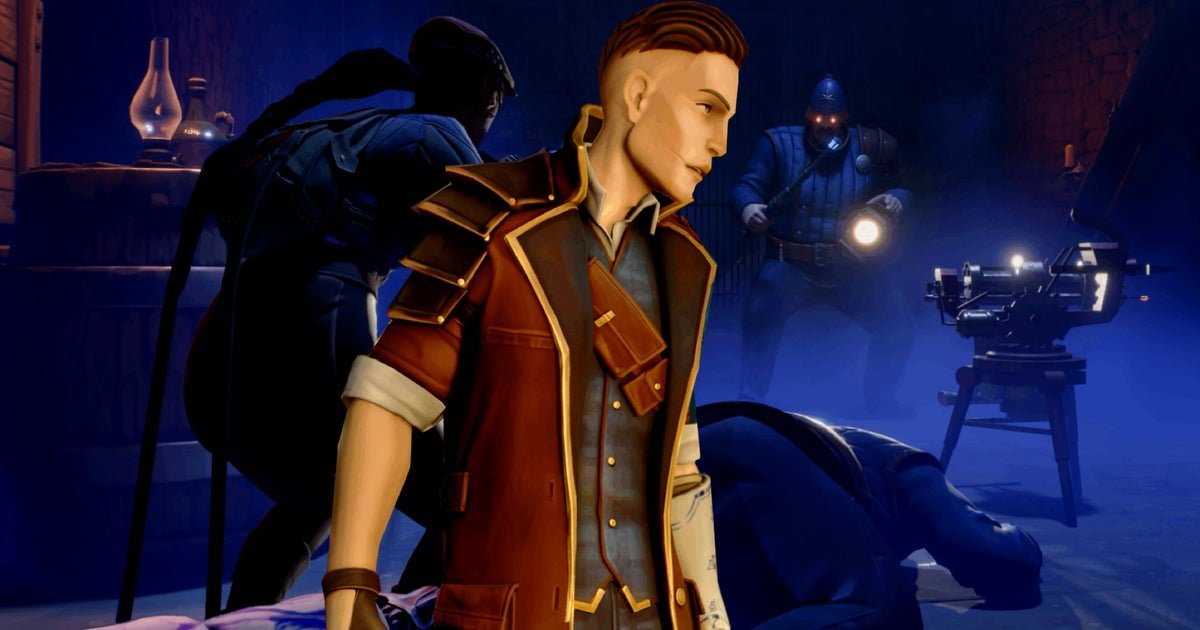
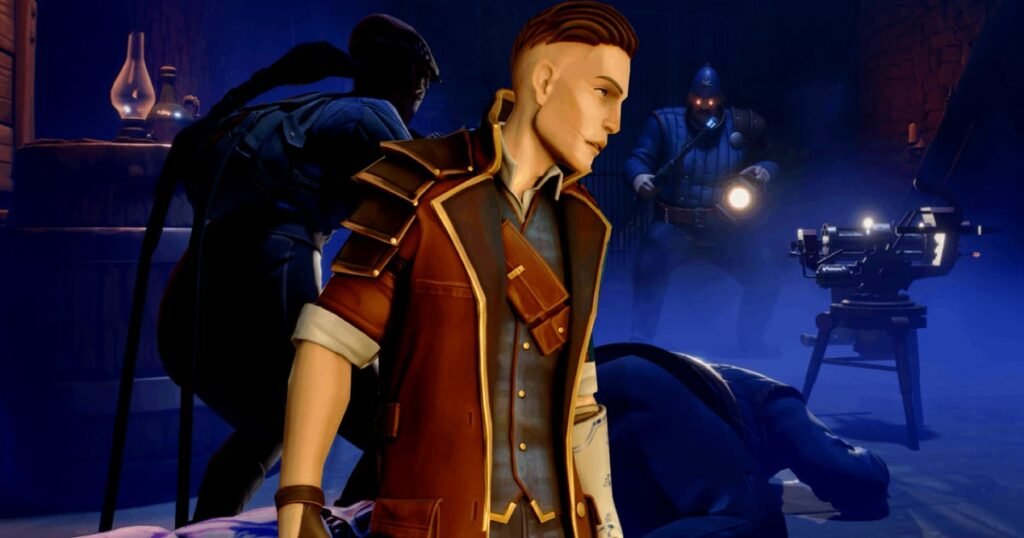
Welcome to Kilcairn, then; an alternate-history Scottish metropolis, somewhere in the 1910s, with a touch of Dishonored‘s Dunwall about it. It’s an attractively cartoonish world of gloomy cobblestone alleyways and tall, teetering buildings, all jostling for space as they stretch endlessly toward a grey horizon. And it’s a world with a whiff of steampunk about it, where suspension trains thunder along overhead tracks against a backdrop of sweeping search lights and neon signs; where missives are delivered by clockwork fax, and where copper-plated security turrets in shadowy corners come to clanking life when carelessly disturbed. But it’s also a world of magic: of door-like transportation portals and disembodied eyeball sentries ceaselessly scanning back and forth, of insult fairies and spectral patrols.
Or at least, that’s how Kilcairn is presented in Thick as Thieves’ two lone maps. This recalibrated version of OtherSide’s original pitch is more modest in scale than suggested back in 2024, a shift reflected in its cheap-as-chips price tag: alongside its scant level roster, Thick as Thieves features just two of its three announced classes (the Spider with her a grappling hook, and the Chameleon, who’s all about disguise), an extremely limited selection of genuinely useful tools, and an equally small number of enemy types. It doesn’t sound like much on paper and in a way it’s not, but it makes the most of what it’s got. And that starts with those two, glorious maps – surprisingly vast, labyrinthine things, rich with stealthy potential and then some.
Each map’s convoluted tangle of doors, windows, air ducts, balconies, secret passages, and short cuts create a pleasing sense of flow, where multiple options are always available so that even if unexpected obstacles demand a change in approach, they don’t interrupt momentum. And Thick as Thieves is designed to be unpredictable. Fire up a map and certain elements, even the atmospheric weather, are scrambled to make for a slightly different experience each time.
Objectives tied to the campaign (which tells a surprisingly compelling yarn, despite being entirely conveyed through text) are fixed, but they’re always paired with broader mission goals, randomised each time. You might be required to swipe a specific high-value item, or loot a map until you’ve hit a specific value threshold, or find several items scattered across distant locations. It’s a decently varied foundation, but there’s more: the stuff you’re looking for won’t necessarily be in the same place each time, and other critical items – a vault key, say – can shift around too. You can brute force objectives, but given the size of levels and the ticking clock, it’s usually wiser to poke around for written clues. These feel just oblique enough to lend proceedings an enjoyable sleuthy texture, and more broadly encourage far-flung exploration that works particularly well in co-op as the two of you scour in tandem – perhaps splitting up to cover more ground or using your numbers to your advantage, flanking enemies and exploiting distraction.
While familiarity inevitably sets in sooner than is perhaps ideal thanks to the scant level roster, the set-up gives matches an enjoyably unpredictable rhythm. But the basic flow is one that’ll be immediately familiar to old-school stealth fans as they skulk through the shadowy interiors of the Constables Guildhall – with its banquet halls and libraries, its opulent office interiors and squalid dungeons – and through the once-resplendant hallways of Elway Mansion that seem to stretch on forever, even reaching up into a cavernous clocktower.
You’ll crouch in shadows, and if there are none, make some by blowing out candles and turning off lights. You’ll skulk behind patrolling guards to put them in a choke hold, or dodge the sweeping beams of sentries, sneaking in close enough to flick their comically conspicuous ‘off’ switches. You’ll dodge under lasers and slip around pressure plates, toss smoke grenades to pass unseen through more heavily guarded areas; you’ll grapple onto ledges, pick locks and doors, shimmy down dumbwaiters or scurry along rooftops, all while grabbing as much loot as you can. But because you’re also operating against the clock and working toward a mandatory objective that never quite plays out the way you might be expecting, there’s also a pressure to keep moving, which makes for an interesting tension in a stealth game. And that’s particularly true once your eight-minute countdown begins.
When an objective is complete, or when only eight minutes remain on the clock, an escape portal is magically conjured into existence somewhere in the level. And you’ll need to reach it before the timer hits zero if you don’t want the previous 30-45 minutes of work to be for nought. It’s extraction-shooter-style flourish that feels like a remnant of Thick as Thieves’ earlier life (one which would presumably have funnelled all players together for one final match scrum), but while it no longer serves quite the same purposes, it turns out nothing focuses the mind quite like a countdown.
Suddenly, formerly leisurely jaunts through the shadows can turn into a slapstick scramble as you attempt to wrap up your business and get out as soon as possible while still abiding by the cautious (invariably now not-so-cautious) rules of stealth. And, in one memorable mission, all while carrying a magical statue who likes to shout insults and alert nearby guards. It’s that interesting tension amplified to the max, particularly when there’re two of you trying to orchestrate your escape in unison, and I don’t think I’ve done a single run where those final eight make-or-break minutes haven’t felt properly heart-in-mouth.
It’s a set-up that works surprisingly well, but at the same time – early on at least – it does feel like there’s something missing. Until that eight minute countdown, the tension is perhaps a little too saggy, a little too one-note; like it’s missing critical staccato moments to keep you on your toes. And you suspect this is the role competing players would have filled at one time – delivering sudden bursts of unexpected action as plans collide and confrontations ensue.
And really, you don’t have to look hard to see lingering hints of Thick of Thieves’ previous form. Your HQ map refers to missions as ‘matches’, while death is met by unnecessary spawn timers and relocation to awkwardly positioned safe rooms that break the natural flow of co-op. The slow reload on your grappling hook feels like a legacy mechanic designed to prevent escape spam, and you drop calling cards when stealing stuff, presumably as a way to gently goad fellow players. The ability to disguise yourself when playing as the Chameleon (unlocked weirdly late on) makes a lot more sense in the context of hiding from others than it does hiding from the rudimentary AI of NPCs. And progression is building around a slow XP levelling grid, tied to unlockable tools and cosmetics, that would be much more at home in a multiplayer game seeking player retention. You get the idea. Thick as Thieves works well in solo and co-op, but it’s hard not to wonder how it might play if OtherSide – rather than pushing it out into the world in its slightly Frankenstein state – had taken more time to properly adjust Thick as Thieves’ mechanical underpinnings to better serve its new direction.
And for a while, the compromises, the conspicuous incisions, the wonkily-paced action, and rough edges – everything from floating geometry to misaligned animations – meant that while I was entertained, I wasn’t entirely convinced. But the more it went on, as levels grew more complex, the more I was sold. That’s particularly true as you begin to unlock more challenging difficulties (and, again, it’s odd these options aren’t available from the start). Suddenly, guards and security systems are more plentiful and their placements are randomised, adding another layer of unpredictability to work around. Time limits are more punishing, and as the challenge increases, the looseness of those pre-climax moments is tightened. It’s faster, tenser, more demanding on your planning and problem solving skills, more engaging, and more rewarding. And, really, just a fun little stealth game.
But does that ‘little’ matter? Even with the cleverly shifting mission design, I do wonder how long two levels can sustain interest. In a way, it’s a moot point – you can’t really argue a fiver for eight-plus hours of entertainment isn’t a decent value proposition. But there’s just such a strong, engaging foundation here, I just genuinely – and greedily, sure – want more to see more, to see how OtherSide can develop it further. Promisingly, the studio has already said it intends to expand Thick as Thieves’ “setting and its stories across future content”. And now I’ve got a feel for the shape of its stealth, my initially PvP-averse mindset has softened, and I’d be genuinely curious to try out the game’s original form if OtherSide ever considers putting a competitive mode back in.
So yes, Thick as Thieves, with its strange arrival and slender beginnings, really does feel like it has a story to tell. But this is a compelling first chapter after that slightly perplexing preface, and I’m eager to see how the rest of its story might unfold. Hopefully there really is more to come.