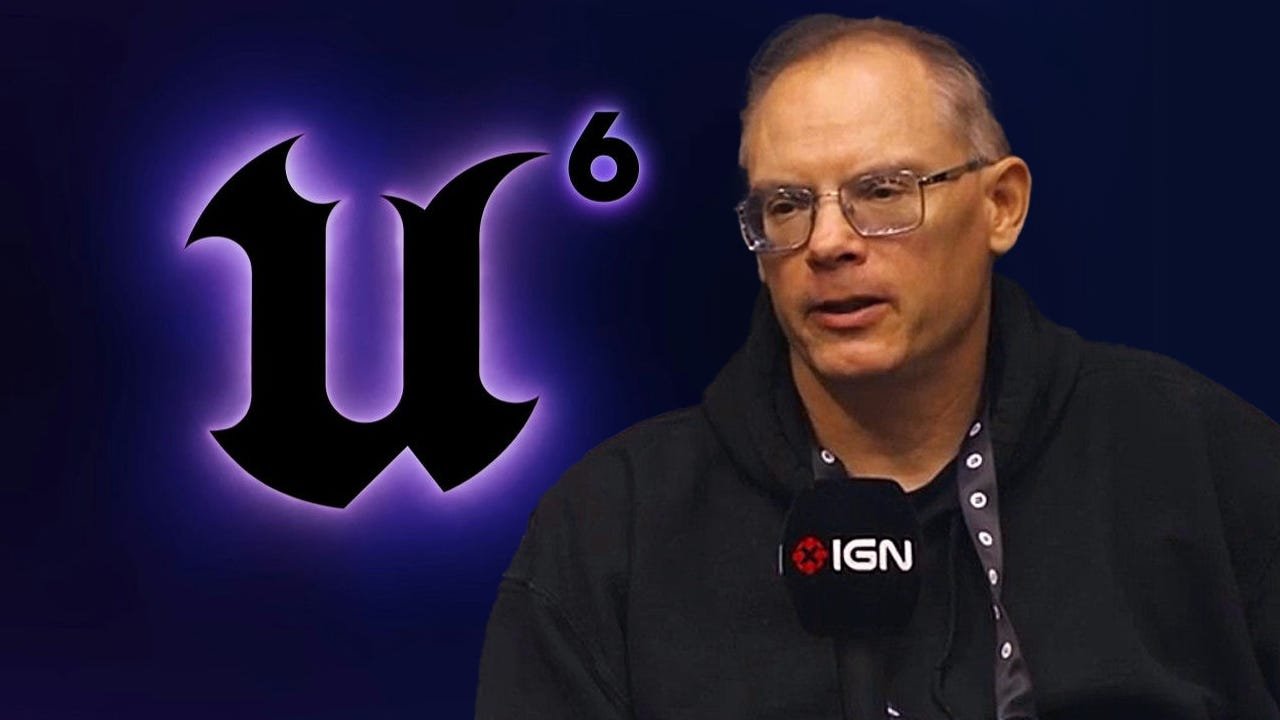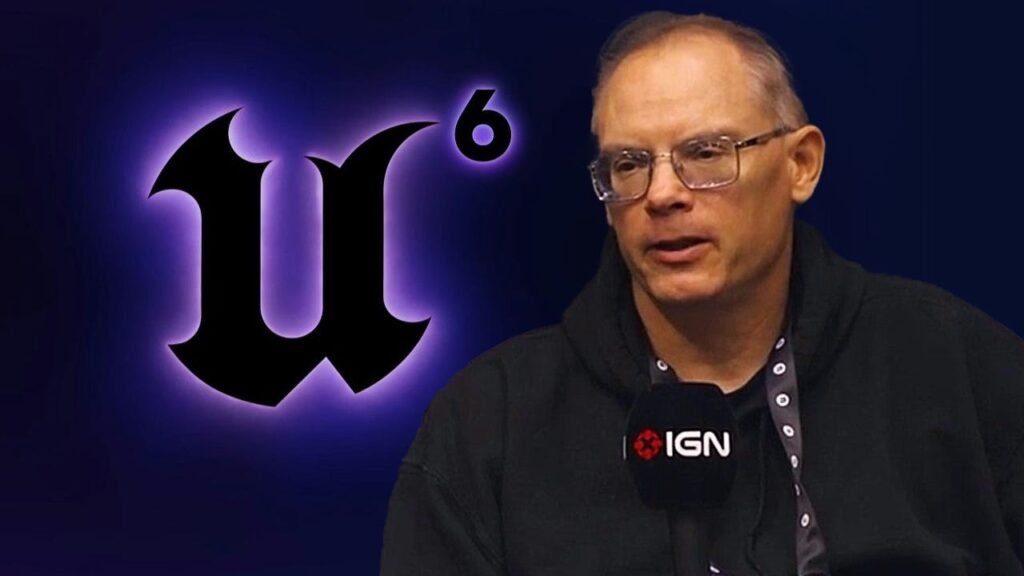

A few hours after the State of Unreal keynote speech, founder and CEO of Epic Games Tim Sweeney, alongside EVP of development Marcus Wassmer, met with us to talk about everything new with Unreal Engine. They’d just announced that UE6 is set for early access at the end of 2027 with a 12-14 month period before its full launch, had developers on stage speak to how Unreal made their games technically possible, and, well, showcased AI tools being integrated in future iterations of the engine.
It feels redundant to say at this point that the games industry is in unprecedented times, but it really is – at the convergence of unaffordable consumer hardware, development studios getting shuttered, and AI getting pushed onto everything in between; this is where we are. With Unreal Engine being so ubiquitous as the framework for which some of the biggest games are made, Epic and its tech has a major role in stewarding the games industry, as fallible as they may be. We talked about all that in the following interview, which you can read or watch below.
IGN: How is UE6 going to change AAA game development? As it gets more expensive and tools get more advanced, it seems like the idea is to help create an environment that’s more seamless for developers and to cut down on development time. Can you dig a little more into that as you transition over to UE6 in the coming years?
Wassmer: I think it’s two things – one, the efficiency of development. Games are getting bigger, games are getting more difficult [to make]. So, all the architectural work we’re doing on the engine should just smooth things out. Not to mention AI creation flows. We showed some demos, and it really should take a lot of the tedium out of game creation and let people just actually focus on the creative part, which should be really nice. Then, the really cool thing, I think we’re kind of inventing a new type of economy here, hopefully with the interconnected and interoperable assets between games, which I don’t think has ever been done. I haven’t seen it done at scale, at least anyway.
Sweeney: I’m really looking forward to the increased simplicity. I wrote the first generation Unreal Engine and with every generation, out of necessity of taking advantage of new features of hardware and expanding the engine capabilities, we’ve made the engine progressively more and more complicated, to the point where it’s somewhat daunting to open up Unreal Engine 5 and look at the five-level MUI nested menus in some cases.
The C++ programming model really requires expert level programming, and the great cleanup in Unreal Engine 6 is to adopt the Verse scripting language that we’ve been pioneering in Fortnite with the Fortnite creator community and bring that into UE6 as the primary way to develop gameplay code. So, it brings the ease of development and programming that you have in an engine like Unity or Godot together with the full power of UE6 on the high-end AAA feature-sets. And to tame complexity of the engine, the ability to prompt a lot of different systems, and have it help you create a particle system and tweak it; it’ll enable you to focus on the details that really matter rather than the boilerplate of creating and repeating the same rote actions over and over. It’s going to be really freeing.
I think it will bring back some of the magic that we had in earlier days that each engine had in its first few years before each engine grew more complex. It’s just making it really easy to create stuff, giving the user an immense amount of creative freedom and the feeling that they can exercise it pretty easily without going off and spending hours or days on tutorials.
IGN: While the State of Unreal keynote was more developer-focused, what would you say to someone on the outside looking in who’s wondering how this affects the games they play?
Sweeney: The biggest opportunity is for games to connect their economies. Not every game wants to connect every part of it; in some cases it’s logical and in some cases it’s not. But if you look broadly across games, there’s an awful lot of stuff that could be shared in common. Every game with human [characters] could share emotes, and a lot of games with similar art styles could share characters such that from a player’s point of view, it would be a whole lot more valuable if everything we bought that is cosmetic in nature worked across all of the different games that we owned.
I think that creates a huge opportunity in the future for an ecosystem where there’s lasting value created in the sense that whether or not you’re playing the current game you’re in, weeks, months, or years from now, the things that you’ve done and earned in it are of lasting utility to you as long as you’re playing some game somewhere.
Wassmer: On top of that, and just even more directly, I think we’re going to continue to see small teams being able to punch above their weight. You take a look at Claire Obscur: Expedition 33 and No Law getting shown off – really small teams doing really, really impressive stuff. I think you’re only going to see that trend accelerate as we go toward the UE6 era.
IGN: One of the things that is also top of mind, especially for games built on Unreal, is performance and scaling for mid-level to low-end hardware. UE5 has had its ups and downs when it comes to playing well on handhelds, which have blown up with the Steam Deck and ROG Ally – and people are playing more PC games on lower-end specs. How is that being accounted for with UE6?
Wassmer: I think we’ve actually been addressing it through 5.7 and 5.8 even, and I think the trend will continue through UE6. We’re a game developer, too. Fortnite players have the same issues as anyone else and we try to scale from mobile all the way into high-end PC.
You see initiatives like Lumen light we showed on stage as an effort to bring the costs of Lumen down to be accessible to more people for global dynamic illumination. We were showing off Mesh Terrain where you can see the new features we’re building that’s built inherently to scale from Nanite to non-Nanite platforms. So, when it cooks down for a non-Nanite platform, it just cooks down to regular meshes that should run efficiently and more efficiently than the old landscape system in most cases.
So, it’s really on our mind. I think you can see games lag a little bit in shipping on engine releases, but as more games kind of hit that 5.7 and 5.8 mark, I think you’ll already see a trend toward efficiency. We have a ton of stuff in the pipeline as we progress towards UE6, and that’s going to land in the engine as well.
Sweeney: It’s the cumulative set of optimizations that have been done. We have Fortnite back on mobile, we’re putting a lot of effort into optimizing the engine so that a developer can ship a game and run on everything from the highest end hardware all the way down to low-end Android and several-year-old iPhones. Over time, we’ve also come to an increasing appreciation of the need to make the engine automatically scale much more of the content in the game. It’s always been the case that with enough effort and trickery, a developer could make their game run on low-end devices. But the more our systems like Nanite can automatically scale, the better. That’s going to be a source of ongoing attention.
IGN: As people who have worked with bleeding edge tech for many years, I want to get your perspective on the increasing cost of hardware – even mid-level hardware just to engage with games that are built on these pretty sophisticated technologies. Does it cross your mind when working on new versions or builds of the engine, do you account for that? And what’s your perspective on the unprecedented times with pricing and hardware availability?
Sweeney: Well, it’s an unfortunate and completely unexpected event that AI would surge so much and place so much competitive pressure on memory prices and everything to the point where it’s significantly affecting the cost of gaming hardware. I think it’s a temporary effect, but temporary over the next two or three years.
I’m sure throughout Asia, there are massive fabs being built to manufacture memory at scales that will eventually relieve the supply pressure. In the meantime, we’re going to have to be judicious and spend more time optimizing knowing that we can count less on Moore’s Law to solve our problems for us, as the game industry has always done with or without intention.
Wassmer: We definitely talk about it and think about it as we’re doing development, for sure. As Tim says, you can’t count on hardware trends to help us out at the moment. So, it is increasing the pressure for a push on optimization across mobile and mid-spec, for sure.
IGN: It’s interesting to see UE5.8 and UE6 using the MCP server and including support for multiple LLMs into its ecosystem. With this increasing ubiquitousness of AI, what’s the role of AI in the game development process from your point of view?
Wassmer: I think its role is as a helper where it’s useful, right? You go look back at Codegen tools back in last November, they kind of weren’t that great. Now they’re pretty good, so you can pretty easily put them into engineering pipelines. I think the main thing is you want to make sure of is to use AI to reduce all of the tedium. All the tedious tasks, like, you don’t need an engineer to go and spend half a day doing root cause analysis on a crash if you can have a thing do that for you in 20 minutes and then tell them what’s going on so they can spend that time optimizing the engine instead, helping a content creator, or whatever. I think it’s horses for courses and there will be places where it’s not useful, there’ll be places where it will.
Sweeney: The whole space is moving so fast. We recognized early on that Epic should just broadly enable everybody to use the tools they prefer and be able to plug them into Unreal Engine in any way they want. We didn’t go out to build like the Unreal Engine coding model, rather, we built an MCP server so that people could bring Claude code, Gemini, or whatever tool they prefer and connect it. Every week or two, there are going to be new capabilities coming out with lots of different companies competing, and we want to be able to support them all and put each game developer in charge of how they want to integrate AI tools into their pipelines to get maximum usefulness out of it and figure out what really gets acceleration maximized.
IGN: There will always be concerns about artistic intent. We saw the demo of how you can build a virtual world foundationally with MCP and Claude coding. There are a lot of people who are on no-AI policies, and these kinds of things get marked on Steam pages as using generative AI. So, when it comes to building worlds and building games, I want to get your thoughts on preserving artistic value when it comes to using AI.
Wassmer: Sure, we’re building all the pipelines in Unreal to maximally preserve artistic intent. We gave the demos and you can see every step of the way. Our intention is, whatever gets built is a real Unreal scene that people can tweak and make exactly the way they wanted it to be rather than just typing into the prompt and trying a million times to get whatever pops out right. It’s really meant to help people explore creatively more quickly, then settle in on the details of what they actually want, and then do the tweaks they need by hand right in the engine. So for us, it’s human control all the way through the pipeline.
Sweeney: Yeah, exactly that. You know, gaming has always been driven by great games built by great development teams and that will continue to be the case. Every generation has had its stereotypical low quality games, from just plain old bad games to asset flips and now we’ll have AI slop. But in the hands of awesome professional creators and serious indies building a game, these tools are just an accelerant. And just as the industry moved from pixel art to Photoshop and then from 2D to 3D, these are just going to be ways to make content more efficiently and avoiding the drudgery of handwiring a giant blueprint and debugging really complicated problems in a program.
IGN: I also want to get your perspective on the physical cost of using AI when it comes to data centers and energy usage, and your thoughts on the impact of AI outside of artistic intent. Is that something that is at the top of your mind or are you looking at this as just enabling the tools in Unreal? Is that something that you account for?
Sweeney: I think that’s for the model providers to sort out. Some of them are operating at a loss such that there’s actually a higher cost than they’re charging to try to grow their businesses. Then there are trade-offs between local AI and server-based hosted AI. I think the whole industry is going to have to sort that out.
With our part, Epic doesn’t have billions of dollars to invest in building a bleeding edge model to compete with these things. What we can do is build an awesome MCP interface so that every one of them can talk to our engine and so on. I think developers and the market are going to ultimately sort that out, and I think there’s plenty of incentive for everybody to do these things efficiently. Cost is going to be formidable when you’re using a bleeding edge model at its maximum capability. And optimizing that is going to be a first-class objective for everybody.
IGN: You’ve been in the business for a long time, and along with the unprecedented times with hardware cost, it’s also unprecedented times with AAA studios more or less collapsing. We’ve seen big name developers either cutting significantly or being shut down by parent companies. Being part of game development for so many years, I want to get your thoughts on the contraction of a lot of these bigger studios and where you think things are going wrong. What lessons do you think need to be learned from all this?
Sweeney: I guess I’ve been around the longest. But you can’t say that this is the first time the industry has gone through a shakeup because there have been many before. I was a young gamer in the 1980s when the Atari crash happened, and the transition from 2D gaming to 3D when suddenly a lot of the games at the time that were being developed ended up not finding a market. And then BitTorrent hit the industry pretty hard, too. There was a time when the industry rumor was that Crysis had sold 100,000 copies and 10 million people had played it. And the solution to that was multifaceted.
Every technology generation, whether it’s seven or ten years – changes accumulate so much that the way people build games and play games changes. The answer can’t be that every generation we just spend exponentially more on game development because the market doesn’t always support that. And I think we’ve seen some very specific problems with specific games. Sometimes a really big budget game ships that wasn’t very good and didn’t sell. But much more often as we’ve seen with a bunch of the big multiplayer games – it could be a good game – the market dynamics prevented players from coming in simultaneously with enough scale to make it viable.
We should set aside flukes where a game didn’t meet expectations of gamers and just look at more of the structural changes. And those are really appreciable, the fact that games are becoming increasingly multiplayer. And not just multiplayer but social, where you’re getting together with your friends and then you’re deciding what to do, what to play, and how to play it. This trend of the gaming economy shifting – some people like it and some don’t – is going more and more towards buying things in games rather than buying games. In-game economy is driving gaming, especially at scale and especially over long durations as you see with these long-lasting multiplayer games.
You have much more of a winner-takes-all phenomenon where it’s really hard for any new entrant to compete with an established game, even if it is incrementally better. After years of established games continually reinvesting and making the game better, it’s hard for a new entrant to compete with a game that’s had many years of development and potentially billions of dollars of development investment going into it over time with a small team building a small game.
Those are the huge challenges and those are generational, different challenges than you’ve seen in the past. Each of them was kind of an isolated problem that had a solution [before], and here the answer has got to be pretty broad change in the way that everybody goes about developing games. We’ve got to develop better games more consistently and we’ve got to develop them a lot more efficiently.
The only way that we can hope for new games coming into the market to be able to succeed when there’s so much Metcalfe’s Law at play and so many captive audiences in the really big games – you know, Fortnite, Roblox, PUBG Mobile, and a few other really huge ones – it’s got to be that those games get momentum by connecting to the economies in other games. I think that can really reinvigorate the market if people are constantly looking to new games and sources of new items that they can earn everywhere and be able to really easily move together with their friends.
It shouldn’t be understated how badly broken the social ecosystem is in gaming as a whole. Most games now are broadly multi-platform. You have a lot of games that are across mobile, a lot of games that are across PC and console, and then you have games that are across all platforms like Fortnite and Roblox where the game is literally on every platform everywhere in the world. For those to compete against that sort of thing, you’ve got to build games that run everywhere and be able to have social connections that work everywhere.
If you look at Epic and a number of other independent multiplatform game developers, we’ve built social ecosystems for that. Your Fortnite friends are your friends across all platforms. You can connect with them; an iOS player, an Android player, an Xbox, PlayStation, and Switch player, and a PC player. And, like, we bled for that. We had a pretty big confrontation with Sony in which we ultimately got a cross-platform play across consoles sorted out in 2018, and we’re grateful for that and the industry is better off for it. But still, most game developers are locked into these single-platform ecosystems. Xbox voice chat doesn’t chat with PlayStation voice chat, and Nintendo’s a separate thing still. All these players on Steam can’t talk to their friends on Xbox and PlayStation unless they’re playing a big game that’s developed as a bespoke custom system.
One of the solutions to this has to be making social work across all platforms natively and naturally, and getting all the platform holders and all the big game makers to work together to make that happen. I think it’s in everybody’s interest to do so, like, massively so. I think every platform would have a lot more engagement, and every game acting through the system would have a lot more engagement if we connected things, literally. Not just Epic, but name all of the top game developers, I think Xbox, Epic, Roblox, Riot, Tencent, EA, all the different studios within Microsoft – we’d all be better off if we connected our stuff. We’d all be making more money and our gamers would be happier, so it’ll be just a great outcome for the world.
Michael Higham is an editor at IGN who regularly contributes with reviews, previews, features, and news in written and video form. He’s usually entrusted with covering long RPGs and tech products, but he’s got range when it comes to games. You’ll also catch him at events and hosting video content, including IGN’s weekly podcast Unlocked.