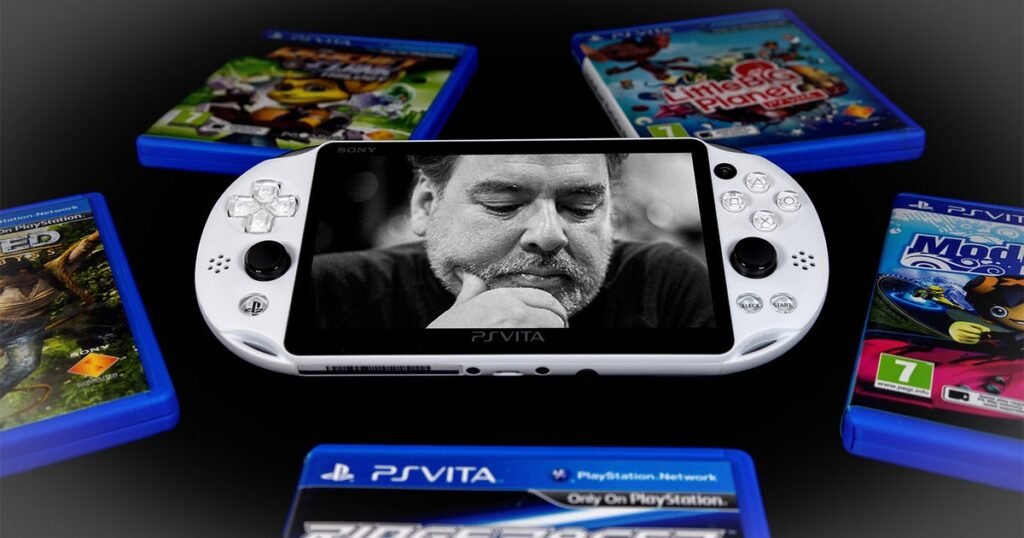
Former PlayStation leader Shawn Layden has given more context to comments he made recently about how Sony shouldn’t have made PlayStation Vita – but instead made PlayStation Portable 2.
His argument, outlined to me in an interview, boiled down to Sony overdoing the feature-set with Vita. Advancements like back-touch, OLED, and proprietary memory cards: Vita didn’t need them, he said. There was no need to reinvent what had already worked well for the PSP, but Sony tried to do it anyway, and that brought the associated costs up and, ultimately, end-user sales down.
“Well the PSP2, what I meant by saying that is: just take a PSP and put another stick on it,” said Layden. He was referring to comments he made during an interview with French gaming publication PlayStation Insider.
“The big complaint we had about the original PSP was it only had one analogue stick on it, and that became a drag after a while,” Laden told me. “PlayStation 1 had the first analogue controller and so over time, people learned how to navigate themselves through game space using two sticks in tandem, and then going back to PSP with one stick felt like ‘oh my God someone cut my arm off!’ So PSP2 was like: give us another stick – give us better sticks, frankly. But that’s what we need, and that’s what I meant.”
Whereas the PSP used small, universal media discs (UMDS), Vita opted for bespoke cartridge-like memory cards for games. This meant there was no compatibility between PSP and Vita, and that people couldn’t use memory cards they already owned but rather had to buy Sony’s expensive new ones.
Then there was the OLED screen, which was “just unnecessary expense”, according to Layden. “While you’re building these machines, you have to take a look at their bill of cost, and every time you put another whizzbang on top of it, that is a cost associated with it so it drives the cost up. And is the balance of the amazing [thing] that piece of technology can do: does that match the cost it’s going to add to the final product you’re going to put out?
“I think we put too much on it which made the cost of producing it higher so the cost associated with selling it had different impacts around that” -Shawn Layden
“There was a story years ago,” he went on, “I don’t know if it’s true but it sounds true so I’ll go with it – that Miyamoto-san at Nintendo, when he was designing his games, he would look at things and go, ‘Oh that’s a 10-yen feature, that’s great, keep that in there; oh that’s a 30-yen feature, oh fantastic…’ And once he got up to 5900 yen, it was: ‘Okay, stop – we’ve got the right amount of value in it for the cost of the game that we’re going to put out.'”
There’s a tipping point where you’re putting more into a game than you get back for it – where it outstrips the “value proposition”, as Layden called it – “too much game for just $60”. And you can apparently tell which games this has happened in. “I’ve made a few of them,” Layden said. One game series that came immediately to his mind in this regard was the lavish racing simulation Gran Turismo.
“We went from like 65 cars in the first one to having to do 290 cars in the second one, for some reason,” he said. “But each one of those has a cost associated with it, with its licensing costs, with design and balancing and all of that, where maybe that time should have been spent on other features than just packing in more content value, because then it serves the proposition out of whack. Because if this is 60 cars, this is 290 cars, the next one’s got to be 4000 cars!”
Realistically, you can’t drive all 4000 cards. “No,” he agreed, “but you can certainly pay licensing fees for 4000 cars!” And with that he laughed. It’s a point that brought him back to PS Vita. “I think we put too much on it,” he said, “which made the cost of producing it higher so the cost associated with selling it had different impacts around that.
“But also again,” he quickly added, “you’re trying to create a new format, and how do you bring people along with you? There’s a theory that if you’re going to go from here to there, from product one to product two, how much innovation can the end-user handle? How much change is enough to say ‘that’s enough change for me to want to get one’, and how much more change that you add onto it, which has a cost associated with it – R&D costs or parts cost – how much of that becomes a diminishing return?”
The PS Vita was a flop for Sony. The PS Vita was released in 2011 at two price points: £230/£280 – a positively paltry sum by today’s grossly inflated hardware standards; PS6 may cost Sony $1000 to make. And while the PS Vita was a nice device to use, it failed to appeal to a wide audience. Sony stopped reporting PS Vita total sales after a slow start, and lifetime sales figures are hard to find. A widely cited estimate puts lifetime PS Vita sales between 10-15m, but I can’t vouch for this number or find a hard source for it.
“Every time you have a new generation of hardware, it seems you take an entire generation’s content and put it in a lockbox and throw it into the ocean and you can never get it” -Shawn Layden
Sony does list lifetime PSP sales, however, which as of 2012 – 14 years ago – were more than 76.4m. Presumably, it’s sold more since. So you see: the difference between the success of the two handhelds is vast. Sony stopped shipping PSPs in 2014, nearly 10 years after release, and PS Vita production wound down in 2019.
Sony announced last week it would be closing the online PlayStation Vita store, along with the online PlayStation 3 store, meaning you’ll no longer be able to buy games for those older platforms this way. Thankfully physical editions still circulate in the second-hand market, but if that weren’t the case – which is a topical consideration given Sony’s decision to stop making disc-based games – access to those older games would have disappeared.
“That’s forever thus in gaming,” said Layden, “and that’s one of the challenges we have, which music, movies, and television don’t. I mean, I can still watch a movie like Citizen Kane if I want to. I can still buy a laser disc or a Blu-ray disc or some format, and that movie is 100 years old, and I can still watch that. I can still listen to Charlie Parker Jazz from the 50s – I can find some way to get to that. We can’t.
“Every time you have a new generation of hardware, it seems you take an entire generation’s content and put it in a lockbox and throw it into the ocean and you can never get it,” he added. “Some people spin up emulators, or if you want to keep your PS2 in good nick so you can play PS2 games on your own, you can do that. But largely, past titles become inaccessible; I think that’s the forever-challenge of this industry.
“And closing the store for PS3 or PS Vita: that’s really a financial equation, isn’t it? If there’s no activity on those stores, or very limited activity, there comes a time when you can’t spin up the whole machine just to serve 100 people.”
Layden had a similar theory about Sony’s decision to stop making PlayStation discs from 2028, calling it a “spreadsheet decision” and one that wasn’t, he believed, guided by a desire to stamp-out second-hand sales.
Shawn Layden left Sony in 2019 after 32 years there, and has since consulted for large gaming companies like Tencent, though he’s currently in the process of creating his own publisher focused on double-A-tier games. It’s that smaller-scale and more sustainable tier of game-making that’s disappeared, he believes, taking with it an appetite for creative risk and difference. Tom Phillips did a wonderful wide-ranging interview with Shawn Layden for PlayStation’s 30th anniversary, about his many years there, that’s well worth a read, by the way.