Last year, on a bit of a whim, I ended up playing Tomb Raider 1’s superb remaster and Crystal Dynamics’ 2007 remake Tomb Raider: Anniversary. Both, it turns out, are enormously enjoyable – and very different – ways to play Lara Croft’s trailblazing original platform adventure, which celebrates its 30th anniversary this year. So I can understand why the minds behind Tomb Raider: Legacy of Atlantis might want to do something beyond a slick visual overhaul. But after my latest Gamescom look, I’m not exactly convinced this remake – now due to arrive next year – is heading the right way.
Unlike Chris’ “strangely double-A” hands-on time with Legacy of Atlantis earlier this year, its Gamescom showing was strictly hands-off; a “first look” at developer Flying Hog Games’ reinterpretation of Greece – a location that comes roughly a quarter of the way into the original game. And for this latest showing, Crystal Dynamics, which is overseeing the project for Amazon, opted to show off an “updated and reimagined” version of the Damocles Room sword puzzle deep beneath St. Francis’ Folly.
Our presentation begins in what’s perhaps one of Tomb Raider 1’s most memorable areas: the intimidatingly vertical chamber directly below the church, where what remains of a vast central column, stretching up from the depths, provides a treacherous means of reaching different gates situated on different floors of the chamber’s perimeter. In the original, it’s a complex bit of level design, requiring both navigational prowess – most of the walkways and staircases between areas are long gone – and puzzle-y thinkery in order to acquire the keys required to proceed.
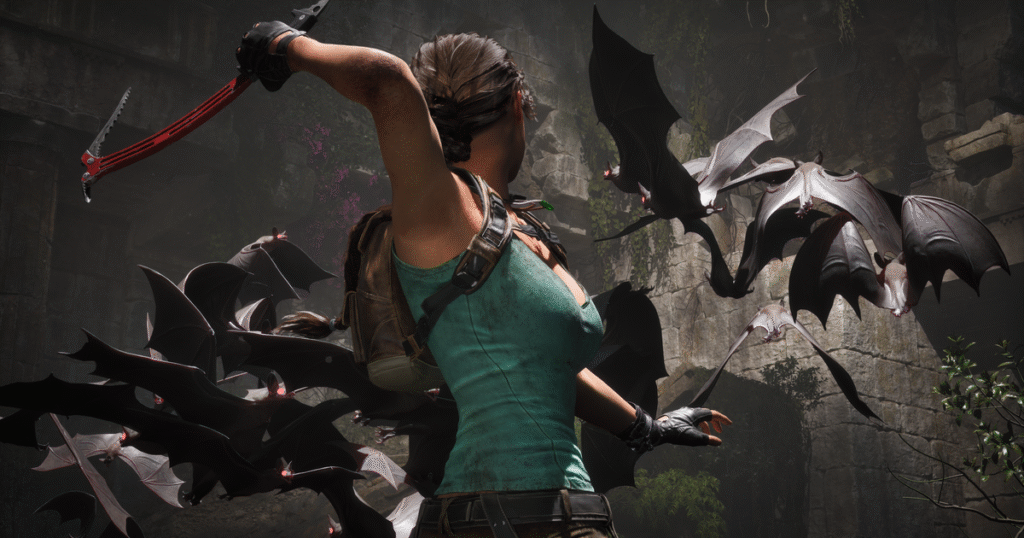
And there’s no doubt Legacy of Atlantis’ take captures the original’s spirit: you’ll still navigate the imposingly vertiginous chamber, puzzling your way into four different rooms so you can puzzle your way back out with four different keys (technically gemstones in this version). And there’s no doubt it looks a treat while it’s doing it; shafts of light striking through the ancient darkness, as thick vegetation, rich with colourful bursts of flowers, run wild across stone. And it’s a joy to hear new Lara Croft voice actor Alix Wilton Regan warmly quip her way around the place – immediately, welcomely resetting the tone back to the past, a million miles away from the wretched misery of Crystal Dynamic’s divisive reboot trilogy.
.png?width=2048&height=2048&fit=bounds&quality=85&format=jpg&auto=webp)
.png?width=2048&height=2048&fit=bounds&quality=85&format=jpg&auto=webp)
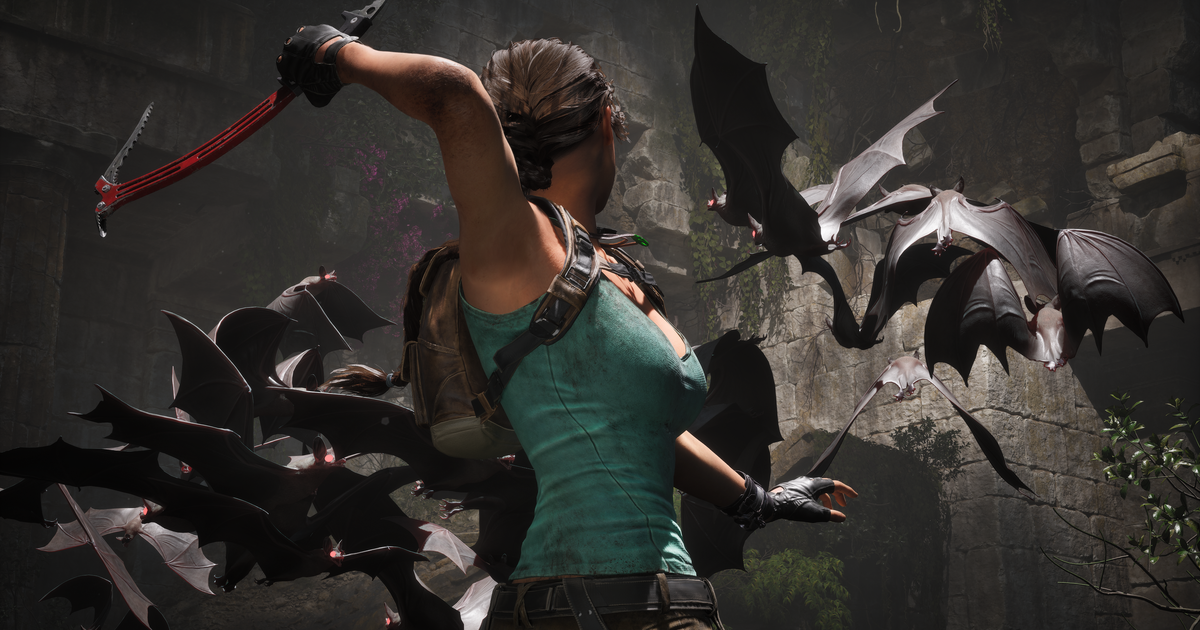
But as Crystal Dynamics experience director Jeff Adams, who’s narrating this alpha gameplay playthrough, reminds us, Legacy of Atlantis goes beyond an audio-visual makeover. “The team seeks to preserve what made these locations so special in the beginning”, he says, “but we want to find new ways to surprise and delight”. The goal is to give newcomers a “sense of awe and wonder”, while old-hands feel like they’ve had their first play experience “reignited”. The level’s bat enemies have, for instance, now been turned into thick undulated swarms with more unpredictable movement patterns. But there’s the other, more controversial stuff Crystal Dynamics is shoving into Legacy of Atlantis, including the reboot era’s RPG-like progression elements – skill trees, crafting, and other faff (not to mention its own dollop of gen-AI).
In this new version, Lara can snaffle up environmental junk – I’m pretty sure I see her swipe a turnip at one point, despite not being a vegetable known to thrive in the ancient half-light – in order to craft the likes of boon-granting foods. Which leads to the comical sight of our demo player scrolling through a list of recipes – an enormous plate of stew, a massive pan of baked beans – which Lara promptly twiddles out of thin air. And after that, it’s onto Legacy of Atlantis’ other big new feature – a scanner – which players can use to analyse environments for “greater insight” into how to proceed.
.png?width=2048&height=2048&fit=bounds&quality=85&format=jpg&auto=webp)
In the example we see, Lara scans an imposing gate situated near some sort of opening mechanism containing four visible slots. “The gate is still shut,” Lara usefully explains after the scan is done, “and the opening mechanism has four distinct slots”. Exactly the kind of insight a skilled treasure hunter with years of tomb raiding experience might need! It’s clearly a gambit intended to ease less experienced players into this world, but – as with a lot of Atlantis’ new additions shown in the demo – there’s something about the immersion-busting implementation that just feels inelegant and ill-considered.
Incidentally, Adams notes the scanner is “optional”, if you’re the kind of person who’d prefer not to hint themselves out of an adventure. But then comes word of a secondary function: the ability for Lara to scan the world to learn of its history, as if the one thing a woman of her knowledge and experience has always needed is some kind of portable ChatGPT.
Perhaps I’m just getting unnecessarily hung up on this stuff, though. And some of Legacy of Atlantis’ additions look neat! A nicely-animated leopard fight on the way to finding the Key of Damocles shows some enhanced enemy behaviour – in this case, the cat can hide and perform a sneak attack – suggesting there’ll be a little more meat to combat beyond frantic twirl-and-shoot. Lara’s grappling hook, meanwhile, has some new utility that lets her grasp onto distant levers, ascend and descend from certain grapple spots, or latch onto masonry and whizz over gaps. There are artefacts to collect that unlock outfits (the Tomb Raider community loves an unlockable outfit), and the demo ends with a particularly striking view.
.png?width=2048&height=2048&fit=bounds&quality=85&format=jpg&auto=webp)
.png?width=2048&height=2048&fit=bounds&quality=85&format=jpg&auto=webp)
As Lara emerges out of a gloomy tunnel, we’re suddenly met with an impressively sprawling vista: an ancient city built into the walls of a huge underground cavern, its elaborately arranged buildings peering above a canopy of thick, green foliage amid towering waterfalls. “We have preserved that beauty of classic Greek culture, but we’ve now fused it into this vast subterranean wilderness that you’re gonna get a chance to explore”, Adams notes, so there’s perhaps more room for deviation here than we were previously aware.
As for the reimagined Sword of Damocles puzzle, if you were wondering, the big twist is that once you’ve run under the giant swords to bring them crashing down, you can climb onto them in order to navigate the room. And if you don’t want to risk your neck, they can also be dislodged by shooting them – as long as you’ve extended their range by unlocking the Dead-eye skill from the skill tree, of course. And at one point early in the sequence, as Lara collects the key from the chamber’s inevitably booby trapped plinth, she needs to dodge the falling swords by doing, yes, three back-to-back QTEs.
.png?width=2048&height=2048&fit=bounds&quality=85&format=jpg&auto=webp)
I love Tomb Raider (not so much the dour reboot trilogy, admittedly), and I’d love nothing more than to see Amazon’s long-awaited series revival restore the elaborate exploratory rhythms and vivacious energy of the series in its heyday. But if Legacy of Atlantis is any indication of Crystal Dynamics’ future plans for the series, I’m going to need more convincing. The familiar Tomb Raider action looks enjoyable enough, but – and I hope I’m wrong – all that other stuff shoehorned around it is already giving the impression of a remake that feels tired and outmoded before it’s even got here. The superfluous crafting, the scanning, the progression, the QTEs; it all seems so graceless – exactly the opposite of what Lara Croft should be.