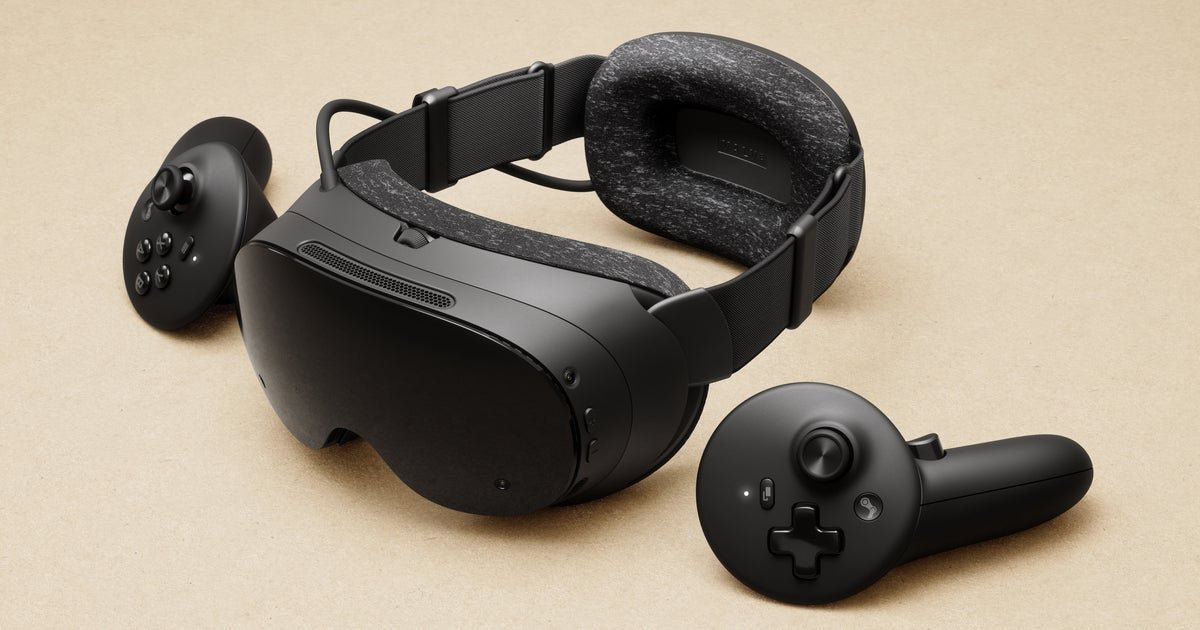
And so here it is: Steam Frame; Valve’s second in-house VR headset following 2019’s Index, featuring a boosted spec sheet, PC-to-headset streaming, and the ability to function standalone. It is, if you don’t mind spoilers, a good, often great bit of kit, and fascinating machine – lightweight and wonderfully comfortable, with some neat ideas, and a pleasure to use if you’re doing PC-to-VR. As a standalone device, though, I have reservations, and there’s a sense that here it’s perhaps not quite ready for prime time.
Before we get too far into things, though, a caveat: I love VR, I think it’s cool in its niche, and capable of offering a uniquely immersive way to enjoy games (Fireproof’s wonderful urban fantasy adventure Ghost Town and studio Chyr’s properly discombobulating room-scale puzzler Hotel Infinity are unquestionably two of my favourite releases of last year). But I’m definitely more of a casual VR fan and not especially technically minded, so if it’s a thorough tech breakdown and analysis you’re after, Will Judd’s Steam Frame preview from last year is a good place to start, followed by RPS hardware editor James Archer’s Steam Frame review.
What I can do, though, is whizz through the basics. And compared to Valve’s previous foray into VR, 2019’s Index, Steam Frame is a huge step up in every way. Its weight has been almost halved, down to 440g from 800g; its screen resolution has been boosted from 1440×1600 per eye to 2160×2160; its display runs between 72Hz and 144Hz, and gone are the old fresnel lenses in favour of pancake lenses, enabling thinner headsets and increased clarity. Movement and position tracking is now handled by on-device cameras rather than separate base stations situated around the room; Frame has an on-device battery so it can be used without being connected to the mains, and, of course, it can operate standalone.
In terms of more modern comparisons, Frame isn’t quite as radical an upgrade from 2023’s Meta Quest 3 – still one of the most popular consumer VR headsets and a machine I’m more intimately familiar with – but it absolutely brings notable improvements. Per-eye screen resolution is slightly higher than Quest 3’s 2064×2208 (but unlike Sony’s PSVR2, neither headset features OLED panels), it’s slightly lighter (Quest 3 weighs 515g), and it features in-device eyetracking. Elsewhere, Frame contains twice as much internal memory (16GB versus Quest 3’s 8GB), and a more performative CPU: the Qualcomm Snapdragon 8 Gen 3 versus Quest 3’s Snapdragon XR2 Gen 2 – which should, says RPS‘ James Archer, be around 30 percent more powerful in synthetic terms, providing a performance advantage over Quest given Frame only has about 2 percent more pixels to push.

So what does all this technology cost? Well, Steam Frame isn’t cheap. It starts at £889 for the 512GB model – around £340 more than 512GB the Quest 3 – and climbs to £1,089 if you want 1TB of storage. For that, you get the headset and a swappable battery pack that lives round the back of your head, two controllers, a USB streaming dongle, a charging cable, and a spacer for your glasses – although Valve partner Zennioptical is offering snap-in prescription lenses for around $70 a pair. Then there are the optional upgrades: the £59 Ergonomic Accessories Kit and the separate £29 PSU if you need one.
For some, the £340 difference between Quest and Frame (likely a result of the AI-fuelled component crisis driving up hardware costs, the better bits inside the Frame, and the fact that, unlike Meta, Valve doesn’t subsidise its hardware) won’t be factor, particularly if it means they can avoid Meta’s Faustian Pact. For others it’ll be more of a concern. But whatever you make of the price, my two weeks messing around with Steam Frame have revealed a good bit of hardware with the potential to be great.
Set-up, as you’d hope, is all very simple, aside from an unexpected 40-minute halt as the headset installed an update – although it’s unclear if that’s to be expected or just a quirk of the pre-release beta software. And once that’s sorted, a number of options immediately present themselves: you can install your games directly to Frame’s internal storage for standalone play (Frame supports VR games and flatscreen games via Valve’s Proton compatibility layer), or you can stream directly from your PC.

Valve, if you weren’t aware, is leaning heavily into Frame’s ability to play flatscreen games, which makes a lot of sense: both as a unique selling point, and given the current VR climate which has seen a slowing of VR-focused games. And to handle potential compatibility issues, it’s implemented a Steam Frame verification system similar to its work with Steam Deck and Steam Machine, meaning everything listed as ‘Great on Frame’ in your Steam library and in-store should run well in standalone mode. Valve says around 130 games will be Steam Frame verified at launch, but that figure is split between VR games and traditional flatscreen titles (the latter must hit 720p at 30fps and the former must “run at a minimum of 72 fps at 1728×1728” to meet Valve’s verification requirements).
And the first big surprise for me after firing Frame up was just how few of the VR games I own currently have Valve’s ‘verified’ seal of approval: Arizona Sunshine 2, Pistol Whip, Moss VR, The Room VR, and Walkabout Golf (my non-VR verified list was far more expansive, including the likes of Factorio, Dread, Inside, Animal Well, Dave the Diver, Silksong, Portal 2, and Streets of Rage 4). Any excuse to play Walkabout Golf is a good excuse in my book, however, and, as expected, its cheery low-poly golfing runs flawlessly in Frame’s standalone mode. And the lack of faff required to get it running smoothly provided a handily consistent baseline for testing as I started to get to grips with the Steam Frame hardware itself.
And where better to begin than the headset? There’s obviously no getting around the fact you’ve still got a not-insubstantial bit of hardware clamped around your head – it’s the fundamental limitation of VR – but Steam Frame is undoubtedly the most comfortable VR headset I’ve tried yet. In comparions, Quest 3 feels like a brick. It’s light (the front core is apparently just 185g) and extremely well-balanced; by clamping the battery pack to the rear of your head, weight is shifted from the goggles and spread more evenly around your dome, making it more manageable for longer play sessions. But gravity is gravity, and, in its out-of-the-box configuration, that 400g did eventually attempt to return to earth, creating familiar forehead discomfort as it slowly slid its way down my face. Which is where Valve’s optional Accessories Kit began to feel like an essential purchase.

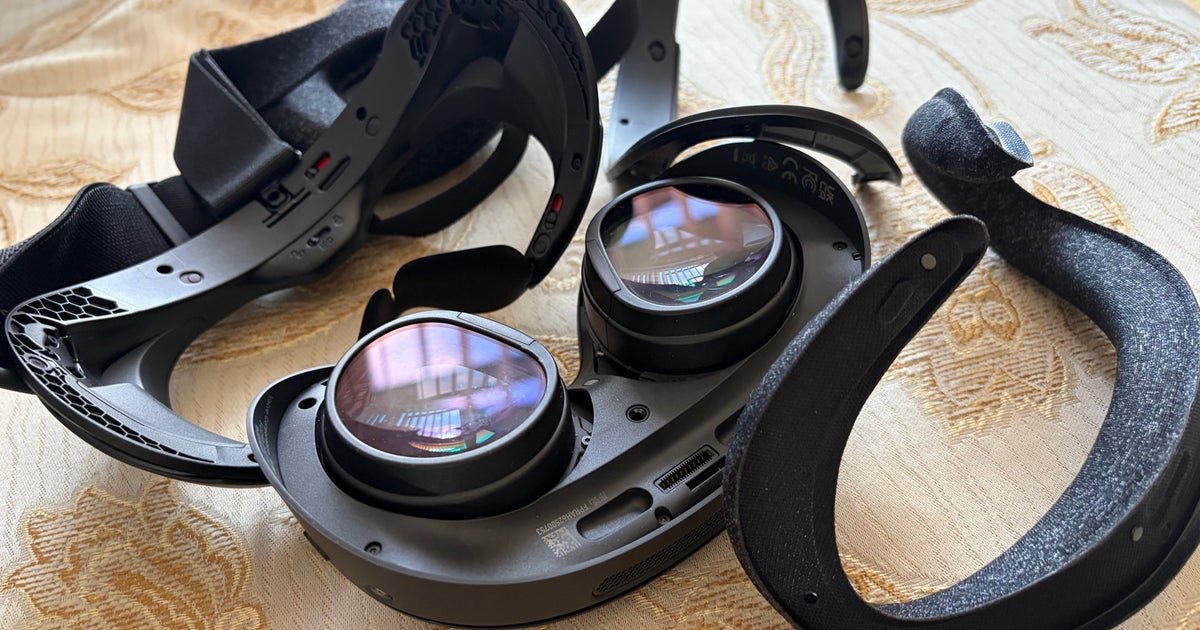
This includes controller grip straps (snugger and more secure than the default Switch-style wrist bands, and enabling you to hold the controllers open-palmed in lieu of handtracking), a sort of rubbery nose flap, and most importantly, a headstrap which provides additional support for Steam Frame, shifting some of its weight from your face. With it installed, I found I could play far longer using the headset, even if it does introduce a few quirks. Chiefly, the strap pulls the top of the headset inward, creating a gap for light to creep in toward the bottom of the goggles, which is where the nose flap comes in. Fitting it is a fascinating adventure, requiring you to pretty much pull the entire headset apart using its clasps and clips – a simple process that provides insight into just how elegantly modular the device is – but once it was in, I did find quite a lot of light could still creep in from below.
As for the headset’s picture quality, it’s crisp and decently rich, but not, to my eyes at least, an especially notable step up from Quest 3 (I’ve not used the OLED PSVR2 to compare). It’s still quite a ‘goggly’ headset, too, despite its “up to 110 degrees” field of view. And audio is a touch underwhelming. It utilises “dual speaker drivers per ear, integrated into headstrap”, and they’re punchy enough, capable of conveying a convincing surround soundscape, but bass leaves something to be desired. And while there’s no headphone jack, one of my interviews with Valve mentioned an “enthusiast” accessories pack coming a few months after launch, supposedly including a “premium” audio solution, alongside a swappable battery (right now, you’ll get an hour or so of play in standalone mode on a single charge, which isn’t great).
Any other quirks? Steam Frame’s fan vents circulate a notable amount of cool air around your eyeballs, and eject a surprisingly amount of heat out top – but it’s angled in a way that so far hasn’t been a concern. Also, I’ve found it a little tricky to adjust the headset when it’s on my face without accidentally dislodging the magnetised strip that holds its cushioning foam in place, requiring a bit of fishing around to recover it. But this stuff is mildly irksome at best, and it’s still an extremely comfortable headset I’ve enjoyed a lot.

One other thing that’s worth mentioning: Frame’s passthrough cameras, which allow you to see the world outside your headset, are monochrome. Personally, I haven’t missed the downgrade from Quest’s full-colour cameras given I generally only use pass-through for outside orientation, but if you’re a fan of mixed reality gaming it might be a concern. Valve partner Arcturus has, however, created a full-colour camera upgrade for £129/€157/$149, which it claims offers fidelity “beyond” Quest 3 and Apple Vision Pro.
As for Steam Frame’s controllers, they’re also good! Each weighs around 140g, supports six degrees of rotational freedom, plus full finger and thumb tracking, and you should get around 40 hours on a pair of AA batteries. During play, they feel precise and responsive, and ergonomically, they’re very similar to Quest 3’s Touch Plus controllers, meaning they sit comfortably and naturally in my average-sized hands, and are lightweight without feeling insubstantial. Notably, though, Frame includes a more generous series of inputs compared to Meta’s offering: there’s a d-pad on the left controller and four face buttons on the right; each has a control stick, a clicky shoulder button and more resistant trigger beneath it, plus a “dual-stage” inner grip trigger that, if I’m honest, feels a touch too flimsy for my tastes.
But the important bit here: by mirroring the layout of a standard gamepad, pretty much every Proton-compatible flatscreen title you care to throw at Frame should work just fine natively using the included controllers (although you can connect other gamepads, mice, and keyboards via bluetooth if you like). And, actually, I’ve quite enjoyed Frame’s cinema-like wraparound experience while tootling through Cuphead and Hades in standalone mode – and given Frame supports Steam features like cloud saves, it’s an easy hop between devices. A minor moan: I’m not a huge fan of the vast circular void Valve still insists on using as a VR backdrop (a couple of cosier options would be nice for flatscreen play), but it does have a few neat tricks. You can, for instance, set the surrounding virtual uplights to mirror what’s happening in-game, adding a cute bit of extra immersion while playing.

There’s a bit of an important caveat to all this flatscreen talk, though. As nice a feature as it is, especially when there’s no guarantee of a regular release cadence for new VR games, Steam Frame isn’t a processing powerhouse (it isn’t even as powerful as Steam Deck, RPS’ James Archer informs me), and that’s going to limit what you can play in standalone mode. After a bit of experimentation, 2D games, even those still unverified, seem reliably playable as long as they’re supported by Valve’s Proton compatibility layer (which essentially allows your Windows games to work on the headset’s Linux-based operating system). But when I moved onto modest 3D indies that didn’t have Valve’s tick, the results were variable. Games like Botany Garden failed to sustain a stable framerate, even on its lowest settings, suggesting most modern blockbusters are out the window unless their dev teams want to roll up sleeves and optimise specifically for Frame. Older-era titles like Dark Souls 2 should work, but even so, I found playing 3D games at 30fps in VR unpleasant enough that I’ll likely stick to 2D.
My bigger issue, though, is Frame’s standalone VR experience, which feels a little too hit and miss right now. Frame’s Proton compatibility layer does a good job of actually getting your games to open, but the results are unpredictable, especially given how comparatively few VR titles are currently verified. Some games I tried work flawlessly out of the box (Walkabout Golf, The Room VR, Pistol Whip, Arizona Sunshine 2), some work well enough with minimal tinkering (Tetris Effect, Ghost Town), others didn’t work at all (Serious Sam VR and Escape Simulator refused to boot, The Walking Dead: Saints & Sinners got stuck on the menu, and Myst VR crashed so hard it turned my headset off). Others are absolute slideshows, even on their lowest settings (not that I was expecting much success with No Man’s Sky given Frame’s standalone limitations), and others are technically playable, but only if you’re willing to ditch antialiasing and opt for the lowest resolution.
There’s just a little bit too much faff as a standalone experience, and the end results too often feel slightly compromised – it’s certainly far removed from the slick plug-and-play of Meta’s native games library. Of course, if developers are able to properly optimise their games for the Frame and get that verification tick, the problem should ease with time. But, even so, I can’t help feeling verification should be further along than it is right now.

As for the Frame version of Half-Life: Alyx – a game worth mentioning given that it’s free with all purchases, and has, according to Valve, shaped so much of Frame’s hardware – it’s an impressive achievement, making zero concessions in terms of gameplay. Alyx’s wonderfully unpredictable mix of blockbuster action and horror, its slick cinematic pacing and clever immersive tricks, still makes for an incredible experience. But there are some compromises you’ll have to reckon with. And I found the swirling, shimmering jaggies constantly on the edge of my peripheral vision (it uses foveated rendering to dynamically increase the resolution of whatever you’re looking at) just a little too intrusive and distracting.
But! The PC-to-headset experience Valve has cooked up for Frame is a delight, and perhaps the most compelling reason – for me at least – to make the switch from Quest. It all works through Frame’s bundled-in dongle, officially a “plug and play 6GHz wireless adapter”, that provides an entirely wirefree way of streaming your VR and non-VR games from your PC (but not Steam Machine, at present) to your headset. As someone who has routinely managed to tangle themselves into a wire-based PC-to-VR deathgrip in the past, and who has utterly failed to get Meta’s wi-fi reliant Air Link feature working, Valve’s solution is elegant and effortless enough to be, for my needs at least, a game changer.
From a tech perspective, as far as I understand at least, the key to it all is foveated streaming – which, in a similar fashion to foveated rendering, uses your eye position to optimise network bandwidth and image quality by decreasing bitrate and pixels outside where you’re looking at. And to my eyes, it works extremely well, letting me use the extra grunt of my PC – summoning the added visual bells and whistles, the higher resolution, and refresh rates – while being wire-free, faff-free, and with no obvious degradation in image quality or latency. It’s got good range too: I successfully managed to stream to the more room-scale-VR-appropriate office across the hallway from my computer, but your mileage may vary if you don’t live in a new-build with paper-thin walls. In fact, the only time the dongle failed was when I ramped up all No Man’s Sky’s settings, pushing my PC too hard and taking streaming with it.
So that’s the Steam Frame. As a standalone machine, I have some reservations: it can be fiddly and unpredictable, far from the plug-and-play ease of Meta Quest, but that’s an issue Valve’s expanding verification programme will hopefully address over time. But as a PC-to-VR device, it’s a delight; liberating in its stress-free, wire-free functionality, if you can deal with the fleeting battery life. And that – alongside the feature bump and wonderfully comfortable headset – has already made Frame my go-to headset, Quest exclusives aside. Frame isn’t a machine for high-end enthusiasts though, I don’t think, and despite its many nice-to-haves, it perhaps doesn’t offer a dramatically different in-headset experience to the far cheaper, more intuitive Quest 3, meaning Meta’s machine is still in the conversation. And so, honestly, I’m not sure if the Frame is for you. But as unhelpful as this might be, if you think it is, you’re probably right.
A Steam Frame was provided for this review by Valve.