A synergy of everything that has made the series great for generations, Fire Emblem: Fortune’s Weave hits the pinnacle of combat design, and is a sumptuous feast of a game.
I cannot remember the last time I put this many hours into a game for a review. And still, I’m sitting here, writing this, itching to play more of Fire Emblem: Fortune’s Weave. Despite some odd decisions for an RPG of this depth and scale – a single save slot and diluted difficulty, to name two – I haven’t played a game that has captivated and fascinated me like this in years. This is Fire Emblem at its peak, a game as sharp and satisfying as Awakening on the 3DS, with character work and story as compelling as Three Houses. It summons the same sense of wonder and scale as those multi-disc PS1 RPGs did back in the 90s. Developer Intelligent Systems has refined all the map-building, scenario-setting work it did with Engage and iterated it alongside the storytelling tour de force of Three Houses to create something exceptional, no matter what direction you look at it from. This, right here, is a reason to buy a Switch 2.
Let’s start at the end of the world, shall we? An introductory section of the game shows you the end of everything. It’s up to you, mysterious God-like avatar, to rewind time to the Heroic Games of 1449 and peer into the political intrigue of the Dagdan continent to unravel how we got to this undead-filled apocalypse. It’s all very anime, very high stakes and high drama, and honestly, this introductory crawl is the worst bit of the game. But, if you can stick with the megaton exposition dump and endure the slow-paced tutorial battles, you’ll crack open the oddly sci-fi-flavoured carapace to feast on the rich nectar of fantasy role-playing within.
With the narrative wrapper discarded, you get to see what the game is really about: four distinct paths, following four distinct characters. You’re limited to one save slot, because all the paths are intrinsically linked: you can hop between stories at will (though I’d recommend at least giving yourself some guardrails to ensure progression, otherwise you’ll never make it out of Chapter 1). By 80 hours and counting, for what it’s worth, I had played each of the four paths – though two were somewhat rushed for timing’s sake and I played only story-critical missions for those. I reckon a full, leisurely playthrough of this game will take a good 200 hours, if you’re a completionist. But even that may be conservative.
You’ve probably seen our core cast in the trailers: the four main protagonists are Theodora (the loyal, citizen-first warrior queen), Dietrech (a violent and intelligent foreigner determined to uncover Dagda’s mysteries), Cai (a young village boy caught up in a peculiar conspiracy), and Leda (a traveling performer lusting for revenge). The quality, depth, and voice acting work across all four stories is great, though I have to single out Leda’s path as the most emotive and well-acted of the lot. You’ve got more production value in just one of these paths than most smaller RPGs get in their entire runtime, honestly. You just have to accept that the majority of plot-first cutscenes are going to happen in one of the same 30-or-so backdrops, with very minimal over-the-shoulder camerawork. It’s not really a problem though, because the writing is generally good enough to hold your attention, and the little animated portraits do more than enough to convey what’s going on.
As you pluck away at the knotted, labyrinthine plot, you start to become aware of the impossibly complex web Intelligent Systems has spun here. I kept expecting to run into the same fights on the same maps in different paths, but Intelligent Systems has somehow placed and paced everything so that every single path feels different. Even when you do team up Theodora and Cai, for example, the convoluted route to get there is so different – and the final battle so twisted – that you wouldn’t even really know they were the same fight without the prompts. There’s probably twice as much going on here as Three Houses, and that’s an ungenerous take.
It’s better, too: whilst Three Houses excelled in some ways, there was a little bloat either side of the (in)famous timeskip that hampered the overall game a little – the school sections sometimes felt prolonged, and the pacing sometimes a little clumsy. Fortune’s Weave has been engineered to cater more to your tastes; if you don’t like the ‘social simulation’ side of nu-Fire Emblem, you don’t have to engage with it. If you’re more interested in giving the right gifts to the right people, and filling your army with just about every bonus unit imaginable, you’ll need to create a spreadsheet to min-max it properly. But Intelligent Systems doesn’t need you to play either way: There’s more agency – and urgency, at times – in Fortune’s Weave than Three Houses ever managed. I think there’s a three-way split here: the opening hours of the game appeal to nu-spec Fire Emblem fans with its Persona-flavoured social focus, and Chapter 2 is more akin to the itinerant fights of 2005’s Radiant Dawn or 2008’s Shadow Dragon. The last portion stands alone. I won’t divulge too much of that here for both spoiler and embargo reasons.
Because of the pacing – the pendulum swing between story-critical fights and languorous open world exploration – Fortune’s Weave also never suffers from the weight and complexity of the plot. As you enter Chapter 2, things get a lot more streamlined: you basically need to get your army set up, your social links bolstered, your army equipped with decent weaponry and so on before you hit that first point of no return. The ‘War’ section of the game (sandwiched in-between the four paths of the first section and the end-game run) is an inclement gauntlet of battles, the Fire Emblem equivalent of a boss rush – where you get to see the mechanical gears that animate the great structure that Fortune’s Weave is moving nakedly. Combat puzzles are artisanal and engineered with deft strategy in mind, the maps designed with variation and gimmickry, the pacing somehow both high-adrenaline and fascinating. It is, blow-by-blow, a visceral counter to the almost indolent pace of the first third of the game. The contrast is a drug, here – so potent and impactful that even on your fourth explosive entry into Chapter 2 you’ve barely built up any tolerance to it.
The combat, incidentally, is as better than Fire Emblem has ever been. The once-simple ‘rock-paper-scissors’ weapon triangle is largely mooted. That simplicity has been modified by so many different weapon variations, special moves tied to different weapon types, and some interesting wrangling of classes, that it’s no longer a simple case of ‘mage needs to kill an armoured unit’. Don’t get me wrong, I wouldn’t send my pegasus-mounted swordswoman into a gaggle of archers, but each class and each unit has more utility than simply ‘A beats B’ this time around. To offset the more diluted specialty pool each unit has, there’s more variation to victory conditions across maps than any other Fire Emblem game I’ve played before: there’s a lot of ‘kill the enemy commander’, sure, but there are also gimmicks baked into the biggest fights that will make you think more about mobility, strategy, and stalling (!) than simply ‘who can dish out the biggest damage’. Adding Blaze Arts for the main characters also gives very powerful abilities that cost HP, rather than weapon durability, making room for even more utility-per-character, as long as you have a decent White Mage to hand.
In some battles, the mathematical catnip of figuring out how to overwhelm enemy forces will have you grinning wildly as you mow down defenseless units with sadistic ease. Others knock onto your back foot so often, it feels like you’ll never gain momentum. So when you do – when you orchestrate a flanking maneuver and break a tight formation with your splinter units that have fought tooth and nail to peel back your enemy’s iron-clad defenses – you feel like a genius.
And that’s where the role-playing conceit meets the strategy in Fortune’s Weave. Each path’s leader has a couple of ‘core’ army members that have special quirks or abilities that make them particularly effective fighters, usually complementing the main character very well. Having an offensive mage that can also heal on Leda’s team, for example, synergises very well with how her Dance command allows allies to have a second go. The downside of this is that I found myself relying on my ‘story allies’ so much that I felt unmotivated to go out of my way to recruit other units in most paths. Each army does have a clear blindspot you’ll need to cover if you want to overcome some of the trickier fights, though. And thanks to the writing, you’ll almost certainly gravitate towards units you’re going to want with you at all times (Lilian, you’re the GOAT). But then, I prefer the role-playing and tight-knit realisation of my armies to expansive, impersonal ones. I get more support conversations between my core cast this way, too.
The only thing I can anticipate both newcomers and dyed-in-the-wool Fire Emblem veterans complaining about is the difficulty. This is, on regular difficulty, the easiest Fire Emblem yet – in playing through four paths, there was only one instance of permadeath I encountered. And you can rewind time for free on Normal mode. For balance, I started a new save on Hard mode and here things got a little bit spicier, with more friction that had me really going down to the wire and relying on critical hit percentages to come out of some important story battles unscathed. It’s also worth noting that the pathing works for difficulty, too: if you start with Cai, you’re going to get an easier story that introduces you to gentle concepts and primes you on the narrative a bit more. Go for Dietrich, and you’ll be facing down more intense fights that require more strategy. Given that you can also choose either ‘Classic’ or ‘Casual’ (read: permadeath on or off), there is a lot you can do to make the game a bit more challenging, but my overall impression of Fire Emblem: Fortune’s Weave is that it’s an easy game – especially by classic Fire Emblem standards. We can probably expect a ‘Lunatic’ or ‘Maddening’ mode in an update somewhere down the line, at least.
If you’re after more of a challenge, you can take on the expansive side activities on offer between the main bouts of the Heroic Games tournament (and beyond). Each path has specific side missions to engage with – sending supplies back to your countrymen as Theodora, dancing in taverns across the land as Leda, and so on – that add a bit of variety to what is an otherwise pretty similar filler experience between the paths. The bonus battles are usually pretty easy, though, and there’s this very interesting parabolic effect on difficulty as you progress. Basically, as you play, the meta-narrative revolving around your God-avatar from the start of the game comes into play.
You get rewarded ‘karma crystals’ for feats performed across the whole save file: play for 50 hours? Get some crystals. Kill 200 undead units? Crystals. Watch five A-level ‘support conversations’ because you’ve become besties with your whole crew? Lots of crystals. These can be used to unlock various Boons of Salvation – doubling XP earned for certain classes, getting discounts on weapons, making levelling up weapon proficiencies easier – that makes latter paths an absolute breeze. You don’t have to engage with these boons, of course, but as someone playing a game like this on a deadline, I absolutely did – and it turned what could have been a soulless grind through the later paths into a fun, breezy victory tour that showed a side of Fire Emblem I’ve never seen before. As someone that likes to have my games punish me, doing my last path with an overpowered crew harvesting rewards their forebears manage to acquire beforehand felt really good. It showed me how fun Intelligent Systems’ designs are, even when you’re breaking the game a little bit. Your mileage may vary, but I’d rather have too many tools than too few when it comes to customising my experience of the game.
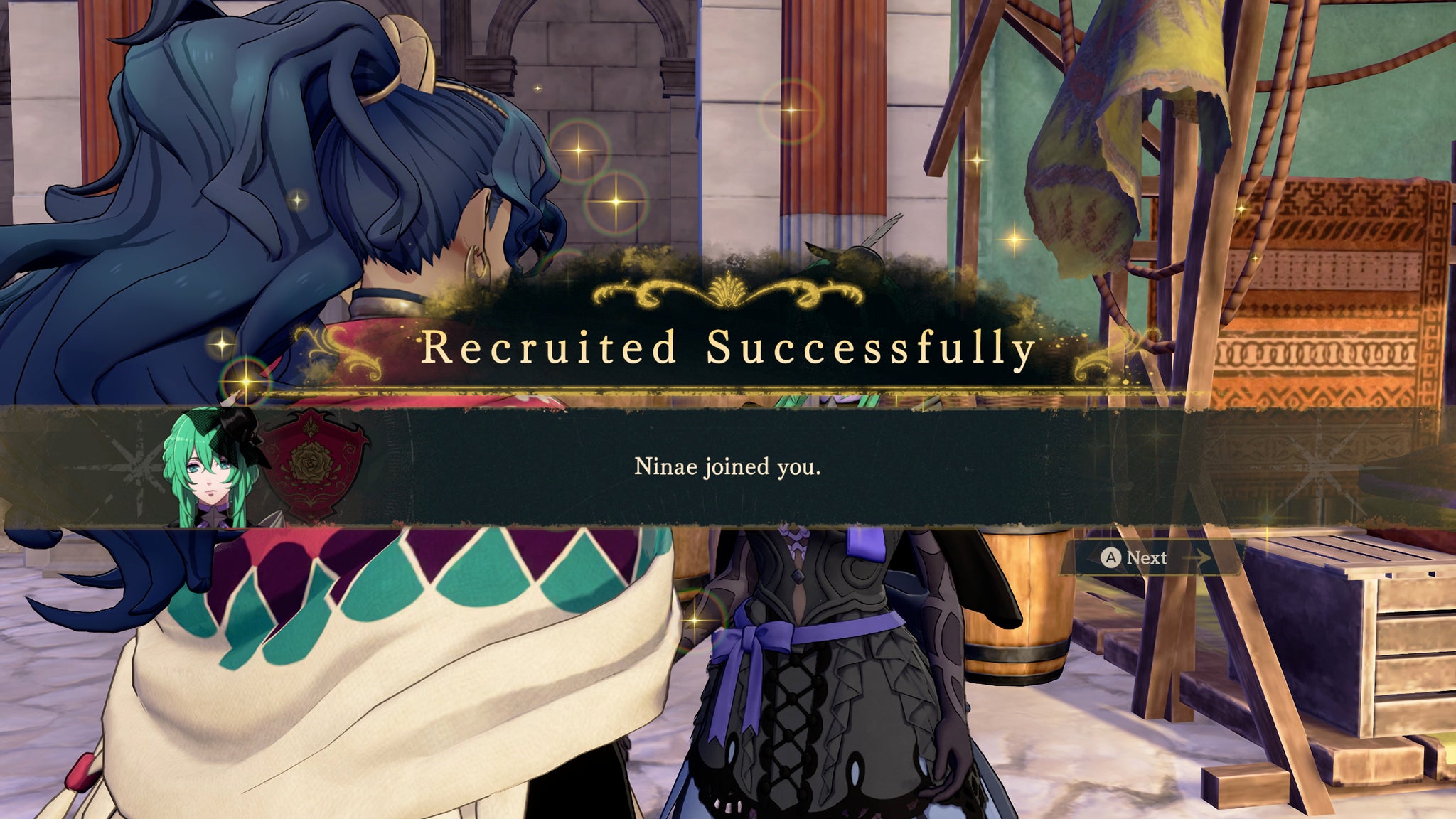
Ultimately, Fire Emblem: Fortune’s Weave represents the pinnacle of Intelligent Systems’ achievements. It plaits a tapestry from all of the series’ various highest highs, somehow managing to entwine the storytelling prowess of Three Houses with the clean, satisfying combat of Engage, threading a bonus party-based battle system from the 3DS title Fire Emblem Echoes: Shadows of Valentia into a world map that’s bigger and better than anything we’ve seen in the series to date. It reminds me of Path of Radiance, at times, with its taste for drama and consequence. It is an absolute visual treat, and its lush Mediterranean setting inspired by medieval Spain makes the whole thing feel exciting and unfamiliar. Even complaints about the difficulty can be distilled into something playful – a look into how Intelligent Systems likes playing with its food, a flirtation with power fantasy and a break from the grindstone in a game all about contrasts. Fortune’s Weave has an obsession with scale; but it never loses sight of the minutiae because of it – this is a game with heart, and brain. A shining jewel in the strategy RPG genre, and an essential one for the Switch 2. I can’t wait to play another 80 hours.
A copy of Fire Emblem: Fortune’s Weave was provided for this review by Nintendo.