I’m taking a look back at each of the core Grand Theft Auto games and replaying them in the lead-up to the arrival of Grand Theft Auto 6. What we’ll be putting together won’t be traditional re-reviews, and they won’t come with any new IGN score, but they will re-examine what made each GTA remarkable upon the time of its release. By the end of the project, using GTA’s previously six-star wanted level, you should be able to get an idea of where each of these games roughly rank in my long-term love for this series.
Our last stop in this series is Grand Theft Auto V: a game so nice, they released it thrice.
13 years. Three console generations. 230 million copies. Over $10 billion in revenue. The numbers that tell the story of Grand Theft Auto V’s longevity and success are wildly impressive and virtually unprecedented. The only other games even in the conversation are Minecraft or, depending on your criteria, about 200 different versions of Tetris. The numbers, however, don’t tell us why GTA V still sells more copies every few months than most games will ever total. They don’t tell us why people can’t get enough of it, and they don’t tell us why it’s special. So how did we get here? I guess it was the weather.
While GTA IV’s Liberty City sandbox was a dense, modestly-sized, and entirely urban environment, GTA V’s vision of the city of Los Santos was considerably more sprawling and varied. Yes, it retained a grid-like downtown district packed with tall buildings and a few particularly sizable skyscrapers, but Los Santos otherwise has a wholly different identity to that of Liberty City – and the map encompasses an area way beyond Los Santos itself.
The aesthetic shift is stark. Weather depending, the beating San Andreas sunshine gives vehicles a dazzling gleam, casts crisp shadows, and saturates the whole place with a sharp, sun-bleached vibe. It’s not the stylised orange tint that illustrated the oppressive heat of 1992 Los Santos in GTA: San Andreas, but it’s bright, effective, and a striking visual departure from the cold, drab, and gritty appearance of Liberty City.
It’s also such a different place to explore. The town is splintered into dozens of distinct districts that seamlessly blend from one to the next – from the affluent mansions of Vinewood Hills and Richman to the spectacle of Vinewood itself, glowing under a thin layer of grime and entertainment industry sleaze, and from the sun-kissed sand and beach bum backalleys of ageing Vespucci to the graffiti-tagged and struggling suburbs of South Los Santos.

Outside Los Santos, the countryside opens up to include desert, forest, mountains, and a handful of other small towns dotted around the map. It’s essentially a greatly expanded vision of the southern segment of GTA: San Andreas’ map – the section that features Los Santos, Mount Chiliad, and its immediate surroundings. It’s actually more than twice the size of GTA: San Andreas in its entirety, even if it doesn’t always feel that way, considering you can’t travel beyond the fringe of the county to find a fully-fledged San Fierro or Las Venturas. However, that’s more of a statement about how utterly special GTA: San Andreas’ map really is, rather than an indictment of GTA V in any real way.
That is, GTA V’s map remains a stunning achievement. It’s a world that – even after 13 years – I’m still spotting signs, storefronts, and subtleties that I don’t think I’ve overtly noticed before. Like all the best developers, Rockstar understands that true immersion emerges through accumulation: a single graffiti-tagged wall, bill-covered pole, or interesting piece of architecture might not be hugely remarkable on its own, but combined they become something else altogether. Funnily enough, a world full of thousands of such details can make an entire city so realistic you essentially stop noticing it. It’s almost counterintuitive; things don’t stand out, because they look so authentic, lived-in, and normal.
Streiht Up Menace
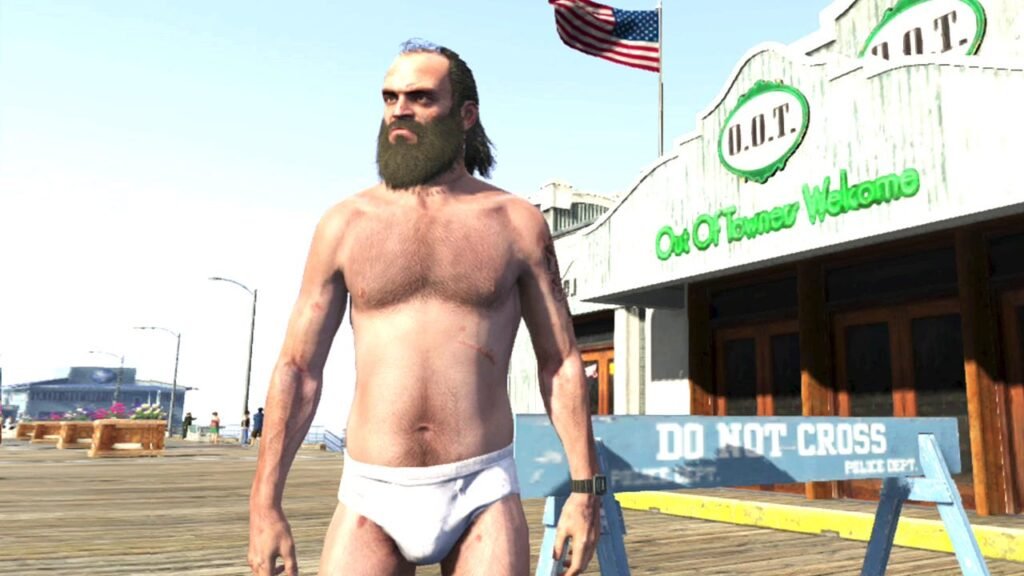
The smartest way Rockstar exploits this densely detailed map is through GTA V’s defining innovation: its trio of protagonists. You swap between Michael De Santa, a retired criminal becoming increasingly agitated at his otherwise comfortable suburban life; Franklin Clinton, an aspiring, small-time hustler looking for a real payday to get him out of his rundown neighbourhood; and Trevor Philips, a wildly volatile Canadian psychopath who was formerly partners with Michael.

The system is much more than a novelty. Switching between them allows Rockstar to prod us into different parts of the world to explore, without relying on a single character to experience everything. For a map this large, it makes a lot of sense.
For clarity, following the release of its single-player expansions The Lost and Damned and The Ballad of Gay Tony, GTA IV also ultimately featured three protagonists – and three different lenses through which we could view and interact with Liberty City. Similarly, it was a really smart way of squeezing more value out of the map, and drilling down on parts of it Niko Bellic’s story never really took him to. But while you could certainly regard this as a first draft of a multi-protagonist approach, you can’t switch between them in real time in GTA IV; you have to pause and load into the expansions separately.
In GTA V, the transition between characters is far, far more rapid, and occurs after just a brief zoom out and back in again, dropping you into Michael, Franklin, or Trevor’s life in the middle of whatever they happen to be doing at the time – which may well be dropping a man off a bridge. The transitions give the illusion that these guys continue to exist beyond the missions in which they appear.

Do It (’Til You’re Satisfied)
GTA V’s missions are typically far more varied and layered than those in GTA IV. After experimenting with it in The Ballad of Gay Tony, GTA V introduced mission checkpoints and finally shed what had arguably become the most frustrating characteristic of the series – the need to completely start from scratch after failing a mission.
This is what allows GTA V’s missions to be longer and regularly more wild than ever. With checkpoints as a safety net, Rockstar could really push the boat out with what it asked us to attempt – free from the sometimes debilitating concern that messing up at the last minute will result in a long drive and a lot of backtracking over things we’ve already done.

Of course, the highlight here is the focus on multilayed heists, taking the fan-favourite Three Leaf Clover bank robbery mission from GTA IV and blowing that concept out to make it the central pillar of GTA V’s campaign. There are multiple big scores that can be tackled in overtly different ways, something made easy to experiment with thanks to the ability to easily replay missions from a list of those you’ve previously completed. With the exception of The Ballad of Gay Tony, in past GTA games, the only way to play the missions again was to start over from the beginning.
The heists are where the three-character structure becomes most effective. We’re not just passengers on these huge marquee missions; rather, GTA V builds elaborate on ramps to these heists focused on planning and preparation which typically draw on the different skills and traits of Michael, Franklin, and Trevor. It gives the heists, and the campaign as a whole, a sense of scale and variety that would’ve been difficult to achieve through a single character.

Higher Love
Beyond the multiple protagonists and the escalation in mission variety, GTA V also made major changes to the car handling and significant refinements to the shooting. Vehicles are certainly more approachable to drive in GTA V than they are in GTA IV; they brake hard and respond sharply to steering input. The result isn’t superficial or overly light, but it does feel very grippy. It’s a handling model that I think is particularly suited to sure-footed sports cars, although I have to concede a part of me prefers the way older vehicles feel with the “slidey cars” cheat on. It’s just more drift-friendly.
In terms of vehicle variety, however, GTA V is very much a welcome shift back to the broad spectrum available in GTA: San Andreas after things were scaled back significantly in GTA IV. As a result, one minute you could be fanging an 18-wheeler down the freeway, and the next kicking tyres and lighting fires in a fighter jet. GTA V dialled things up rather than back, so go ahead: land that jumbo on the beach and escape via a jet ski. Why the hell not?

Combat was polished too, with more nimble movement and more dependable cover shooting. The highlight for me is the sound of firefights, as guns bark and bullets thunk into car panels. It’s brilliant stuff. The integration of the weapon wheel, which functions similarly to Red Dead Redemption and Max Payne 3, also means you can carry way more hardware – as well as multiple weapons within a single class. The weapon wheel stores all of the weapons you collect and you’ll never lose them, even if they run out of ammo or you get busted.
Party All The Time
When GTA V launched on Xbox 360 and PS3 in September 2013, both of those consoles were approaching the end of their lifespans. With the Xbox One and PS4 arriving in November that same year, you could probably make a strong case that GTA V felt like the last great statement of that generation. Many people did. However, I think there’s more to it than that.

A couple of weeks before its September 17 release, I was fortunate enough to conduct the world’s first hands-on with GTA V for IGN. Revisiting and playing it again so extensively this week has very effectively taken me back to how blown away I was in that moment. I was stunned by what I was playing, and utterly convinced GTA V was outright good enough to upstage both Microsoft and Sony’s new consoles. In fact, I wrote never mind November; the next generation will start when Rockstar says it does. In 2013, that was a comment reflective of just how ahead of its time I believed GTA V was; that it was simply streets ahead of its peers, squeezing next-generation scope and ambition out of a console that first launched in 2005. Simply put, it felt like a new benchmark for an era that hadn’t even officially arrived yet. On September 3, 2013 – two weeks before GTA V came out – maybe that’s a bold claim. But with new and improved versions of GTA V going on to loom large over the generation to follow, and then doing it all over again for the generation after that – all to the tune of 230 million copies – I don’t think it was ever an exaggeration.
Verdict
Grand Theft Auto V was a game so preposterously future-proof upon its 2013 launch on Xbox 360 and PS3 that its subsequent ports to modern machines remain the benchmark for open-world action-driving games. At the conclusion of this GTA Legacy Review project I find myself too emotionally attached to the PS2 pair of Vice City and San Andreas to push past my adoration for the style and soundtracks of those period piece classics and place anything above them but, make no mistake, there are very few games I’ve played more than GTA V. Combining an enormous and extraordinarily detailed world, three compelling protagonists, a thrilling set of varied missions and heists, and the foundation for a world of multiplayer that is simply a whole separate discussion, GTA V is the peak of the series. At least for the next few weeks, that is.

For more reflections on the incredible Grand Theft Auto series, you can read our new Legacy Reviews of Grand Theft Auto, Grand Theft Auto 2, Grand Theft Auto III, Grand Theft Auto: Vice City, Grand Theft Auto: San Andreas, and Grand Theft Auto IV.

Luke Reilly is an award-winning journalist with 23 years of media experience. He previously served as Editor of Official PlayStation Magazine – Australia and Australian 360, before joining IGN in 2011. You can find him on Bluesky @mrlukereilly to ask him things about stuff.