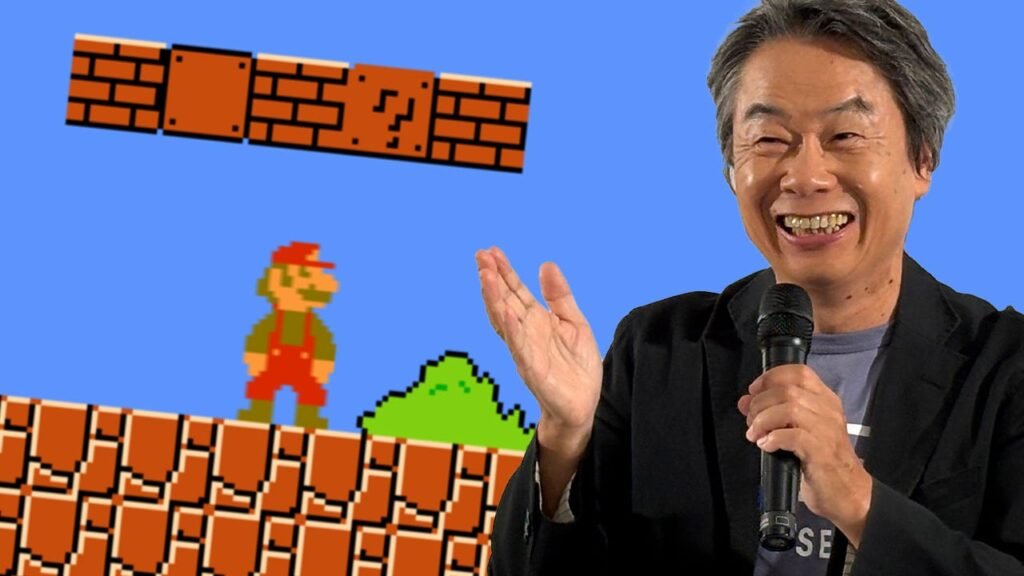
World 1-1. We’ve all run, jumped, and brick-bashed our way through that familiar first stage. It seems so simple and second-nature to us now, but in this modern age of iterative entertainment, it is almost impossible to convey the magnitude of the leap Super Mario Bros. represented compared to everything that came before it. That cabinet, that game, might as well have descended from outer space. Its art, music, smoothness, and most of all, its level design were light-years beyond.
World 1-1 introduced game design principles and a geometry of motion so perfectly calculated that it endures as one of the great works of the art form to this very day. But how was this miracle performed? Well, let us tell you, with the help of its creator, Shigeru Miyamoto.
The closest things to the opening level of the plumber’s first solo adventure up to that point were the stiff-but-serviceable screen-flipping Pitfall! and the gorgeous but terrible side-scrolling Pac-Land. Both were early essays on game design: Pitfall! presented a two-layered jungle with plenty of enemies and obstacles to jump over, but its flip-screen progression, huge non-linear map, strict time limit, and unintuitive treasure placement made it feel more like a puzzle to solve than a world to explore. Pac-Land was simply beautiful to behold and scrolled fairly cleanly in one direction, but the layout of the levels was haphazard and frustrating, and the controls felt maddening.
In comparison, Mario was like exploring a realized, unified, and diverse world. Every step revealed new threats and sights. Leap over enemies or land on them? What’s in those question blocks? There’s a Starman?! Wait, hidden lives? A secret underground treasure room with its own music?! Wait, there’s a FIRE FLOWER?! You can hold B to run or blast turtles with pyrotechnics?! What even is this game????? But in order for all of this madness to be built, it first needed solid foundations, and that’s where World 1-1 really comes into its own — teaching you the basics in the most elegant manner possible.
Super Mario Bros. isn’t nearly as big as it feels. In fact, World 1-1 measures only about 15 screens, including the underground room. It feels much bigger because over two or three screens, the tone of the terrain changes, from the intro section to leaping over pipes to platforming to pits. And yet within that tiny space, you have every power-up in the game, a hidden multi-coin block, a pair of traversable pipes, an invisible 1-UP, two enemy varieties, and a secret fireworks display.
But perhaps the biggest secret of 1-1 is that it’s a school. And the course is Mario 101. In a 2015 interview with Eurogamer, Shigeru Miyamoto and Takashi Tezuka talked about the extraordinary degree of thought that went into the design, beginning with World 1-1’s iconic opening: a tiny Mario facing an empty plane. Then the team considered how to teach the player several skills at once: how to avoid enemies, how to destroy enemies, how question blocks work, and how to tell an enemy Goomba from a helpful mushroom. All three are accomplished within the first steps of this opening level.
“If a suspicious enemy appears,” states Miyamoto, “the player will need to jump over it.” Running forward into the first Goomba just kills you, a lesson a player need only learn once before discovering they’re much safer in the air. Then moving forward, the player discovers some low bricks and question blocks.
“If we have a question block, they might just try to tap that as well,” continues Miyamoto. “If they see a coin, it will make them happy and they’ll want to try again.” Tapping the second block releases a mushroom that slides away, then bounces off a pipe to come hurtling at the character. The low ceiling makes it very hard to avoid, and the mushroom hits Mario, but instead of damaging him, it transforms him into Super Mario. In a matter of seconds, you’ve learned how both rewards and dangers work through the rest of Super Mario Bros.
“We kept simulating what the player would do”, Miyamoto explains. “So even within that one section, the player would understand the general concept of what Mario is supposed to be and what the game is about.” Even small details mattered. The opening screen’s first enemy was supposed to be a Koopa Troopa, but teaching the player the jump and kick movement necessary to overcome one worked less well at the beginning than they’d hoped. So they invented the simple-to-stomp Goomba (late in the game design process, according to Tetzuka) to help players understand the basics first.
Another valuable lesson, holding B to run before a long jump, is taught safely by two gaps later in 1-1. Pointing at this area, Miyamoto says, “Here we are preparing the player for the B-Dash”. He notes that the first gap is a pit with a filled-in bottom, a safe place to experiment and learn about long jumps without risking lives. This jump is followed immediately by a nearly-identical variant, a pit where, if the player falls, they will die, but by applying the skills they’ve just learned, they will easily survive. “By doing that, we wanted the player to naturally and gradually understand what they’re doing”, he continues. “The first course was designed for that purpose: so they can learn what the game is all about.”
Miyamoto further explains that the tutorial nature of early stages usually comes only after the team has crafted more sophisticated levels, so the creators know what skills the players need to develop. “Usually when we have a really fun course, they tend to be the later levels”, Miyamoto confirms. “World 2-1, World 2-2, we create those first and then afterwards come back and create World 1-1. There’s a lot of testing whilst the game is being built. I don’t give them (players) any explanation and just watch them play and see how they do it, and most of the time I think they’ll play a certain way or enjoy a certain part, and they end up not doing that. I think ‘That’s not what I intended!’ So I have to go back and use that as feedback”.
The intricately crafted layout creates a satisfying illusion of choice and a constant curve of advancement. Miyamoto sums it up perfectly: “Once the player realizes what they need to do, it becomes their game.”
The level layout is tuned to match Mario’s famous momentum, allowing a skilled player to perform precise jumps, slides, and combinations. An experienced Mario jockey can run forward at the beginning 1-1, squash a Goomba while hitting the first mushroom block, sprint forward, hit a coin block, reverse direction, jump up, catch the mushroom before it hits the ground, and hit the other coin. The team wisely mapped run and fireball to the same button, creating a slight degree of real-world physical dexterity challenge to trading momentum for projectiles. Likewise, the need to hold B to run and press A to jump made long jumps just slightly and satisfyingly more difficult.
Then there’s the music. Unlike most software development teams, the Mario team’s composer, Koji Kondo, was embedded with the developers. The famous Mario theme was composed and edited over and over as the level layout changed to match the pace of the design, and from then on, those few bars of digitized score would never leave our brains again.
And all of this magic was achieved using only the most limited of tools back in 1985. To really understand why Super Mario Bros. works so well, you first need to understand how the NES renders graphics. The animated characters that move around the screen, such as Mario, are sprites, detailed and mobile clusters of pixels. The NES can only handle a few sprites onscreen at a time, so most of the rest of the world, including the ground, platforms, hills, and backgrounds, is made up of tiles and 8×8 blocks. Most of the objects you see in Super Mario Bros. are composed of these chunks. The question blocks, walls, and bricks are all made up of four combined 8×8 tiles, creating distinct 16×16 squares. It’s similar to the process used to build levels in Mario Maker, only more granular. These little tiles were the tools that Shigeru Miyamoto and team worked with to build a masterpiece.

Super Mario Bros is an early NES game, created before advanced memory map chips stretched its graphical capabilities. That meant that to achieve their vision, the Mario team had to push the hardware to the absolute limits of its capabilities. The entirety of Super Mario Bros.’ source code is 40K. That means the entire game, including graphics, fits on about thirteen closely-typed pages. Crammed into that space are 32 distinct worlds, eight boss battles, a second quest, myriad secrets, and a memorable cast of characters.
That restriction meant the design team had to make every bit count, and that led to all kinds of clever tricks to save space. Ever noticed the clouds and the bushes are just the same palette-swapped tiles? Or that the blocks in 1-2 are just recolored blocks from 1-1? Both tricks (and many others) were used to compress space and make room for more features.
Add together the level design, gorgeous visuals, perfect controls, and iconic music, and you have a game that transcends the tropes of older action games. Super Mario Bros. took levels and made them worlds. And Mario just went on from there. World 1-1 to 1-2. An underground kingdom. Then later, forests. Castles. Bridges. Under oceans. Worlds upon worlds.
But none would exist without that very first. Hell, it’s arguable that video games as they exist now wouldn’t be a thing if it weren’t for World 1-1. From the most meagre of pixelated tools, Miyamoto and the team at Nintendo crafted a miracle, and one that’s still as fun to play today as it was 40 years ago.
Jared Petty likes writing about how wonderful and silly video games are. You can find him at Bluesky as Bluesky as pettycommajared.