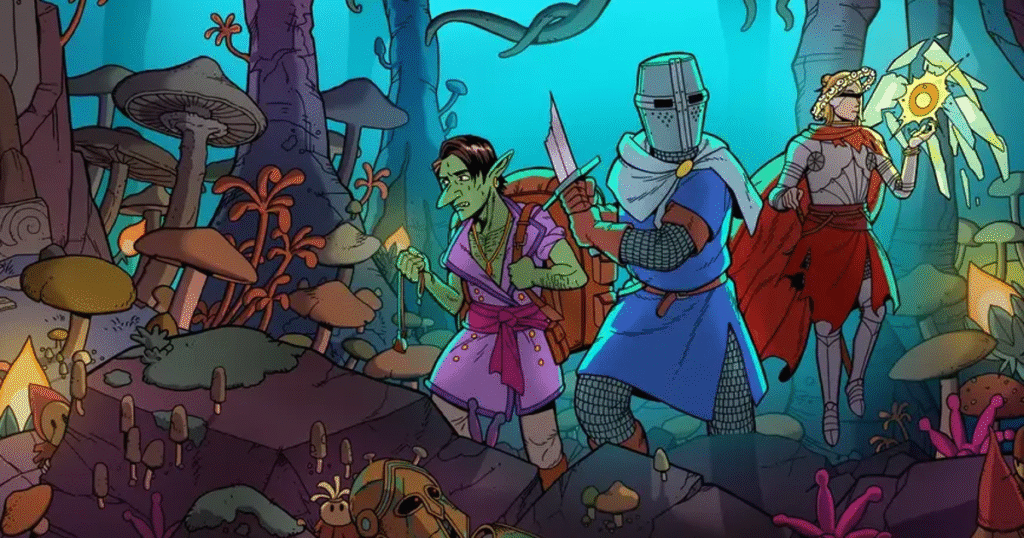
Weaving Terry Pratchett, Terry Gilliam and more, Esoteric Ebb is a comedic D&D adventure where a waylaid Cleric is tasked with solving a crime, days before the world’s first election.
When I tell people about Esoteric Ebb, I mostly say that I play an idiot, because there’s something deeply comforting about being a waylaid government oaf. Sure, I’ve pledged allegiance to hierarchy and bureaucracy, but there’s always the possibility of doing something naughty or exciting or even something unexpectedly brave. As an unassuming representative of the establishment, I dance on the knife’s edge of plausible deniability and weaponised incompetency. Ultimately, though, there’s always the chance that, as a Cleric of the state, I’ll just slump back into line out of anxiety or complacency or whatever it is that keeps civil servants glued to the teat of government service, because life is hard enough, and having to worry about things like work accommodations and job safety and the respect of your fellow man is tiring.
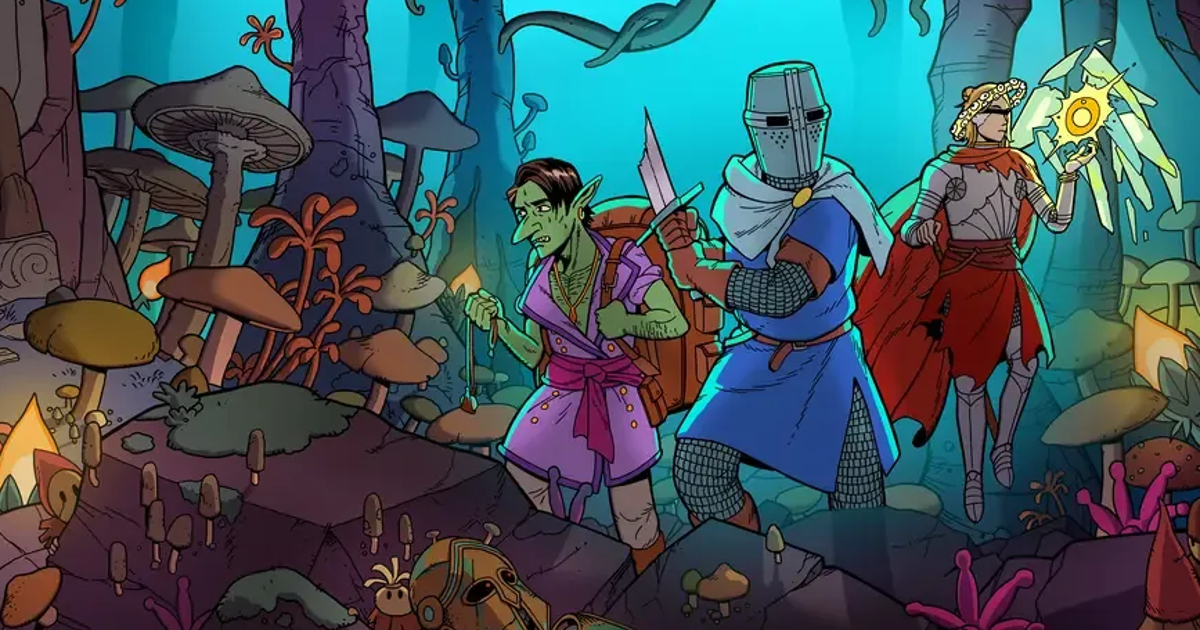
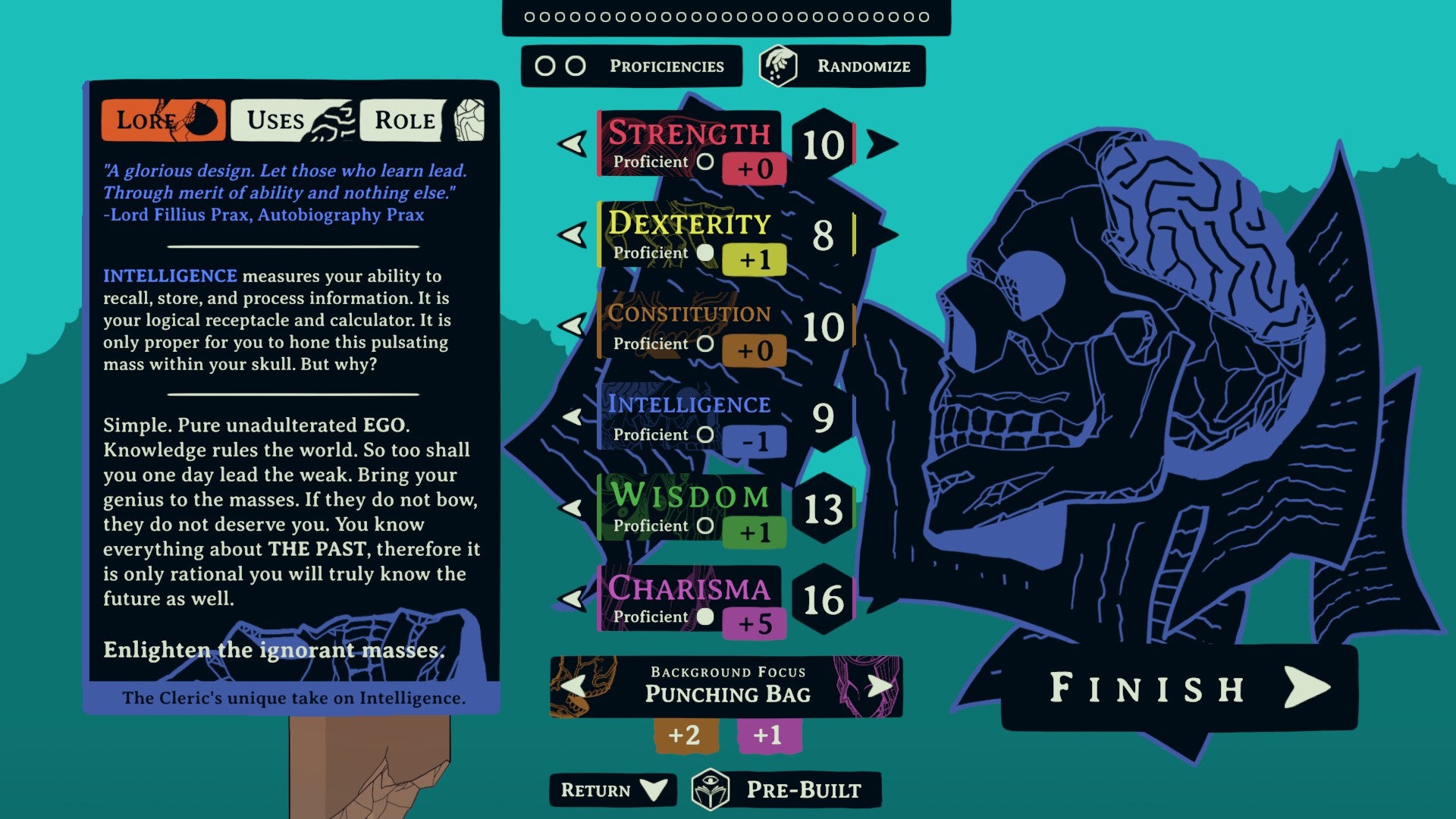
Nevertheless, I am determined to be a useful idiot, though I’m not yet sure to whom. I roll my Cleric to be respectably wise and competently dexterous, with the strength and constitution of a sickly Victorian orphan. I have been assigned to investigate a crime – a local tea shop just blew up – in the lead-up to the world’s first-ever election in the city of Tolstad. Unfortunately, it seems that I somehow died, before being found and revived by the local mortician – the game starts as I wake up on a stone slab, bedraggled and confused, with a ruined spellbook and horribly weakened magic abilities (esoteric, in this setting, is a specific kind of magic). I have five days to figure out what happened, and more importantly, maybe make my first real friend.
Esoteric Ebb is a game that proudly wears its influences on its sleeve, with one big obvious one; here we have a nonlinear, narrative-focused, text-heavy dice-roller that has parts of my Cleric’s psyche jockeying for dominance via said dice. We live and die (sorry) by D&D skill checks, like real gamers, and collect wearable items that can enhance or diminish certain stats; simply perceiving NPCs, too, requires a skill check that reveals more information with higher rolls. There’s a tiered magic system that requires prepping spells at altars scattered around the map, with buffs for skill checks during combat encounters, and D&D staples to understand languages, speak to animals, and so on. Its ‘feat’ system, too, was a good bit of flexible fun – after completing a certain set of objectives, the player gets to choose a specific buff or gameplay advantage related to the narrative themes of said objectives. These can be swapped out through the course of the game, offering a little bit more customisation in the Cleric’s build.
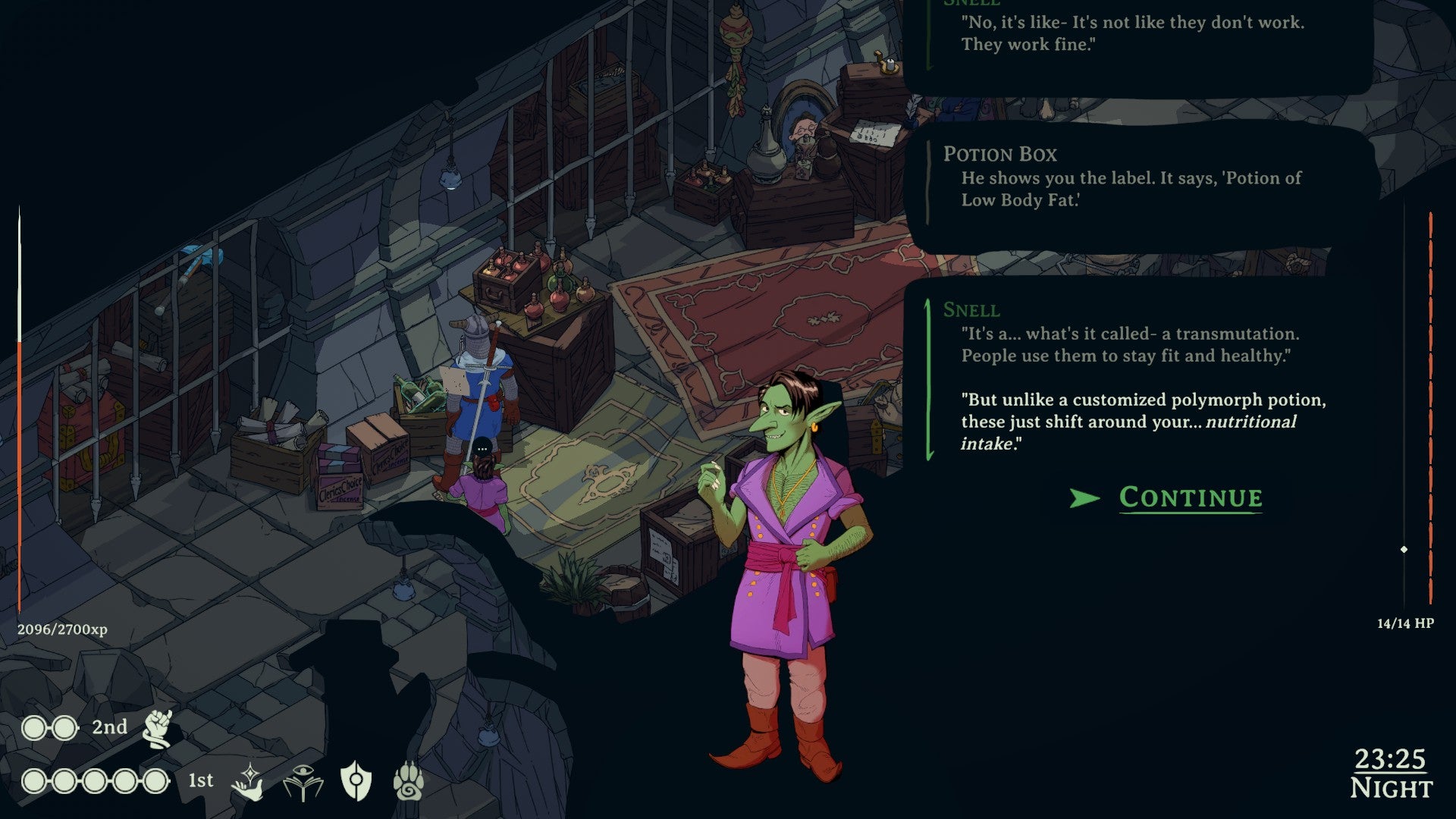
It weaves political intrigue and personal failure into a charming web, mixing in humor and comedy that echo literary fantasists like Terry Pratchett, Max Frei, et al., a touch of Terry Gilliam, and all the messy frivolities and anxieties that pervade contemporary culture (we do find, at one point, the esoteric equivalent of Ozempic buried in a mound of smuggled goods, because why wouldn’t a culture of magic users do that). This is, after all, a game about meeting and learning about people, pathologically riddled with universal idiosyncrasies and insecurities that transcend space and time and genre.
My first concern in Esoteric Ebb was the immediate and unavoidable comparison to gaming’s most punished pariah of discourse, Disco Elysium. A wrong, but common cursory assessment of what made Disco Elysium’s writing so effective was a matter of verbosity, rather than a deeply rhizomatic approach to narrative design; that some players were simply starstruck by the sheer reams of prose and lyricism and brute force rhetoric. Now, there is (ironically) a lot to be said about how people perceive text in games, and in an ideal world, we wouldn’t be in a place that conflates “many words” with intellect and eloquence. We can do better than this sort of dichotomy. And we can certainly do better in how we tend to shackle profundity to cynicism and self-loathing and gravitas. Still, to be honest, I was a little worried that Esoteric Ebb wouldn’t be able to clear this hurdle, but it does, capably, on its own terms.
What Ebb does really well is this: it has some fantastic moment-to-moment writing and an excellent overall approach to tone and consistency in its humour. This is the sort of game that makes the concept of agency simulation feel seamlessly fun and instinctive within the first five minutes of experiencing the starting area vibes (did I attack the tutorial zombie for no reason? Yes. Did I fail shamefully and keep going back for seconds and even thirds? Also yes). The scale and interconnectedness of this entire narrative setting is genuinely lovely to behold, even when I’m just reading snippets of arcane history and theology or learning about the powers that move in circles far above me.
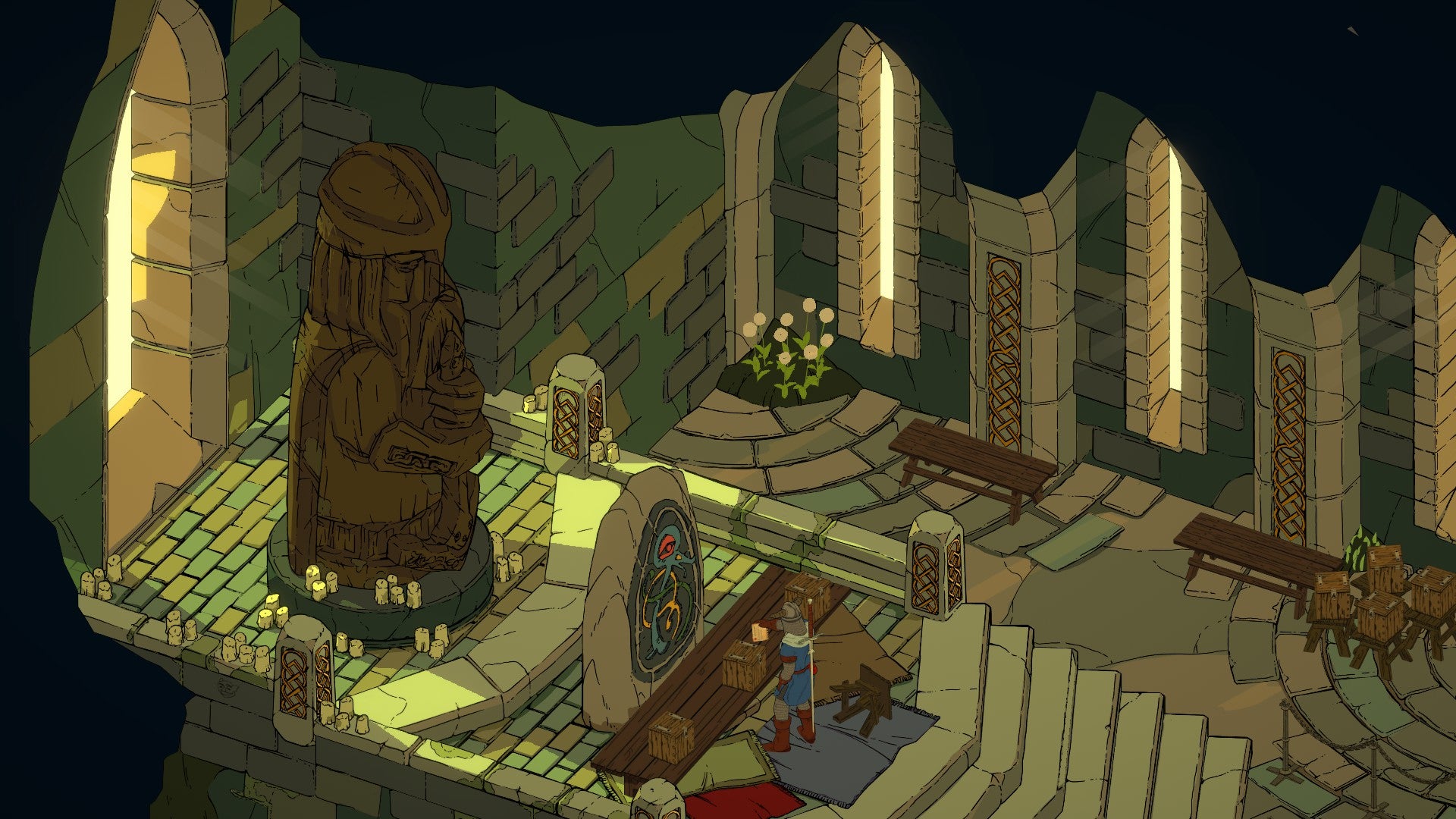
Ebb simmers in a great stew of situational comedy and classic pathos that nudges my Cleric toward unlikely solutions and useful indignance – if I can’t get something done because I’m too weak or clumsy, I can lean into my ineptitude with aplomb. I can have a crisis of faith and purpose while contemplating running a side hustle to deliver milk for a questionably little amount of money, or spend a questionably large amount of money to supposedly buy the property rights for an underground lake. I embarrass myself horribly time and time again, conjuring real-life PTSD from younger years when I still had the sort of fortitude and survivalist shamelessness that I’m trying to cultivate in my Cleric like a resilient little seed. When I fail at assessing NPCs because the dice don’t behave, that opaqueness and frustration build wonderful tension between characters and in the overarching mysteries and objectives that make up my journal.
Occasionally, though, it feels bloated by uneven writing and scenario design, and at times, briefly veers into excessive self-indulgence that crosses the line from neurotic self-effacing banter to tedium; one example is the cat-people gauntlet corridor in the catcombs which I felt was, in theory, an interesting exercise, but in execution, unsatisfying and unwieldy. A couple of times, the barrage of bantery one-liners don’t fully hold the weight and tension they need to maintain the whole concept of containing multitudes; this doesn’t happen often, but it’s such a load-bearing part of the gameplay that it’s really noticeable when it does. In part, Esoteric Ebb is an exercise in information maximalism due to its tooltip/wikipedia-style interface that lets the player click on various terms and names in the game text to show summaries of important concepts and figures in the history of this world. This in itself is not the problem; I actually quite liked this system as a means of information delivery, mostly because I love good, dense, borderline overwhelming worldbuilding.
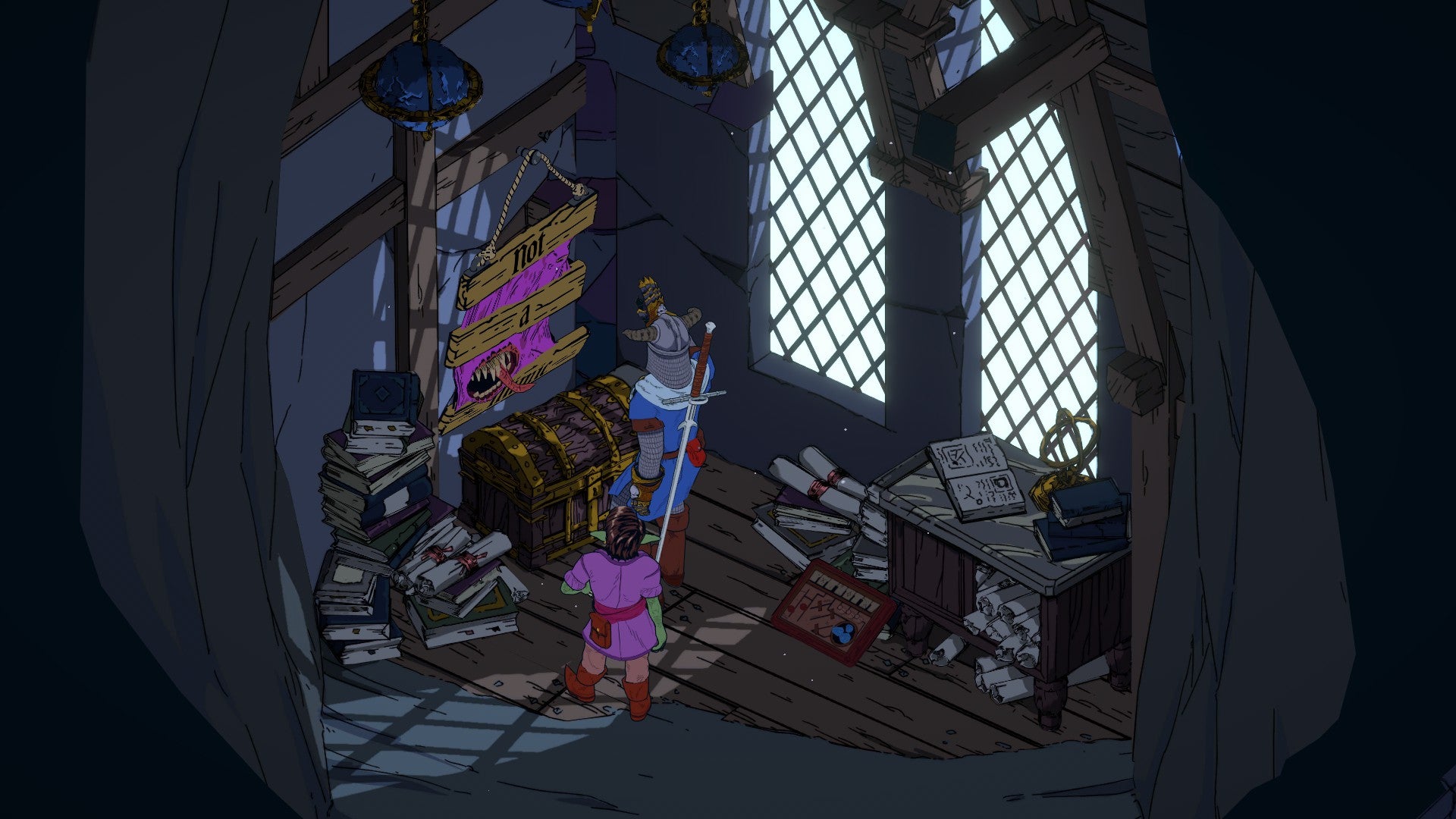
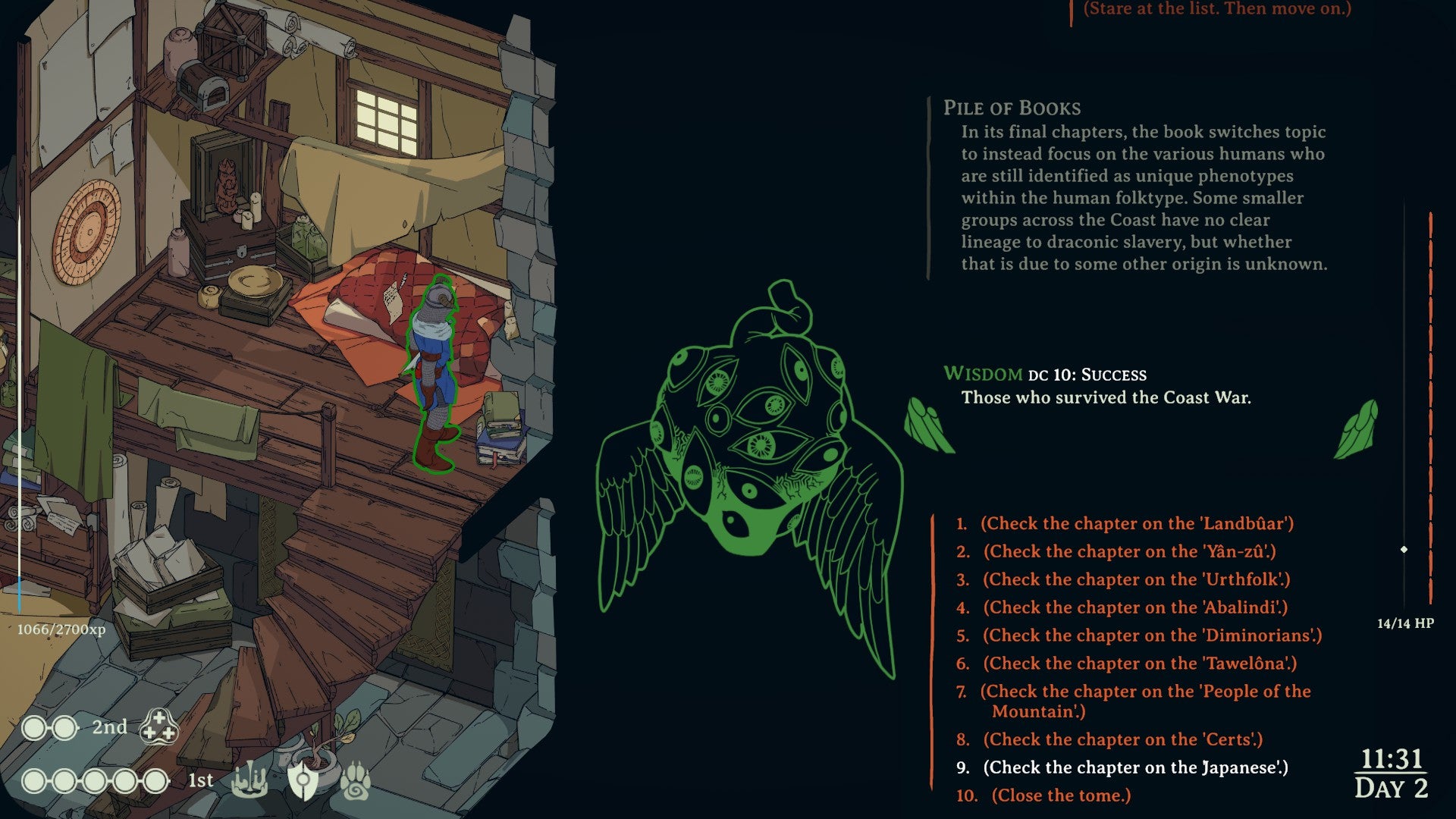
I try my best to avoid the word “cringe” as a descriptor, but sometimes there’s no better way to encapsulate the feeling of awkward, gnawing disappointment when you’re having a nice time exploring a neat fantasy world and bump into one of the most pernicious guarantees of western genre storytelling: casual, jokey, self-deprecating orientalism. There is, in a pile of books in the Cleric’s living quarters, a tome about the various peoples of this world – all fantastic folktypes like Urthfolk, Diminorians, Certs, and People of the Mountain. Keep in mind that we are in a D&D homebrew setting that is rooted in magic and theocracy and dragons; it is fantastically detailed and incorporates real-life languages into its various mythologies (Tolkien, among others, did a ton of this – his Elven is heavily Finnish-coded, and in this game they are straight-up just Finnish).
At the end of this list of people is “the Japanese.”
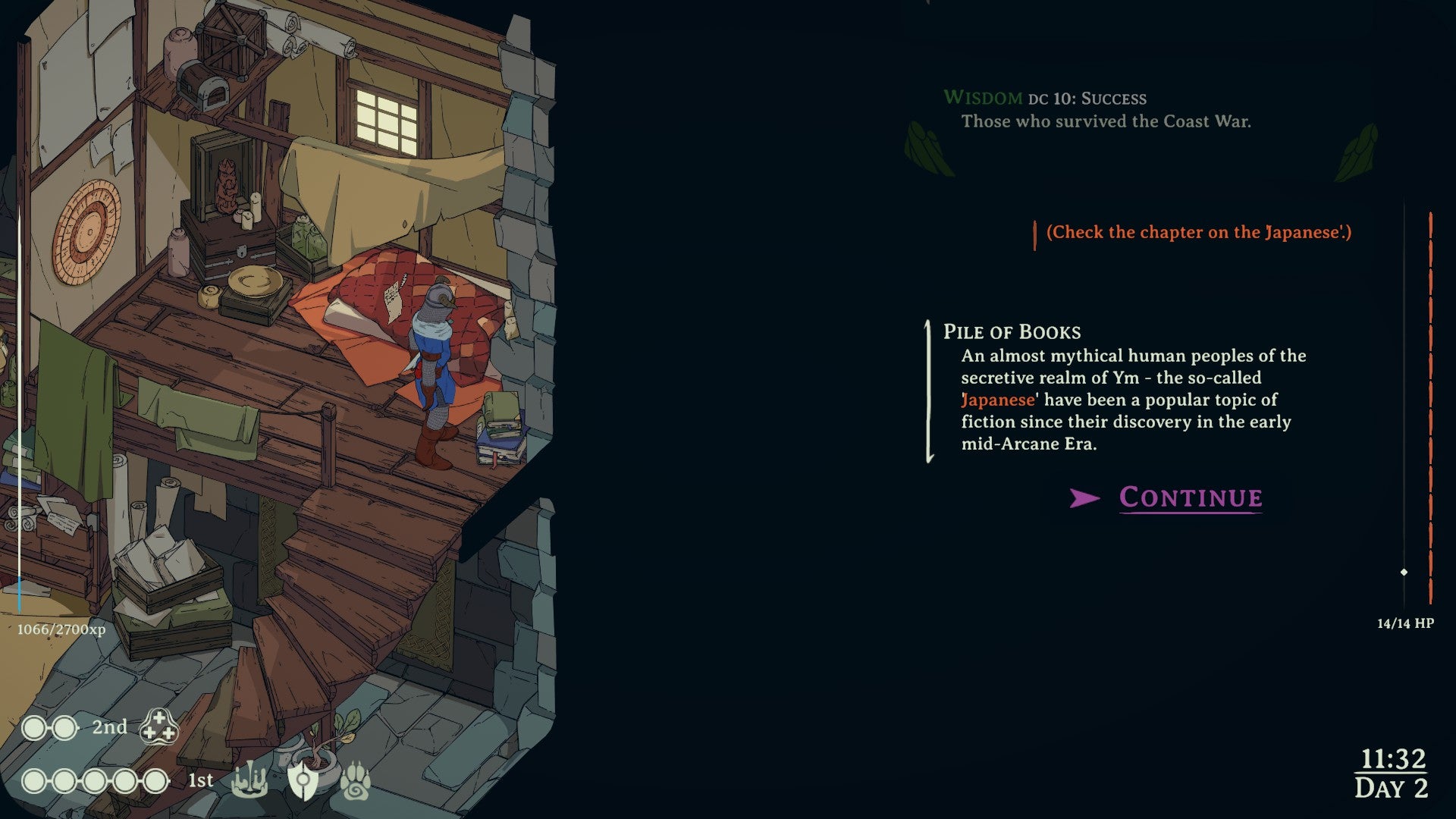
The Japanese, in this world, are more or less described with the same sort of feverish hyperoriental allure that made people like James Hilton a celebrated author, that turned isolated East Asian locales into a butchered run-of-the-mill trope across movies and comics and pulp stories. “An almost mythical human peoples of the secretive realm of Ym – the so-called ‘Japanese’ have been a popular topic of fiction since their discovery in the early mid-Arcane Era,” reads the book’s chapter. Reading this extract triggers my Cleric’s wisdom – a successful roll – to further clarify that the Japanese are “mysterious human people of Ym, who live in an isolated kingdom upon great plateaus, deep inland.” My Cleric’s charisma comes forward, now, to offer up a piece of self-reflection, as the game informs me that “You, too, were swept up in a Samurai-phase during your early years.”
Esoteric Ebb’s writer/developer Christoffer Bodegård probably meant this as a joke, as a tongue-in-cheek jab at how East Asians, particularly Japanese people, are often fetishised into objects of western adoration and worship. It is ostensibly supposed to be a bit of silly self-referential fun, but after all the care and effort that went into crafting this whole setting, it comes off as sloppy and self-indulgent. The fact that fantasy has traditionally been built on a rock-hard foundation of weaponised Othering, racism, and xenophobia isn’t news; this is simply something that fantasy enjoyers can either choose to acknowledge and engage critically with, or pretend they’re still eight years old. The fact that Ebb cares enough about racism in fantasy to directly address it in other subplots and character dialogue – second-class citizenship, for one, and open discrimination against birdfolk, for another – makes this whole Japanese attempt even more disappointing, as if there’s some sort of reverse-weeb exceptionalism here, that only smart and respectably self-aware westerners will understand and find relatable or even endearing. One wonders why this is even endearing in the first place, and to whom, and if western pop culture writing can ever be a little bit normal about Japan.
Omitting this whole entire situation from the game would have diminished nothing, but including it left such a bad taste in my mouth it was hard to forget. My first playthrough is about fifteen hours, so it’s not like I could memoryhole that particular bump quickly, but it wasn’t hard to move on because Ebb is good at momentum. Halfway through my second playthrough right now, I’m still an idiot, albeit a more constitutionally robust one with a better sense of the game’s systems, and I’m still not fully confident in the game’s hybrid class system that lets me choose another role (say, a Druid or a Warrior, which must be unlocked by talking to relevant NPCs).
But this low-key muddledness goes well with how the game forces the Cleric to commit to his own identity through verbalisation and articulation – the more I identify myself to people as, say, a Cleric, or as apolitical, the more it affects my alignment in said categories. I end up trying to be a sort of Cleric-Druid, though I don’t fully utilise the build in my first playthrough; it is also probably relevant to add that the Cleric is canonically some kind of arcane savant, and though we’re not exactly operating on “chosen one” levels, the game is explicitly clear that my precious buffoon of a holy lawkeeper has a preternatural gift for the esoteric. It’s hard not to enjoy a game that extends double-edged grace and questionable opportunity to even the biggest fool, especially when I don’t deserve it.
Finessing political alignment is arguably one of the most fun parts of the game – this is, after all, an election period – because it does the lord’s work by roasting my Cleric whenever I describe myself as apolitical. I feel the withering disdain of my fellow voters as I proudly describe myself as apolitical to anyone who will listen – the dwarves who fight for labor rights, heavyhanded Freestriders who use power and coin to shape democracy in their image, and my long-suffering companion, Snell, a goblin of many talents and inhuman patience. It’s shame all the way down when I, a seemingly incompetent instrument of the state, talk to passionate stumpers about my indifference to the material problems that plague our city. I am a waste of space, and when I finally hit rock bottom and commit my Cleric to a cause, even I feel less ashamed of him.
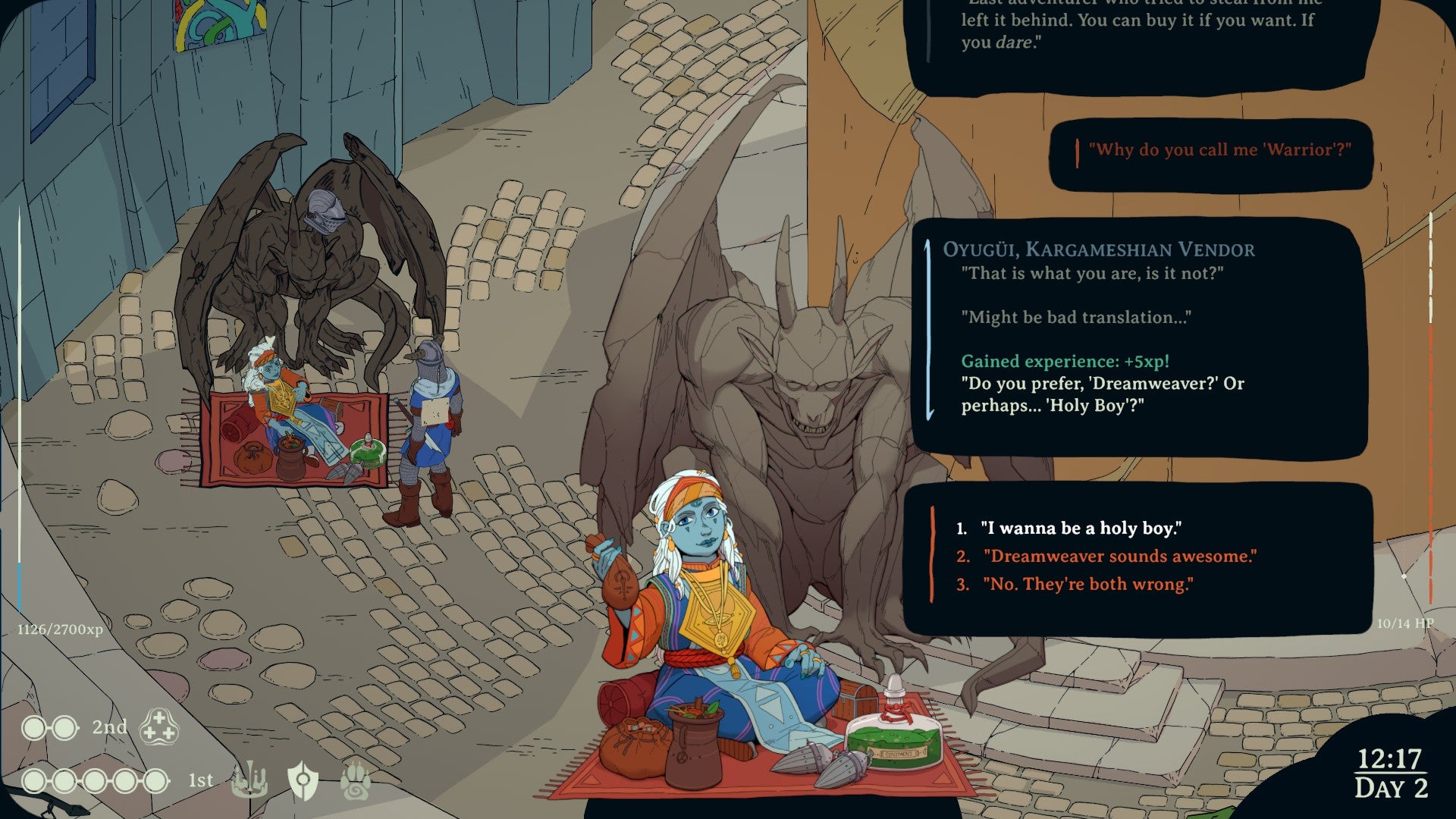
Probably the most succinct way I can sum up the essence of Esoteric Ebb is my Cleric’s initial meeting with Snell, in which I choose to do a wholly inappropriate greeting that befits an “uncivilised” tribal goblin, and my charisma butts in to ask, correctly, “what the FUCK are you doing?!” In the best spirit of D&D, this is a game that celebrates the very core of that question with generous comedy and a bit of camp and a lot of shenanigans, as befits a world that runs on dice and dreams and a good dose of eldritch horror. Free will is a hell of a drug.
The final scene of the game unfolds on election day – the entire city gathers to vote, and everyone you’ve met heads to the city center to perform their civic duty. Everyone is here making history; the atmosphere and impending sense of catharsis on election day gives off just-the-right-amount of resonance with regard to real-life feelings on migraine-inducing realpolitik and corporate lobbyists and the classic, helpless misery of “I have no better choices.” If 2026 somehow becomes the year of the funny election game (the other big one being Cosmo D’s Moves of the Diamond Hand – okay fine, I’m making up a trend based on two games, leave me alone), then let Esoteric Ebb be the approachable buddy comedy that gets everyone to think a little bit about their own place in the world, and the sort of useful idiot they want to be.
A copy of Esoteric Ebb was provided for this review by Raw Fury.