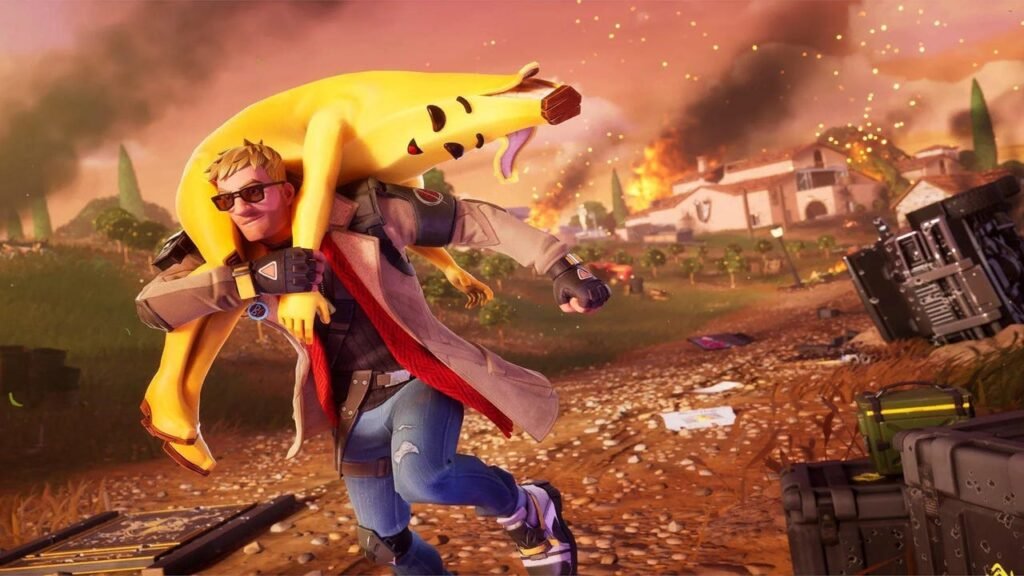
This week, Epic Games announced one of the largest rounds of layoffs the video games industry has ever faced, with more than 1,000 staff told they were out of work in one devastating morning. Fans of Fortnite, which remains one of the biggest games in the world, were blindsided by the news. But no one was more shocked than the employees themselves — some of whom had dedicated a decade of their lives to Epic and Fortnite, and established the breakout battle royale as a global phenomenon.
Days later, the scale of the layoffs is still sinking in. Alongside the many veteran developers now looking for work via social media, those who remain have said they simply don’t know how Fortnite will look later this year and beyond with almost a quarter of the company’s staff, including several key figures, no longer present.
But while there’s no mistaking the truly stunning scope of Epic Games’ decision, analysts have said that some form of cost-reduction — likely layoffs — was inevitable. Announcing the news this week, Epic Games boss Tim Sweeney blamed rising development costs and a downturn in player interest in Fortnite through 2025. But, speaking to IGN, analysts say there’s a broader picture here of a company now paying the price for its lengthy and costly bets that it can continue to upend the video game industry.
“Since late 2017, Epic has largely relied on the success of Fortnite to expand its business and heavily invest in product development,” Piers Harding-Rolls, veteran games industry analyst at Ampere Analysis told IGN. “While the foundation of potential future growth has been laid through its platform and storefront strategy, a drop in engagement for Fortnite in 2025 has meant an immediate need to cut costs once again following layoffs in 2023. This brings its workforce down to closer to 3,000 employees, close to its size in 2020 at the start of the pandemic.”
Three years ago, Epic Games went through a similarly large-scale layoff, ditching 830 staff and divesting others as the games industry emerged from its Covid lockdown-era boom. Two months later, Fortnite hosted its “Big Bang” live event, the game’s attempt to pitch itself as a multi-genre experience that featured Epic-developed racing, music and survival game modes without guns. Fortnite’s player count spiked, but the effect was temporary.
Fortnite’s fortunes have always been cyclical, with some battle royale seasons landing better than others, and an annual bump in player numbers each fall as a new battle royale Chapter arrives. But 2025 felt a particularly slow year for the game, something reflected in publicly-available user data. As interest in the game’s OG mode slowed and its non-shooter portions were sidelined, Fortnite’s main battle royale spent its summer months hosting an unpopular alien bug season. It was unfortunate timing, too, just as the popularity of rival metaverse game Roblox went stratospheric, as mini-games such as Grow a Garden and Steal the Brainrot became bigger than Fortnite’s battle royale mode on their own.
“Fortnite’s recent seasonal updates at the end of 2025 have not had as big an impact as updates at the end of 2023 and 2024,” Harding-Rolls agreed. “The OG map return had a major impact at the end of 2023 seeing MAUs [monthly active users] across PlayStation and Xbox increase by 51% month-on-month following the release, but Chapter 2 OG saw diminishing returns with a 15% MAU increase month-on-month, and the late 2025 updates saw peak MAUs at 14% lower than at the end of 2024.
“Since its high in 2023, Fortnite’s annual peak MAUs across PlayStation and Xbox have decreased by 28%,” he continued. “Engagement has also steadily fallen, dropping from an average monthly playtime in December 2023 of over 29 hours, to 15.4 hours in 2025. Meanwhile engagement on closely competitive titles have started to exceed Fortnite. In particular, Roblox had a surge of popularity from April 2025 onwards and saw average playtime and daily visits grow above Fortnite for the first time. This reveals the more immediately competitive environment for attention and monetisation that Fortnite is operating in. As revenues have dropped, so has the need to cut costs to defend profit margins and with staffing being the largest cost it is perhaps inevitable that Epic has had to reduce the workforce.”
“Epic says they are spending more money than they are earning,” noted Dr. Serkan Toto, CEO of Japan game industry consultancy firm Kantan Games. “We need to assume this is true and that the business model is not working anymore, so Epic pulled out the hammer instead of announcing a bunch of small cuts over a long period of time. If revenue falls, companies look at costs, and here, personnel is typically the biggest block. So if the ship sails into the wrong direction, firing people is the most impactful way to stop bleeding red ink. Boosting revenue and profits in a tough market like the current one is much harder than cutting costs, so Epic reacted in the way they did.”
Of course, developing Fortnite is just one of Epic Games’ costs. Alongside the development of its industry-dominating Unreal Engine toolkit, Epic has spent years waging high profile campaigns against Apple (which it is still fighting), Google (which it has settled, allowing Fortnite fully back on Android phones), and Steam (where its bid to launch a rival PC game platform has met with mixed fortunes).

Speaking to IGN last year, in a quote which has been resurfaced and widely shared this week in the wake of the layoffs, Epic Games boss Tim Sweeney said his company had lost a huge amount of money while fighting Apple and Google, though he had “no regrets” about it. “The fight against Apple and Google has certainly denied us a billion dollars of revenue, perhaps several billion,” Sweeney said, before suggesting Epic Games had a big enough war chest to continue its campaigns long into the future. “I think we might run into serious financial problems after a couple more decades of this.”
“Epic’s recent redundancies are understandably being linked by many to Fortnite, but that framing is likely too simplistic,” said Adam Smart, Global Director of Product – Gaming at mobile analytics firm AppsFlyer. “While Tim Sweeney has acknowledged a softening in Fortnite engagement since 2025, reflecting broader industry trends, that’s only one part of a much bigger picture. Epic has spent the last several years investing heavily across multiple fronts, most notably in its prolonged legal battles with Apple and Google. Those cases were hugely consequential for the industry — particularly in opening up the conversation around direct-to-consumer payments — but they also came at an enormous financial cost.”
Half a decade on from Fortnite’s initial spat against Apple and Google, has the cost in legal fees and lost profits been worth the battle? It’s a question that will surely be on the minds of Epic employees this week — those still at the firm, and those now unemployed, as Sweeney blames layoffs on the company spending more than it has been earning.
“Beyond that, Epic has been building out a much broader ecosystem,” Smart continued. “The Epic Games Store has required sustained investment across PC, console, and mobile, with mobile in particular still not fully realised despite years of effort tied to those same legal challenges. At the same time, the company has explored additional initiatives, including potential B2B direct-to-consumer payment solutions. Even where those haven’t fully materialized, they represent significant upfront cost in terms of product, partnerships, and go-to-market efforts. When you layer all of that together, the redundancies start to look less like a reaction to a single product, and more like the result of cumulative strategic investment meeting a tougher macroeconomic environment.”
Added Toto: “The legal costs of the year-long campaigns against two of the biggest companies that ever existed are surely astronomical, but every live-service game peaks and then starts declining one day. It seems even Fortnite’s best days may be behind it. Their UGC initiative never became a danger for Roblox, Steam is still much bigger than the Epic Games Store and their various M&A deals over the last years apparently did not contribute to revenue significantly enough either.”
Sweeney devoted a large portion of his message to staff this week discussing general industry trends that Epic Games, despite its size and Fortnite’s popularity, remains vulnerable to. These add further to the complicated picture of a company experiencing what feels like a real turning point, as Fortnite’s momentum and Epic Games’ costs intersect with pressures felt across the video game industry.
“Epic expanded its workforce rapidly over a five-year period starting in 2019,” Ampere Analysis’ Piers Harding-Rolls noted. “Like other games companies that followed a similar course during the pandemic, competition for talent during this period fuelled wage inflation and ballooned the costs involved in games development. This was compounded by general wage increases to cover high inflation due to the pandemic and Ukraine war. This has put broader pressure on margins across the industry, hence an increase in prices across consoles, paid games, subscriptions and in-game items and battle passes. Against this backdrop any drop in revenues will put a significant pressure on margins and will require cost savings to correct course.”
AppsFlyer’s Adam Smart, meanwhile, pointed to the fact that Epic Games has not (outside of its 2023 layoff) gone through the same cyclical, project-based scaling up and down of teams usually seen in the video game industry. “Parts of the industry — particularly on the PC and console side — have historically operated in a more cyclical, project-based way, not unlike film production,” Smart noted. “Teams scale up during development and often contract post-launch, which can make financial performance appear stronger once those costs come off the books.
“While live-service models like Fortnite have shifted that dynamic, the industry is still in transition between those two approaches. Ultimately, what we’re seeing with Epic is a convergence of factors: long-term strategic bets, the high cost of challenging platform incumbents, evolving business models, and a more difficult global economic backdrop.”
Indeed, numerous video game companies have experienced layoffs over the past few years, with Epic Games’ own just the latest among a series of brutal cuts by Microsoft, a slow drip feed of departures at Ubisoft, and the loss of various studios owned by PlayStation. Nintendo, too, has had to adjust its costs, increasing the price of its aging Switch console and Switch 2 accessories, and announcing plans to soon start selling physical games at a higher price than digital copies.
“All companies, whatever size or success, are in a battle to manage their costs,” Harding-Rolls added. “This will not get any easier with another round of global inflation expected due to the U.S. and Israel war with Iran. Unfortunately, staffing costs are where big cost savings can be made, but that has implications for general job security and workforce morale. Overall, while Epic has specifically mentioned that AI is not a factor in its decision making, the looming backdrop of rising inflation means that games companies of all sizes will be eager to leverage AI to become more efficient. That is likely to have some impact on sector hiring in the future.”
What next for Fortnite? If Epic Games continues down its current path, it’s perhaps worth remembering what Sweeney told IGN less than 12 months ago at Unreal Fest 2025, when he said that the company’s biggest challenge was still convincing a wider audience that it had made an “everything game” that wasn’t just a battle royale. In his note to staff this week, Sweeney said that what Epic Games needed to do now was “clear: build awesome Fortnite experiences with fresh seasonal content, gameplay, story, and live events; accelerate developer tools with greater stability and capability as we evolve from Unreal Engine 5 and UEFN to Unreal Engine 6.” In other words, Fortnite needs to be better as a battle royale, while its metaverse ambitions need to have a stronger technological base. Intriguingly, Sweeney also noted that the company would be “kicking off the next generation of Epic with huge launch plans towards the end of the year.” Has the firm finally solved the problem of making Fortnite something bigger than a battle royale, for real this time?
“The redundancies feel less like a signal of a single failure and more like the result of a company that spent years betting it could reshape the economics of the entire games industry — a period of consolidation was probably inevitable,” Smart concluded. “It just looks bigger when it’s Epic.”
Tom Phillips is IGN’s News Editor. You can reach Tom at tom_phillips@ign.com or find him on Bluesky @tomphillipseg.bsky.social