Resident Evil’s Spencer Mansion is a life-or-death slash course in scarcity that wrote a genre’s rulebook in blood and ink ribbons. It’s a clockwork crucible made of stairways and statues that demands mastery to unlock, and its interior was scratched into our cerebellums from the second S.T.A.R.S. slammed shut the front doors.
When Resident Evil launched in 1996 there wasn’t a name for what it was trying to be yet. Capcom’s marketing wizards coined the instantly immortal term “survival horror,” but the average PlayStation owner had no idea what that meant, their gaming tastes firmly rooted in power fantasy and forward momentum. And so Resident Evil suddenly had to walk us through complex ideas like route optimization, bottomless item boxes, and herbicide titration. Spencer Mansion was built to teach us all that.
The Entrance Exam
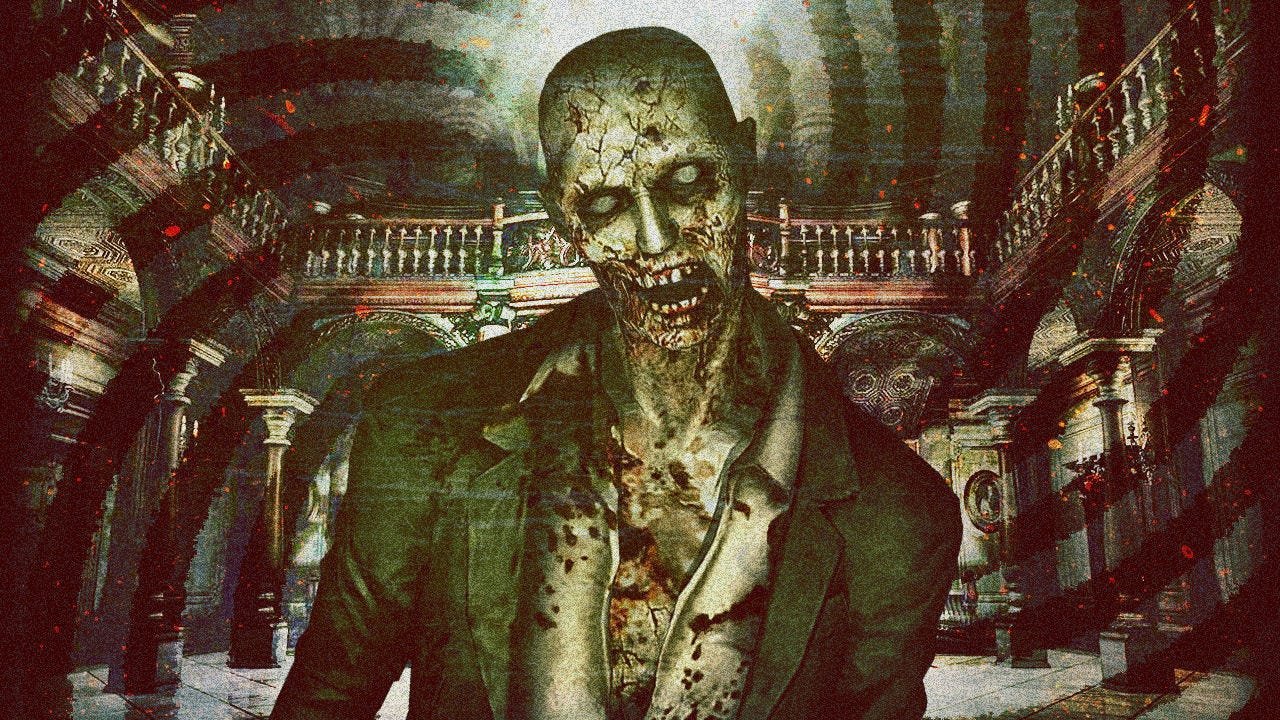
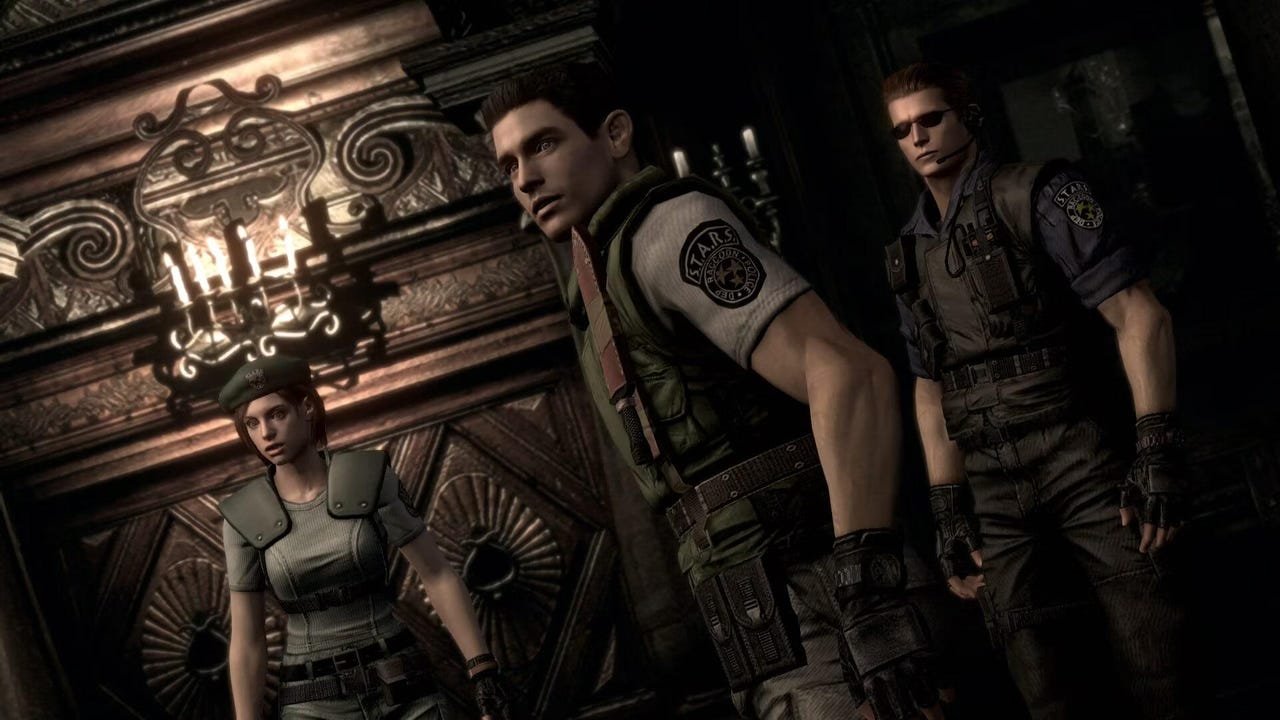
Resident Evil begins with what’s left of the Raccoon City Police Department’s S.T.A.R.S. Alpha Team locked inside a cavernous foyer, alone, afraid, and – unlike traditional console heroes of the time – unable to jump, with rabid mutant hounds at their heels. Doors and neo-classical columns surround our heroes in all directions as a red carpet on the tiled marble floor guides their gaze up stairs and a sweeping wraparound balcony.
There were a lot of sweeping wraparound balconies in the ‘90s. Many games of the early 3D era saw fit to include a bespoke tutorial zone, a place for gamers to get their C-button legs as they wrapped their minds around a new dimension. In 1996, that meant big, wide-open living spaces with grand staircases, stained-glass windows, and walls adorned with paintings. Lara Croft climbed crates in her stately crib the same year Mario BLJ-ed his way across Peach’s castle. Palatial homes are tailor-made for 3D exploration and Spencer Mansion is no exception, with roughly symmetrical wings, verticality, and looping paths trapped behind progression locks which remain closed to you just yet.

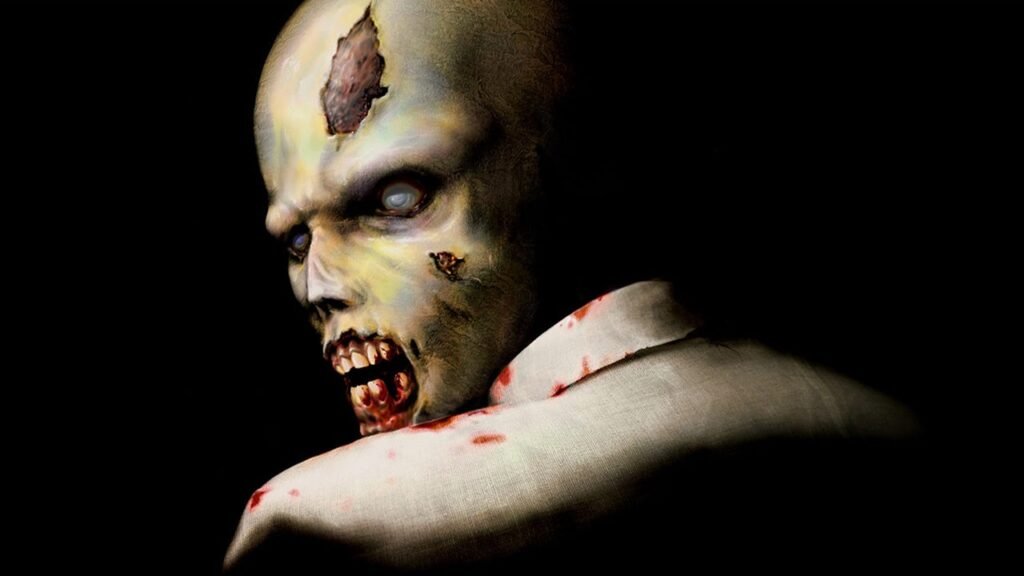
An in-engine cutscene steers you immediately into a vast dining hall dominated by a massive table, an oppressively ticking clock, and a statue looming near the broken bannister above. Depending on your chosen player character, Jill Valentine or Chris Redfield, you’re either sent to investigate an adjoining room or left to do so of your own volition. Step into the deceptively cozy-named Tea Room and receive your first real test. It’s a multiple-choice question:
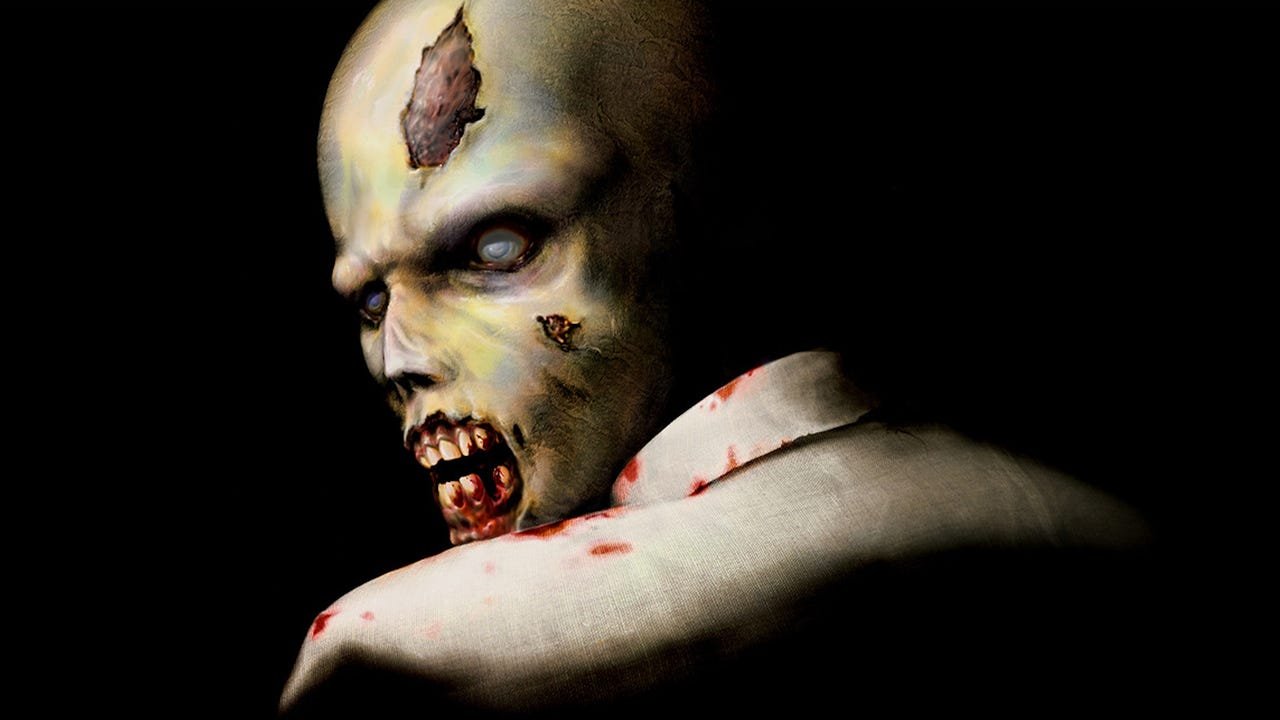
A ghastly creature feasts on the corpse of your fallen comrade, Kenneth, and meets your shocked stare with its own dull gaze. What should you do?
- Slash away from melee range with your dinky knife in a costly, clumsy battle.
- Shoot from range, but waste precious bullets. (Note: only available for Jill, Chris has no weapon.)
- Turn and sprint back to the relative safety of the dining room, where bearded girldad Barry Burton can blow the monster away with his Colt Python.
The correct answer is, of course, to run, although Barry’s backup only appears in Jill’s path, and he’ll dispatch the zombie whether you squandered your ammo or never went into the Tea Room at all. There’s a lot of interesting permutations of the opening, but the lesson stays the same. In one tense sequence and several door loading screens we learn almost everything there is to know about survival horror: Resources are precious. Our protagonists are awkward, ill-equipped, and squishy. Most fights are better off avoided. This was not the most familiar concept during the reign of Duke Nukem.
Back in the foyer, Chris finds a gun and Jill gets a lockpick from Barry, who offers the most quotable compliment in gaming history. He also advises her to stay on the first floor. Jill announces her intention to check the double doors, but not before doing a mandatory lap of the room to give you one last chance to safely wrangle with the strange controls. Resident Evil doesn’t often offer much overt direction, but it’s good at suggesting towards the critical path in an era unbesplotched with yellow paint.
It should be clear by this point that Jill acts as the game’s de facto “easy mode”, which goes unlabeled in the game’s English version. It’s an immersive and non-judgmental way to give new players a slightly easier time with tweaks more considered than just extra health or additional ammo. She’s got several get-out-of-jail-free cards and built-in shortcuts that blend seamlessly into the story.
Most of the entrance hall doors are unlocked, and you’re now free to explore the mansion as you see fit. You can check out that strange shotgun on the wall, shove some boxes around, or step outside for some fresh air and local fauna. When you’re ready, swing by the Storeroom for the Sword Key, or skip it completely as Jill. Her lockpick lets her bypass puzzle chains and open up the estate for exploration early on.
Alone in the Mansion
Resident Evil’s entrance and dining hall sequence is extremely successful at setting the stage for what’s to come. The initial venture into Spencer’s estate is an all-time classic act of onboarding that rubs shoulders with legendary tutorial levels like Mario’s World 1-1 or the Central Highway of Mega Man X. The whole mansion is, really. And even when you’ve learned how to navigate it, its corridors continue to teach you the meaning of horror, right up to the finale.
The terror of the Spencer Mansion is experiential, emerging as you navigate the labyrinth with no clue what lurks around the corner. A lot of this special flavor comes courtesy of technical limitations: the only actual 3D entities are characters, enemies, and items projected onto pre-rendered images with collision boundaries mapped out. The camera is completely out of our control, switching harshly when we cross an invisible line that signals the next room or perspective. These fixed-angles arose from necessity: Resident Evil would have been a first-person shooter if the PlayStation hardware could have handled it. When the initial vision proved impossible, the devs looked to France for inspiration.

Infogrames’ 1992 computer classic Alone in the Dark is strikingly similar to Resident Evil, though it hits much differently. Resi is far more mechanically-minded and slickly-presented, with badass SWAT people in cool uniforms subbing for the dweeby Edward Carnby. Alone in the Dark’s noir-ish protagonist is no boulder smashing he-man, and he’s probably not showing up in a crossover fighter anytime soon, but he is scrambling through a sprawling, ornate house festooned with zombies and a giant boss monster plant. Resident Evil director Shinji Mikami was reluctant to admit the influence for years, but Derceto Manor is clearly a hypothesis that Spencer resoundingly confirms.
Mikami, planner Hideki Kamiya, and the entire Capcom Planning Room 2 team weaponized their limitations to inform the mansion’s design: dramatic angles, unseen threats, and claustrophobic corridors that force confrontation as you squeeze past the lumbering undead. Low onscreen character counts meant every enemy had to be a genuine threat, with precision constructed encounters that equal the most tense and atmospheric scenes in cinema – a window cracking under pressure, a moan of untraceable origin, a spider scurrying just out of sight overhead.
We remember our time in the Spencer Mansion so well because the camera wouldn’t let us look away. The lens dares to venture where our modern right sticks seldom do, and the detached, candid point-of-view does wonders for our sense of the mansion as a space. It’s almost voyeuristic; we don’t see Spencer through our avatar’s eyes, we observe them existing among its nooks and crannies, weak and outgunned, following the invisible pattern that leads them deeper into the mansion’s mysteries.
There’s always a tinge of melancholy in Resident Evil games when you leave the spiraling puzzlebox behind and descend into the more sterile worlds of secret labs and military installations that inevitably lie beyond. It’s hard not to fall in love with these intimate, intricate spaces, to fondly reminisce on every brilliant shortcut and chill save room sesh bathed in green herb glow. Spencer Mansion is where we fell head over heels with survival horror. It will always have a place in our hearts, so long as they’re still beating.