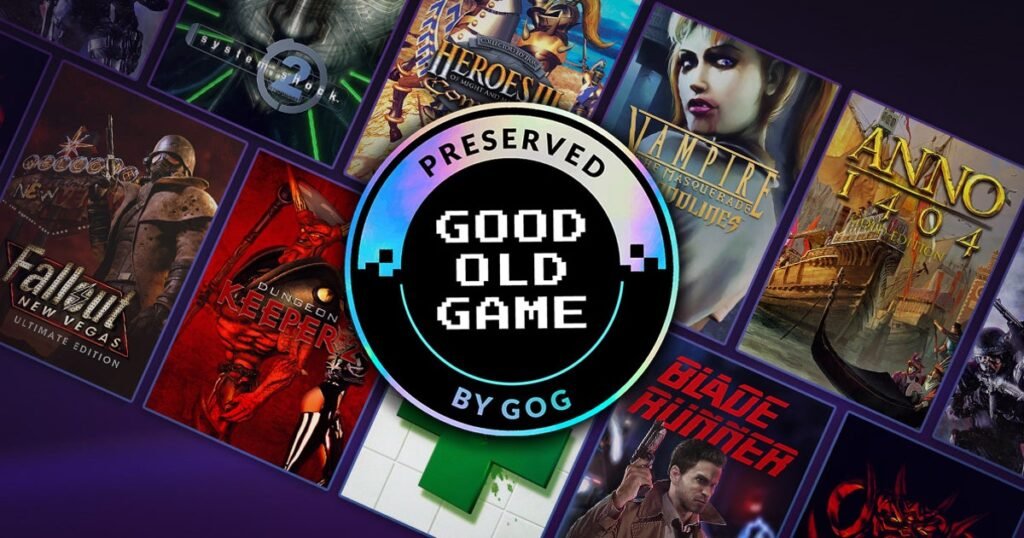
Newly independent PC digital game shop GOG is interested in getting into publishing indie games – something it apparently couldn’t do while part of CD Projekt Red.
It’s a notable change for a company that’s focused primarily on restoring classic old games as well as selling some newer games – notably CD Projekt Red games – since its launch 17 years ago. But it’s one of the areas Michał Kiciński, the company’s new owner, told me this newly untethered company can now step into.
“I’m also co-owner of an indie game publishing company called Retrovibe,” Kiciński said – Retrovibe being the publisher responsible for retro-styled games like Project Warlock, Shardpunk, and BIOTA. “So one of the directions which were not that much possible in the past is evolving GOG more into publishing business, and that’s something we will certainly discuss.
“No decisions have been made yet,” Kiciński added, “but this opens a whole new area of activities for GOG which was not that much possible together with CD Projekt Red as one group, because at CD Projekt Red, all publishing activities were connected with their own games, and they didn’t want to spread attention into some other topics.”
GOG had before now always been part of CD Projekt, the parent company of CD Projekt Red, but as the company evolved away from game distribution and more towards making its own games, CD Projekt Red grew to encompass the totality of what CD Projekt did and does. That’s why GOG was put up for sale last year.
“This opens a whole new area of activities for GOG which was not that much possible together with CD Projekt Red”
Kiciński was one of the founders of GOG, coincidentally, and a co-founder of CD Projekt. But he hasn’t worked at the company since 2012, since before The Witcher 3: Wild Hunt, remaining only as a major shareholder since.
Leaving the safety of CD Projekt Red’s orbit might seem like a challenging thing to do, given the prestige of that company and the excitement surrounding its games. GOG leveraged those games with attractive price promotions and enjoyed an elevated position courtesy of its proximity to CD Projekt Red. But the gravitational pull of that burgeoning studio worked both ways.
“It’s quite a common business situation when you have two entities of very different sizes in one group, and naturally, the attention and resources goes to the bigger part and the smaller part has some benefits but also has some difficulties in being a much smaller brother in such an environment,” Kiciński said.
The upside for GOG, now that it’s privately owned and entirely by Kiciński, is there are no investors to worry about, so decisions can be made quickly and perhaps be riskier as result. GOG managing director Maciej Gołębiewski noticed the opposite thing creep in during the past 10 years he’s been there, as the company grew massively following the release of The Witcher 3.
“CDPR, since I’ve joined the company, grew so much and became a much more complex organisation, stretched across continents,” Gołębiewski said. “GOG is a fairly small and nimble company. Having one single owner simplifies a lot of things in terms of potential decision making or risk appetite. A big company that’s listed on a public stock exchange: it’s probably a little bit more complicated or complex to execute risky stuff.”
“That’s a good point,” Kiciński added. “I know from the other projects I’m involved in, the decision making process is super easy. I’m super accessible and decisions can be made fast, and also, I’m not afraid of risk as a private investor.”
“We have a big appetite for the growth of GOG”
Besides a possible move into publishing games, there aren’t plans to dramatically change what GOG does. The founding principle of finding and restoring old games that no longer work remains a strong one, as does selling games with no DRM. And the close relationship with CD Projekt Red will continue, courtesy of a six-year deal that offers very favourable rates on GOG, I’m told.
It probably also helps that the two companies are neighbours, housed inside the same office complex, and that Kiciński is a major CD Projekt shareholder. The two companies might be separate but they’re not entirely separated. Not yet.
But it’s early days. The deal was only completed in mid-December and Kiciński wasn’t sure it would go through until it did. There were rival bidders. So his first day back in the office today, 8th January when we spoke, marked the proper start of figuring out what’s next.
“What we agreed already is that GOG can improve on what’s doing right now,” he said. “We also discussed that there is no need for any pivots or changes in philosophy or something like that. GOG has a very special place on the market, very unique values, very loyal customers, and we appreciate that, and we want to build up on that, not changing too much. So that’s what was discussed. And we already started discussing the publishing activities possible with GOG.
“And that’s it. Then we have a few weeks and months to work out the bigger strategy for the future. But for sure, we have a big appetite for the growth of GOG.”