Following the discovery of a Sony patent application for an AI PlayStation game assistant earlier this year, a similar patent filing has been spotted from Microsoft, this one concerning an AI helper that can temporarily take over an Xbox session and play a game for you.
As unearthed by Tech4Games, Microsoft filed the recently published patent – concerning “state management for video game help sessions” – back in 2024. It’s intended to offer a solution to what the company calls the “rudimentary” currently available methods of getting help to “overcome in-game difficulties” – methods that, it says, “takes a great deal of effort.”
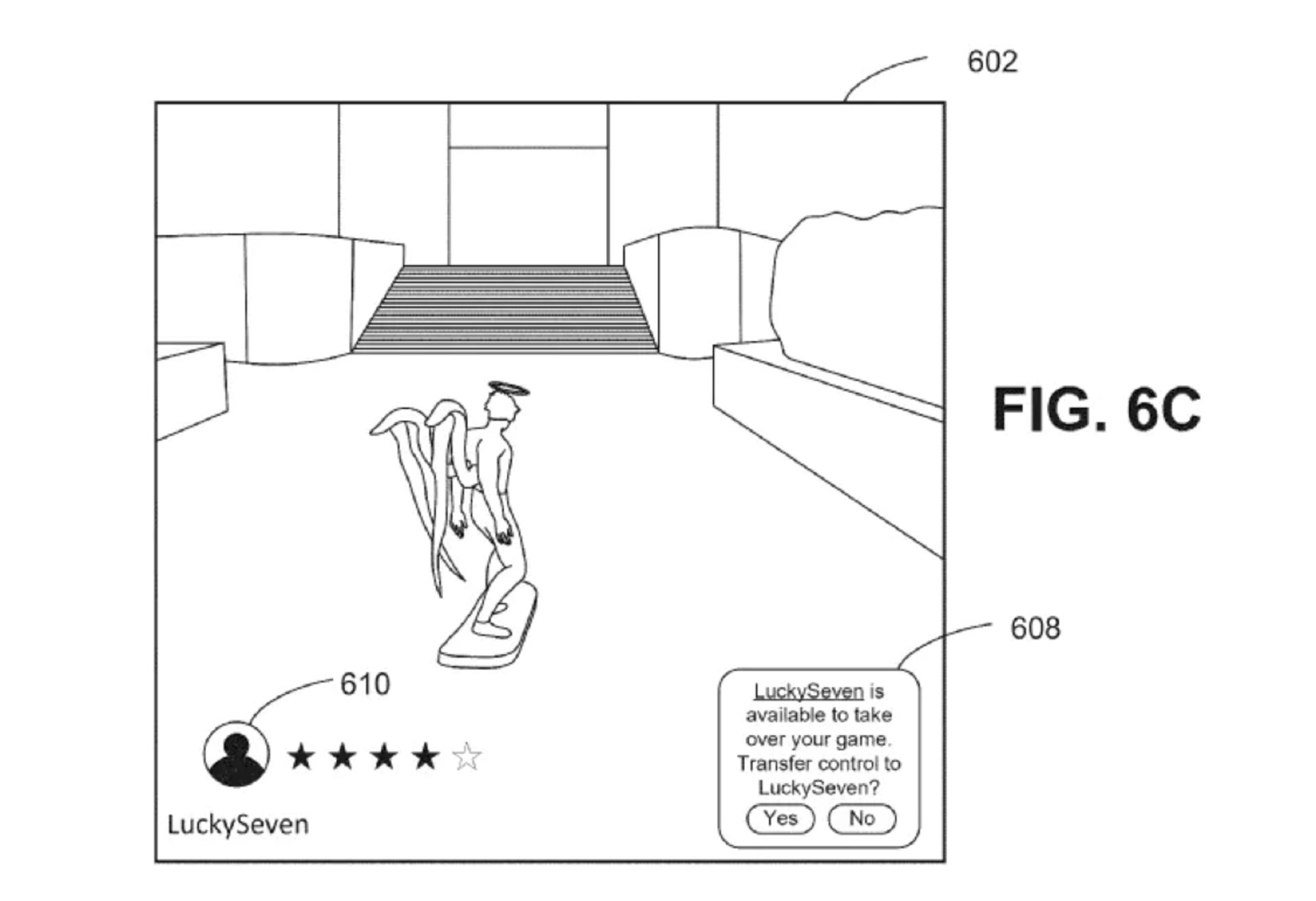
Specifically, Microsoft’s patent filing discusses the implementation of cloud-based help sessions which might involve text, chat, or video-based communication – and which would give players the option to temporarily transfer control of their current gaming session to “another game player”. Then, once the session is complete, an “updated help session state” is obtained – and the player can either accept it and proceed with the game from that point, or reject it and return back to the starting state.
As for what’s meant by “another game player”, Microsoft says the assistant could either be “a human being or, in some cases, a machine learning model.” It then outlines what it calls a “generative model” for help sessions, which might be capable recognising objects in input images, and which could be used to produce a combination of “text, images, video, audio, application states, code, or other modalities as inputs and/or… outputs.”
The rest of the patent is largely concerned with the specifics of how game sessions might be triggered and end, but there’s a brief detour where Microsoft suggests game helpers could be given ratings – an overall rating, as well as ratings for specific genres, games, and even for elements of a particular game – which might be then used when selecting a helper for a session.
If nothing else, it’s an interesting glimpse into Microsoft’s vision of game help back in 2024 (also the included pictures of angels trying to skateboard up steps are neat!), especially given last year’s Xbox Gaming Copilot beta launch – Microsoft’s AI-driven “personal gaming sidekick”, designed to offer real-time advice in games such as Minecraft.
The company’s patent filing also makes for an interesting comparison with Sony, whose own recently surfaced game help filing proposed an in-game AI ‘ghost’ that could assist PlayStation players if they get stuck in a game – either by offering guidance or instruction, or simply by completing a section for them.
Of course, AI – particularly generative AI – remains massively controversial. Quite aside from the substantial ethical and environmental concerns surrounding the technology, the huge quantities of RAM needed to power it is now causing strife for the consumer electronics industry at large amid memory shortages and soaring prices caused by tech giants’ escalating AI arms race. Already Valve has confirmed a delay for its Steam Machines alongside dwindling Steam Deck supplies, while Nintendo is reportedly mulling a Switch 2 price hike and Sony is said to be considering a PS6 delay.
AI’s increasingly negative associations recently also led Xbox’s new head of gaming, Asha Sharma, to decry “bad AI”, following concerns about the proliferation of AI slop and her previous role as Microsoft’s president of CoreAI.