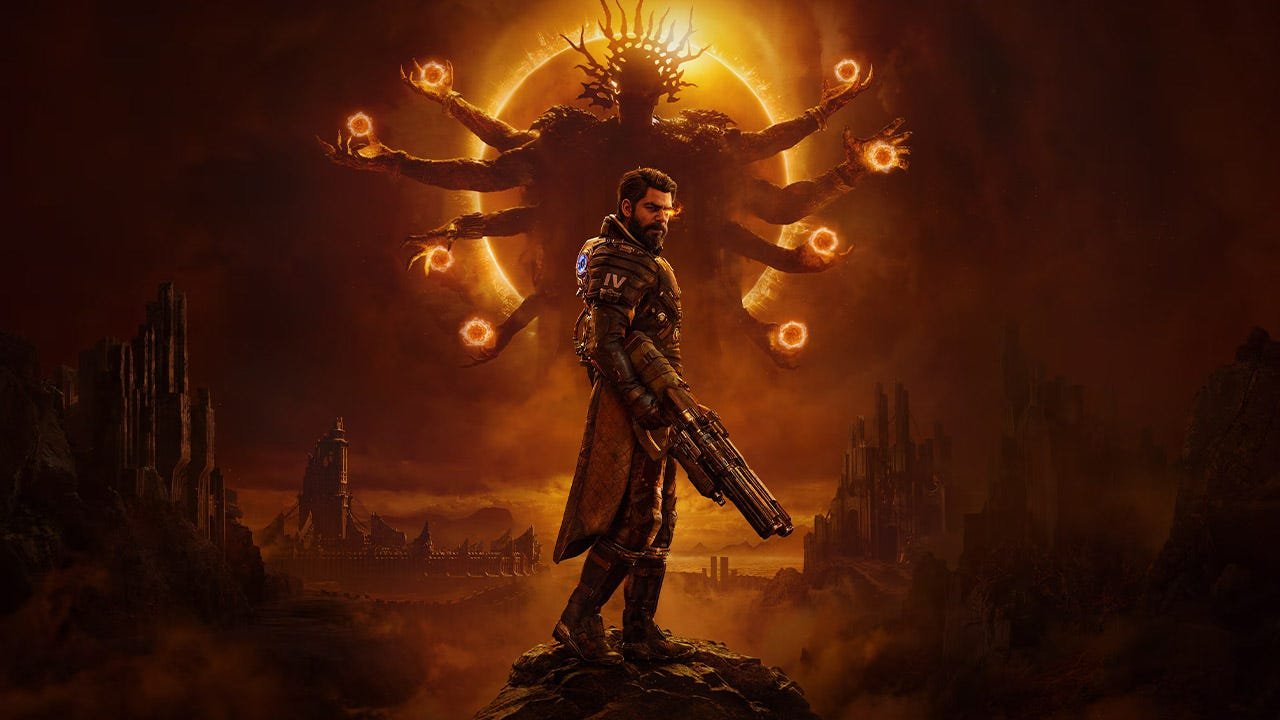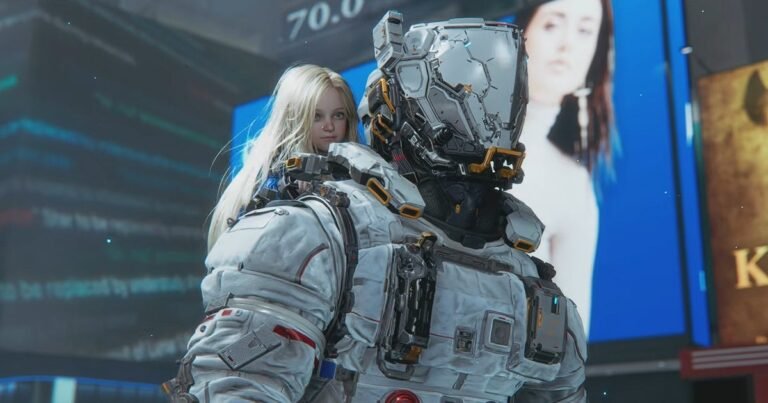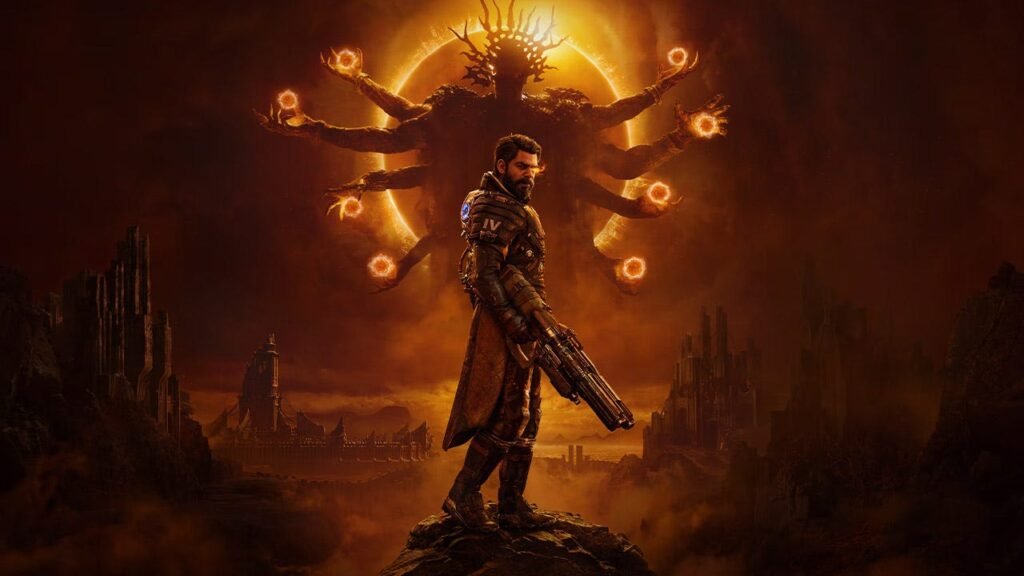
Risk and reward. Those two words power every aspect of Saros. Whether diving headfirst into a flurry of bullets, choosing between two weapon types, or embodying protagonist Arjun Devraj and seeking the painful secrets his story dangles in front of you, there’s a risk inherent to unlocking each of Saros’s rewards. Housemarque’s follow-up to Returnal takes what made the 2021 third-person “looper shooter” so acclaimed and twists it into a whole new cosmic horror bullet-fest that aims to surpass its predecessor. And from playing three hours myself, I think it’s doing just that.
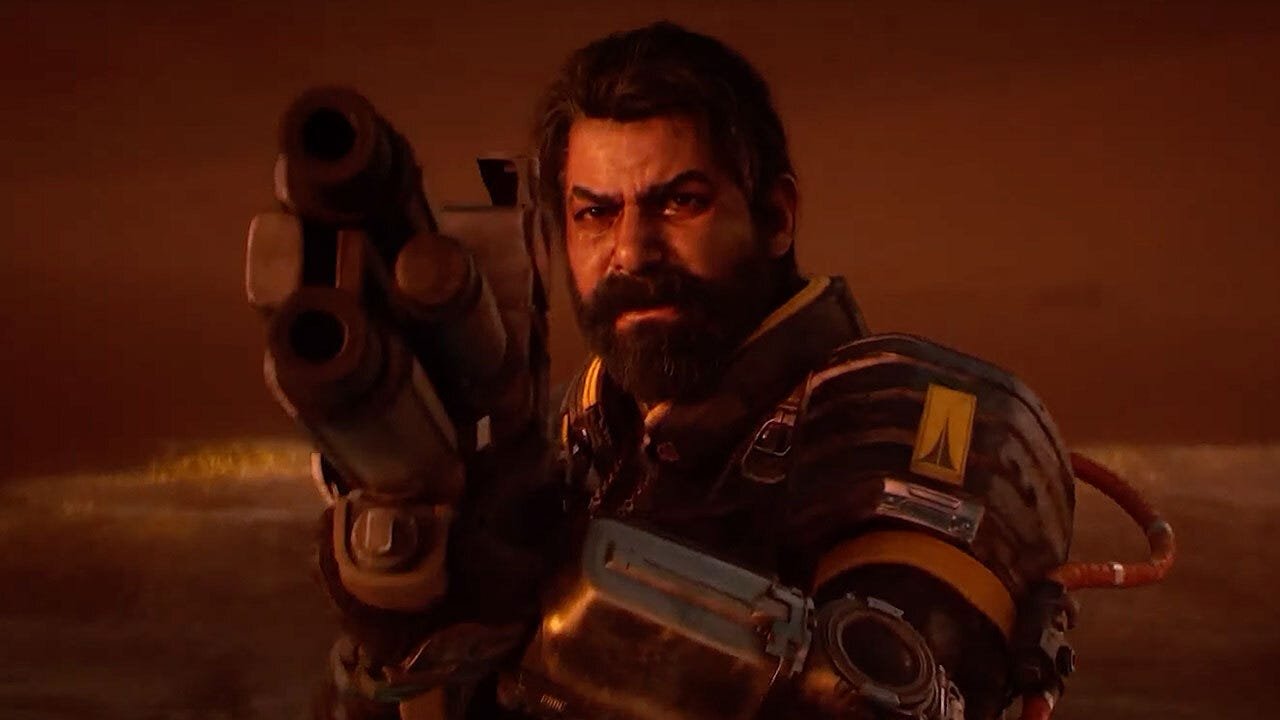
Carcosa is an alien planet that has been targeted by the human mega-corporation Soltari due to its rich deposits of the incredibly valuable resource, Lucenite. It’s a sci-fi setup as old as time, stretching from Alien to Avatar, and if you’ve seen any of these films, you know things never go quite to plan. Several Soltari ‘Echelon’ crews have been sent to scout and colonise the planet, but contact has mysteriously been lost with them, so it’s your job as Arjun Devraj, a member of Echelon IV, to find out what has happened. But this isn’t just any old search and rescue mission, because Carcosa isn’t just any old planet. It shifts and morphs its geography each time you venture out into its unknown.
“It’s almost revelling in the chaos it provides,” says Gregory Louden, creative director of Saros. “When you have handcrafted levels that are all connected, fireworks can happen. It’s a world that kind of shapeshifts and kind of surprises you.”
In gameplay terms, it’s the perfect setup for a roguelike, which is essentially what Saros is, even if the team at Housemarque prefers the term “shapeshifting” shooter. It’s also much more narratively ambitious than any of the studio’s games to date, further building on those Returnal foundations. This desire to tell more fully-formed tales perhaps informs the slightly kinder approach Saros has to player progression. From speaking with lead narrative designer William Shaughnessy, it’s clear that the team would like more players to reach the end of Saros than people did Returnal, hence why Saros will launch with auto save and multiple save slots at launch, something many found frustrating that Returnal neglected to have on release.
Runs are also shorter this time around, with each dip into Carcosa aiming to be over in less than 30 minutes (the majority of mine were around 20). Perhaps more transformative is the ability to teleport straight to the next unlocked biome from your base, instead of having to repeatedly fight through already-cleared environments as so many other roguelikes do. Then there’s Carcosan Modifiers, which can add to or mitigate the challenges present in each run, much like Hades’ Pacts of Punishment. It’s yet another example of making things kinder to the player without taking away the core challenge for those who seek it. It’s encouraging to see Housemarque stick with what made Returnal so good, but also take on feedback that prevented even more people from loving it.
“The feedback we did get is that more players wanted to love Returnal, and they wanted to get further,” reveals Louden. “So for us, it was about providing that ability. So it means we don’t dilute the challenge. There’s still a very challenging game there, but there is also the ability to kind of modify the challenge.”
That challenge involves navigating each of Carcosa’s multiple biomes, which are home to deadly enemies and winding paths, each of which you’ll need to overcome in order to reach its boss. Do so, and the next area will unlock and the story will continue, but die, and you’ll be spat back into the action, albeit one sporting a rearranged version of the threats you previously encountered.
Saros: Preview Gameplay Screenshots
These threats vary impressively in size, speed, and spectacle, too. From what I’ve seen so far, they’re largely mechanical monsters who love nothing more than to spew waves upon waves of projectiles toward you, creating a deadly dance in each encounter. And dance is exactly the right term, because Saros isn’t a bullet hell game, but much more bullet ballet in its approach — one that demands you respect your enemy and turn their tools against them. Louden tells me that Saros’ combat is much more like a “playground, not an obstacle course.” Dodging will only get you so far here; to thrive, you need to dive. Thankfully, Saros gives you the perfect tool for the job.
The Soltari shield is a key tool in Arjun’s arsenal, and the thing that sets it apart from Selene’s skillset in Returnal. With a press of a button, you can encase yourself in a bright blue spherical shield that not only blocks damage, but also absorbs projectiles of the same colour. Suck up enough alien ammunition, and you’ll be able to unleash a powerful missile that explodes on impact — essentially turning your forearm into a recharging rocket launcher. Of course, there’s a risk to this reward, as your shield can only stay active for so long, meaning you need to perfectly time those forays into the line of fire so as not to end up an overconfident corpse. It’s the brand of aggressive action I seek in games of this nature, and it reminded me both of the front-foot shield recycling of Doom Eternal and the health-harvesting design that Remedy, another Finnish studio, infused into Control’s combat.
Carcosa stands still for no one, which made each moment I stood motionless feel like a second wasted. This is reflected in combat, where cover is used sparingly and open space is dashed around in to avoid each new volley of violence. “We made sure that movement is rewarded, movement is incentivised,” says Mitja Roskaric, associate design director at Housemarque. That approach is displayed in Saros’ opening minutes, in which you take on a boss you’ll almost definitely die to, but who teaches you a valuable lesson in how to survive your next such encounter.
“I don’t think Returnal was that hard of a game, but it took a while to learn how to play it properly,” Roskaric continues. “So we did pay a lot more attention to the onboarding experience. We wanted to make sure that we teach the player how to play the game properly, not just with the text on the screen, but also by designing the spaces and encounters and other challenges with that in mind.”
Inevitably, though, no matter how quickly you learn, you will end up dead. Thankfully, though, Saros is always willing to make that next run feel a little less like hard work. Returnal was challenging, and from what I’ve seen, Saros is no different when it comes to the difficulty of its action. But, crucially, it does offer new ways of making things kinder. Key among them are permanent upgrades that strengthen Arjun, unlocked using that sweet Lucenite you collected on your previous run. These range from major perks, such as adding a highly valuable second-chance revive mechanic, to more incremental boosts, such as raising the base level of the weapons you pick on each run.
Those weapons all feel glorious to wield, too. You start off with a heavy-hitting pistol, before later discovering an assault rifle with a high rate of fire and a devastating shotgun that tests just how close you’re willing to get to your prey. Again, that risk comes with high-damage rewards. Housemarque has honed the craft of gunplay across 2D, top-down, and 3D planes for decades now, so it should come as no surprise that it all feels incredibly slick and punchy, no matter which gun you’re armed with.
I love that each weapon also comes with its own alternate fire option, too, engaged when the left trigger on the DualSense is held down halfway — it’s nice to see someone actually taking advantage of those adaptive buttons. These damage modes are randomised on each run, though, keeping you on your toes. They genuinely gave me pause for thought as I weighed up the damage output of one weapon versus the handy alternate fire my other choice came packed with. For example, by default, there is a soft lock-on when firing all guns in Saros, but if you’re willing to back your own aiming skills and put your money where your mouth is, you may select one that deals increased damage at the cost of having to manually aim completely.
Even in the few hours I spent on Carcosa, I began to find my favourites and started to tailor my loadout, knowing what threats populate each biome. This is most clearly highlighted in the challenge its first boss, “The Prophet”, poses. For much of the fight, you’re tasked with gunning down glowing growths that emerge from each side of this grotesque, plant-like monstrosity. As such, a weapon with auto-lock on helps the fight go far smoother, especially if it’s modded with the perk that enables its bullets to split off and ricochet between multiple targets at the same time. This ultimately allowed me to park having to aim at the back of my mind and put all my focus on dodging projectiles, absorbing them, and slinging back explosives into the beast’s gaping maw. Freshly covered in plant matter, I was then free to move on to the planet’s next region.
Saros September 2025 State of Play – Screenshots
But let’s back up a little, because I haven’t even mentioned the big, hot, glowing elephant in the room: the Sun. You see, Carcosa is a mysterious place. A beautiful one at times, too, with its crimson overgrowth crawling up the sharp lines of its Italian futurism-inspired architecture. But when the solar eclipse draws in, any of that potential wonder is substituted for an oppressive, dangerous atmosphere filled with fresh horrors. There is no escaping the eclipse either, at least not at this early stage. It’s mandatory for Arjun to summon it in order to proceed through Saros’ first two biomes, even if you’d rather do literally anything else. When triggered, the world of Carcosa undergoes an almost-demonic makeover, as long thunderous guitar chords echo into the freshly orange sky, and dread-filled shadows loom darker than before. It’s a sight and sound to behold, and one that got me more pumped than a bouncy castle at a kid’s birthday party. But the eclipse isn’t just a visual flourish; it’s a signal for every enemy under its glare to go batshit crazy.
Attack patterns are switched up, mixing new corrupted yellow projectiles into the volleys of blue ones I’d become accustomed to soaking up with my shield. As you can imagine, this complicates things a little, heavily shifting the balance in favour of risk far more than reward. Getting stuck in and charging up that power weapon is still key to success, though; you’ll just have to learn a whole new rhythm to the dance these foes are leading when the sun goes down. It’s an exciting new challenge, and very smart of Housemarque to essentially use the pre-eclipse sections of a level to train you for the terrors you’ll need to eventually overcome. Also affected are pickups, which come with greater rewards but carry the risk of damaging your stats. For example, you may find a much more powerful hand cannon, but picking it up will mean you now take fall damage. It’s up to you to find the balance that works for your playstyle.
The sun, and the blocking out of it, seems to be crucial to Saros’ story, too — indeed, the title is the name for the repeated 18-year gap between eclipses. Much of this tale remains a mystery to me, but what is clear is that the civilisation that exists, or existed, on Carcosa worshipped this solar entity, either out of fear or love. But when the eclipse erupts, it has a corrupted effect on anyone witnessing it, something that is inferred to have been the downfall of the previous Echelons, and one that is already taking its toll on Arjun.
“It’s a story about determination, overcoming adversity and maintaining your drive and your stability along the way while facing temptation,” says Shaughnessy. “That temptation could be like, put the controller down in a sense. But of course, the game’s engaging, and you’re going to keep that control in your hand, and you’re going to want to see what happens next in each level.”
It’s far too soon for me to say if the plot will come together in a satisfying way — this is Housemarque’s most ‘story-led’ game to date, so let’s hope so — but the early signs are highly promising. Cinematic cutscenes offer flashes of former lives and glimpses into characters’ psyches. The environments and setup for the story may suggest a traditional action sci-fi approach akin to a James Cameron blockbuster, but the almost ethereal visual language of its cinematography and focus on the battle between the psychological versus the physical remind me of more human-centred, emotive space stories, such as Claire Denis’ High Life or Andrei Tarkovsky’s Solaris.
This feeling is anchored in the nuanced performances delivered by the likes of Rahul Kohli as Arjun, supported by an ensemble led by Returnal’s Jane Perry. While much of the story is told through cinematics, there is the option to dig further in and talk to friends and read text logs while roaming around The Passage hub between runs.
“90% of your interactions with NPCs in The Passage are optional, and some of them can be missed along the way,” reveals Shaughnessy. “The only way to really get to know them fully is to engage with all that.”
I still feel like I’ve seen so little, but I could nonetheless sense a long and fractious history between the crewmates that blended personal with professional tensions. I can’t wait to spend more time with them, and see them gradually lose their minds.
There’s a story-rich texture to Saros that feels like Housemarque stepping further into the PlayStation Studios family, which is already home to so many cinematic blockbuster series. Indeed, Louden says he feels almost a “responsibility to showcase the PS5”, and from a technological perspective, it feels near-flawless in this regard. “I’m even really proud that we have an opening titles in the game that uses haptics,” states Louden. “We really try to thrill, we scored it with music, and we have lots of messages in there.”
On the surface, Saros may not look like a huge risk when compared to Returnal, but venture a little deeper, and its fresh, alien ways reveal themselves to you. By working within an established framework of Housemarque’s 30-year creation, smart risks, not huge swings, are being taken here, with the rewards set to be felt by all who step onto Carcosa when Saros launches on April 30 on PlayStation 5.
Simon Cardy is a Senior Editor at IGN who can mainly be found skulking around open world games, indulging in Korean cinema, or despairing at the state of Tottenham Hotspur and the New York Jets. Follow him on Bluesky at @cardy.bsky.social.