
Silent Hill’s stellar revival continues as new developer Screen Burn melds stealth, meticulous world design, and a dash of social realism for a different sort of survival horror.
As I watch the credits roll on Silent Hill Townfall, it’s hard to believe this is the same series that had, until just a few years ago, been neglected into near-irrelevance. Like 2025’s excellent Silent Hill f, Townfall is a fascinating thing; a game of bold creative swings that’s part inversion, subversion, and evolution of the near-three-decade survival horror series, charting its own idiosyncratic path while still feeling entirely Silent Hill.
Silent Hill f played a bit of a long game, reimagining so much of what the series could be in its shift from North America to 1960s-era rural Japan, that it took a while for that Silent Hill spirit to emerge from it all. Townfall, by contrast, rattles through so many of the series’ classic touchpoints so fast – behold a sad man with a clearly guilty conscious roaming the darkly shifting melancholy mists in search of a woman – I was worried we might be looking at the kind of the Silent Hill 2 cover act that nearly killed the series dead first time around. But instead, Townfall is far more ambitious than its early moments might suggest.
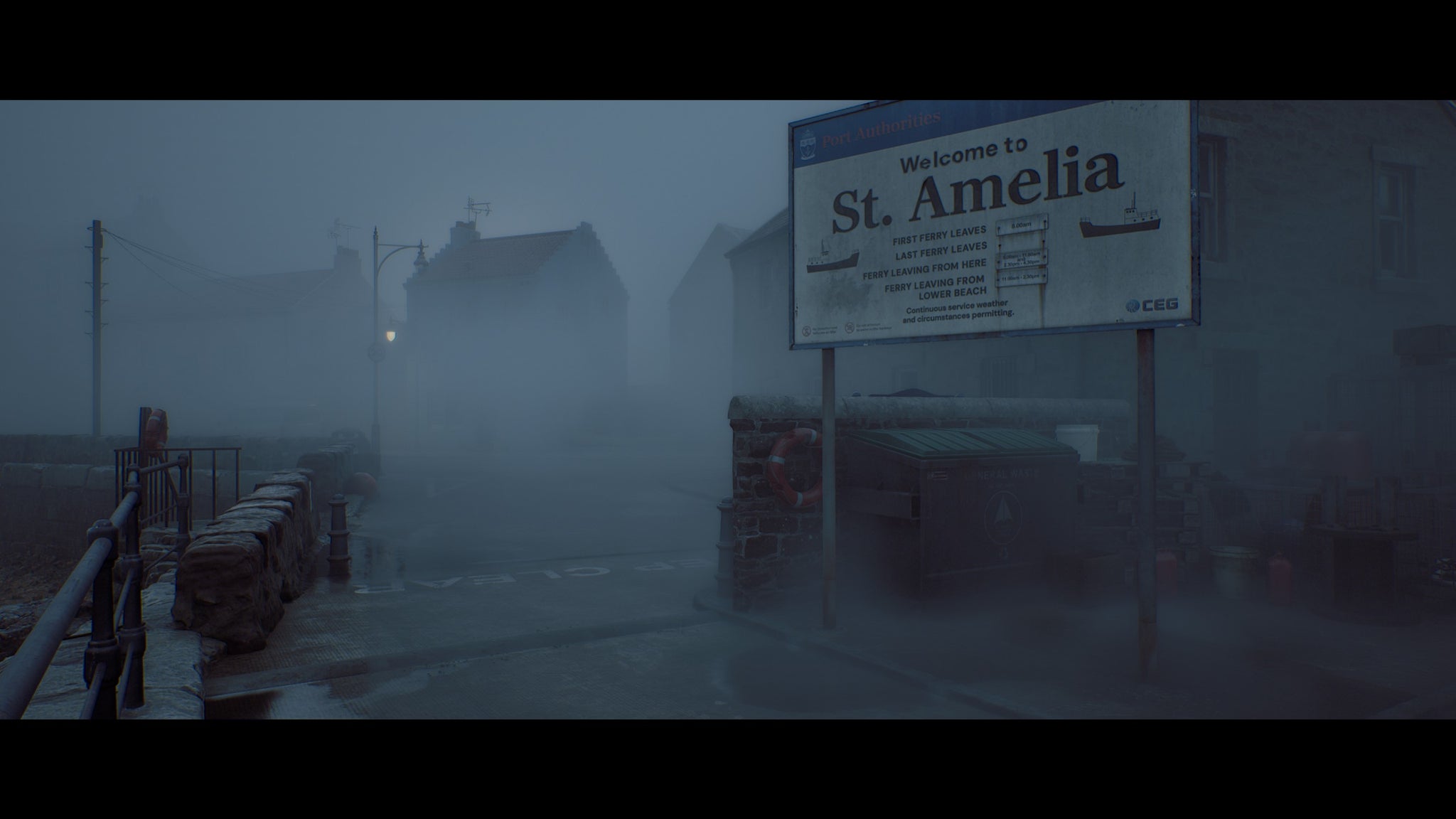
Geographically, of course, this is yet another kind of Silent Hill. Scottish indie developer Screen Burn, which created the acclaimed Observation and Stories Untold, shifts the fog again: this time to 1996 and St. Amelia; a small Scottish town on a remote island in the North Sea. And it’s an exquisitely realised space, sharing the kind of slavish verisimilitude that made The Chinese Room’s Everybody’s Gone to the Rapture (a game Townfall shares a certain ambient kinship with) such a deeply transporting creation.
From the moment our confused protagonist Simon Cordell hefts himself out of the water beneath bleak Scottish skies – IV bag mysteriously taped to his shoulder, drip tube snaking into his hand – you can practically taste the sea salt in the air and feel the chill damp seeping into your bones. St. Amelia is a world of such convincing detail – the very British street signs, the blinking crossing lights, the cheery bunting, the local noticeboard ads – that it’s engulfing even before you’ve stepped away from its weather-battered seafront into its cobbled market square.
Here, quaintly decorated shops – the local post office, a newsagent, a video store – jostle cosily along narrow streets, and it’d all look wonderfully picturesque if it wasn’t for the rows of ‘for sale’ signs and ‘closed for business’ notices suggesting the decay had started even before the fog set in. And slowly, the world expands outward – toward pebbledashed terraced houses and blocks of flats, toward tatty pubs with gloomy beer gardens, and roadside cafes. Later, modernity encroaches with a shift to stark 70s brutalism, and as trite as it might be to say, St. Amelia really is as much a character as anything else in Townfall.
It’s fascinating, too, watching Screen Burn reinterpret Silent Hill’s iconography through a different cultural lens: gleaming white hospitals become cramped NHS wards, spacious malls now stark concrete shopping precincts. This world of fading industry and fractured community is a familiar one, albeit shattered – as we learn early on – by awful tragedy. Townfall’s horrors aren’t solely phantasmagorical, and Screen Burn infuses its tale with a quiet sort of rage as it grapples with themes of corporate colonisation and worker exploitation (here, the nurse isn’t a shambling cleavage monster but a traumatised key worker reeling from the horrific death toll). It’s social realism as a grounding force for the horror, and a powerful emotional throughline.
As for Simon, I suspect most people will clock his role in all of this even before the prologue is over. Which is fine. This isn’t a game whose story – told with surprising directness for a series that traditionally delights in obfuscation – is particularly concerned with big twists. Rather it invokes Silent Hill’s established narrative systems to explore ideas of interconnected grief and guilt (and there are some intriguing implications here for lore fans too).
Which probably all sounds very lofty. But Screen Burn, once Townfall’s patient first chapter is over, absolutely does not skimp on the suffocating horror. That starts with its shift to first-person (technically Silent Hill 4 got there first, but only in its hubworld). It’s a more limiting, vulnerable perspective compared to the series’ usual third-person camera, and, combined with a focus on slow-paced, violence-avoidant stealth, makes for sometimes unbearable tension.
Combat isn’t absent in Townfall but it’s limited, mostly consisting of clumsy blocks and wild melee swings. And creatures – tumorous things with axe-like heads or grasping syringes that burst from puckered wounds – hit hard and pursue aggressively, making direct confrontation risky too. Even when a revolver is added to your arsenal later on, providing significantly more stopping power than the deteriorating wooden planks you’ll be brandishing most of the time, it’s got the kind of reload speed you could boil an egg by. It’ll also draw the attention of every creature in a wide radius – and fights against multiple enemies rarely end well. So while brute force is possible, survival undoubtedly favours those with low squats and soft footfalls.
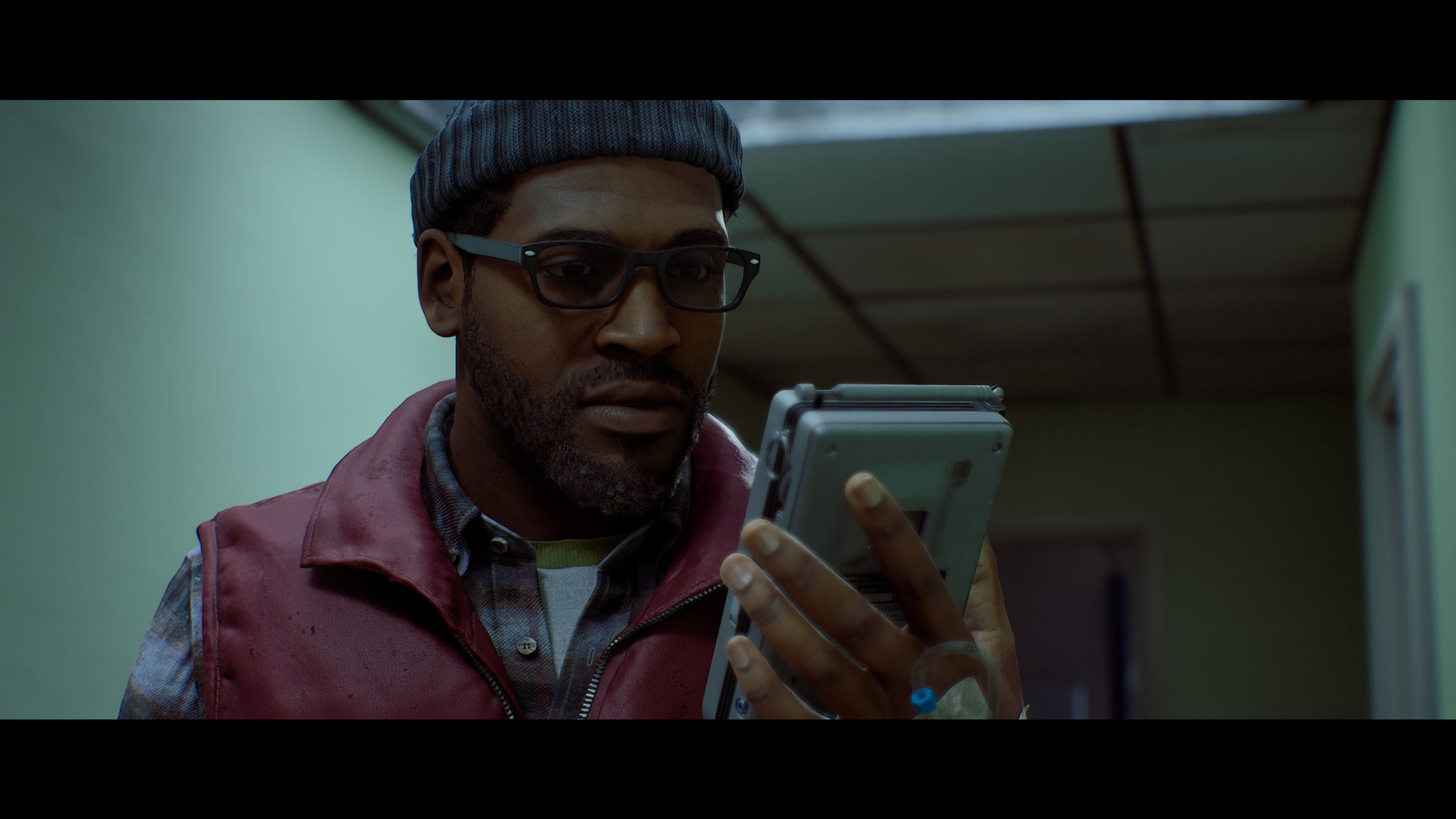
Enter your CRTV. Part Game Boy, part tiny portable television, it’s a neat twist on Silent Hill’s classic radio static early warning system. Move into an enemy infested area and you’ll be greeted by a quick hiss of static, signifying that new signals have been added to its dial. Each represents a single patrolling creature, and once you’ve locked onto their signal, their isolated silhouette appears in the screen’s roiling red static, but with no other visual clues.
This creates an unusual dynamic where you’re often aware of distant enemies and their movements well before you’ve any sense of the area they’re patrolling, and the resulting rhythm reminded me a little of original Silent Hill designer Keiichiro Toyama’s cult classic horror game Siren. In that game, you’d arrive at a new perimeter, then, by peeking through the eyes of the monsters in the area, slowly build a fragmentary picture of the gauntlet to come. Townfall isn’t quite the same, but the end result is similarly stressful in its deliberate withholding, forcing you to push forward with only a tentative grasp of the layout ahead and a rudimentary best-guess plan. You’re not totally helpless, though: aside from that last-gasp revolver, you can arm yourself with rocks and bottles to stun enemies or draw them away from their patrols. And, alongside your supply of healing items, Simon’s IV drip, if filled, can buy you a useful revive.
Simon, I should note, is a bit of an odd protagonist; something of a cipher in his own story, which makes him slightly dull company early on. But Townfall is a game about shifting perspective in other ways too. What, it seems to ask, about those other faces in the fog; those unwitting players in the protagonist’s story? I’ve ummed and ahhed over how much to reveal here, but given the shift happens early, I’ll just say this: Simon isn’t the only playable character in Townfall. This allows for added narrative richness as events unfold through different eyes, but it also creates a natural way for Screen Burn to build tension by subverting its own rules.
Whenever Simon isn’t in the picture, for instance, neither is the CRTV. Suddenly, your safety net is gone, forcing a more intimate form of stealth that pushes you deeper, more precariously, into enemy territory and increases your reliance on environmental cues: peeking around corners, listening for sounds, or watching for flickering streetlights as a creature passes below. Townfall’s often expansive maps require constant adaptation too, as criss-crossing objectives pull you from claustrophobic corners to exposed spaces and back again. And invariably, just as you’re settling into this newer rhythm, it’s all-change once more.
There’s a long sequence as Townfall enters its latter stretch that makes the Silent Hill 2 remake’s prison level feel like a breezy afternoon stroll as it smothers the world in corpses, setting a grim game of spot-the-difference in motion as it repeatedly sends you back and forth across this awful, twitching minefield. It’s unrelentingly intense – almost unbearably so – but then Townfall reinvents itself again; teasing a sudden shift into power fantasy then immediately dashing hopes in a prolonged sequence of jumpscare hide-and-seek in near darkness.

Each new chapter brings its own ambient flavour too. At one point, daylight suddenly turns to night like a flicked lightswitch, yellow streetlamps giving the fog a queasy glow. The rust of Silent Hill’s hellish otherworld is reimagined as a maze of stark concrete, artfully lit in shades of transfusion red and ambulance blue. Sometimes St. Amelia’s skies turn crimson, recasting the town in striking silhouette as impossibly vast tangles of industrial pipes rend the once-familiar world. And while composer Akira Yamaoka soundscapes are as much a part of the series’ distinctive ambience as its suffocating fog, Townfall sees composer Anthony Scott Burns makes a stellar series debut; capturing the texture of Yamaoka’s music – the melancholy synths, the industrial cacophony – but with a beauty and violence of its own.
If Townfall stumbles, it’s in its broader rhythms. Silent Hill’s classic fogworld-otherworld shifts aren’t just an aesthetic device, they’re a vital pressure valve too, deflating high-anxiety states with quieter restorative lulls. But once its melancholy opening act is over, Townfall roars into high gear and pretty much stays there. Screen Burn clearly isn’t oblivious to horror’s critical ebb and flow, and it breaks up the stealth with some grimly inventive puzzles (one clever bit has faint echoes of the text-adventure-inspired Stories Untold, another sees a house shifting back and forth in time, which the studio uses – as it so often does – as an opportunity for subtle environmental storytelling). But Townfall’s refusal to settle for long means that respite is brief, as you’re invariably dragged through more enemy encounters on the way to a solution.
It is, perhaps, just a little too relentless, too keen to keep players held in wearying states of prolonged emotional extremes across its 15-or-so hour runtime. And without a true release, the tension steadily deflates; the already slightly too lengthy chapters increasingly outstaying their welcome. That’s particularly true of a slightly fumbled closing chapter, set in easily the game’s most blandly realised location. It unfortunately compounds some of Townfall’s more irritating ticks – excessive backtracking through fussy enemy encounters, occasionally obtuse puzzle design – making them harder to overlook, and drags it all out interminably at a point the story needs momentum. Thankfully, Townfall finds its footing again in time for the resolution, with a denouement (one of five possible endings) that’s at once fitting for this idiosyncratic tale and very Silent Hill – even if it does feel like Screen Burn has, by then, made its point and then some.
Silent Hill: Townfall is, though, an often phenomenal ride; reverent to its roots, rich with ideas, and yes, properly unnerving too. And there is, I think, some pleasing symmetry in the fact the two grandaddies of the survival horror genre – Resident Evil and Silent Hill – have bookended the year with their own distinctive highs; one with a warm eye to the past, the other taking bolder, more experimental strides. Silent Hill has, from near-death, blossomed into something unexpected. Under the watch of Konami – itself undergoing a bit of a revival – and in the hands of talented studios with their own distinct sensibilities, it has, I think, transformed into one of gaming’s most fascinating series. And long may its big creative swings continue.
A copy of Silent Hill: Townfall was provided for this review by Konami.


