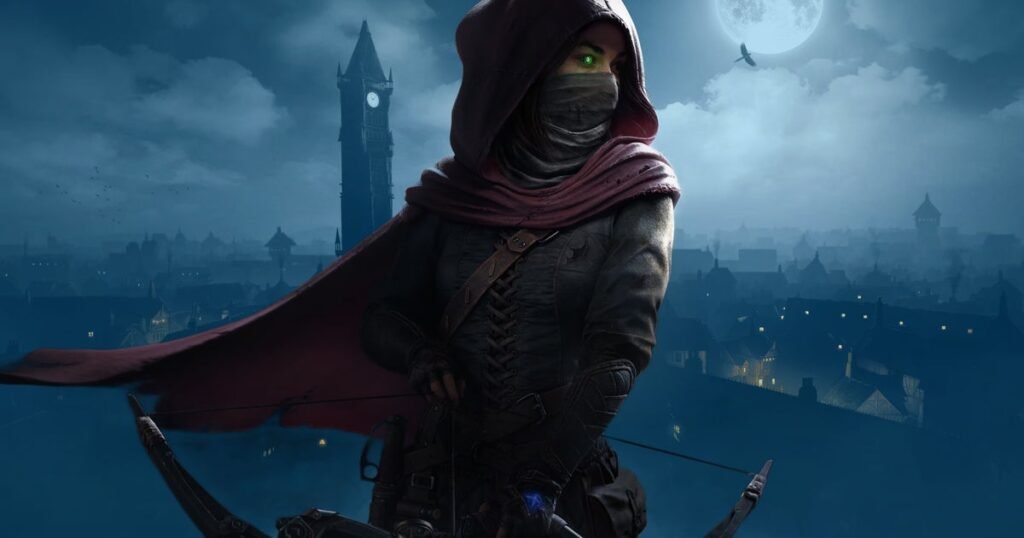
There’s something very satisfying about crouch-walking up to an oblivious guard and whacking him once on the back of the legs with a blackjack so he drops down onto his knees, and then hitting him once more on the back of his head to knock him out. This seems to be the best tactic for quietly silencing a problem that could potentially see you and then stab you in Thief VR: Legacy of Shadow but, like all good sandbox games, it’s by far your only option.
During the first couple of levels I’ve been able to avoid contact with stationary or patrolling guards by using cover and shadows to my advantage, a tactic which stealth purists would undoubtedly prefer. I’ve been able to knock out guards from afar using special ‘blunt’ arrows or outright kill them with pointy ones, and I’ve also been able to find hidden alternate routes that bypass threats entirely. Or, thanks to a rare bout of over-confidence, I’ve biffed my approach completely and received a sword to the spine as I tried to beat a hasty retreat.

This type of methodical, exploratory and emergent gameplay really shines in Thief VR. While I’ve always considered horror to be the genre that best fits virtual reality, games like Thief VR prove that stealth comes very close indeed. This is mainly due to the more measured way that you approach the levels, which leaves you with more time to be immersed in your environment. Waiting in the shadows for a guard to pass, for example, gives you drink in the atmosphere, be it flickering lights on a wall catching a pursuer’s shadow, or some muffled dialogue from nearby NPCs that adds a bit of lore and colour to the world as you skulk around.
That feeling that you’re really ‘there’ is only enhanced by the fact that you have to crane your IRL neck to look out onto the streets as you poke your head up from a sewer grate. You have to physically lean your body to peek around corners as you’re crawling around in the shadows and any weapon you use, be it the bonce bonking blackjack or a bow and arrow, has to be swung or pulled by your actual arms. These are all things you can do in an immersive flat-screen game with a controller, sure, but without that added physicality and the 6DoF views afforded by the VR helmet, you’re basically looking through a window into another world, all while pressing a series of buttons as you sit back with a tube of Doritos balanced precariously on your tummy.

The three small sandbox levels I’ve played so far aren’t the most intricate, especially when compared to the original Thief, but Legacy of Shadow’s gameplay does feel like an authentic addition to the series, especially with the welcome return of Stephen Russell as the voice of Garrett. There’s actually a strong Dishonored vibe to the gameplay too, which is quite cool if you’ve ever dreamt of playing those games in VR, and there’s a lot of fun to be had in chasing every little trinket stashed around each level – especially those that are located near the watchful eye of a guard or two. Physically reaching up to yoink a golden chalice from underneath someone’s nose and then quickly scuttling off again before they spot you is both thrilling and almost comical in its mischievousness.
All this immersion is helped by some lovely, moody visuals too. I’ve been playing on PSVR 2 and, thanks to some busy set design, both The City and the two stately manors that I’ve been tea leafing my way through have felt both lived in and realistic, despite the semi cel-shaded art style. The intro level set in The City is especially pretty with its tall, higgledy piggledy wood beamed buildings and dank sewers all lit by moonlight, candlelight and flames from furnaces. The darkness and shadows make great use of the headset’s HDR capabilities too and I didn’t spot any massively noticeable mura effects from the PSVR 2’s OLEDs which is something that can often completely ruin a game that’s set in constant darkness (hello to Metro Awakening VR, especially).

| Image credit: Vertigo Games
Thief VR isn’t a perfect stealth game though, the enemy AI is fairly basic and easy to predict and there don’t seem to be as many alternate routes around its levels as I’d like there to be. This is especially true on the first level which seems fairly linear, but I’ll cut that one some slack as it’s basically a tutorial level. The VR implementation is great, too, with lots of things to pick up and throw, accurate climbing, simple but satisfying lockpicking mechanics and a couple of minor environmental puzzles to solve per level too. It’s a shame then that Magpie, the player character, only consists of a pair of floating hands rather than a full body. It’s not exactly game-breaking but those that demand maximum immersion with their VR will no doubt be disappointed by the lack of a full body rig.
Judging by the trophy cases in the game’s Clock Tower hub area, Thief VR: Legacy of Shadow will probably be fairly brief and I’ve heard from other players that earlier levels are also reused later on in the game, which is pretty disappointing if true. That being said, some things can be both short and sweet, and my first couple of hours in Thief VR have so far been exactly that. It’s not as polished or immersive as the other VR game with ‘shadow’ in its title, Batman Arkham Shadow, which is basically the gold standard for VR at the moment. Nevertheless, Legacy of Shadow feels like something I could easily recommend to fellow helmet heads who are looking for a nice, solid, narrative led adventure with a world that’s easy to be absorbed by, even if it won’t steal away a lot of your time.