If there’s one thing I had to tell you about the expectations I held for adult life when I was eleven, I could probably boil it down to a single word: henchmen.
Back then, I assumed that adult life would be all about fighting henchmen. I thought they would be my number one problem, and my first weary thought when I awoke in the morning as a grown-up.
And I was not alone in thinking this. When I was eleven, I went from primary school to secondary school, and a lot of the people in my class were similarly worried about henchmen. Some of my classmates tried to hack together their own martial art to give them an edge in bar brawls. One of my friends took to carrying a spanner to school in case he needed something heavy to hand for dishing out justice. Alas, it fell out of his bag once when he was scrabbling for his homework in RE, and he was “Spanner” for the next seven years of his life. (Even as I type this I’m aware that it sounds very much like I’m writing about my own specific experience from a false distance. In truth, I was so far down the hierarchy I could only wish I had a cool nickname like “Spanner”.)
There were two main reasons for all this worrying about henchmen. The first is that I had just gone up to big school, so was now significantly smaller than everyone else in my social world. It was terrifying! And being born in June just made me smaller still. Some of my own year towered above me.
And then there was what nobody at the time referred to as the media landscape. Henchmen were a big deal in media in 1989. There had been an Indiana Jones film that year, sure, but the summer belonged to Batman, and Batman wasn’t looking for treasure. He was out to fight henchmen. He fought henchmen in the movies and he fought them in the American comics that were suddenly easier to come by.
But most of the henchmen lived in cyberspace, behind the curved, smoked glass of the monitors down at Computer Planet in town. Computer Planet was not actually called Computer Planet, but I feel the need to employ a kind of nominative witness protection scheme for it. (Probably because of all the henchmen.) Computer Planet was where everyone in our school ran to at 3:30pm – it was a good mile and a half away, so not bad for cardio. We ran there to pay 50p or whatever it was for half an hour on one of the computers along with a rented game.
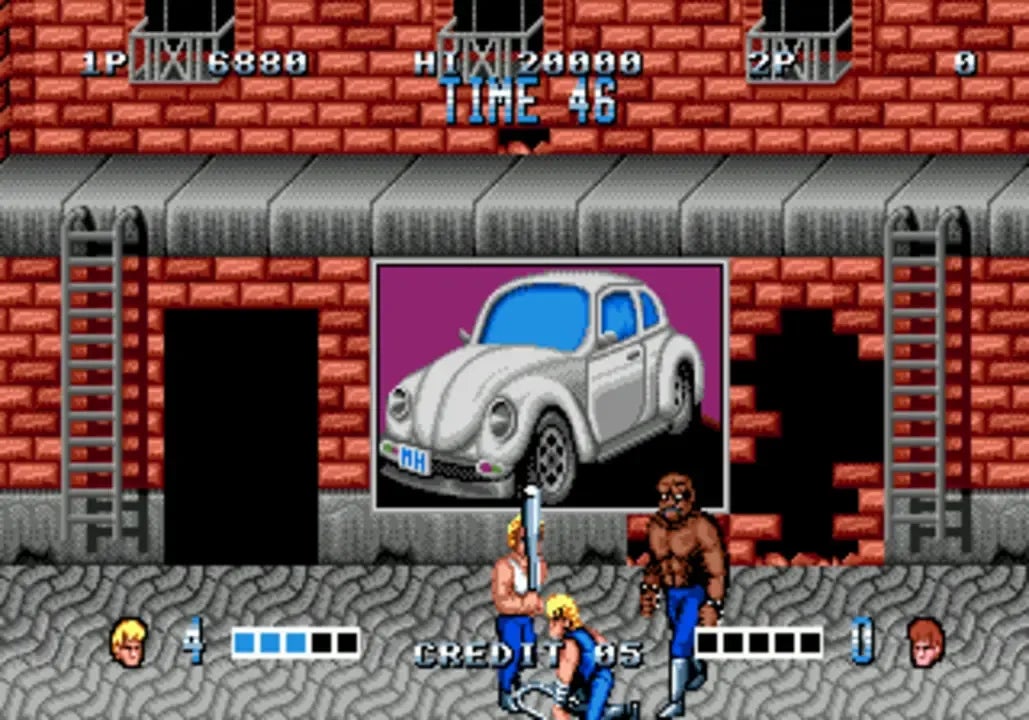
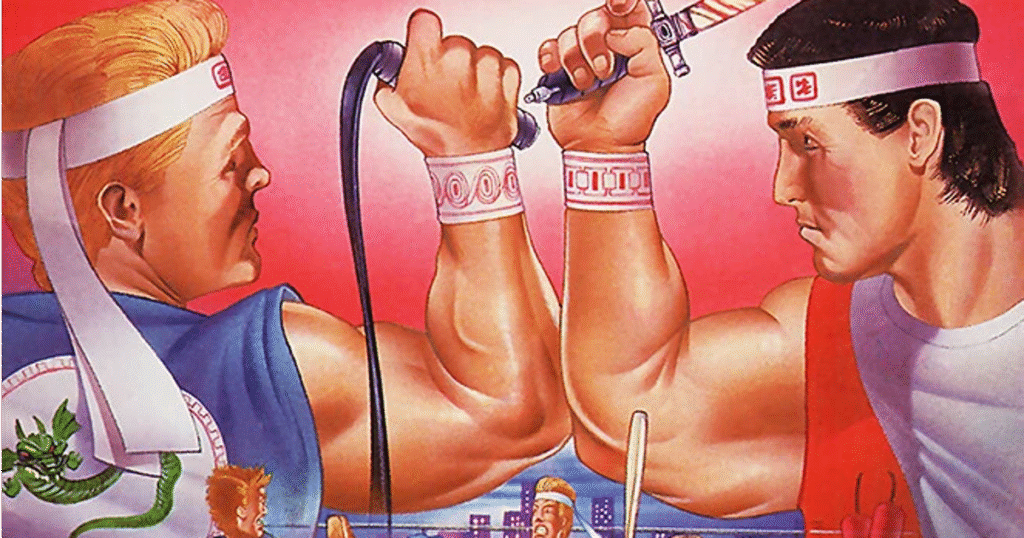
The game of choice was Double Dragon. It was a two-player co-op beat-em-up, and when I heard today that its creator, Yoshihisa Kishimoto, has just died aged 64, I felt a sudden pain that I now recognise as heartache. Double Dragon isn’t my favourite game – I haven’t played it in years – and I can’t pretend to know anything about the traditions or ideas it drew upon in its design. But when I was eleven, thousands of miles from Japan, it was briefly THE game. The only game. It was the only game that counted.
And this is because it was all henchmen, all the time. It was a strictly henchmen only affair. No broken bottle? No threatening chain held glinting in the giant fist? No service. It held us all rapt. And it kept Computer Planet in business.
Its appeal was very simple. After years of playing games about cavemen who rode stone unicycles or hungover millionaires trying to clean up their mansions, here was a game from the modern urban world. I think we thought it was a kind of realism. I see it in my mind now and it’s alleyways, railyards, the patchy unclaimed territory that lurks behind a really good biker bar. And the objective is simple: kill all the henchmen.
Like Batman, nobody is hunting for biblical treasure in Double Dragon. At least I don’t think they are – we were always iffy on the plot, and just assumed that someone important had been kidnapped. So our mission was to walk around, slowly making progress down whatever alleyway or railyard we were in, and punch everyone we came across.

If there were combos, I can’t remember them. What I can remember is that people flashed on and off when they were finally downed, and that the throng of henchmen kind of wandered back and forth before attacking as if they were caught in a very small whirlpool. They would cover small, highly personal territories, these henchmen, with their pixel fists raised and their badass leather outfits glinting in the 8-bit sun.
All of which was wonderfully simple and effective when it came to maintaining a hold on the 11-year-old imagination. When we weren’t playing Double Dragon at Computer Planet we were running there to try and get a free seat. Or we were writing elaborate Choose Your Own Adventures about Double Dragon in stolen exercise books. I say Choose Your Own Adventure, but any adventure you were likely to have had been chosen for you by the nobly over-confident author well in advance and little deviation was allowed. Turn to page 9: “You hear a barrel tip over in the darkness. Henchmen appear!!!” Over on page 17: “As the chopper takes off, it drops shadowy forms from those bits underneath helicopters: henchmen suddenly surround you!!!” All henchmen all the time. Grab the dice to fight them. (And maybe a nearby spanner.)
None of which is to make fun of Double Dragon even a little bit. It was the perfect work for its audience and its age, and looking back I cherish its memory as much as the memory of a Friday night trip to Blockbuster, where one might rent the kinds of films that played out a bit like Double Dragon too, but were never quite as good. I look back at it all now and I can remember the passion I felt for all this stuff – and the delight I felt that all my friends were similarly swept up in it too. School was suddenly scary. Cinema heroes were suddenly troubled and gothic. And Double Dragon was there to make sure we made it through in one piece.
Thank you, Yoshihisa Kishimoto.