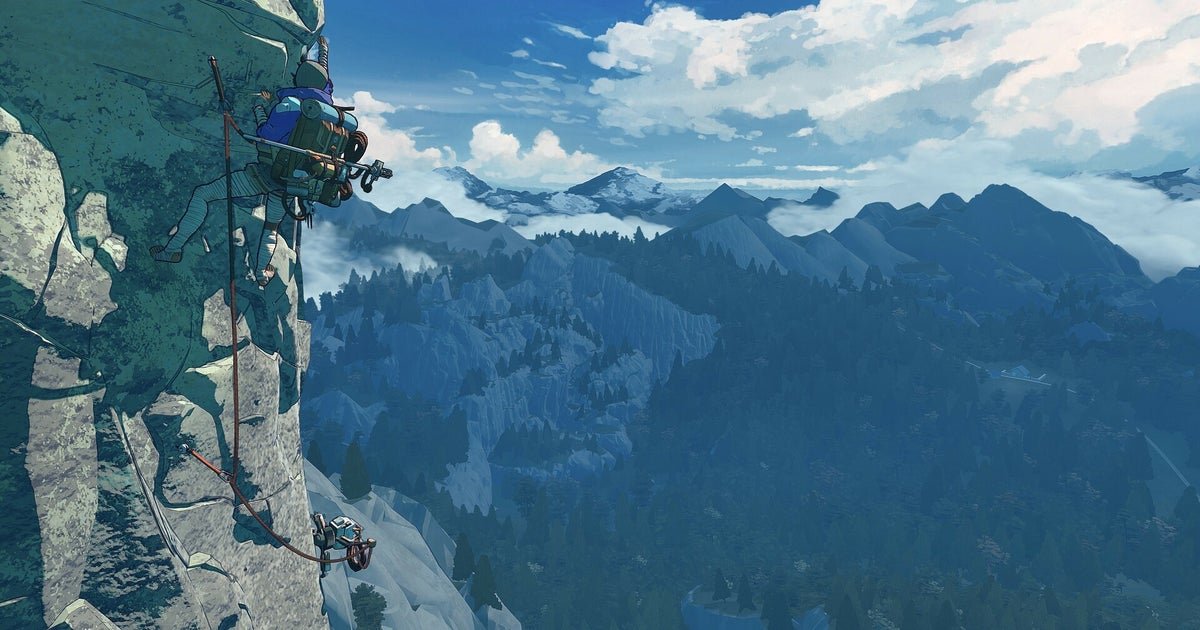
As I type, Cairn protagonist Aava is squished awkwardly against a rock, hands twisted back into cracks, legs shoved into improbable spaces. I’ve been inching my way up this particular cliff face for some time; carefully scrutinising its contours and surveying the possible paths ahead in the desperate hope I’m not heading toward some insurmountable impasse. It’s slow, stressful, and surprisingly exhausting. But I also know the moment I finally drag myself up onto the nearing precipice – when the craggy rock surface I’ve been staring at for the past half hour suddenly explodes out into another stunning vista and I can finally exhale – it’ll all be worth it.
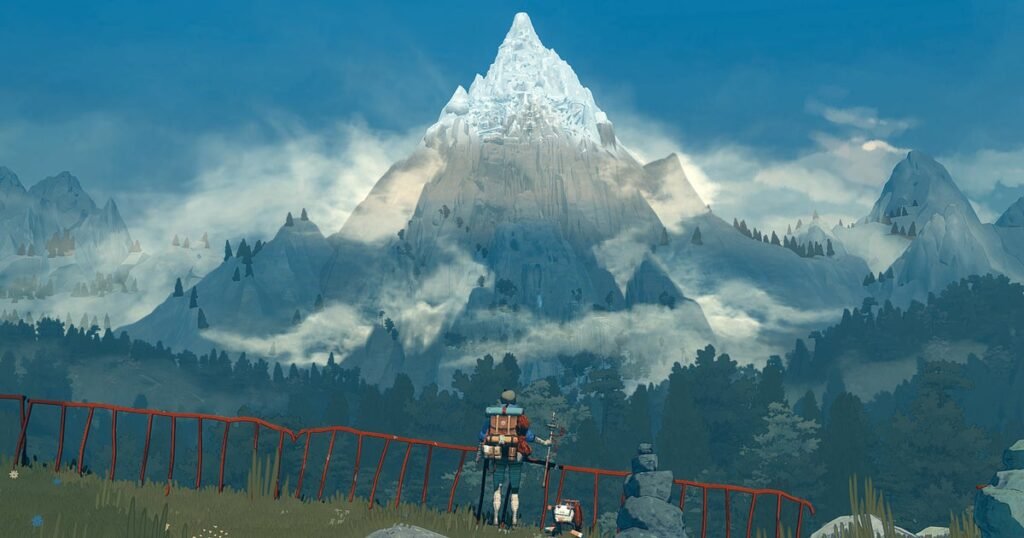
Plenty of games – from Resident Evil, with its steadily mounting anxiety, to the gut-gripping tension of Dark Souls – know the power of a well-placed pause. It’s a chance for release and a reset before the cycle begins anew, and a space to inhabit with contrast – elation, triumph, relief – creating a richer emotional experience overall. But there’s something about the way Cairn deploys its pauses, works them into its very soul, that’s particularly tickling my brain. It helps, of course, that Cairn is beautiful; a seamless world of meticulously framed vistas and dizzyingly vertiginous drops, presented in an art style reminiscent of a Moebius comic strip. Here, aside from the occasional sprinkling of gorgeous synthpop, the only sounds are of nature; of wind sweeping across grassy plateaus and waters spilling to unseen depths, all as the blush of dawn slowly slides into a star-swirled night.
Amid it all is Aava, a professional climber who – for reasons you soon suspect might be a little more personal than ‘because it’s there’ – is about to begin her ascent of the perilous Mount Kami. There’s a wisp of story here, as the friends and lovers she’s left back home call in from time to time (Cairn’s beautifully naturalistic voice acting is a real boon), and there’s a broader sense of intrigue as developer The Game Bakers (Furi, Haven) seeds the faintest sense of near-future calamity across its landscape and hints at something deadlier than the elements on Kami. And it combines to create an unusual hybrid of climbing, exploration, and survival.
Kami is vast; a seemingly endless wilderness of jagged rocks, buffeting winds, driving rain, and other natural forces you’ll need to adapt to and overcome. The Game Bakers calls Cairn a “realistic climbing simulation” and, to a degree, that’s fair. You’ll scrutinise rock formations, identifying the routes most likely to support your balance and weight as you ascend each cliff face; you’ll manage your stamina and gamble your limited pitons when the risk of falling feels too great. And as days turn to nights, you’ll need to be diligent about maintaining your health, hunger, thirst, and warmth in order to survive the deleterious effects of the terrain.

You’ll pick herbs and swig water from natural springs; you’ll find supplies by raiding bear boxes and abandoned vending machines; you’ll gather hints and terrain maps from occasional corpses; and whenever the opportunity to set up camp arises, you can save, cook, or rest until the weather turns more favourable again (and if all this is making you anxious, different difficulty options enable you to dial up or down the survival).
So far so sim-like, but Cairn’s climbing – built around a QWOP-like system of individual limb movement that frequently leaves Aava contorting impossibly; arms twisted, legs over ears, bum in the air – does rather undermine its sense of realism. And honestly, the jury’s still out on Cairn’s climbing as far as I’m concerned. Each new plateau presents a fresh rock face to parse, seeking out routes of varying difficulties, after which you can start your careful ascent, inching upward limb by limb. You’ll place a hand securely into a crack, pull up a leg and jam it against a protrusion. That might give you enough reach to grasp a distant overhang, to shift your weight ready to start the cycle over again. This way, climbing becomes a series of small, interesting choices, driven by observation, intuition, and – occassionally – blind hope.

And when it works, there’s an enormously satisfying rhythm to it all, as you scurry spider-like across each rock face, slowly building momentum. But often, too, Cairn feels like it’s fighting against you, and the result can be frustrating. Chiefly that’s down to its automatic limb selection, which chooses the limb you’re able to move next based on factors including weight distribution. It’s supposed to be helpful but frequently feels unintuitive and unpredictable in a way that can make forward planning difficult. There’s a manual selection option, but it’s slow and fussy, and the whole thing – particularly when tight paths cause Aava’s limbs to be obscured by her body – can be infuriating in situations where rapid readjustment is required.
Quite often, I’ve found myself absolutely despising Cairn, exhausted by forces that seem resistant to control, but then the wilderness momentarily relents, bringing an enormous sense of reward. As you might imagine, all this makes for an intensely fraught climb, but somehow this works in a game about unwavering determination, about facing impossible odds on the path toward a seemingly insurmountable goal. And Cairn absolutely understands the healing power of a pause. As I make a final desperate scramble to the precipice above and pull myself onto my solid ground once more, the frustration gives way to triumph, and all is forgiven as the red mist dissipates amid the gentle winds and endless beauty of Mount Kami. And soon I’m ready to start over, to continue my impossible ascent; leg over my head, bum in the air.