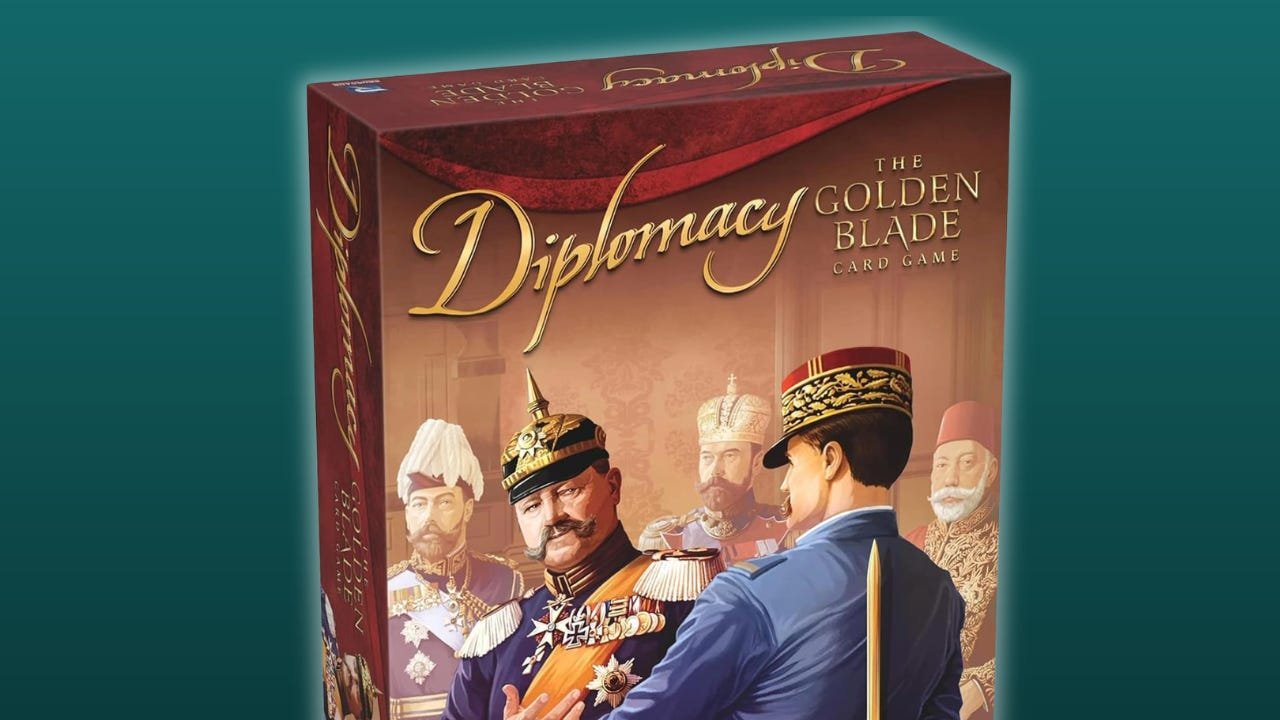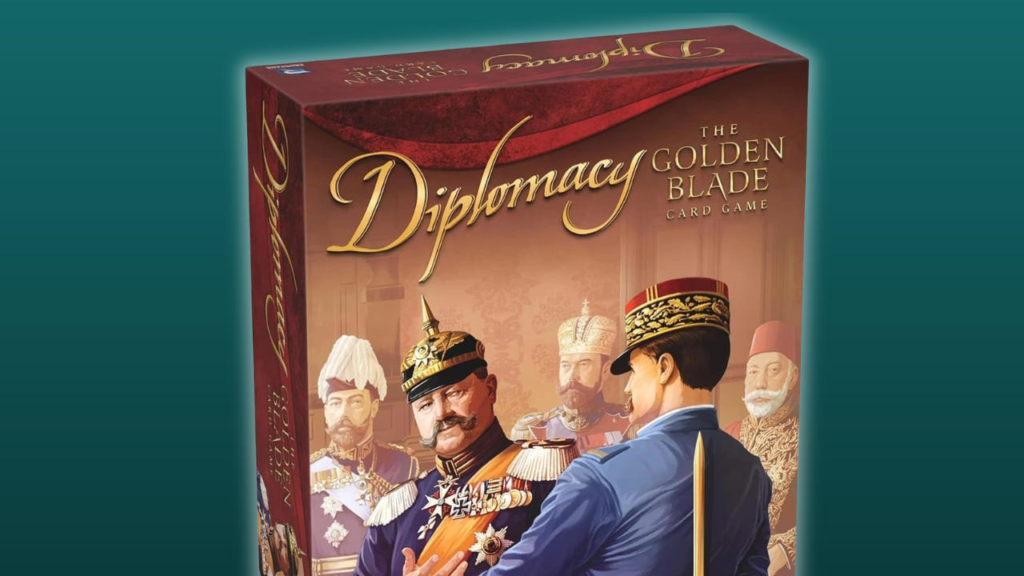
There are few more storied titles in the annals of board gaming than Allan B. Calhamer’s Diplomacy. Reputedly the favorite game of John F. Kennedy and Henry Kissinger, it sees players taking control of one of the great powers of Europe on a map of the continent and fighting it out for military supremacy. Its genius is a 1:1 combat system where pieces simply eliminate other pieces, making it impossible to gain an edge over rivals without an alliance. And it’s in these negotiations and inevitable betrayals that the thrill of the game lies.

Diplomacy: The Golden Blade
0
The trouble with Diplomacy is that it runs long: with the optimal full complement of seven players, it can easily take up most of a day. Diplomacy: The Golden Blade makes the unlikely claim of retaining all the stab-in-the-dark charm of the original while cutting out the board and slashing the play time to around 15 minutes per player.
What’s in the Box

Without a board or unit pieces, there’s not a lot to talk about in terms of the box contents. Most of the components are cards, in two different sizes. The smaller ones are unit cards, representing your military forces. The larger ones are order cards that you’ll be playing to enact your decisions against opponents and these have both a picture and a text description of the order. There’s nothing special about the cards, artwork or icons, everything is clear and functional.
More curious of all are a series of punch-out cardboard tags that you use to delineate three rows and seven columns for your play area into which you place your unit cards. They show you what “level” you’ve reached in each row as you fill it with cards. These are fiddly, easily moved during play and, strictly speaking, unnecessary, although they do help all the players read the game state at a glance rather than card-counting.
Rules and How It Plays
Each player has a grid outlined by cardboard markers into which they play units cards from their hand. There’s a row for each of the three unit types: army, political and navy. One or two cards gives you level 1 in that unit type, three to six cards gives you level 2 and seven wins you the game. Most turns you’ll only get to play one card into your grid, although the randomly drawn selection in your hand may mean you can’t always play what you want.
However, this being diplomacy, these cards are tangential to the meat of the play, which is order cards. Every player gets an identical set of 12 of these, from which they’ll secretly select two each turn, one for each neighboring player. There are four kinds, one matching each type of unit which you can only choose if you have an equal or higher level in that unit type than that neighbor, and a fourth, “promises”, that you can play anywhere and which generally rely on your neighbor selecting a particular card.
In a turn, you’ll start by drawing a unit card, then there’s a timed five-minute negotiation period where you can make deals with other players – none of which are binding, of course. After that you play your order cards face-down before everyone reveals them all and you go around the table, working out the impact of each pairing. Finally, everyone plays a new unit card to their grid. It’s a simple core loop, easily taught, but the complexity is in the text on the order cards themselves.
Each kind has the potential to achieve different aims. Army orders let you interfere with your target’s units, allowing you to swap cards from your hand with theirs, or even removing played units from their grid. Political cards can give you a leg-up by letting you play an extra unit card or blocking enemy orders that interfere with the cards in your hand. Your naval choices include drawing extra cards, or blocking the most powerful army and political orders. This, then, is a cunningly varied game of rock, paper, scissors in which you get the chance to persuade your foes of your intentions, honorable or otherwise, before selecting an option.
However, it’s the promise cards that really give the game its flavor. Two of them, coalition and accord, give both players vital benefits if they both select a matching card. The former lets you block the order of your other neighbor, while the latter gives you two extra unit cards to draw. Alliance, on the other hand, allows that neighbor to resolve their chosen order against your other neighbor, and it can never be blocked. Critically the card says “may” … so it leaves you very vulnerable to a sudden stab in the back.
Because you can’t play orders on an opponent unless you match or exceed their level in the matching unit type, players are caught between wanting to try and race towards the seven units needed to win and diversifying to protect themselves. Sometimes that decision is made for you by a lack of unit cards of the desired type, others by what your neighbors are choosing to collect. Either way, picking what to play each turn can be made part of both your ongoing strategy and your ongoing negotiations, bluffing about what you’re holding and might choose to play.
This network of options is, frankly, brilliant. Although it’s initially overwhelming, when you understand the effects of each card you’ll see how they interlock to create a framework of delineated decisions that feel like the free form of maneuvering and fighting in a map. Just like full-fat Diplomacy you can make and break alliances, broker deals, lie, cheat, and backstab to your heart’s content. And because your unit cards are visible to everyone, also just like classic Diplomacy, you’ll certainly have to betray one or both of your neighbors in order to win, because once you reach five or six units cards in a row, everyone will band together to stop you.
So it’s kind of a shame that, while you can still do all the things that drive the original game in this slimmed-down version, it turns out that the real draw of that game is in the cream that’s been lost.
It turns out that racing to seven cards simply isn’t enough time to establish the interpersonal relationships with the other players to really make it feel worthwhile. And it doesn’t matter if your opponents are friends or strangers: you still need time to build up a sense of trust, or develop a really festering feud, within the context of a single game. Without that, the inevitable twists of the knife just aren’t as painful, or as satisfying. Often, in games, the epic feel that players long for can only be delivered by devoting epic amounts of play time to deliver it.
Also, because the game is so short, and there’s a tendency for some players to race ahead in their favored unit type, it’s often a good idea to start getting those stabs in early. Accord is powerful if you pull it off because a bigger selection of cards means it’s more likely you’ll have what you need to push towards your goal. And everyone knows it, so you tend to get a round or two of that before such niceties give way to brutal warfare. Things pick up again towards the end of the game where alliance cards, suggested in the spirit of stopping the leader from getting over the line, can be exploited to give the betrayer a quick leg-up, but backstabbing is so commonplace at this point that it’s rarely the surprise it should be.