Maybe the best way to understand the kind of game Dawn of War 4 wants to be is through a single button. If you’re playing a campaign mission in DoW 4 and you’re not really feeling it, or you made a silly mistake right at the end and got summarily wiped by the AI, or maybe you’re in a hurry and just really curious about what happens next in the story, you have a quietly revolutionary option to hand: you can just hit the ‘skip mission’ button, and move on.
Dawn of War 4’s game director, Jan Theysen explained the thinking to me like this: “In the end, we feel it’s not that we want the player to play, necessarily, the game we envision for them. It’s more like: here is the thing you can play with, and have fun.”
That line of thought seems to permeate Dawn of War 4 in all kinds of places, and in turn makes it come across as incredibly generous. My most recent time with the game, for instance, focused on the campaign and the skirmish mode. The campaign alone is massive. It has four sub campaigns within it, one for each faction, their stories linking to form one grand narrative surrounding the planet of Kronus – returning here from the original Dawn of War’s cult favourite expansion, Dark Crusade. Any one of those four campaigns is, according to developer King Art Games, longer than the entire original Dawn of War campaign. And within each there’s at least one fork in the road, where you make a choice leading you down one of two mission paths. In other words, each campaign is really almost two campaigns in one.
The two I’ve played – right the way to completion, making that about half the total game’s campaign already – are those of the time-honoured kunnin’ Orks, and the shiny new techno-Catholics of the Adeptus Mechanicus (Admech, to the 40k nerds). To pick one example of how these can split, the Orks’ campaign initially focuses on Guzkutta – a local Kronus upstart with suitably big ambitions – and you’re given the choice of sticking with him or switching to the glorious, returning warboss Gorgutz, who may or may not need knocking off his perch. The campaign that follows mixes wonderfully chaotic infighting between the two Ork factions, with a fair bit of Admech-stomping and human-squashing on the side.
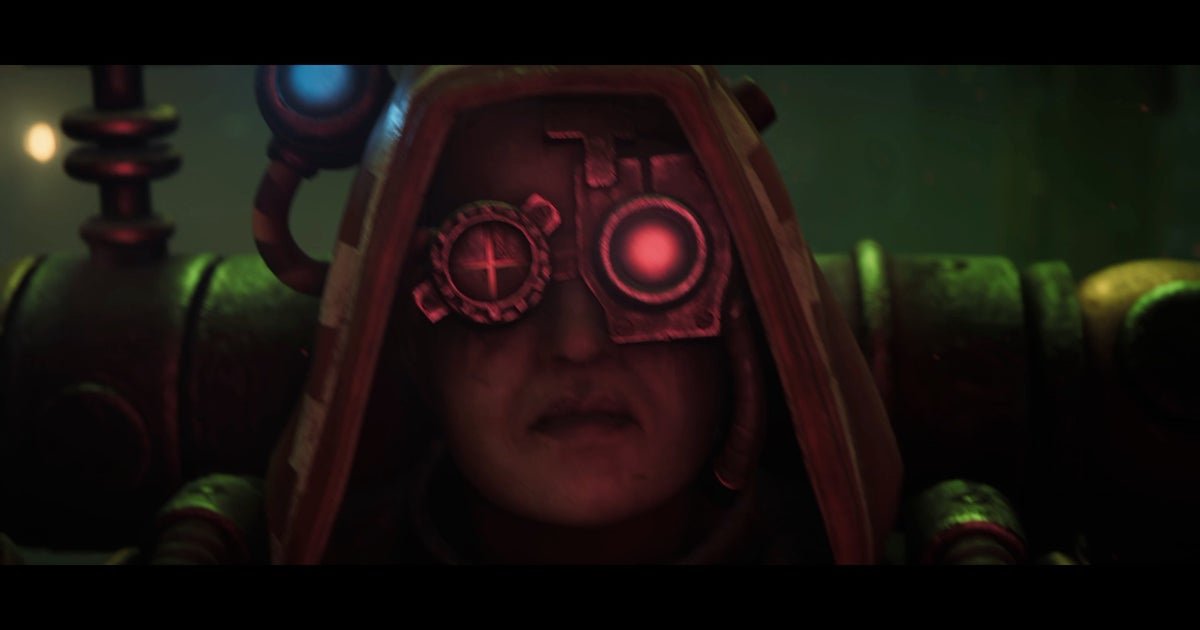
The Admech campaign is similar. Without spoiling much, you begin playing as a deeply inquisitive Potentia-Delta-9, who goes digging around in Kronus’ deserts without a sufficient remit. All that’s laced with an array of delightful 40k-isms: Mysterious voices! Betrayal! Computer spirits! Outraged officials citing revered and highly verbose bureaucratic procedure! If you’ve read any of the 40k novels (or indeed the Horus Heresy; those mysterious voices will jump out to anyone familiar with the first couple of books) then you will be well at home here. Dawn of War 4 has nabbed John French, one of the Black Library’s Horus Heresy authors, so perhaps none of this should come as a surprise.
These splits then play out smartly in the structure of missions themselves. Some might be a race, for instance, where you and your rival need to fight your way through to a final point beyond a single, powerful enemy’s base. I found one version this format especially enjoyable in the Admech campaign, when those two separate, essentially linear paths converged at one point, creating a supremely 40k type of bottleneck as three warring factions all met at once. I found success by letting my rival battle the stronger Ork faction, then darting in to pick off their main army for a major setback, then brute force my way through the remaining, slightly soften Ork horde. Then I coudl send my my newer reinforcements from my base back into that chokepoint for more stalling while what was left of my vanguard made a big push to the finish.

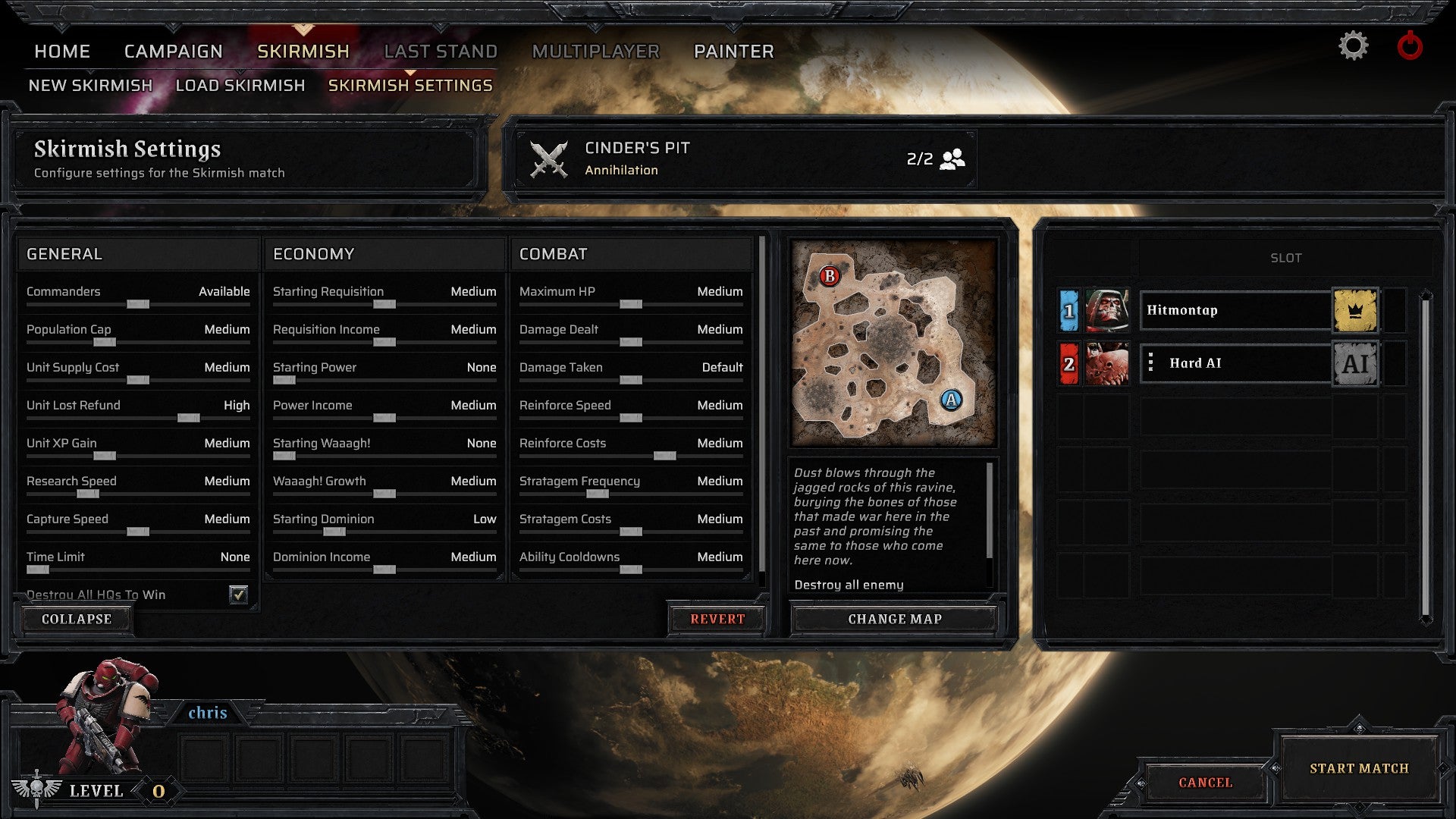
Back to the sense of generosity, meanwhile, and the other part of this comes in the skirmishes, where there’s an extraordinary amount of customisability available. You can tinker with the game’s underlying numbers to make units squishier or tankier by default, or to make research or point-capturing faster or slower. You can change income rates, reinforcement costs, cooldown times. By my count, there are nine ‘general’ settings, eight ‘economy’ ones, and eight ‘combat’ ones to play around with. You can choose from multiple commander units (or disable them or tinker with how they spawn), as well as multiple game modes. There’s the classic Annihilation and Domination (wipe out the enemy or take and hold capture points) alongside new modes called Maelstrom and Defence. These have you racing to claim one-off capturable points that drop in periodically all around the map, and, I’m going to assume… defending something (only the first two modes were playable in this preview). Then there’s the Last Stand mode, which returns here revamped from Dawn of War 2 – again unavailable in this build – and the army painter; a classic feature which I can’t talk about for now. Plus, reams of post-launch stuff to do, from free maps to new modes such as my personal beloved: the Conquest mode popularised in Dark Crusade.
Basically, by RTS launch standards it’s pretty massive. The only limiting factor is that by 40k standards, having only four factions is a little thin, given how many there are in the game’s universe. Four is perfectly standard for launch-version RTS games, but a few big 40k ones are missing here, most notably Chaos, the Astra Militarum, and the Eldar – who all featured prominently in the previous games. (The Astra Militarum are present and briefly playable in DoW 4’s prologue, and pop up here and there in other missions as blobs of unfortunate cannon fodder, so you could reasonably hope they might arrive after launch. More factions have already been promised by King Art for 2027.)That scope is mirrored, in a way, by King Art’s approach to Dawn of War 4’s mechanical side. DoW has a little bit of every Dawn of War in it – yes, even Dawn of War 3, with its huge scale, spectacle, many active abilities, and Imperial Knight-class super units, for starters – and it’s seemingly all the better for it. The sense when you play is that you’re playing Dawn of War in its ultimate form: lavish, spectacular, dark, authentic, deep, and complex – but also a little campy, playful, and inviting to newer RTS players too.

Some more of that generosity, then: there are times, particularly when Orks and Admech are involved, where the screen is quite literally full of units. An ingenious simplifying factor in these cases is the new right-click-and-drag function, whereby you can select a group of enemies to attack in the same way you’d click-and-drag to choose your own units to command. Doing so sees your selected units automatically prioritise targets amongst the opposing group you’ve chosen.
You might think that sounds like it’s oversimplifying the approach, removing the hard-earned skill of RTS veterans to micromanage, a bit like the combo shortcuts of modern fighting games. But that’s not quite right. Instead, in practice I found it means you can efficiently move huge numbers of units into battle knowing they won’t make truly irrational decisions (for the most part), and then get into micromanaging after the fact – which is where the great players will undoubtedly be separated from the good. The same goes for active abilities, of which there are quite a few in DoW 4: you can right-click on one to have that unit automatically use it when it comes off cooldown, so you know you’re not leaving anything forgotten amongst the carnage.
“We basically said: let’s give the player the option to automate a lot of things,” Theysen explained to me. “It might not be 100 percent perfect – there is still something you can do if you really want to be more optimal – but you know, it’s pretty good, right? And it’s definitely better than not using something because you’re overwhelmed.” To Theysen, “the philosophy is that as a normal player, an average player, this really helps you out. If you’re into your esports, and you’re a really high-end RTS player, then you can probably still optimise things and you [will] want to do it yourself. But you know, not everybody is about 20 clicks-per-second.”

I was curious about this – so many games with a PvP element find themselves falling into the trap of appealing to the competitive hardcore, leaving the often larger audience behind. “Basically, what we’re saying is: we do not decide if this is, you know, the next big esports title. There are a lot of people with a lot more money who tried that,” Theysen explained. The team is instead simply trying to “make sure there is no good reason why it couldn’t be … but also, this is not our goal. We are not designing the game for the top one percent. It’s more like, okay, we want a lot of people having fun with it, and we want to make sure that if people want to play it competitively, it’s possible.”The approach is the same when it comes to elements of balance – some of which, such as the reinforce function, have already become discussion points on certain subreddits. “If you balance everything for the top one percent then the game might feel wrong for the 99 percent. Because for them it’s like: why are these units so weak? Well, they are so weak because there is some sort of thing that some pro player can maybe pull off.”
On the topic of reinforcement, players can hit the reinforce button and have a squad produce a new unit after a short moment (or right-click it to have it automatically done as soon as resources are available). Theysen told me that, initially, the game didn’t have on-field reinforcements at all. It’s a returning feature from the first Dawn of War game, and quite a unique one. Later games from original developer Relic, such as Company of Heroes, saw reinforcement shift to be something only done on recalling your units to their main base. But at first it “felt a little bit weird – it’s like lore-wise, it doesn’t really make sense. And it’s also not a super typical RTS feature.”Then the team tested it just in case it was fun, “and it turned out to be really good because it’s a way to bring the metagame, or the economy, into the battles, right?” Suddenly the player has a choice between spending lots of money to reinforce mid-battle, prolonging and maybe turning the battle in your favour, or they can micromanage more closely for a more efficient result. In practice I found myself having it set to ‘on’ almost by default – but in a way that’s a conscious decision too, and a kind of crutch that I may have to ween myself off if I want to improve as a player over time. (Or, equally, something I can just leave on, so I can get on with having fun smashing my sea of Orks into Admech turrets.)

Even Dawn of War 4’s headline visual innovation is a consideration here. The combat director feature – where hordes of individual units lock onto each other in melee with bespoke fighting animations – works in such a way as to take exactly the same amount of time as if your units were fighting each other the old-fashioned RTS way, Theysen assured me. “The things that are going on below the hood and the visualisation are completely separate from each other,” he explained. “You could deactivate the whole thing and the game would still play exactly the same.” Including it is essentially a flourish: something done, as I wrote when first testing it out, simply because one of King Art’s animation specialists loved how it worked in the original and wanted to try something cool with it here.
This, and so much of Dawn of War 4’s apparent munificence, brought another question to mind. How exactly can the team – not a particularly large one, by modern development standards – manage this approach? Amongst all the talk of ballooning budgets and sustainability in games these days, here’s a fairly modest studio stacking feature on feature, promising lengthy post-release support – and, crucially, a lot of these little things are what you could fairly describe as luxuries.
Theysen put it down to a few things. The first is time: “We were very lucky,” he said, with the team having worked on the game for around five years now. “That’s a very long time.” But that was made possible by the relatively small team size, “so the burn rate – the overall budget – is not higher than for other RTS games.” The other factor is that they’ve been working with their current tech and fellow teammates for a long time, making that development more efficient. “Since we had the technology, had a lot of experience already, and had the time, we could basically say: okay, let’s try to get it right – and everybody was very supportive,” he added, citing publisher Plaion and Games Workshop’s patience.


“If you look at some RTS games in the past, and you hear they had like an 18-month development time… I would say it’s not possible to really make a great RTS game in 18 months,” he continued. “Because it’s just too complex – even if you have the technology, you discover stuff while you’re working on the game, and then you can’t follow up because whatever, you have to hit the next deadline. For us it was more like: we like the long development times. We also like long pre-productions where we can really figure out what we [want to] try and do here? And really, really experiment.”
There’s one more factor Theysen put the most emphasis on, however. “We really try hard to keep the team together. So here there are a lot of people who worked at King Art for like 15 years, or even longer, and everybody knows everybody in the team. It’s like you have a sort of shorthand, but also you really understand, well, who is good at what.” He gave an example: “Someone might not be the right person for something, and maybe if we put these two together, that’s going to be great because you know this is really something they want to work on.”
He cites the combat director again. “That was something that came from our head of animation, who was like a huge Dawn of War 1 fan, and he basically said: yeah, we can do the same thing, but we could also make it cooler; give me a couple weeks and I’ll try to figure it out. And [our] first impression, everybody was like: I don’t know how this is supposed to work. Because we have literally tens of thousands of permutations of who can fight who, right – because not only do we have almost 100 units, we also have all the different weapons and all of that stuff. But he basically said: ‘No, no, I have a plan, let me try it out.'”
The result is a feature I’ve genuinely never seen before in the genre, amongst a sea of other neat little ideas that have no doubt come from someone wanting to try something cool, and insisting they have a plan.
“It basically comes down to having the time first, but also having the confidence,” Theysen said. “And knowing the guy [so] that you say: okay, if he believes that works, it probably will, so let him try it. And I think this is really, really valuable. Because you cannot just buy a team. Or cannot just say, you know, we’re doing the next great RTS or shooter or whatever it is, and now we buy everybody that we need for that and two years later we have a great game. That’s not how it works.”
All this has to be hedged by the fact I’ve only played a chunk of Dawn of War 4 so far, of course. But what a glorious, grim, bewitchingly good chunk it’s been. The scale of some of my campaign battles has been stupendous, with huge numbers of units quite literally filling the screen and a level of visual spectacle rarely seen in this genre. The commitment to doing 40k right is eveident throughout, from the obvious narrative inspirations to the relentless, almost comical bleakness (especially in the level of violence imposed on those poor Astra Militarum). And the mix of older elements – requisition points, reinforcement, base-building – with more modern RTS intricacies feels considered and deliberate.
There’ll be tinkering to do, no doubt – melee units look to be a bit too strong for now, and some better artillery-style disruptor units or abilities wouldn’t go amiss – but there’s time for that, and no doubt more to follow it after launch. And even as it is, this is one of the most impressive previews of a strategy game I have ever played.