
From the developer of The Banished Vault, Amberspire is an equal-parts frustrating and intriguing eco city-builder set on a moon that was built as a mausoleum.
Moon’s haunted. We’re living on the remains of a long-dead mausoleum, built to honour the bones of this city’s previous avatars, clinging on to the hope that the moon won’t eradicate every last bit of us. This particular moon belongs to the planet Amber, and our city is named for the deep subterranean spire that defines our core. Amberspire does not belong on the moon, but in this universe, it is locked in eternal war with the four horsemen of ecological warfare: rust, fog, water, and grass.
Amberspire is an isometric turn-based citybuilder that runs on dice, which pits the player’s rolls against the moon. In essence, it is a single-player digital board game for thoughtful sci-fi freaks, rich in influences across multiple forms – Ursula K. LeGuin’s beloved ansible appears in the form of a late-game building, the Old World Venetian-style architecture shares common ground with more than a few Cordwainer Smith stories, and at times it reminds me of interactive artist Ian Cheng’s 2015 Emissaries series, which explored ecological change, progression, and regression in a “game that played itself.” Amberspire does not play itself; that player is me. I am very much the hand that must throw the dice, accept the dice, and bear the consequences of the dice. And all too often, the dice play me for a fool.
As a coping mechanism, I have developed an internal soundtrack of joke songs that pull me through each cycle of the game. I feel deep kinship with the one Chumbawumba hit written as a tribute to working-class solidarity, which I have since repurposed into a defiant Les-Mis-style rally song when the terrain gets rowdy and swallows my neighborhoods in small bites. Tubthumping may well be Amberspire’s national anthem – this is, after all, a city that constantly gets knocked down and gets up again, all atop an ancient mausoleum whose inhabitants faced the same grass and fog in a different lifetime.
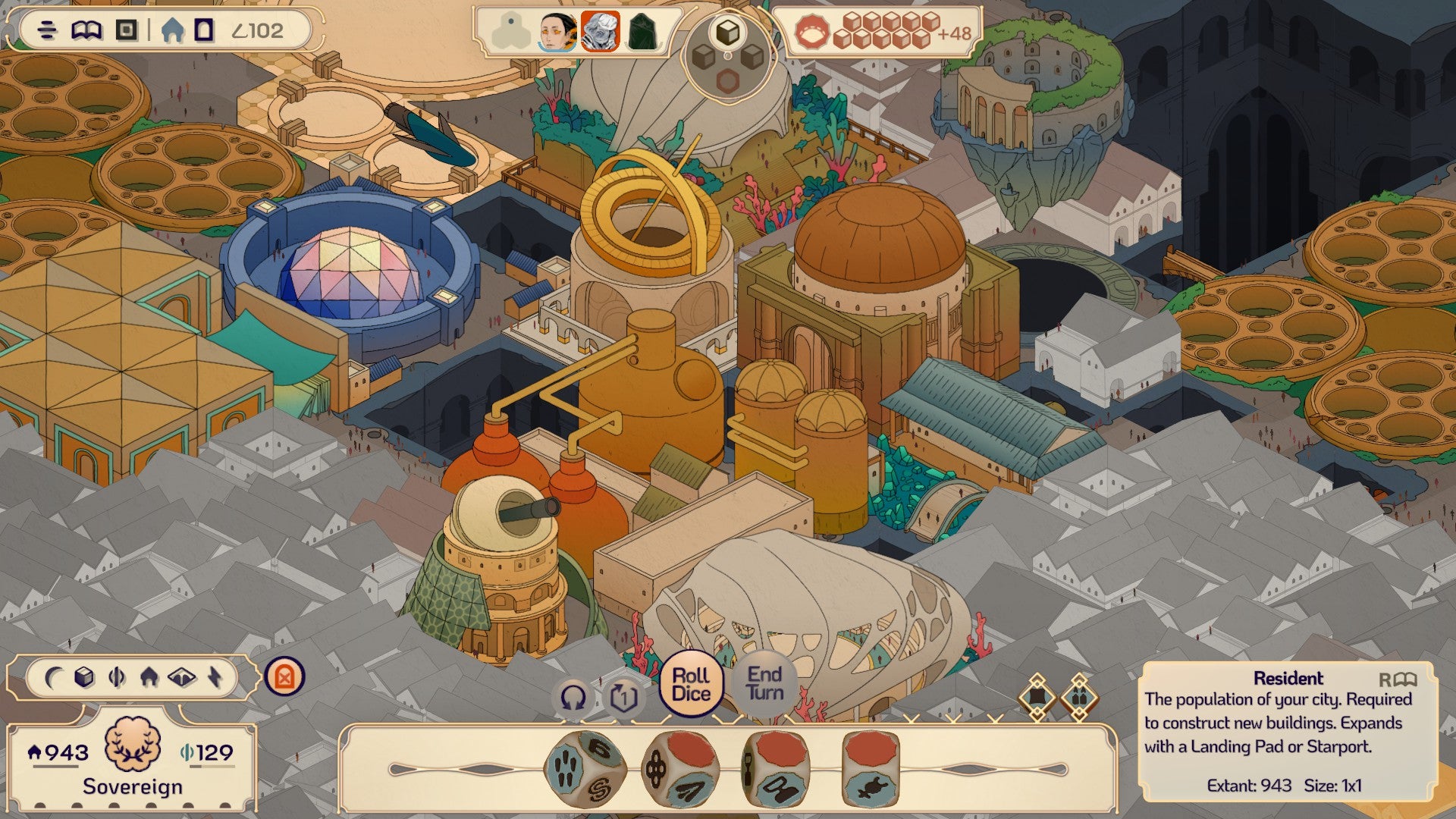
My first session was cautious and exploratory and a little overwhelming – the latter is usually the default state for starting any citybuilder, and this one is no different. The goal is to usher this forgotten backwater into a Golden Age, by growing its population and influence through various tiers of cityhood. It is admittedly difficult to think of this as a small town because the entire moon is a giant tomb – the starting seed will always place the fledgling city around a yawning maw in the ground. Attracting more residents means building more facilities that can harvest resources, which are traded to increase influence. These range from practicalities like metal and brick, to progressively more esoteric materials like void and horizon. Notably, residents can’t be placed in specific locations – they’re more likely to settle around specific buildings (landing pads and starports), and once they’re there, the player can’t manually remove them (they are all, spiritually, this man to me).
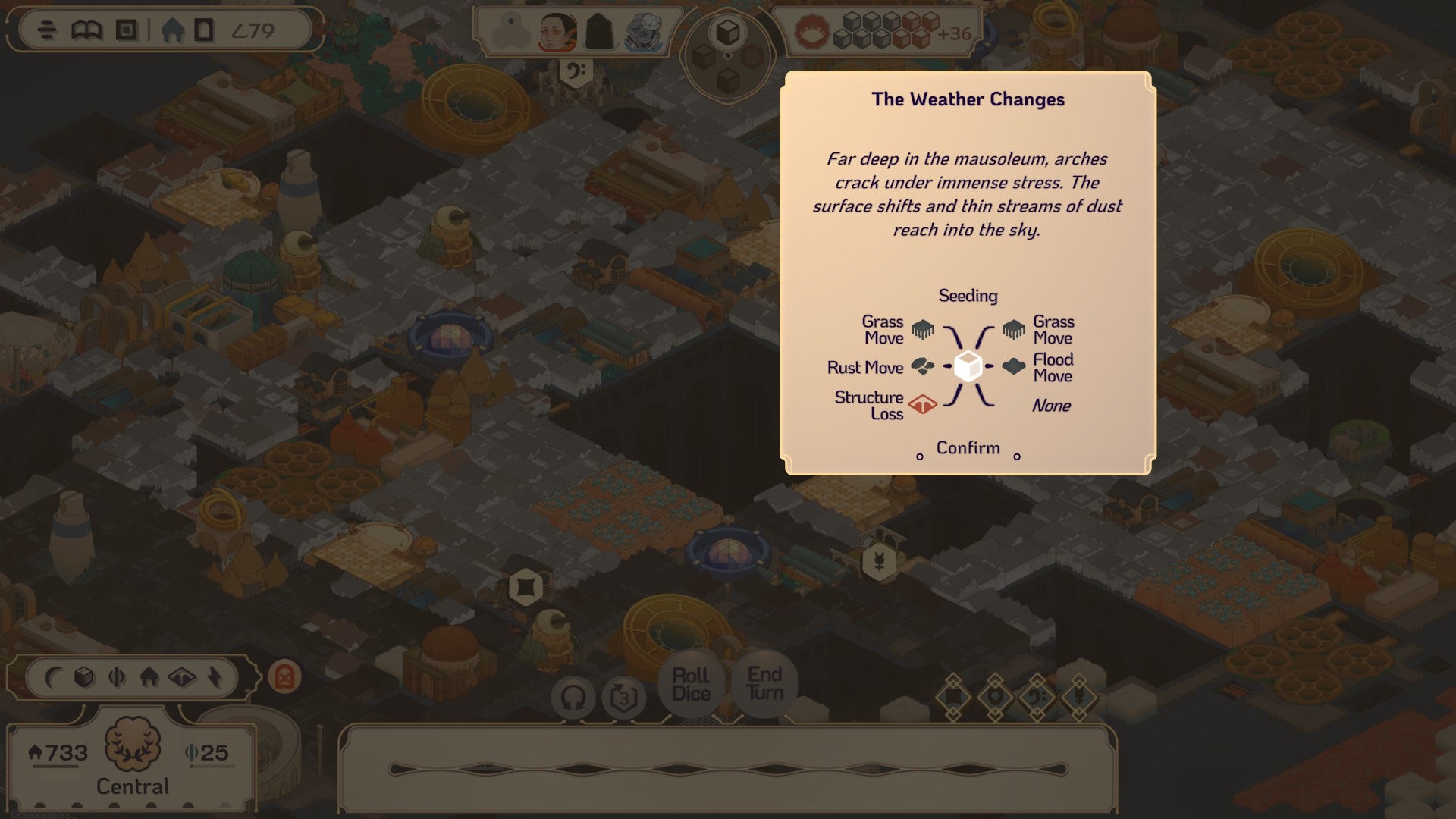
Then there’s the Amberspire weather system. One cycle consists of three player rolls, followed by a weather roll, which is to say: you get three turns to act on your hopes and dreams before the computer – fog and water, et al. – smites you down. The player gets up to six usable dice per turn, while there can be up to 10 weather dice per turn – these can accrue and plague you for turn after turn like an unhinged debt collector (there are also the arguably worse instability dice, which affect residents and buildings). A lot of what happens in Amberspire is luck, but the weather system especially feels like luck plus karma; the moon also has a weather baseline, so I can’t just keep reducing water levels and cutting grass without inviting trouble. All weather has the potential to grow and move and bedevil the city perimeters with decay and destruction: weather is eternal.
I used to think rust was my one true enemy, but fog is worse. As I write these words, it is fog season on the moon. Nothing can help my people now, not even me, the god-hand in the sky rolling uncooperative dice, because I planned poorly and my fogbreakers have been disabled. When too much rust eats away at city structures, it destabilises the ground and entire tiles of residents crumble into the darkness below. Forget about grass, too – on the moon, grass is a pain multiplier, so if you build things within range of grass, you get extra weather dice. As a survivor of 1990s Australia, I never liked Crowded House, but after playing Amberspire I will never hear “Weather With You” in the same way.
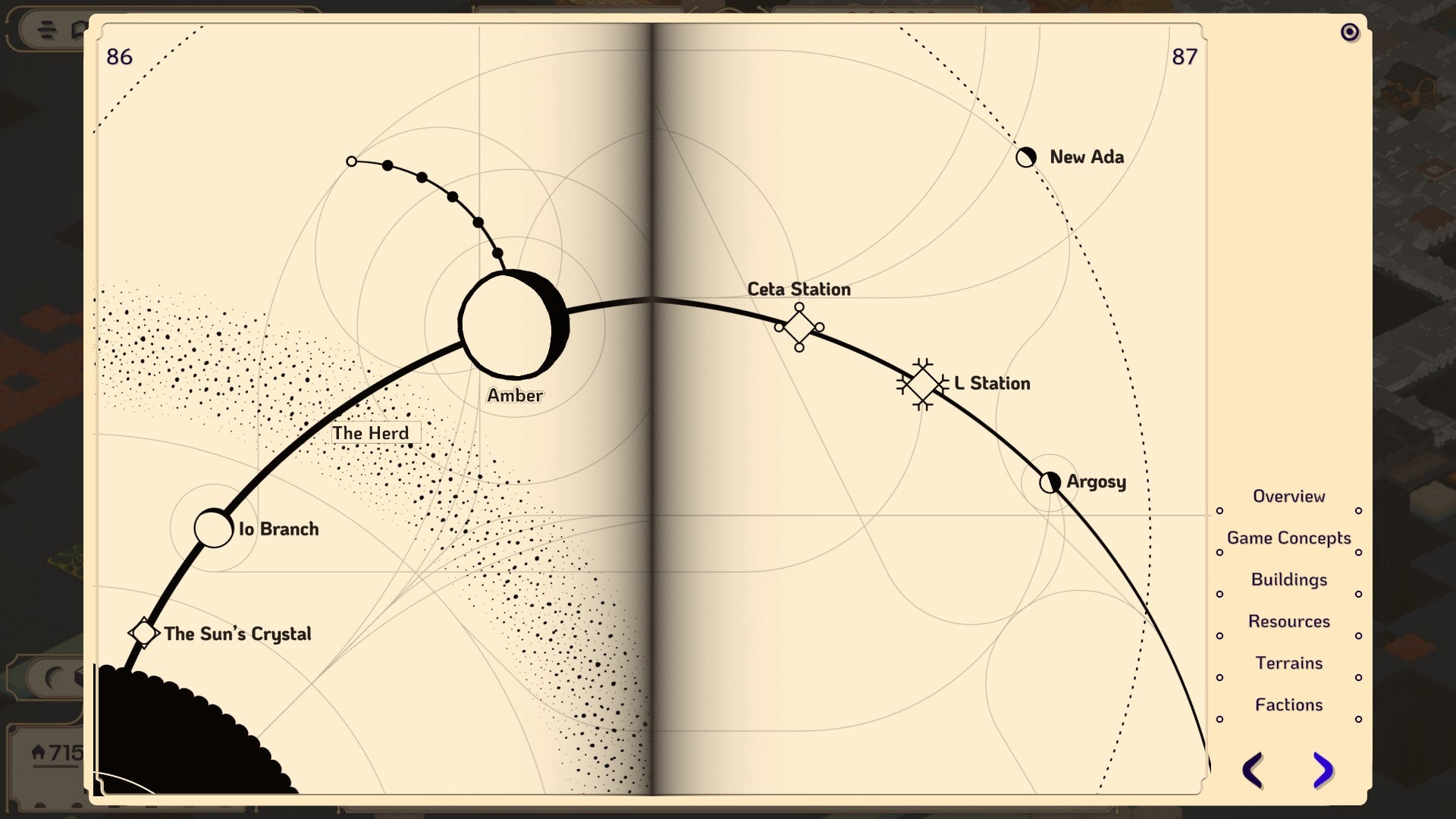
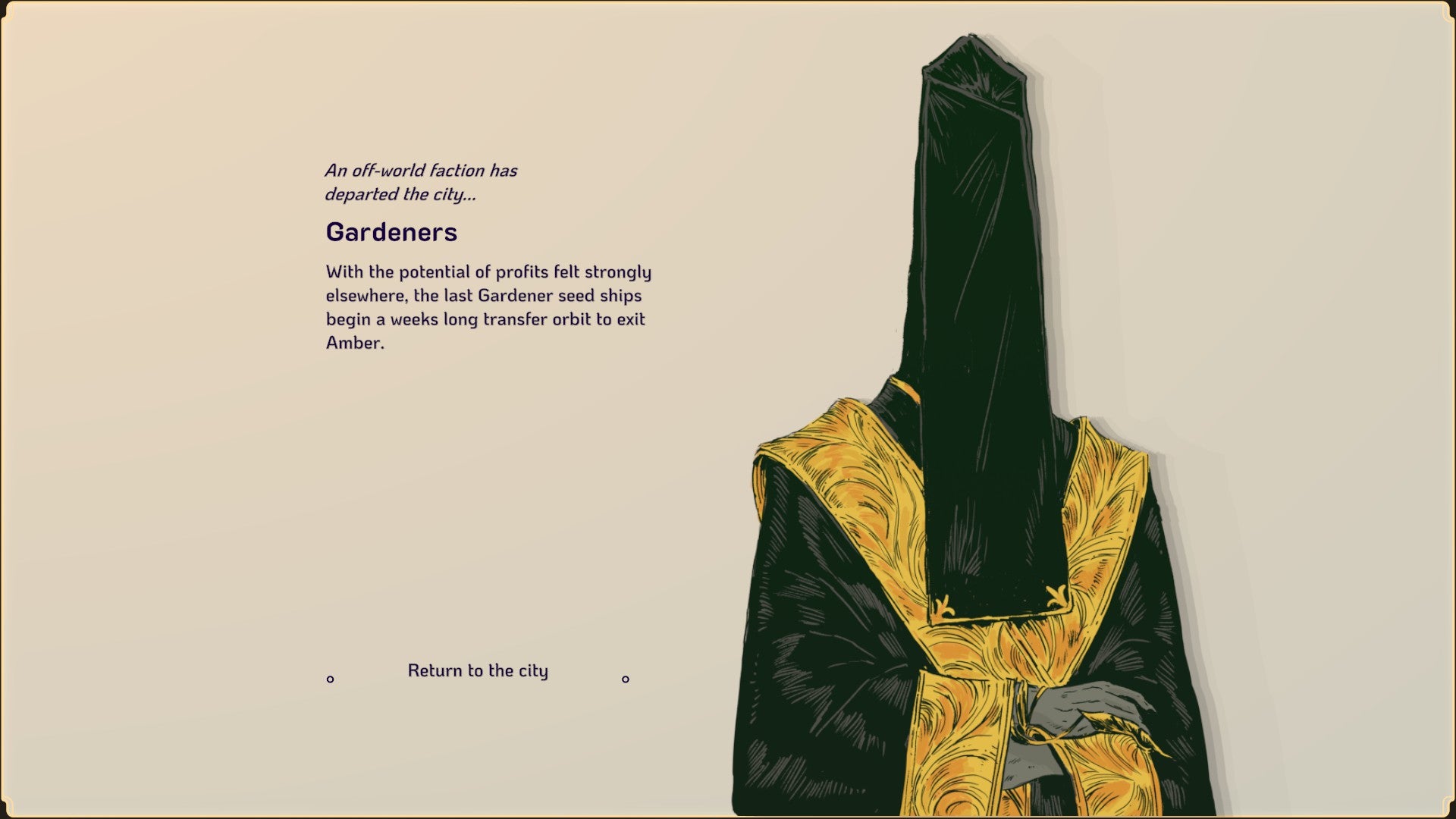
Finally, there are events, which feels like the weakest system in the game. Events trigger after three event dice are used, and can range from residential fire hazards to major moonwide crises. Up to three factions will settle in Amberspire, along with all their traditions and ambitions. The dice determine my relationship with each faction, and depending on whether they like me, and if they’re powerful enough, can add faction-specific buffs/debuffs to my gameplay like extra rerolls or more dice slots. As an aspiring capital, Amberspire attracts the attention of weirdos from across the galaxy, such as the monolith-veiled Gardeners, who have turned space eugenics into a thriving business. Events give lovely insight into each civilisation – the entity known as the Coral Monarch, for instance, panics when one of my clockworks buildings accidentally calculates its actual size, so I must either spend a vast amount of influence or roll to determine the outcome.
My biggest frustration with the event system, even taking into account that this is a dice game, is how inconsistent and capricious it can feel. Multiple times, factions remained neutral for almost the whole game, which meant they didn’t affect my gameplay at all. I had a game where my city struggled so hard that the Gardeners ended up packing up and leaving – a huge blow, surely – only to return a few turns later as if nothing happened. My relationship with each faction often didn’t feel engaging beyond a handful of turns (of course when everyone hated me together, the impact was palpable), and it became clear that pure dice aren’t always great at effecting and maintaining forward movement or tension. The mausoleum as a background setting was interesting – more of an ambient worldbuilding silhouette than a core narrative driver for anything that happens in the events — but ultimately the game’s intent, to offer a greater sense of historical depth through events, came up short.
As my city became denser, with less viable space to expand because the grass and fog have penned me in like a prize pig, I thought with sick admiration of that incredible 2019 Popula essay on the radiant delusion of Miami real estate, all business as usual in the face of the climate crisis. Ecological disasters are the only ways I can replace residents with useful buildings on tiles that would otherwise remain occupied – for instance, when I see fog engulf a Chapel or some extra-niche building, sometimes it’s better to demolish it and build something more strategically helpful there instead of waiting an undetermined amount of time to maybe, possibly de-fog the place if the dice allow you to do so (there is, of course, a cost to deleting buildings, which is more instability).
Throughout the game, my mind drifted to the sunbleached, earthtone curves of Arcosanti, an unfinished experimental town in the middle of nowhere in Arizona, which I visited in 2015. Arcosanti’s designer Paolo Soleri, a problematic figure, had big ideas for arcology back in 1970 (arcology being the marriage of ecology and architecture, not just a weird structure from SimCity), and all sorts of people — artisans, craftspeople, hippie environmentalists — came to live there with the goal of building a radical self-sustaining community before it all fell into relative obscurity. Amberspire, with its gorgeous Mediterranean-inflected architecture and alternate futuristic vibe, is a game of kindred ideas, and to that end, it is particularly interesting to experience it alongside its dev blog. In an urban planning setting, the equivalent blog/timeline for a civic engineering project provides helpful background and vital public outreach (think of the stakeholders!) when it comes to introducing different ideas. This is something the government does a lot here where I live, in Singapore – the future-forward approach of putting up websites and visualisations of big planned projects for the next decade – and asking citizens for feedback.
Amberspire’s dev diaries feel, in the context of citybuilding, like an inventive and inspired form of psychological outreach to Sid Meier players accustomed to the grindset of 4X gaming. All of the game’s subtle but meaningful changes prompt me to examine my own expectations of placemaking: am I balancing my growth with the planet’s needs? If I can’t entirely eradicate the grass, how will I learn to live with and around it? Since I can’t place my residents exactly where I want them, how does that affect my relationship with, and perception of the city as its own organism? Why has years of playing Civilization turned me into such a psychopathic control freak? The entire review process has been a gauntlet of internal examination for me, and I’m grateful for it.
It took a while for Amberspire to grow on me, and I continue to return – I’m on my seventh city now – because I remain enchanted by its ideas even when they feel like they’re unfinished. I do love that these games can be played and finished in normal, reasonable sittings – I enjoy seeing what the procgen gods give me with each new file, and if the dice cooperate I can “complete” a game in one intense, lengthy sitting. It is a beautiful, but incomplete exploration of a genre mostly defined by extraction and expansion. A board game built for one that encourages measured reflection on the dichotomy between the wants of a city and the needs of its surroundings. I simultaneously wanted more from the world it offered, which feels pulled in two ways: Amberspire is a renaissance-shaped fever dream that runs on an active imagination to fill in the blanks, but the game is so overwhelmingly dependent on luck (and honestly, sometimes that’s just how it is) in ways that don’t always save it from stagnation.
My city is now completely fringed by creeping fields of grass. I am trying, like a predatory land developer, to encourage residents to live there anyway, because I still believe that a few good rolls will eventually make things tolerable. I keep trying to pull the camera out for a bigger, more godlike view of my domain, but Amberspire wants to keep me close, so I can pay attention to webs of interconnected buildings, in conscious alignment with the terrain that’s trying to kill me. As a result, my game feels split into discrete biomes, which nudges me away from the conventional citybuilding mentality of unifying or mobilising a greater whole. But when I hit a personal record of 10+74 weather and instability dice, I wonder if it’s time to welcome the meteor, because I can’t – and shouldn’t – win against entropy. Because when my incarnation of Amberspire is long gone, when grass and water and rust and fog finally win this terrestrial pissing contest, the city will begin again.
A copy of Amberspire was provided for this review by Bithell Games.