The Untitled Goose Game team returns with a funny, exciting, and deeply rewarding multiplayer adventure that combines knockabout fun with some surprisingly big ideas.
“Chris, I think you’re muted. Your nose has gone small.”
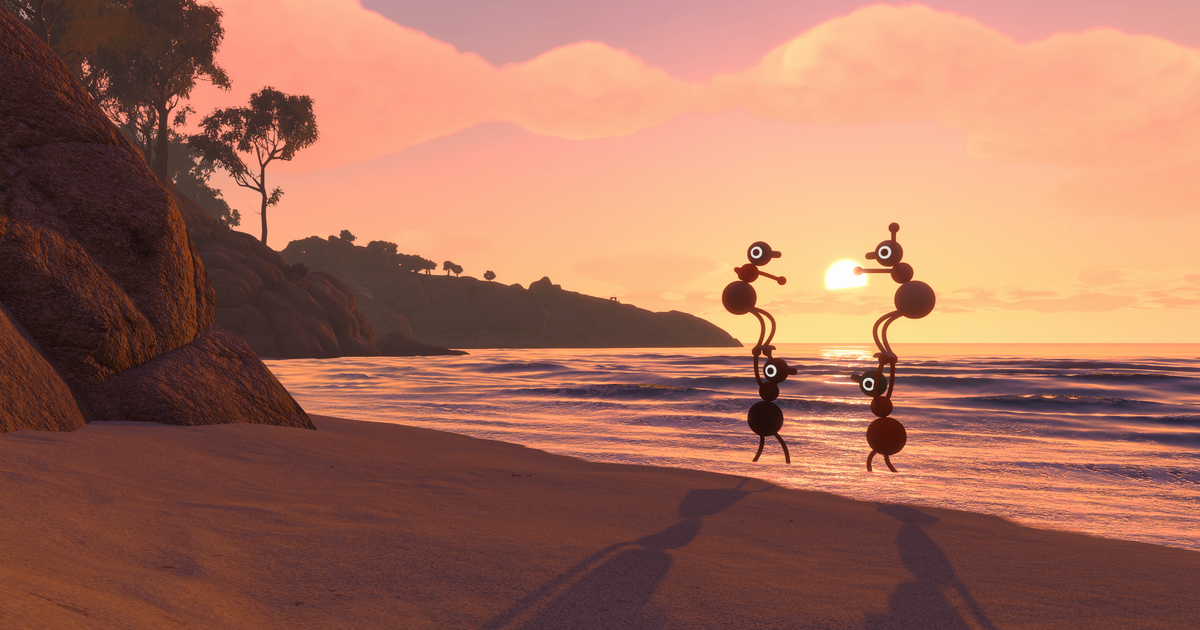
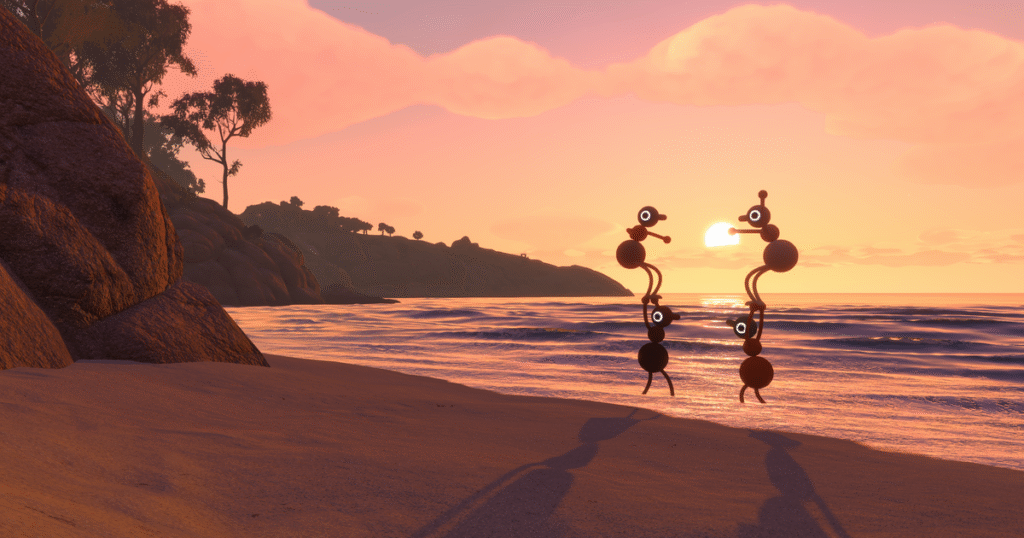
What is Big Walk, exactly? It’s a simple game, really, but explaining what’s special about it is a little more complicated. For starters, you might wonder if the latest game from Melbourne-based House House is anything like its breakthrough. Well, it certainly shares the gleeful devilment of its biggest hit. There are no geese here, though your colourful avatars do have a somewhat birdlike quality; big or small, that nose is slightly beakish. It’s equally smart in the way it wields its silliness, similarly playful and exuberant, and stuffed with innumerable delightful little touches. Otherwise, it’s not much like Untitled Goose Game at all.
What it is is a hangout game par excellence, a superior class of what we must apparently now call ‘friendslop’ – so, friendgourmet? Friendkino? It’s also a co-operative puzzle game of sorts, designed for small groups; certain elements are retuned for two, three or four players but up to a dozen of you can take part if you have the numbers.
But beneath all that, what it’s really about is the frequent joys and occasional frustrations inherent to human communication. (Related: this is my third attempt at writing this intro.)
“I put a clock on your back a while ago, by the way.”
Big Walk is a little like going on an adventure with your friends while being slightly hard of hearing. By that, I mean its implementation of proximity chat, which is crucial to most things that are great about it, is tuned pretty aggressively – you don’t have to venture very far from your mates to find yourself out of earshot. And that’s precisely the point: you have the pleasure of larking about together in the wild juxtaposed with the feeling of being alone, whether you actively choose to wander off or simply lose sight of the rest of the group.
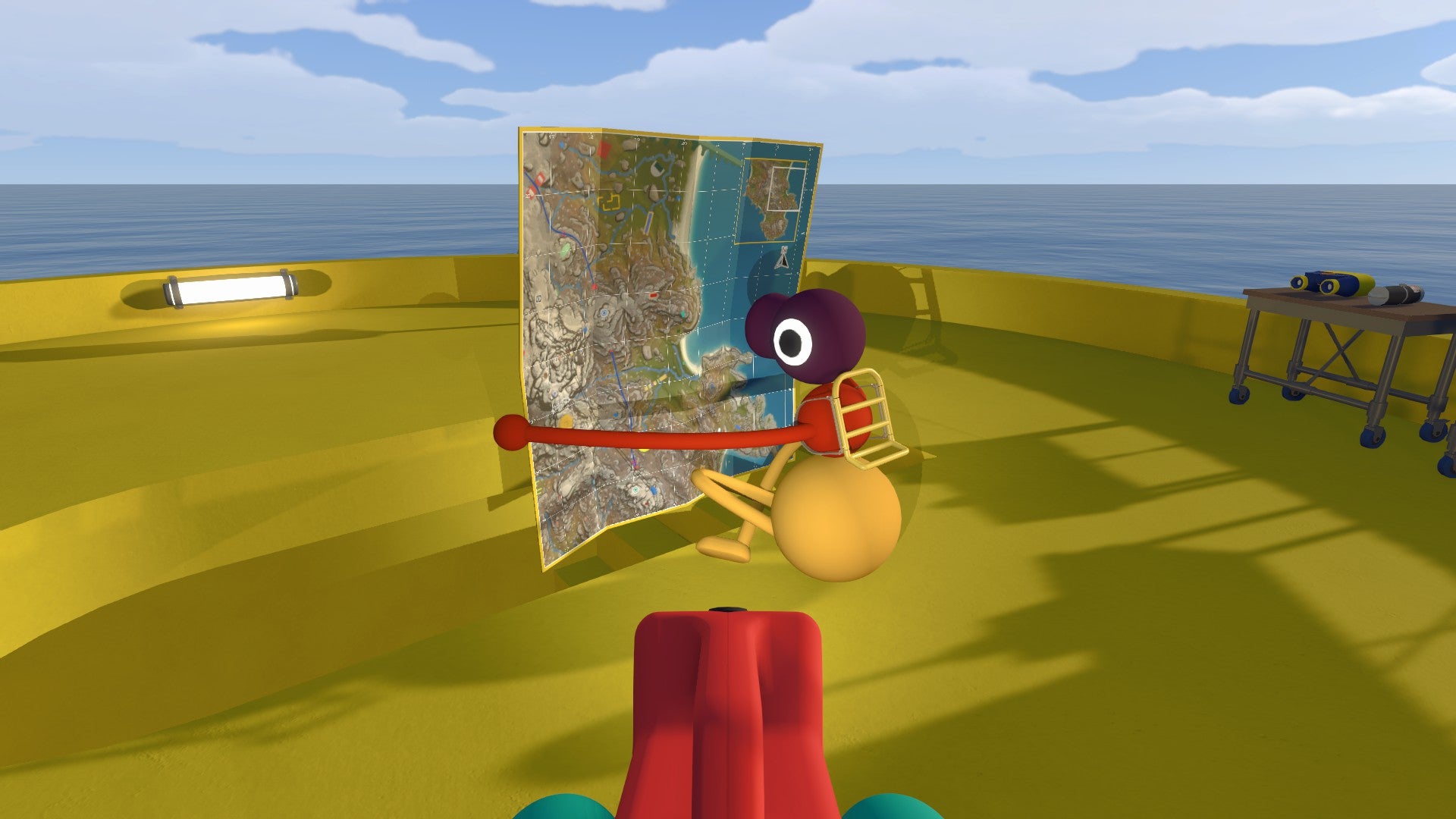
That’s typical of a game of unlikely contrasts and delightful little frictions. Its world is a sprawling island wilderness pocked with colourful man-made objects and landmarks. This appealingly incongruous mix – purposeful artifice meets untamed nature, the tension between the two lending the place a thrilling sort of liminality – speaks to the game’s core principles. Here is a place that’s mostly loose and relaxed, with plenty of room to explore or just mooch around, chat amongst yourselves and take in the views. And then there are pockets of space with more focus and purpose to them, where you need to work together as a team to complete the challenges you’ll find there.
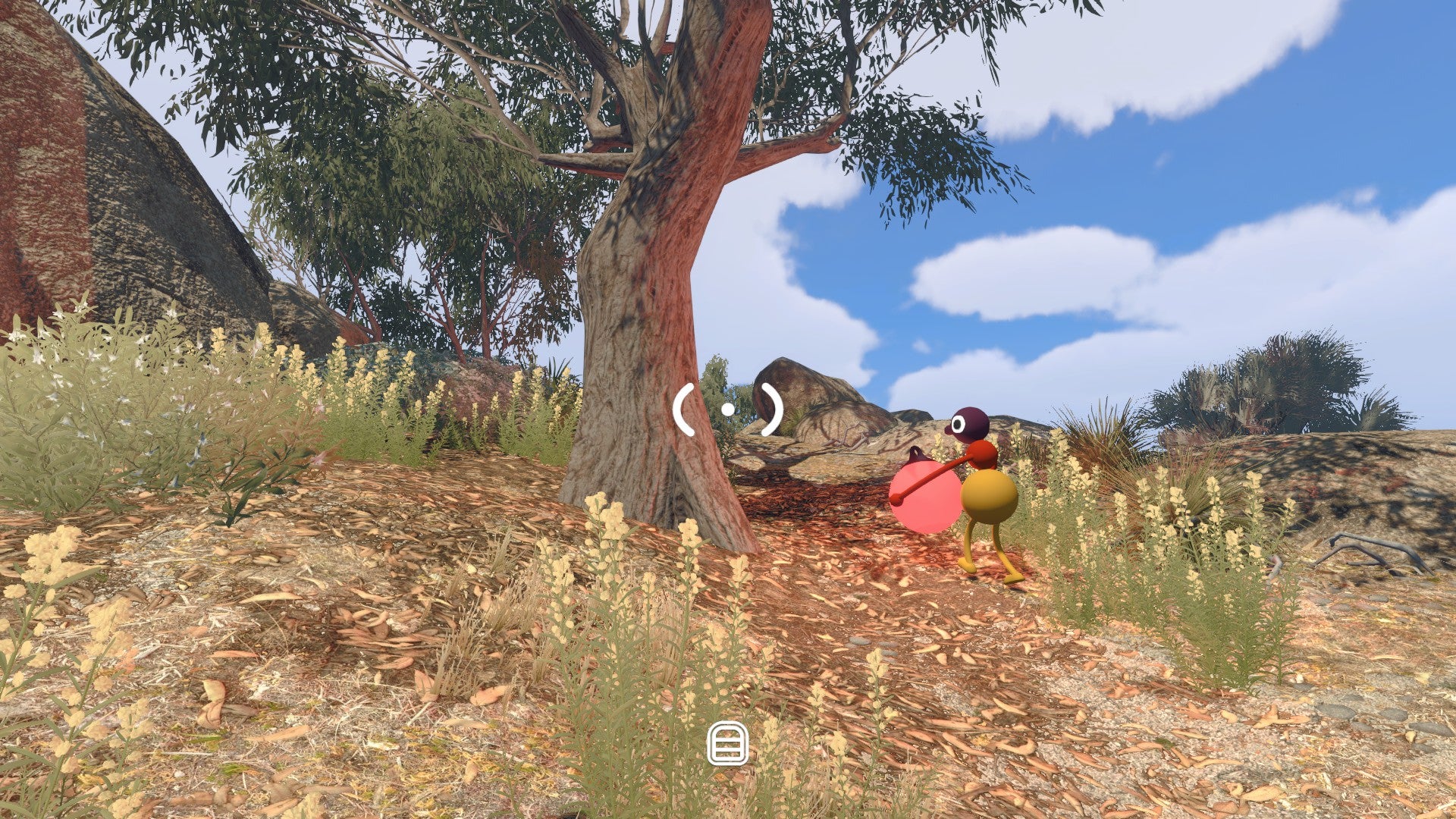
The curved, red objects that are your reward for solving these collaborative puzzles – vaguely resembling a bottle-gourd, or calabash – are effectively your main form of progression, unlocking a handful of genuinely transformative features. They don’t have an official moniker, but our group adopts one after our host decides they look a bit like a certain canine chew toy. The name sticks, and soon it has become part of our shared language, such that no one bats an eyelid when one of us says, “I dropped the kong off the cliff.”
Here’s the thing: one of you will almost certainly drop the kong off the cliff. It’s perfectly round and smooth, and heavier at the bottom, which means one thing: it can and will roll as soon as you set it down. Leave one on the slightest of inclines and within seconds you will invariably find yourself sprinting after it. That’s Big Walk for you: if there is an opportunity for mischief, something that will invariably lead to chaos (and perhaps even some mild chastisement for the dropper in this case) then its makers will grasp it with both hands.
Otherwise, this place is largely player-ambivalent. It’s never actively hostile, even if at night you instinctively wonder what might be out there – not least since Big Walk’s island is clearly modelled on Australia, where a few species of spider are big enough to have their own postcode (fear not, arachnophobes; the only eight-legged creature you’ll see is if you form a tower of four). But the presence of a designer’s hand always gives something back. There is no need for a detective mode, no need to click in a stick or a trigger to ping the environment when just about everywhere you stand, there is something big and bright to draw the eye, and to orient you.
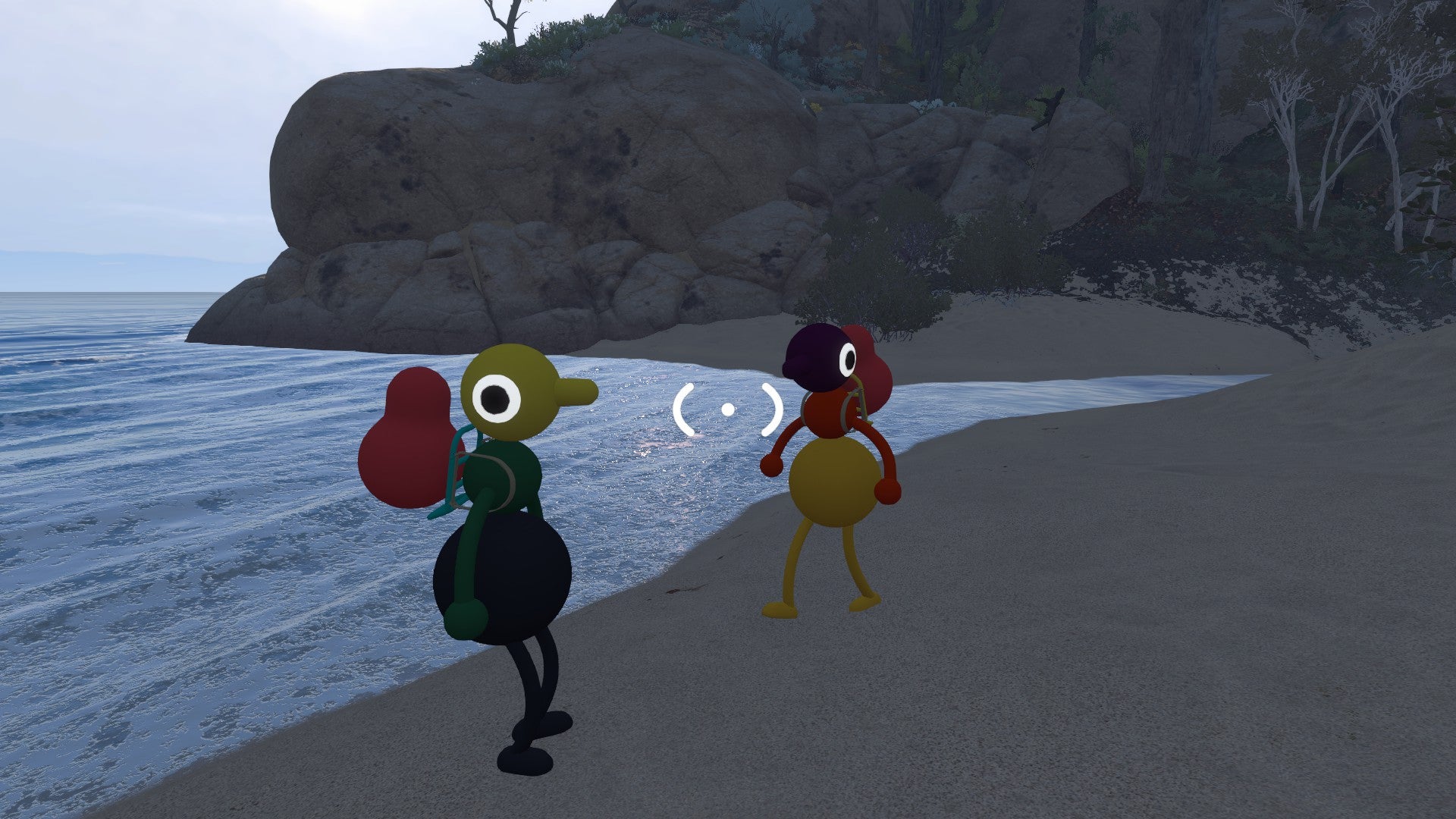
It’s a comfort that in turn lets the developer make the world these structures are (house) housed in feel more authentic: the foliage is allowed to be dense, the rocks properly, well, rocky. Peaks are high, valleys are deep, cliffs are sheer drops. This is not a world you glide effortlessly over like many an FPS protagonist. Exploration can occasionally feel awkward and kludgy, and that doesn’t always feel deliberate. More than once, one of our group gets gently stuck between two rocks – though even in the slightly panicky moments where a situation feels inextricable, I’ve yet to encounter a scenario from which anyone has been truly unable to escape. In any case, you can usually fudge your way up or down a steep incline. But when hunting for an object in the brush is part of the fun, why not take a death-defying leap from Big Walk’s many peaks? The moment when you realise that you can run and click the right stick and hurtle downhill on your backside, those pipe-cleaner legs flailing, is an unfettered joy. Fifteen hours later, on my umpteenth slide, the pleasure is undimmed.
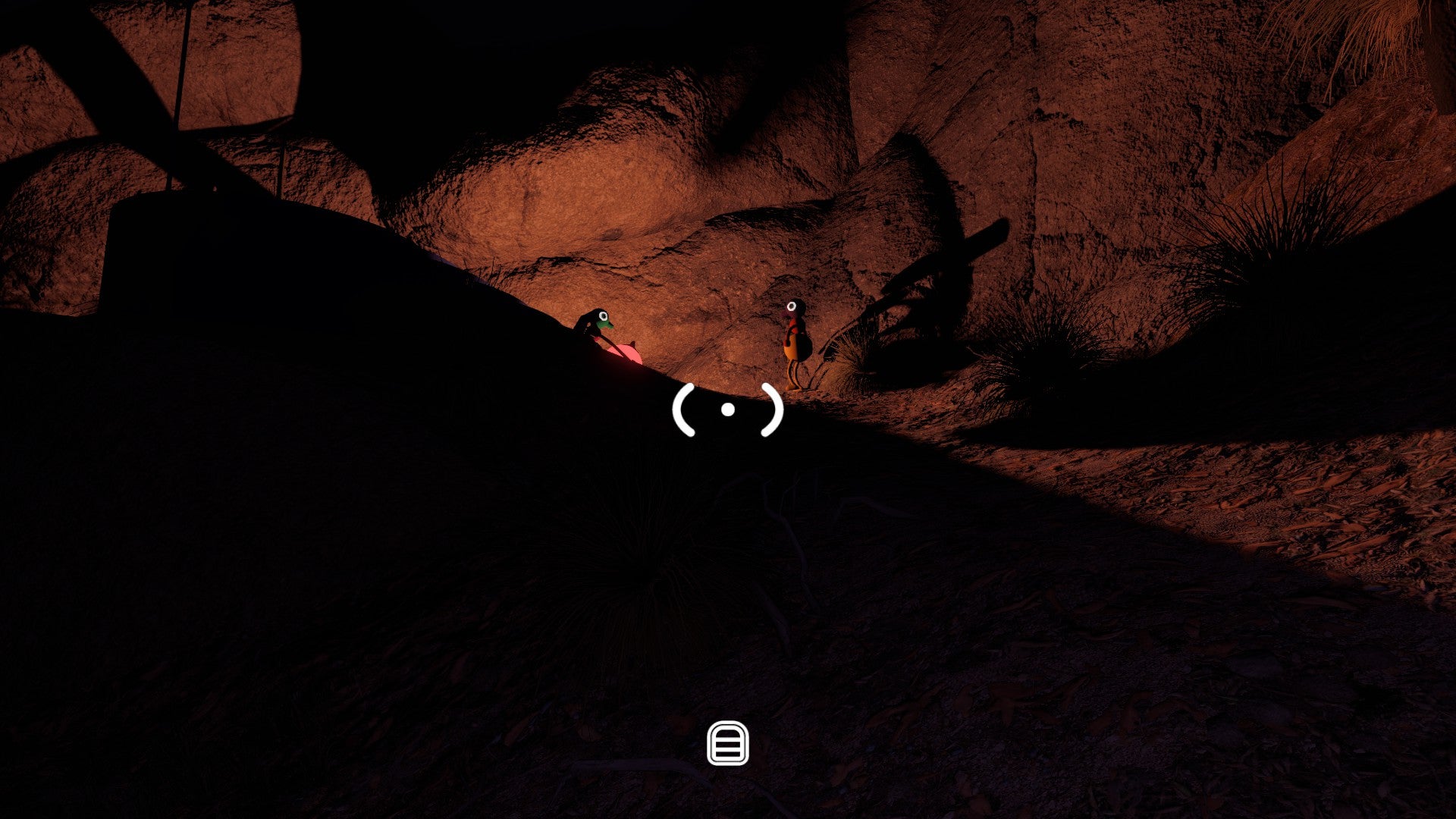
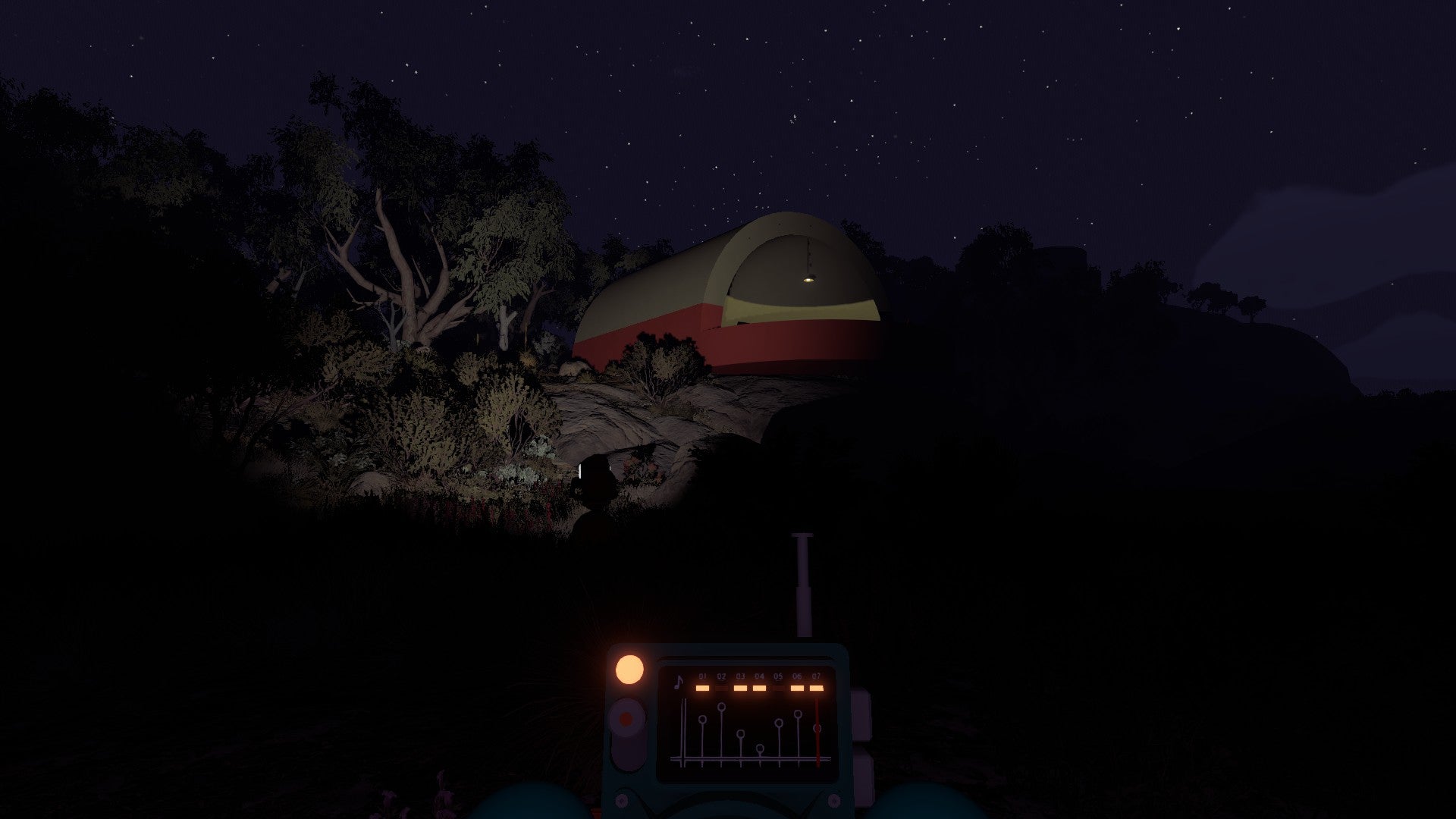
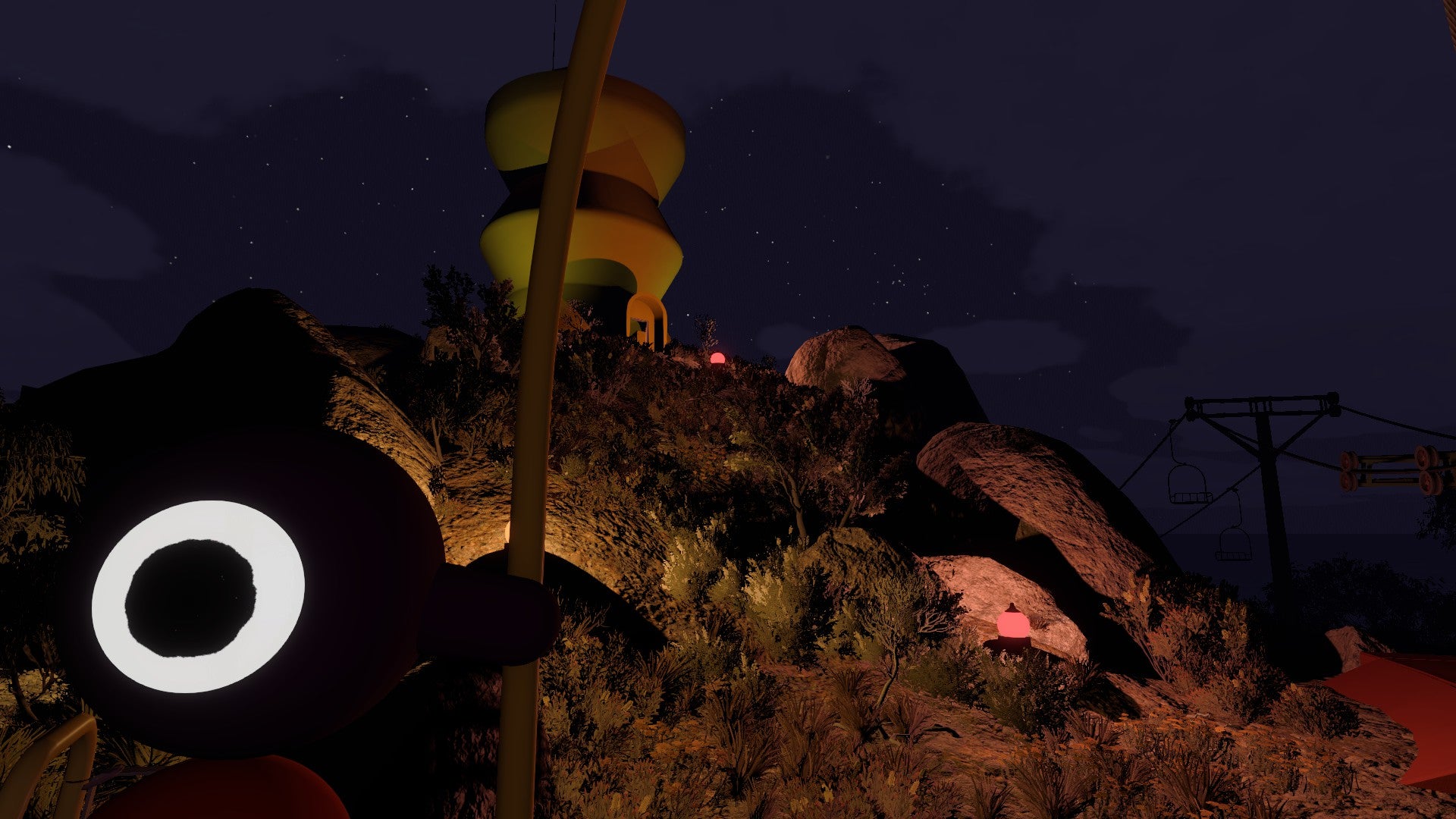
Meanwhile, when darkness falls, which it does with alarming haste, Big Walk’s creators have absolutely no qualms about letting it get really dark. Like Echoes of the Eye dark. Like Dire Marsh (Night) dark. That, of course, is your incentive to carry a light with you. There are torches, yes, but more common are bulbous little lamps – which are also prone to rolling, should you give in to the overpowering temptation to dropkick them. These are perhaps more effectively placed, though, in the circular receptacles scattered across the map, as a helpful reminder to show where you’ve been. Or, if your group has been separated, a signpost of sorts, pointing the way back to a reunion.
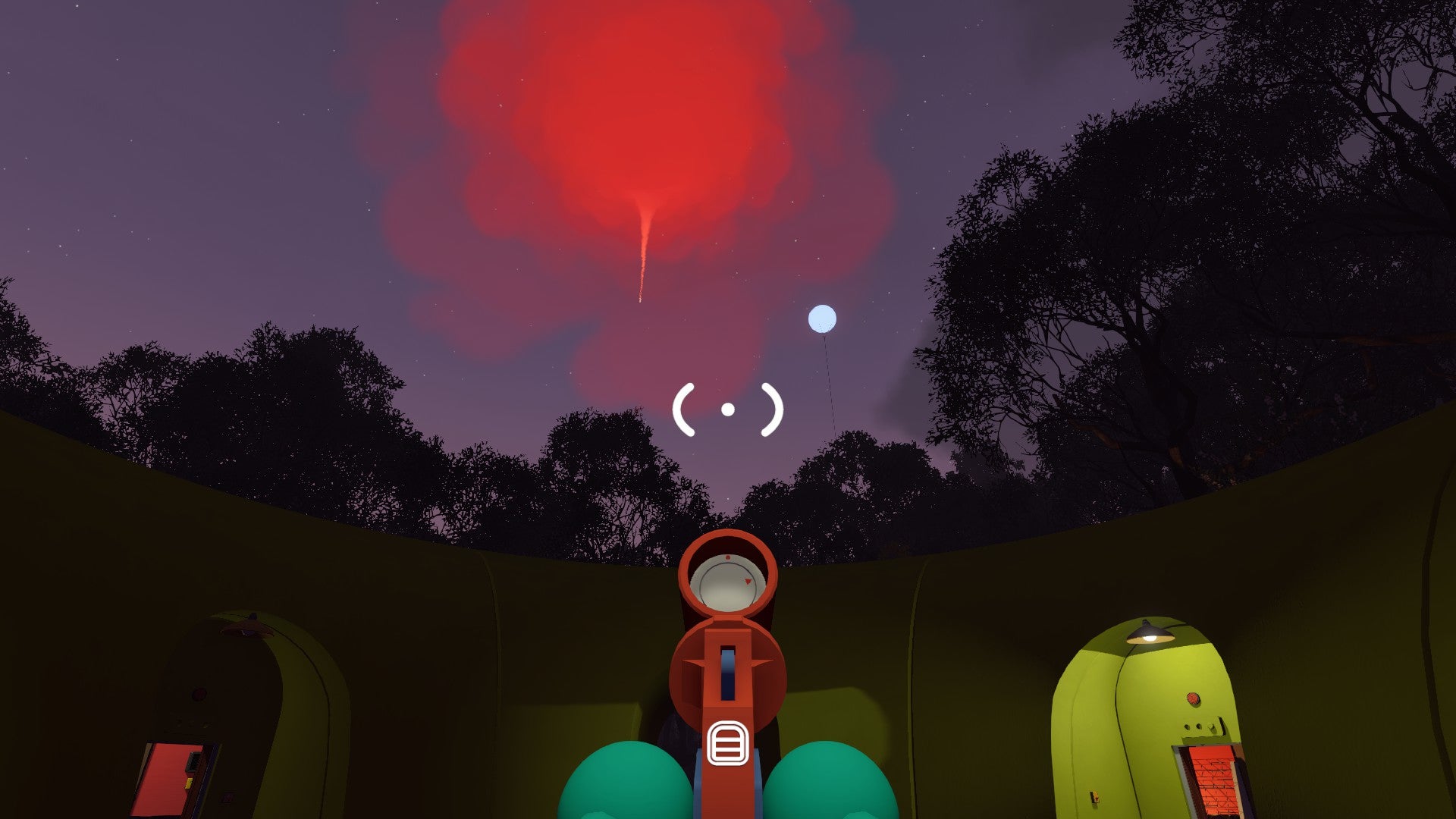
Getting split up is normal – commonplace, even – in Big Walk’s great outdoors. The game’s exterior puzzles regularly contrive to force you apart: for instance, one of you might be invited to launch a sort of clockwork bomb, while another tries to retrieve it from its distant landing spot before it pops. Such instances encourage you to think about how you might stay in contact with one another. Walkie-talkies are the obvious solution here, but until you get a backpack – and what a revelation that moment is – you forgo the ability to carry a second object. In any case, there is no more effective separator than human curiosity, and the clumsiness that often goes hand-in-hand with it. Like the friend who sees something on the horizon and decides to make a beeline for it, neglecting to check you’ve been following them, or, distracted by something or other, strolls casually off a sheer drop, their instinctive “aaaaaah!” comically echoing like a Looney Tunes pratfall. Unless – until – you too hurl yourself from the brink.
Either way, in Big Walk, you’re never truly lost, or at least not for very long. You always have options: you could head for the tower on the top of the nearest hill and launch a firework to tell everyone where you are, or trek back to base and leave a written message on a whiteboard, say, to indicate your imminent whereabouts. Besides, there’s a certain frisson to being alone, particularly if you’re keen to scare someone. When our group meets back up after a mildly frantic ten minutes apart, we discuss the possibility of setting up a four-player game where one of the group is led to believe it’s a three, the fourth cast as a malevolent presence to frighten the wits out of them.
Partly because the organic elements of the world don’t feel overly designed, it’s a game that gently encourages an appreciation of nature – among the many sights you’ll find yourself cooing appreciatively at, its seas and sunsets stand out. Yet, perhaps counterintuitively, what you’re most likely to marvel at is the stuff that’s been put here for you. At times it feels like a gigantic adventure playground, but there are interior areas here that feel surprisingly uncanny, and thus all the more exciting to tiptoe around. And indoors, the sternest tests of your ability to work together await. These puzzles typically force you into separate rooms, but almost always give each of you an incomplete picture, your task being to figure out how to make it whole. You might have to explain what you can see to someone who can’t, or – when the others are still visible but no longer audible – figure out a system of gestures to talk to one another. It’s a useful reminder of something we often forget in life: that a different perspective can help illuminate our own.
“I’m gonna lock you in this building and have a little explore.”
Solutions can entail concocting new methods of communication on the fly. Or you might collectively look at the various pieces in advance, and come up with a plan of action to steer one another in the right direction, before shutting the doors and hoping it comes off. In some cases, you’re effectively entering a code, and House House frequently makes you wait an exquisitely agonising few seconds as it pretends to process the answer before confirming whether or not you got it right. The anticipation!
(It’s worth mentioning here that the answer to the eighteenth question on the excellent Big Walk FAQ is probably the most important thing you need to know going in. Click on that link, scroll down, read it, and come back. Got it? Going in, none of the people in our shared WhatsApp group reads that FAQ beforehand, and yet each of us understands that rule instinctively. There is an unspoken agreement to use the channel exclusively to arrange when next to meet up for the next part of this big walk. Which is only right and proper for a game that wants you to stop thinking about your phone for a bit. You’re in nature! Let the terrible cacophony of the real world fade away.)
And then: the release! The sound of a party blower and a shower of confetti to celebrate a successfully completed puzzle – followed by another short wait as the screw on a vice slowly unthreads to release your round, red prize – is a low-key sort of celebration, that nevertheless feels satisfying every time. And when you later place your reward where it belongs, you’re treated to a sound effect that is up there with the all-time greats. With a decent set of cans, it’s almost indecently pleasurable, producing a bassy, otherworldly reverberation that seems to ripple across the entire island: one more useful way of letting any stragglers know where you’re at and what you’re up to. I’m loath to spoil the bit of ceremony that comes when you’ve filled all the slots in a tower, suffice it to say that it proves more games could stand to be influenced by Timpsons.
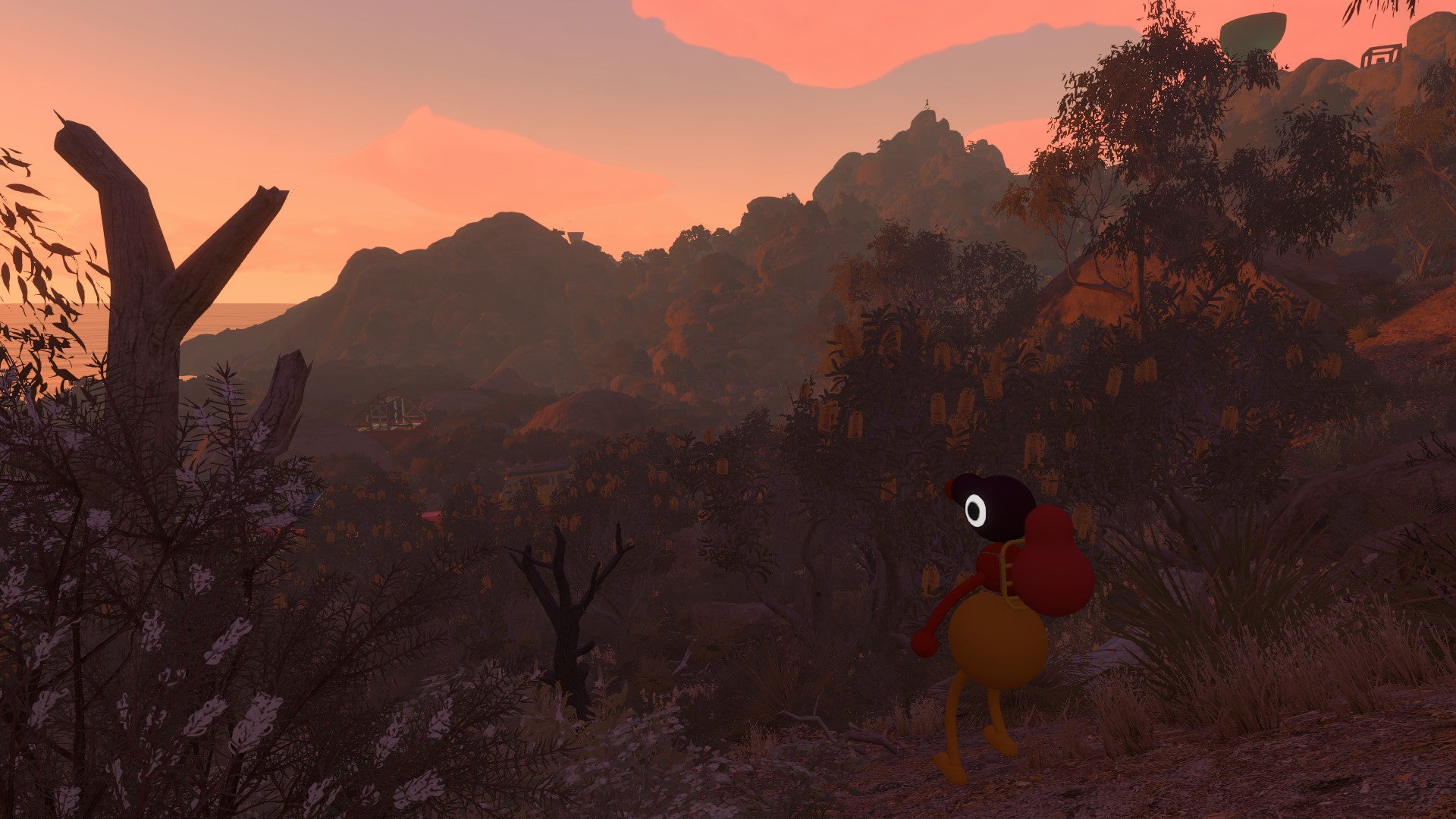
At times, it feels like you could explore this place forever (good job Odysseus didn’t wash up here; he’d never have made it back to Ithaca) but, of course, all big walks must come to an end. At this point, the world opens up further by becoming just a little smaller, funnelling you towards a climax that, honestly, I think I’ll probably remember for the rest of my days.
“So. What happened with the kettle?”
Indulge me just a little longer. I’m of an age where I sometimes find myself questioning the amount of time I’ve dedicated to playing and writing about video games. It’s typically a background murmur in my brain, one I can silence by invoking CS Lewis and childish things. The noise has unavoidably become a little louder in recent years, which I think is a natural by-product of getting older, but also some of the concerns I have about the industry that seems to produce these things while chewing people up at a similar rate. I sometimes struggle to reconcile these fears and concerns I have with everything good I get from games. And so, more often than before, I find myself reaching for the experiences I’ve had that have truly stayed with me. Not just the games I’ve enjoyed in the moment, but the ones I can say, hand on heart, that my life has genuinely been enriched by.
I’m fully conscious of, and a little anxious about, overselling something that a lot of people will treat as a lark, and – genuinely – good for them. Big Walk can absolutely just be that, if you want it to be. But I’m conscious, too, of where this all came from. The provenance of its development can’t help but show through.
Sure, I can’t be certain that House House set out to make something quite this profound so much as they simply missed one another during the pandemic and wanted an opportunity to hang out together again. Yet I can’t help but think back again to the existential horror of the concept of “social distancing” for tactile, emotional animals that thrive in company such as we. There’s a touching intimacy about the way you don’t actually equip your own gear but rather must actively clip it to one another’s backs and hips: a slightly fiddly process I come to value more each session. It’s there, too, in the comparative ease with which you can pick one another up: it’s handy for certain puzzles, but it’s also nigh-impossible to resist the impulse to hoick a pal up on your shoulder as you’re trotting along to your next destination. There’s a point when one of our group has to briefly step away from their PC; without a word, the two of us that aren’t AFK begin carting him to a place he won’t recognise when he gets back. Naturally, we clip a walkie to his holster, too, just so we can hear the confused “huh?” upon his return.
But yes, that ending. I’m reluctant to even hint at it, so I’ll just say that it feels like a subtle but ingenious twist on a familiar game design maxim. If the best video game challenges test everything you’ve learned, this is more about what you’ve come to understand about the people you’ve shared this journey with, and the weird and wonderful ways you’ve invented to overcome the difficulties you’ve faced together.
For a brief moment, I wonder if I’m the only one thinking it feels…magical? But of course I’m not alone – in any sense. As the game enters its closing moments, among the three of us that remain, there’s a collective feeling of euphoria, of giddy triumph, of mild amazement, even. And there’s something else in the mix, too.
“Did either of you get a bit emotional back there?”
The voice in my left ear seems to crack, just a little. I open my mouth to respond, and quickly recognise that the upcoming words are not going to surface cleanly. I nudge the right analogue stick, turning to face one of the dear friends I’ve shared this unforgettable adventure with.
I press a button and my nose goes small.
A copy of Big Walk was provided for this review by Panic.