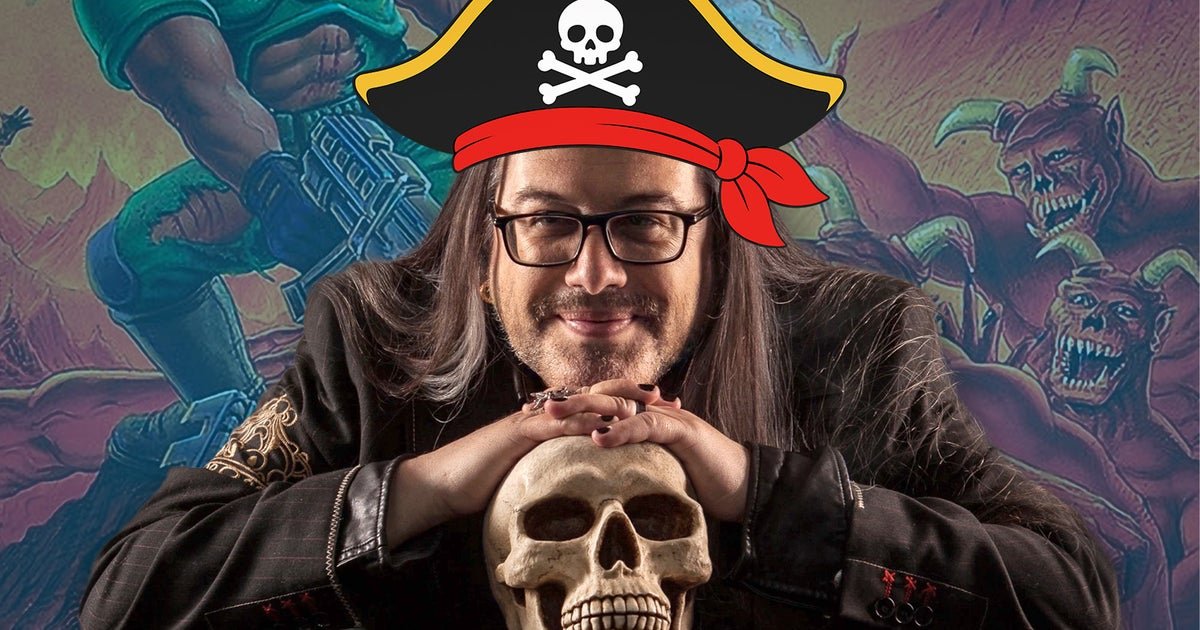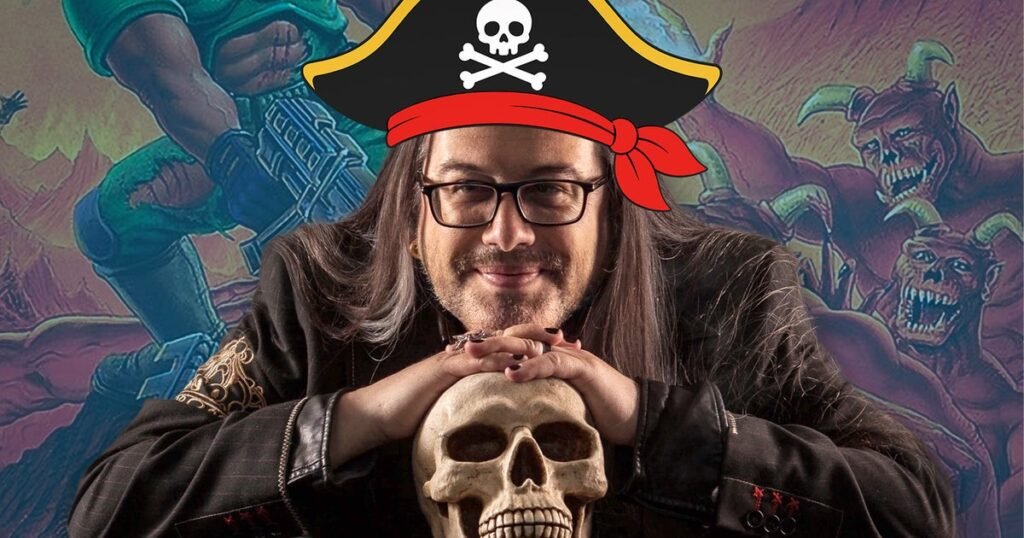
John Romero, the legendarily long-haired co-founder of id Software and father of game series Quake and Doom, has recounted a tale about when id Software worked with Taiwanese pirates to spread Doom.
The tale belongs to the 80s and early 90s, when games used a Shareware business model. The first part of a game was released for free and you could order the rest of it from a company for a fee. It was the model id Software used for Wolfenstein, and then for Doom.
Because there was nothing preventing pirates from copying and reselling Shareware versions of a game as their own, they did, and a cottage industry sprang up around it. “You would go to the store and you would see 10 different boxes that all had the same shareware Doom in it,” Romero recounted in a QuakeCon 2026 panel at around the 20-minute mark (picked up by PC Gamer). “It was awesome. We were totally happy with that.”
Why was id Software happy? Because game-pirates were effectively doing distribution for the game – and in a region id Software wasn’t as familiar with. “We knew in Taiwan that they were copying it, 100 percent,” Romero said. “That was the market back then.”
But instead of trying to fight it, id Software leant into it, harnessing the reach those pirates already had in order to spread the game. “So we contacted the biggest pirates there and went, ‘Can you buy boxes from us? Really cheap; really really cheap.’ So they bought tons of boxes off of us so it would be legitimate.” The message was simple: “Please do it. Don’t give us any money. Just get it out there.
It was in id Software’s interest to support the illegitimate practice. “We made money when people would actually order the rest of the game,” Romero said. It also helped the studio establish a fanbase in the region that presumably be interested in the other games it made. “For us it was: distribution is king.”
It’s a refreshing revelation in an industry that’s fought long and hard against piracy, often burdening players with fussy copy protection systems in order to minimise the piracy opportunities. It’s a battle that’s only recently tipped in game-makers’ favour because of internet-required logins.
“We came from an era in the 80s where, man, copy protection was a war,” Romero recalled. “But there were some publishers back then that did not do that, and we really respected those publishers. But there’s always been a war that’s never been won with copy protection, so we didn’t want to waste our time with that.
“If people want to copy it, they’re going to copy it. They might buy it sometime later, but we knew we didn’t have money for everything that we were playing, so we’re like, ‘Let’s not copy protect it.’ If people want to play it, they’ll figure out how to play it. We only needed enough to make the next game.”
John Romero left id Software the year Quake was released, in 1996, having fallen out with co-founder John Carmack. Today Romero has his own studio in Ireland, co-owned with his wife Brenda Romero, who’s had an illustrious career in games herself. Romero Games was rocked last year when Xbox pulled funding for a shooter it was making, causing the project to be redesigned in order to survive.
Quake turns 30 years old this year and Bethesda gave it a surprise birthday present overnight in the shape of a brand new expansion, Dawn of the Machine. But it’s not all birthday cakes and celebrations at id Software right now as it reels from the latest wave of devastating cuts to restructure the Xbox division.