When you’ve got an open world as big and dense as Grand Theft Auto, you’ve got to fill it with something. Restaurants, tennis courts, hidden packages, Strangers and Freaks. All kinds of treats to reward our exploration, some buried deeper than others. From hearts and minds to signs and shrines, the inside jokes and little secrets Rockstar’s calling card tucked in every corner of the map. This is the history of Grand Theft Auto easter eggs.
Part 1: Gouranga!
The top-down Grand Theft Autos are too sparse and pixelated for the kind of buried treasures that would await us in the 3D era, but easter eggs exist even in this perspective.
The most famous secret of the first GTA games involves lines of chanting bald NPCs dressed in orange robes, evocative of the Hare Krishna devotees famous for descending upon travelers at airports. If you can run the entire procession down sequentially, you’re rewarded with a seemingly nonsensical shout of “GOURANGA!” The phrase, a Krishna term meaning “be happy,” became the series’ signature meme among the early fanbase and resurfaced in the first few sequels, with hidden bonuses for mowing down Elvis impersonators in GTA 2 and football hooligans in GTA: London.

For a series so devoted to examining the American dream, it’s easy to forget that Grand Theft Auto is British-born. The Scottish studio that created the series and the English brothers who made it a phenomenon belong to a storied Britdev tradition of taking the mick in the margins. From the ZX Spectrum emulator Rare buried in GoldenEye to Team17’s profane cheat codes and salty rants against Amiga Power magazine, British studios excel at hiding cheeky winks within their games. DMA Design, later Rockstar North, is no exception.
DMA logos are disguised among the scenery, the pager randomly rags on staffers, and director Keith Hamilton himself sends you on a mission to find “the elements of GTA.” You can unlock R-rated language by naming your character after the studio’s credited “Project Bloke.” The developers are sharing their private jokes with the players, leaving their signatures in out-of-reach places. It’s been that way since the very first easter egg: The people in the game are talking to us, but they make it hard to hear them.
Part 2: You Weren’t Supposed to Be Here
The developers are very present in GTA 3. The game came in hot, suffered hurried changes, and still showed a lot of its arcadey roots. The veil between the game and its inner workings is thinnest here, you can out of bounds and fly the unflyable dodo across nonexistent towns named after team members. Look to La Luna through the eyes of a sniper rifle and pull the trigger to change the size of the moon, since the devs never decided how big it should be. You had to be willing to break the game a little bit to earn your peek behind the curtain, but it wasn’t that hard to do in 2001.
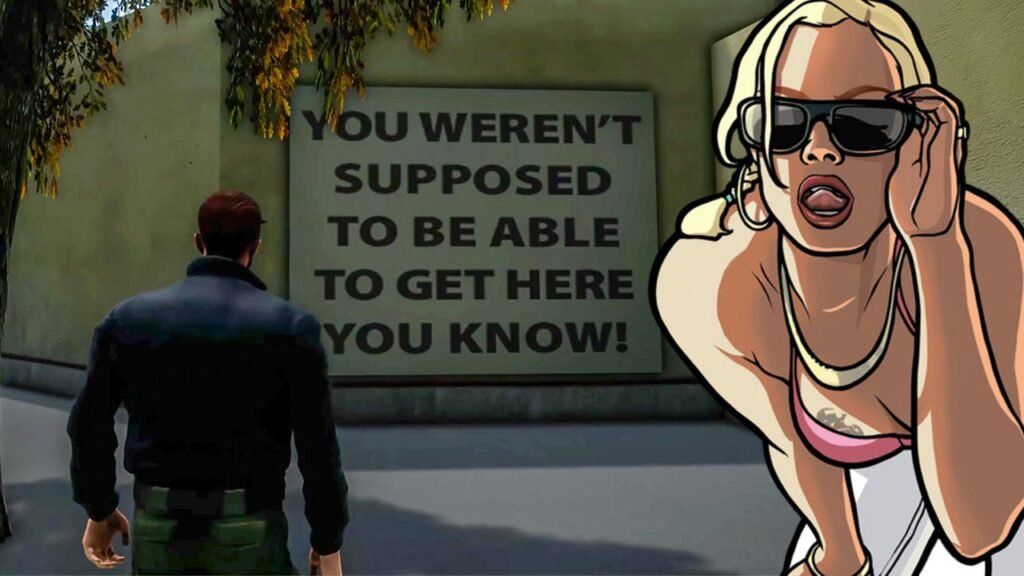
Rockstar anticipated our escape. If you drive up a staircase near a parking lot in Staunton Island, you can hop out and use your car to climb onto a normally inaccessible roof. A precision jump drops you in an unused back alley, where you’ll find a sign that says “You weren’t supposed to be able to get here, you know.” The devs mercifully included a ramp to get us back into the game proper rather than risking a softlock. They knew we’d be snooping around.
Some developers would dummy out this kind of content once it’s discovered, but Rockstar maintained it as a running gag, slapping messages in hard-to-find spots throughout the series. In GTA: Vice City, Tommy can clip through a wall near the VCN helipad to enter a room with a simple marvel pedestal, upon which rests a single egg emblazoned “Happy Easter!”
You’ll find no such ovoid in GTA: San Andreas. The closest you’ll come is the Gant Bridge that connects San Fierro with Las Venturas. The visitor center below contains a display serving up fun facts about the bridge. On closer inspection the text is actually information on the structure’s internal game files, like how it’s made up of 16,000 polygons and takes up a “staggering 1.27mb of disc space.” The sign was actually updated by Grove Street Games for the Definitive Edition release. After 17 years, the bridge’s triangle count doubled, the textures increased fourfold, and the disk space increased a whopping 3,000 percent. Good thing storage has stayed so affordable!
If CJ can tear himself away from the field trip exhibits and land himself on top of the southern suspension tower, he’ll find another secret scolding among the orange steel rivets: “There are no Easter Eggs up here. Go away.” Clearly anticipating you’d be crushed by the disappointment of your futile search, Rockstar eases the pain with a handy parachute to get you back on your feet.
Grand Theft Auto 4 does the bit, too. And cleverly, though nothing mind-blowing for the most part. A museum placard giving out about how hard the dinosaur skeletons were to sculpt, or a warning inside of the Statue of Happiness, through a door in the base reached only by air. “No hidden content,” reads an engraving by a collision-free closed door. Walk through the illusory wall, however and you’ll encounter something far more visceral than anything that’s come before.
Inside you’ll find a ladder vanishing upwards into the body of the rusted copper colossus. Reach the top and you’ll find a scaffold standing just below a huge and hideous heart. Suspended painfully from chains, its maddening beat thunders inside the internal steel chamber and it cannot die. You’re not going to fit this thing in a bunny’s basket.
It’s a darker, more unsettling easter egg than any that’s come before, even if it’s apparently just a jab at Hillary Clinton, who had gone after Rockstar hard as a senator during the San Andreas Hot Coffee scandal. The Heart of Liberty City is the stuff that creepypastas are made of, legends spread in schoolyards and over IRC. The series had outgrown this style of secret by the time of GTA 5. The mysterious content within its sprawling map goes far beyond the scope of easter eggs, with a nearly cultish following all its own devoted to hunting phantom jetpacks.
Simple secrets like these can be more satisfying than the grand ones. There are no forum flamewars, no rumors to chase for decades, the eggs simply exist to be found in a satisfying fashion. The kind of clean resolution that’s usually reserved for the movies.
Part 3: The Opposition
There are generally two kinds of easter eggs. We’ve already covered the first, the ones aimed inward where developers poke fun at themselves and the players. Rockstar’s other specialty points outward: hidden homages to media outside their own domain.
In GTA, this overwhelmingly manifests as movie and TV references, but for a few years the developers also took aim at some of their fellow video games, and they were surprisingly nasty about it. There’s a sense of decorum within the game industry, you might poke fun at your rivals but never call them out by name. But Rockstar, never one to follow the rules, seemed personally offended by the existence of competition.
And there was a lot of competition during the golden age of open world 3D action games. An entire cottage industry of “GTA-likes” emerged in the wake of the series’ success, though the biggest target of Rockstar’s ire actually launched years before GTA 3.
1999’s Driver: You Are the Wheelman, from the (you-guessed-it) British developer Reflections Interactive, sees your undercover cop protagonist engage in thrilling high-speed chases throughout realistic cities. While pedestrians are MIA and you can’t commit any crimes, hero John Tanner is able to walk out of his car in the following year’s sequel for some urban exploration, albeit with some highly unusual animation. Driver was well-liked by gamers and critics, but the release of GTA 3 in 2001 more or less made the series obsolete.
Rockstar knew it, too. A mission called “Two-Faced Tanner” features an undercover cop posing as a driver for Yakuza leader Asuka. She tasks our silent hero with taking out the titular Tanner, who, unlike most mission targets, is represented by a unique character model wearing a very familiar suit. If that wasn’t clear enough, one look at this Tanner’s ridiculous run cycle confirms the devs’ malicious intent.
Reflections fired back in their ill-fated Driv-three-er, slipping in a character known as Timmy Vermicelli. Like Vice City’s Tommy Vercetti, Timmy is rocking jeans and a Hawaiian shirt, along with a pair of inflatable water wings to poke fun at the fact that Rockstar’s heroes couldn’t swim.
By this point GTA was already a massive phenomenon, and some petulant mockery from the genre’s first-mover didn’t make much of an impact, especially given Driv3r’s poor reception, but it didn’t fall on deaf ears either. Rockstar was listening, and used GTA: San Andreas to get the final word in the feud.
In the mission “Madd Dogg’s Rhymes,” CJ sneaks past a character playing a video game, who can be heard to remark: “how could Refractions mess up so bad? Tanner, you suck ass!” Harsh? Yes. Petulant? Absolutely. But what do you expect from a company that made a triple-A game about grade school bullies? Rockstar mocked other also-rans like “True Crime: Streets of LA,” insinuating the game was “rubbish” in response to its rather lame parody of Rockstar as “Jock-straps.”
San Andreas was the end of directly attacking the competition. Such petty rivalries were beneath Rockstar now, old grudges buried in the past along with any other game that could possibly compete with them. You can find the memorial in San Fierro graveyard, on a stone reading “RIP Opposition 1997 – 2004.”
It’s hard to believe, but modern Rockstar is actually somewhat classier now, more dignified as befits their goliath stature. You won’t see them getting in the dirt to dish on other games anymore, but film and television are a very different story.
Part 4: Keep Going
Grand Theft Auto is beholden to cinema. The series is at least 80% made of movies, which is roughly 10% more than famous cinephile Hideo Kojima, and the inspiration is anything but subtle. Entire sequences are lifted from classic films like Heat and Terminator 2. San Andreas simply wouldn’t exist without early ‘90s hood classics like Boyz n’ the Hood, and Vice City is arguably a better Scarface adaptation than the licensed title with Al Pacino’s likeness.
Not every homage is as obvious as Tommy Vercetti gunning down invaders atop his stately manor staircase. Rockstar judiciously scatters movie references throughout their worlds, from NPC chatter to prop design. The most famous of these can be found in Vice City, where a stroll through a random Ocean Beach apartment building reveals a grisly scene within Apartment 3C. Inside, you’ll discover a bloodsoaked bathroom with a chainsaw floating impossibly among the gore, recreating one of the more visceral setpieces from Brian De Palma’s cocaine classic.
You’ll stumble upon lots of these detours and vignettes throughout the games, particularly in Grand Theft Auto 5. Drive far enough into the Chiliad wilderness, perhaps in search of Sasquatches, and you might instead happen upon the aftermath of a drug deal gone wrong, with corpses scattered about a briefcase filled with cash and a dying man warning you not to take it. If you haven’t seen No Country for Old Men, you’ll probably ignore this advice and pocket the dough for a cool $25,000. Even if you have seen it, Trevor Philips and a grenade launcher can probably fend off the assassins who come after you better than Josh Brolin and a bundle of tent poles.
Another secret occurs every night between 7:00 and 8:00 PM, atop a massive cliff in the Chiliad Mountain State Wilderness. Approach the scene by helicopter or watch from a distant road and you’ll see a standoff between law enforcement as two women inside a unique old Tornado, with guitars and a cowboy hat in the backseat that presumably once belonged to Brad Pitt. Rather than surrender, the cornered felons end on their own terms by driving off the cliff, echoing the iconic ending of Thelma and Louise in a parody that’s almost as good as the one in Wayne’s World 2. Unlike the movie, however, we see what happens when the car lands, and it’s not exactly romantic.
There’s much to discover in GTA 5. A ghostly woman who haunts Mount Gordo and writes her killer’s name in blood beneath her. Peyote hallucinations, cryptids and cults. A crashed UFO beneath the sea and the locked hatch from Lost embedded in the Ocean floor, eternally knocking a tap code that translates to “let’s go bowling!”
It approaches a point where the line between “easter egg” and normal content becomes blurry. These indulgences off the beaten path feel different from the winks and nods of yore. They feel more artistic and intentional, without the sense that the developers are surreptitiously speaking to the player.
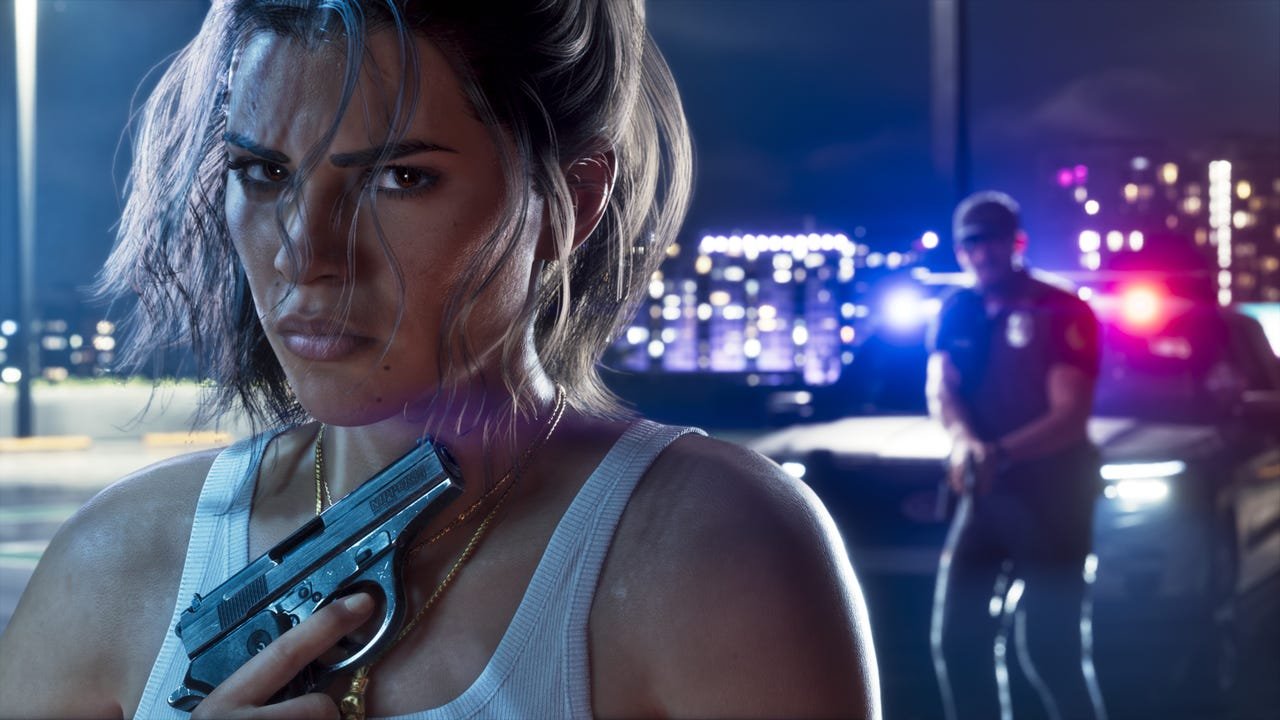
GTA 6’s Vice City no doubt contains a wealth of secrets among its neon streets to sate our curiosity, but the series might just be too big for easter eggs at this point. It’s no longer made by a handful of irreverent Scots but a team of thousands across the globe. New assets go through untold layers of approvals and quality checks before we’re allowed to see them, and the endless demand for online content means that new murals and mysteries can be introduced at intervals, diluting the magic of old school egg hunts now that the games have grown up.

Charlie “Moose” Lopresto graduated law school, passed the bar, and made a financially questionable decision to write about games and movies instead. Contributing to IGN since 2021, he collects solo board games and transforming robots.