
Motorsport is an incredibly dangerous thing to take part in. Think about it: you’re strapping yourself to a machine that harnesses the energy of explosions to propel you forward at speeds that, should you strike another object, will likely prove lethal. And yet so many racing games fail to convey the white-knuckle line between thrill and fear. A whole generation of digital drivers have grown up with on-screen racing lines that show them the perfect acceleration path through a hazardous corner and rewind systems that negate the impact of crashes.
I did not expect Star Wars: Galactic Racer to be the game that addresses those problems. And yet it all makes sense – in a galaxy far, far away, motorsport takes place at vastly higher speeds in much deadlier vehicles across far more dangerous terrain. If it was going to feel exactly right, of course developer Fuse Games had to dial up the fear.
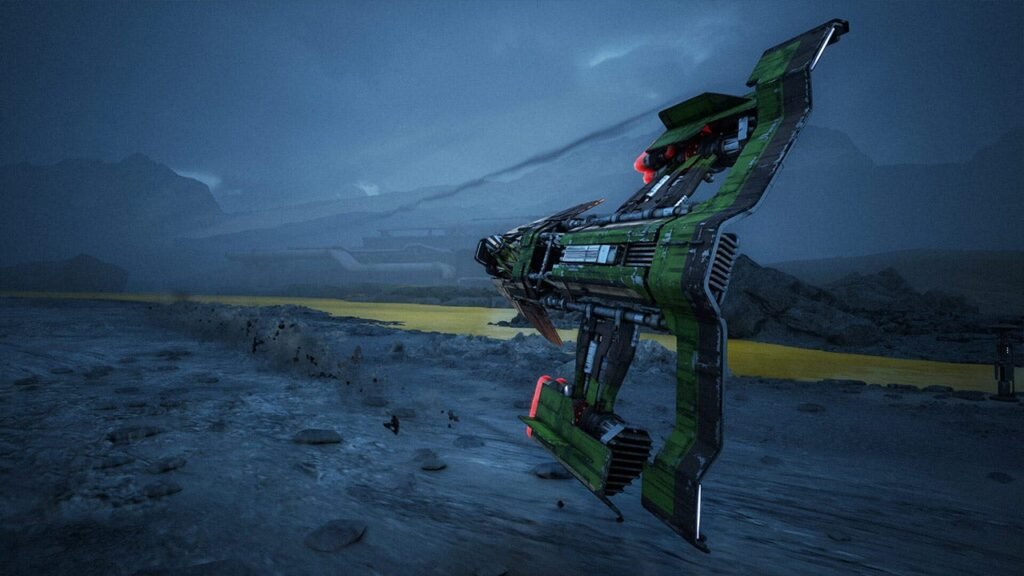
During a four-hour session I was able to play through the entirety of the first act of Galactic Racer’s single-player campaign, which takes your protagonist, Shade, from their first-ever race to the head-to-head qualifier that will earn them entry into the Galactic League tournament. Across that journey, I experienced the thrill of fear in two different ways. The first is the most obvious: speed. Galactic Racer is fast. No matter your vehicle choice – the graceful Skim Speeder, nimble Speederbike, well-rounded Landspeeder, or (later in the campaign) the fast-but-fragile podracer – it’s immediately evident that you’re piloting vehicles that move much faster than the cars of our own world.
That breakneck speed is enhanced by the design of the tracks. On the starting planet of Jakku, you’ll be speeding around and through that iconic crashed Star Destroyer. When you’re hammering the throttle and wrestling with 11 other racers, the sudden switch from wide open desert plains to navigating through the tight tunnels of a spaceship’s engine bay makes for a sudden burst of sweaty-palmed tension. Miscalculating your trajectory into the rusting carcass of an afterburner or fuel line can tear your speeder apart. Crash too many times and you’re out of the tournament, sent back to the very start of the act to try again.
Yes, Galactic Racer is a roguelite. And that’s the second way in which it makes motorsport feel so dangerous: mistakes are costly, and the further into the campaign you get, the higher the stakes become. As you rush through your sixth, seventh, eighth race of the run, every clip and close call becomes ever more distressing. Perched on the very edge of my seat, I found myself willing the racing gods to ensure this final lap went well, save me having to attempt the run all over again.
“We felt really keenly that we needed to progress [racing games],” explained Matt Webster, CEO and co-founder of Fuse Games, when I asked about the roguelite campaign structure. “They need to innovate. It’s felt a little bit static in terms of what you play, how you play, what you play with. [Galactic Racer] looked like a great opportunity for us to lean into consequential decision-making.”
Galactic Racer’s campaign design is all about risk and consequence. The first act sees you compete across four planets, each of which hosts four events chosen from a selection that are plotted across a couple of different pathways. Which path you lock into is one of the earliest choices you make in each run. Analysing each route is crucial to success, as it allows you to consider your own strengths and weaknesses and opt for the event sequence that offers the greatest chance of success.
If there’s a pathway that’s mostly standard races, that’s great – podium finishes provide strong cash rewards and, provided you don’t crash out, even coming in last will keep you in the running. Even better is the Field Test: a solo speed run in an experimental vehicle with the aim of pushing your engine (and your skills) to the very limit. Succeeding provides a bounty of rewards, but perhaps more importantly, there’s zero punishment if you fail. Even better for the cautious player is a path that includes a “Mystery Encounter”, which rather than an event you can lose is a conversation with a friend (or foe) that can offer an interesting upgrade. Much more nerve-wracking is the Eliminator, a brutal race in which those tailing behind are knocked out of the tournament. Only those in the top three can progress.
“You fear the Eliminator,” says Webster. “You fear the critical malfunction. When you’ve got one crash left, you start to race differently. You start to think, ‘Maybe a podium finish here isn’t for me. I’ve just got to survive.’ And that’s a very deliberate balancing act to land those emotional feelings.”
Each run is randomly generated, but the RNG that powers Galactic Racer’s campaign uses a calculated ruleset to ensure each pathway offers an interesting journey. Every run provides options – some easier, some harder – with paths designed to push risk, reward, and consequence.
“The richness of the experience, the highs, the lows, the journey, the goal setting, that is the special sauce right there,” says creative director Kieran Crimmins. “We saw it in other games. We wanted it in racing games.”
“There’s a lot of craft and care and attention put into that to sculpt [the campaign] emotionally,” adds Webster. “And here we are talking about an arcade racer! And that’s the surprise that I think that we really wanted to bring here.”
As I began to settle in and learn the ins-and-outs of my Landspeeder, I found my priorities shifted significantly. After discovering just how dangerous each race can be, and the consequence of failing a run, I became very risk-averse. I’d choose routes that had more Field Tests and fewer Eliminators, knowing that even if I failed those Field Tests I’d still be in the game. But I soon realised that simple survival isn’t always the best path – you need victories to earn the best rewards, and those rewards upgrade your vehicle into a much more powerful machine. I learned how I like to race, that I love to take on dangerous corners and narrow pathways but that my judgement of those distances is impaired by my speed. And so I invested in bolstering my Landspeeder’s resilience and drifting, allowing me to swing through those chicanes without worrying about scraping along the edge of the circuit (as well as smashing through other competitors). Those choices made victory more realistic, and so I took more risks. I earned the rewards. Every moment became a decision on the road to victory.
“We want every corner to matter,” says Crimmins. “We want every engagement with another racer to matter. We want the race and the line that you pick, whether it’s on the map or on the track, to matter. We want the build that you’re playing to matter because we think the highs of that are so much higher when they’re meaningful and you’ve got something on the line.”
It’s this buildcraft – both the way you “build” your campaign through event choices, and the vehicle you craft with the resulting rewards – that makes Galactic Racer feel so fresh and enjoyably complex. The idea of the “CarPG” isn’t new, but the way Fuse Games has adapted the roleplaying elements of games like Hades and welded them onto a racer is genuinely fascinating.
Your vehicle is your weapon, and standard upgrades improve its stats. But there’s so much more to invest in beyond that; Racer Styles appear to be rough analogues for character classes, providing broad starting bonuses that can be honed into build specialisms. Parts offer precise, criteria-driven enhancements – for example, increasing your speed each time you perform a takedown, or expanding your afterburner’s fuel tank every time you redline. Abilities install gadgets that can be activated during the race, like shields to brace against damage, or an autopilot to deftly navigate difficult circuit sections (these are primed at the starting line using a series of button prompts, a fun touch that really makes you feel like you’re flicking switches to activate your engine systems).
The right combination of these components, added in layers with each successive victory, promises to carry you to higher heights. But before you hit those heights, you’ll inevitably crash and burn – this is a roguelite, after all. Failure is part of the experience. But your achievements are not totally lost. At the start of a new run, your old speeder is sold for scrap and the credits used to buy a new vehicle. More heavily upgraded models sell for much higher prices, and so you’re able to spend more money on the next run to enhance the base stats of your new vehicle right out the gate.
I wasn’t able to get a true feeling for how this approach cushions failure, as playing within the confines of act one (and my relatively brief few hours) means I didn’t create a vehicle with astronomical value. But I think it promises a welcome safety net, one that doesn’t erase the classic roguelite challenge of reacting and adapting to the RNG – the specialised component parts are only available as rewards or purchased from your mechanic’s randomised inventory, so you can’t start a run with a highly-tuned machine.
Those parts are vital because they help you master the challenges posed by each unique planet. “The locations in Star Wars are almost characters in themselves,” says Webster. “We know them by name and we know them by biome. What we recognized there was an opportunity not just to have a visual change, but to lean into this concept that the location has a much deeper impact than just the configuration of the racetrack.”
In act one, the jungle world of Lantaana features tracks that snake through a volcano. The magma spills cause your engines to overheat – push your ramjet thruster as far as you did on the previous planet of Jakku and you’ll quickly find yourself at the start of a new run. Survive Lantaana and you’ll trade fiery magma for the ice fields of Ando Prime, where the chilly conditions mean you can push your afterburner harder than ever before without overheating… a tactic that’s practically mandatory to stop your engines from freezing over.
With a fresh hazard on each planet, the pathway to the perfect vehicle isn’t a straightforward upwards climb – the idea isn’t to just improve, but to specialise.
“Your first experience is, ‘Okay, the cool does this, the heat does this, or the freezing effect does that.’ But then you start to get certain parts that subvert that,” explains Crimmins. “So any of those that are negative, I can now make them a positive and vice versa.
“You can start to build into a system where things that started off like, ‘Oh, I better avoid the lava’ becomes ‘Now I’m going to go in the lava because it’s going to increase my ramjet. And not only is it going to increase my ramjet, it’s going to make me go faster. And then I’m going to equip a [component] so I can turn that into energy. And then I’m going to use that energy to ion blast another player.’ And it’s at that point you start to get into a place of combinatorics that just has so much more depth and breadth than your average racing game.”
It’s that level of depth and breadth that makes Galactic Racer such an exciting proposition. When I arrived at Fuse’s studio, I entered assuming I was about to play a nostalgic throwback to Star Wars Episode I: Racer. I left having played something much more forward-thinking. This could very easily have been a classic circuit or open-world racing game, adhering to the tried and tested principles. But the roguelite campaign structure changes everything – the adrenaline, the stakes, the emotional highs and gut-punching lows. Galactic Racer is shaping up to not just be a great Star Wars game, but a genuine trailblazer in the racing roguelite niche.
Matt Purslow is IGN’s Executive Editor of Features.