1666: Amsterdam returned to the public eye this year after a protracted 15 year conception that involved legal battles, rewritten concepts, secret publishers, and finally: an actual game. Suffice to say, this is the game Patrice Désilets has wanted to make for a very long time – Désilets being the original creator of Assassin’s Creed and more recently the mind behind primate evolution game Ancestors: The Humankind Odyssey.
But the return of 1666: Amsterdam – developed by Désilets’ Panache Digital studio, which he co-founded in 2014 – was marred by a ‘mixed’ reception to its short playable prologue, released in June on Steam. It was a glimpse of 1666 Amsterdam that left me with as many questions as it did answers, such as ‘What will the combat be like?’, ‘Will we be able to actually explore Amsterdam?’, and ‘These overlapping timelines are confusing.’ Okay, that last one isn’t a question, but it’s true; its action takes place in 1666, 1999, and the present day, and moves between the three of them. There were a lot of ideas not especially well explained. But now I know more.
I recently travelled to Amsterdam to play more of 1666: Amsterdam, and to talk to Patrice Désilets about it. During the trip, he takes us around the city to show us places modelled in-game. He even shows us the inspirational “Anno 1666” plaque he saw on a wall while on a fateful aeroplane layover here in 2011, which ultimately inspired the game. And standing among these tall, tottering buildings, his idea to make an Assassin’s Creed-like experience set in Amsterdam absolutely makes sense: it’s a powerfully distinct place to be.
Let’s start with what I play after the Prologue ends, as this is where my hands-on demo begins. That Prologue is the start of the game, by the way, and moments after it ends, we’re back as protagonist Noa in 1666 and combat finally begins. She fights by – I kid you not – twirling a wooden broomstick around, and by casting spells, though this early on we don’t know any. Instead, combat revolves around one kind of attack, one kind of defense, a dodge, and that’s it. It’s very one-note. Even later on, when spells are available – a petrify spell turns enemies to stone, for example, and a levitate spell lifts them for aerial assaults – that limited core underpins and somewhat stymies the experience.
The encounters themselves are wave-based, and you’re cinematically locked into a multi-stage encounter until it’s cleared. Enemies appear seemingly out of nowhere, until you’ve either defeated them or raised your intimidation level high enough to scare them off, which is a nice touch. With attacks landing from all angles, it can feel awkward, and there’s a general feeling of scruffiness, or jank, to the build I play. But I like how enemies insult you, and there’s a sense of occasion about these staged showdowns.
After combat, I experience more of the game’s exploration, and at pace: you can fly on your broom across Amsterdam’s watery canals, twirling like Darth Sidious to barge boxes and other light obstacles out of the way. But as with other areas of the game, this isn’t as freeform or liberating as it sounds. There are specific areas for flying – it’s not something you can do everywhere – and it’s more like hovering above a surface on a prescribed track than soaring through the air.
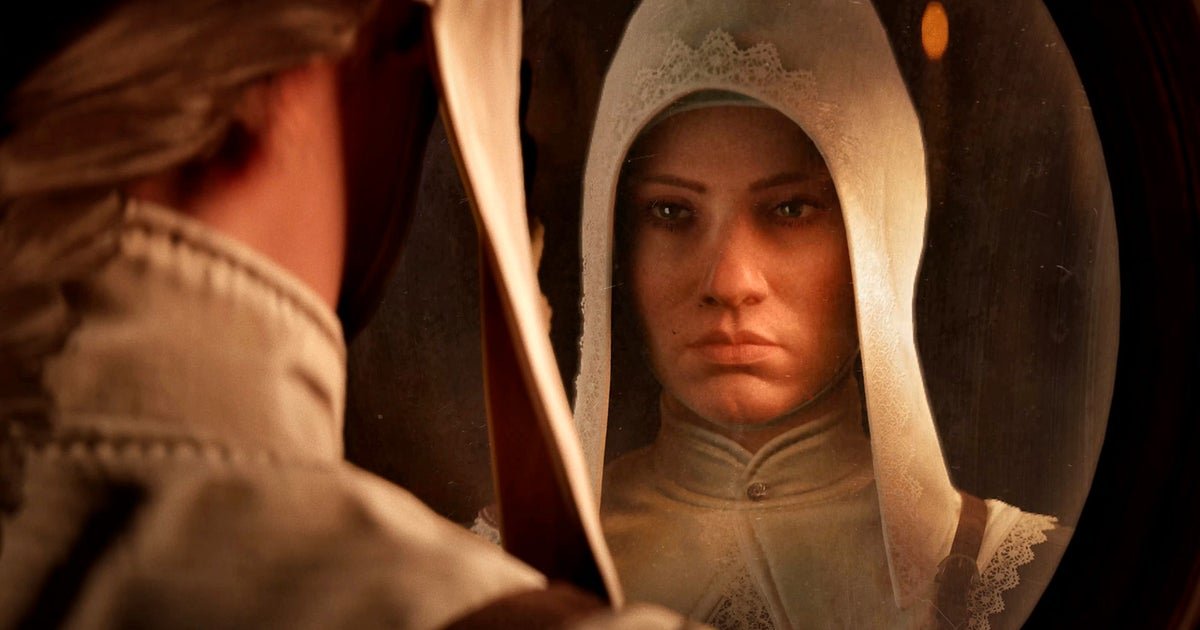
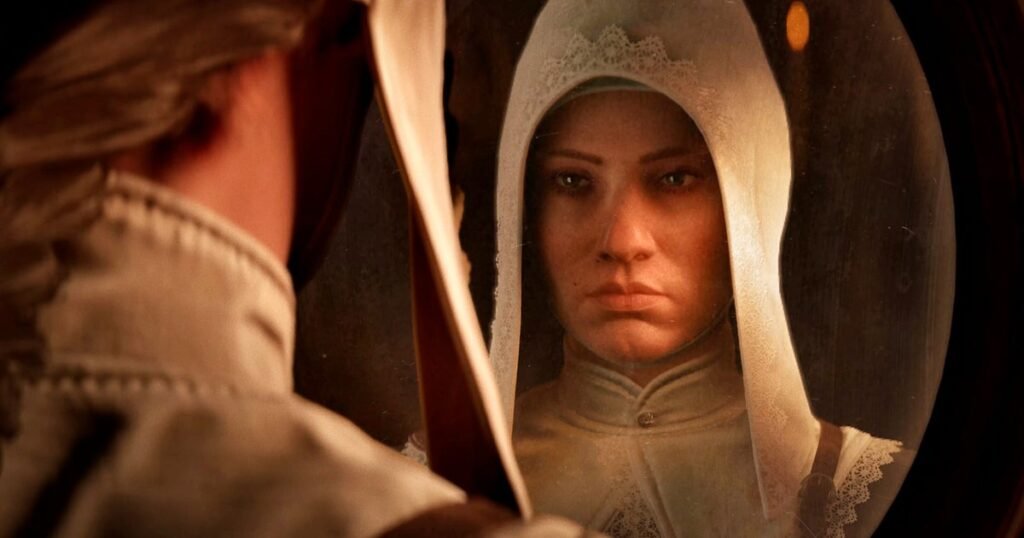
The experience improves as we arrive in Amsterdam proper, landing on a bridge at night amid a city bustling with activity and people. It’s also here that the shape of 1666 Amsterdam, as a game, becomes much more transparent. Noa, now in civilian form – if she were to stay as a witch, a suspicion gauge would fill and authorities would be alerted, such is the mistrust of witches in the era – proceeds towards a house to find an Original she’s come to ‘collect’ from. You are a sort of debt collector for the devil, you see, and Originals are people who made deals with the devil 333 years ago. Now, their time is up.
As with Assassin’s Creed, then, there is an element of hunting a target, a pursuit that will later occupy entire chapters, though to begin it’s a simple affair. A key component of city exploration is the cat, your familiar, which you choose at the beginning of the game and who accompanies your travels. The cat is also your link to the year 1999 and the character Aaron whose timeline that is, because in the year 1666, Aaron is Noa’s familiar. Then in 1999, the roles are reversed: Noa is Aaron’s cat.
There are a few benefits to having a cat familiar. The primary one is breaking and entering – cat burglary, you might call it. Cats give 1666: Amsterdam its parkour. Noa can open a window enough for Aaron-cat to fit through, at which point you possess him and pad around as a cat finding a way to let Noa in. Rooftops, drain pipes, small gaps and crevices: these are the domains of the cat. You can unlock doors, unbar entry ways, and collect consumables for your human counterpart, and it makes for nice variation.
The cat moves with pleasing feline grace, too, and makes good use of Amsterdam’s iconic teetering vertical spaces, though again, you can’t move entirely freely. There are specific ledges and windows you can use, and a kind of ghost-like hint system showing you where to go. Your cat companion can also offer hints on demand if you’re stuck about what to do. The buddy system in general: I like.
The capstone of a hunt is a confrontation with an Original, who are major, scripted characters within the story who occupy all kinds of positions in society. Once you’ve amassed the various pieces you need to solve an investigation, you can perform a ritual to reveal their inner demon and have a boss fight, basically, and the one I experienced early on was tough. The black shadowy horror I fought defeated a few times in just a few hits- it was a sharp difficulty spike – and these Original boss hunts painted the game as far more of an action experience than I’d realised it would be.
Yet, it wasn’t until Désilets led a later-game demonstration that even more interesting parts of 1666: Amsterdam came into view. By now, entire districts of Amsterdam were open to explore, and Désilets and team made a point of reiterating that every building you encounter in the city is explorable, offering clues and power-ups and a soft sense of puzzling as you work out how to get in. Noa also has her own house, a sort of base of operations, where she can craft items and cool down her suspicion gauge before venturing out again – in a dramatic swan-dive from her window that’s more than a little reminiscent of Assassin’s Creed.
But what really grabs me about this later part of the game is the roguelite structure it has, which I had no idea about before now. The thinking is that each Original represents an enclosed roguelite experience – a chapter you approach your way and accrue powers within while trying to tackle it. Die and try again and these powers reset and shuffle, which is intriguing. These powers can be spells or a charged melee attack, say, and are visually represented with a nice flourish in that they’re decorations in your hair, or things attached to your person, so you can see at a glance how loaded you are, so to speak. Should you succeed in your hunt, you’ll retain them.
Here, then, 1666: Amsterdam reveals itself as a much more systems-led game, giving you the freedom to slowly explore a city and piece together clues – or just noodle around doing your own thing – and to mechanically play with character builds. There’s one rebuild spell which quickly puts market stalls back together after you’ve blown them to smithereens, which is wonderfully animated. And it’s here 1666: Amsterdam finally comes fully into view, I think, and shows what kind of game it will be. It also suddenly makes much more sense why Panache Digital thinks it’s a good fit for early access, a model systems-led games typically adore but narrative-led games avoid.
The other side of that – Désilets doesn’t hide it – is that Panache needs money to finish the game. “We all need money at the end of the day,” he says, “to finish our stuff.” 1666: Amsterdam had a secret publisher for several years, which was rumoured to be Xbox but Désilets won’t confirm it. Panache is alone now, though, and not looking for another publisher. “The publisher is the people who are going to play the game with us,” Désilets says.
Herein lies an important distinction to make, then: there may be comparisons to the Assassin’s Creed series but there are nowhere near the resources, and you can tell. A team of 70 people are making 1666: Amsterdam, and while there’s a lot of commendable artistic style influenced by the Dutch masters Rembrandt and Vermeer – which is particularly impressive in the interiors of buildings and on Noa herself – secondary characters and game performance can be poor. Frame-rate is something I’d usually overlook in a demo ahead of release but it was especially choppy and we are only a few weeks from early access on 25th August. It’s enough for me to be concerned.
Then again, it’s also worth remembering this is an early access release, a period designed to address things like performance and gameplay and everything else, and Désilets seems enormously encouraged at the prospect of working with a community. And while there’s only approximately 10 hours of the game being offered for its early access launch, which is less than half of what Désilets wants to have in the full game, there’s a plan to finish it should it be successful in early access or not. “I’ve waited 16 fucking years to finish what I started,” he says, smiling. “I finish what I started.”
Whether or not 1666: Amsterdam will have been worth the protracted wait, I can’t yet tell, but I’m encouraged by its difference. At the front of my mind, while playing it, is a conversation I had recently with former PlayStation leader Shawn Layden, about a lack of double-A games today. This middle tier is where the creativity and risk happen, Layden reasoned, and without it, we drown in sequels and risk-averse blockbusters. 1666: Amsterdam is not that: it’s not risk-averse. Maybe it does have one too many ideas, maybe it is a bit scruffy, but it’s not something I’ve played before. And that, I think, counts for a lot.
This piece is based on a trip to Amsterdam to see 1666: Amsterdam. Panache Digital paid for flights and accommodation.