This is an IGN opinion piece from writer Jeremy Peel, who had played over 200 hours of ‘regular’ Marathon before trying out the new experimental Vault Breaker PvE mode, which is live until August 18.
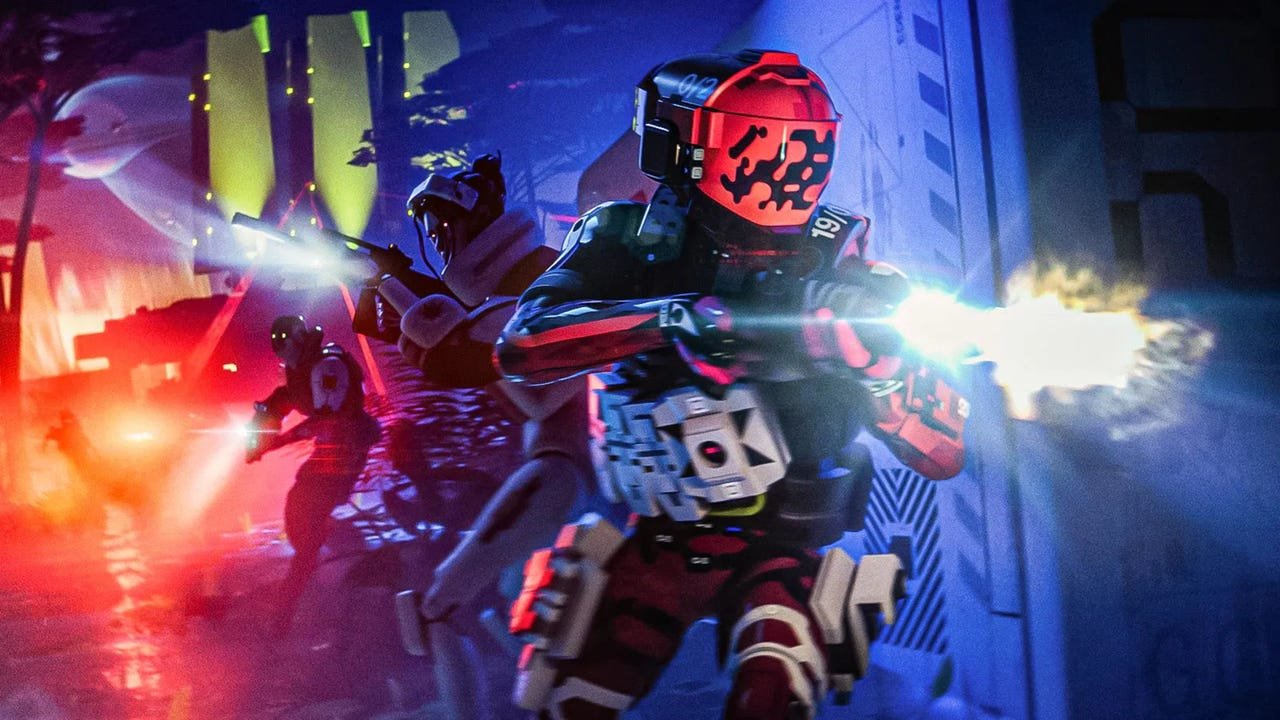
The vault’s door rolls back with a yelping alarm, as if the very act of opening comes as a shock after a century of stillness and silence. Its stalactite-strewn staging area is home to trolleys laden with toolboxes – a suggestion that this place once knew human hands. But further in, the walkways narrow to crawlspaces walled by thick pipes and electrical cabling – the domain of only the most unfortunate engineers aboard the UESC Marathon. Vents coat the floor in frost, and a simple sign warns staff to ‘WORK IN PAIRS, LEAVE IN PAIRS’. Certainly, a trio of consciousness-imbued metal shells armed with blades and shotguns was never meant to be here.
For 200 hours in Marathon’s company, I was never here either. During that time, I navigated Dire Marsh in the dark, relying on blueprints drawn only in memory. I cracked open the Pinwheel at the heart of Outpost and shanked teams in its clinical corridors, where greed runs rampant. I foiled ambushes in the ravines of Perimeter, picking out the giveaway sounds of player movement against a backdrop of buzzing robots and squawking birds.
But the secrets of Marathon’s raid map, Cryo Archive, remained largely closed to me. Partly that was because of its entry requirements – weekend only, and restricted to those who’d put in the hours to level up two dozen times in a season, which ruled out any friends with children or a sensible set of priorities. But even once aboard, newcomers were victim to the tiny subset of top players who had already learned the Archive’s labyrinth, and who ruled its gangways. The rest of us – distracted by dazzling loot and the fundamental puzzle of how to disable the Archive’s security – became easy prey.
Don’t get me wrong: I fully believe that the magic of extraction shooters lies in the way they split your focus, between a hostile environment and the everpresent possibility of player attack. The trouble with Cryo Archive as a PvPvE proposition, though, is that it asks too much E from you. Its Destiny-style vault puzzles, steel-hard bot encounters and vertiginous maze are more than enough to grapple with; the sprinkle of sentient, highly-skilled enemies on top merely overwhelms the majority of players, before they can ever hope to find a foothold on the map.
Bungie’s new Vault Breaker mode solves that problem by taking out one of the Ps, making a satisfyingly knotty PvE shooter of Cryo Archive. It may not be the approachable co-op entry point that longtime Destiny heads have been crying out for – it’s frankly a little too brutal for that – but it does reduce the cognitive load just enough to allow the map’s majesty to slowly bloom in the brain.
Upon loading up Vault Breaker – a temporary addition to Marathon which will run until August 18 – you’re handed a key to one of the Archive’s lowest-security vaults and pointed in its direction. To get there, you’ll fight through waves of defending bots, either alone or with a team, and gradually expand your access to different areas of the ship. Many thresholds are blocked until you can upgrade your security clearance, by hacking terminals and looting tags from enemies. And the vault doors themselves are powered by batteries; they’re scattered liberally throughout the Archive, yet tend to go unnoticed during a hurried search. Thankfully, batteries emit a telltale sound when near, and can otherwise be uncovered by activating wall scanners.
Victory isn’t particularly likely on your first couple of attempts. But over time you’ll find your way into those first vaults, and pull out the Indexes – little doodahs that constitute currency in Vault Breaker. This is how Bungie protects the rest of its PvP game from a sudden influx of Archive riches: by restricting your winnings to Indexes only. Any high-level weapons you come across during a Vault Breaker run might well be useful in the moment, but they won’t be coming with you on exfil.
Instead, you improve your odds for future runs by spending Indexes on permanent improvements to your Vault Breaker kit – better shields, bigger backpacks, spare batteries, and starting upgrades to your security level. It’s a roguelike-adjacent system that helps ensure steady progression through the Archive. On early runs, you might be grateful for the pickings of Vault 1, and trigger an exfil right there and then. But later, you’ll be tempted to break open multiple vaults back to back, plunging deeper into the Archive’s network of grand fridge-freezers.
In the higher-numbered vaults, things get more complicated. You’ll often need to come prepared with containers filled with coolant, a head for pattern-matching puzzles, and a trigger finger ready for boss fights. In at least one vault, an ambient virus attacks the very operating system your avatar’s shell runs on – eating away at your health bar, like a nightmare dreamed up by John McAfee.

Despite the difficulty, the extra breathing room afforded by removing enemy players allows you to take it all in. You start to notice the details in the level design. The body-shaped compartments, carried on racks in morbid mimicry of a dry-cleaning service. They must once have held passengers in stasis. Then there’s the screening room, where row after row of seats face an image of floral bliss. Was this how the crew kept ahold of their sanity across generations, with bittersweet echoes of home? “Reminder,” says your onboard AI, Oni. “300 years of cryosleep is not recommended.”
Most striking of all is the vast Panopticon, at the centre of it all – an awesome sight, straight from the scribbles of ‘70s sci-fi concept artists. Here, real-life reference points simply fail. Is it a dark metal pineapple, draped in strawberry laces? A squat sea mine, under assault from a misguided jellyfish? Though humanmade, it’s as alien as anything found on the surface of Tau Ceti IV. Perhaps that’s only appropriate; the ship was built inside a moon from Mars, after all.
The Archive may keep beating me back in its original PvPvE format, but thanks to Vault Breaker, I finally feel like I’m learning something each time I go up against it. I haven’t had to compromise Marathon’s sense of mystery by digging into wiki entries or watching YouTube explainers. Instead, I’ve been able to muddle through, picking up knowledge through trial and error, and via the example of grudging Sherpas. One player I was grouped with initially tutted at my inexperience, but ultimately taught me a couple of valuable tricks: where to find the direct route from Control to Cold Storage, for one. And how to take advantage of the Medic’s passive to spread anti-virus protection among a team. “We’ve all had to learn it,” he acknowledged, a touch of Midlands melancholy to his English accent.
I don’t get the butterflies in my stomach while booting up a game of Vault Breaker, the way I do in Marathon’s standard modes. Co-op can’t match the adrenalised terror of PvP; the tension of stealth or shootouts when your life and gear is on the line. But Vault Breaker has a valuable role in the push and pull of normal play. Raid enough vaults and you can cash out, exchanging Indexes for powerful blue shields or killer weapons you can bring back to the main game. Then, when PvP inevitably goes wrong, you can crawl to Vault Breaker to lick your wounds, replacing your lost guns in the process.
Marathon regulars have appreciated the yin and yang between PvP and PvE modes before. But dismayingly, never for long. Bungie has always marked its non-competitive modes as ‘experimental’, and ripped them away just as they’ve become familiar and welcome parts of player routine. Evidently, the studio has been concerned about splitting its playerbase between too many modes when matchmaking is already slow. And perhaps it believes there’s value in the artificial scarcity of temporary modes, too – a kind of FOMO that keeps us logging on.
Thankfully, Bungie has promised a permanent PvE outlet – a way to cool down between the more painful bouts of competitive gear-snatching. It’ll arrive with Season 3, on September 22. And I wouldn’t mind if that eventual mode turns out to be a lot like Vault Breaker. As it transpires, Cryo Archive’s warrens and conundrums are engaging enough without the threat of ganking from enemy players. Given a space of its own, the map blossoms, and you can feel your synapses crackling as you come to understand it in new ways.
Bungie would tell you that Vault Breaker’s final boss is the Compiler, the multi-phase monster that awaits in Vault 7. But a part of me hopes that, one day, I’ll bring all I’ve learned about Cryo Archive back to PvP, and get revenge on the high-level hyenas who’ve become so accustomed to playing with their food in the shadow of the Panopticon.
Jeremy Peel is a freelance journalist and friend to anyone who will look at photos of his dogs.