Peter Molyneux does his greatest hits, mixing god sim, business sim, and third-person adventure into a charming, appealingly tactile – if slightly awkward – whole.
If Godus taught us anything, it’s that caution should probably be exercised at the point Peter Molyneux, his 22Cans studio, and early access meet. That game languished in Steam early access for eleven years (spawning an equally unfinished early access spin-off, Godus Wars, along the way) before its unceremonious removal in 2023. Masters of Albion – a sort of Molyneux best-of blend of god sim, business sim, and action-adventure – enters early access in clear need of refinement, and with missing modes and at least some of its world cordoned off. Scepticism is understandable. But with that warning out the way, here’s the surprising bit: Masters of Albion is good. Weird, yes – propelled by a fascinating, occasionally discordant mishmash of systems – but enjoyable nonetheless, even if that does come with some early access caveats.
Masters of Albion does not, however, put its best foot forward. Its performance is erratic even after a lot of tinkering, eventually landing somewhere close to a judderingly unstable 30fps on my decently specced machine. Its UI, meanwhile, swings from the unhelpful to the bewildering, even when it comes to the most basic stuff. If you want to quit the game from the main menu, for instance, you’ll need to go into ‘settings’ then switch to the ‘misc’ tab to find what you’re looking for. And if you want to return to the main menu once you’re in-game, you’ll need to quit to desktop and come back in. Resolution and refresh rate is tied to your Windows system and can’t be changed in-game; DLSS support appeared to be broken for me, and you’re out of luck if you were hoping for multiple saves. And yet…
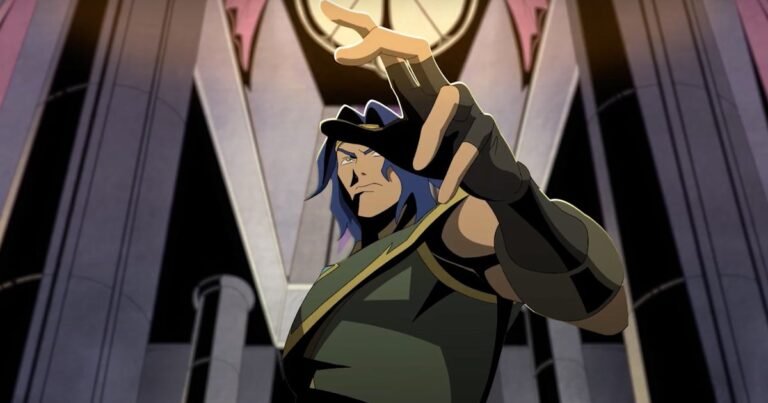
Masters of Albion is not a Fable game. Its setting might share a name, but this is another ancient Albion facing a looming calamity; another ancient Albion in the grip of magic and tyranny, and another ancient Albion imagined as a bucolic idyll shot through a distinctly British sense of whimsy. It’s got a bawdy (and unexpectedly sweary) spirit; it runs a gamut of silly voiced regional accents, and Fable composer Russell Shaw’s dark fairytale score is lovely but, well, quite a lot like Fable. And yet, there’s enough skill and artistry and earnestness here that it rises above cynicism, making for something that’s at once soothingly familiar and genuinely charming.
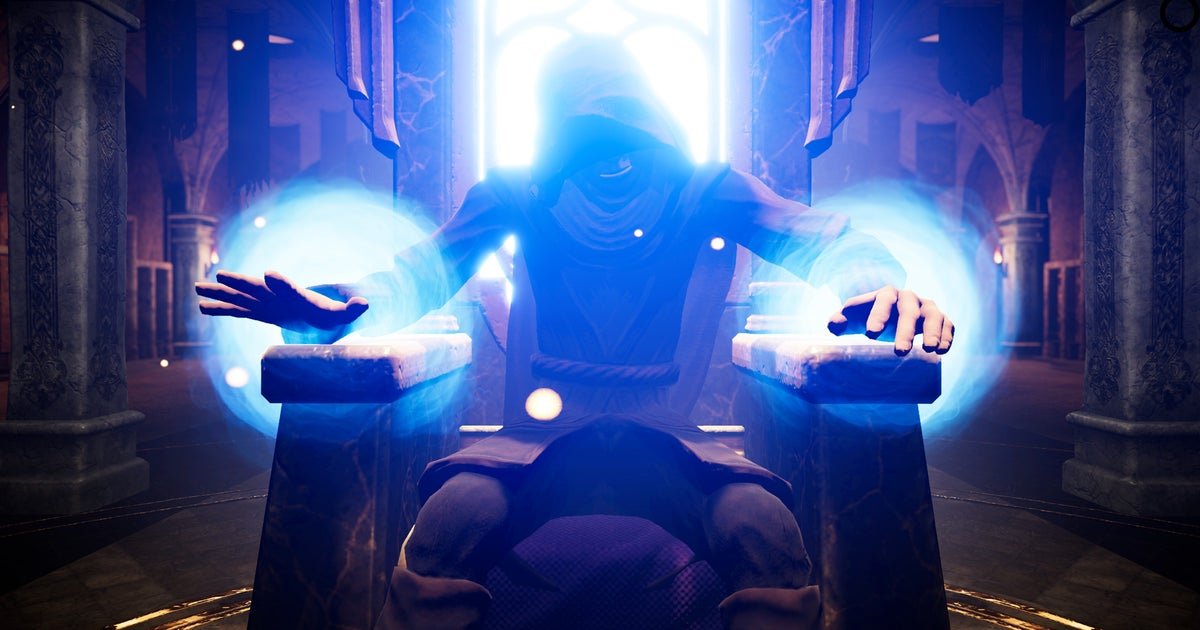
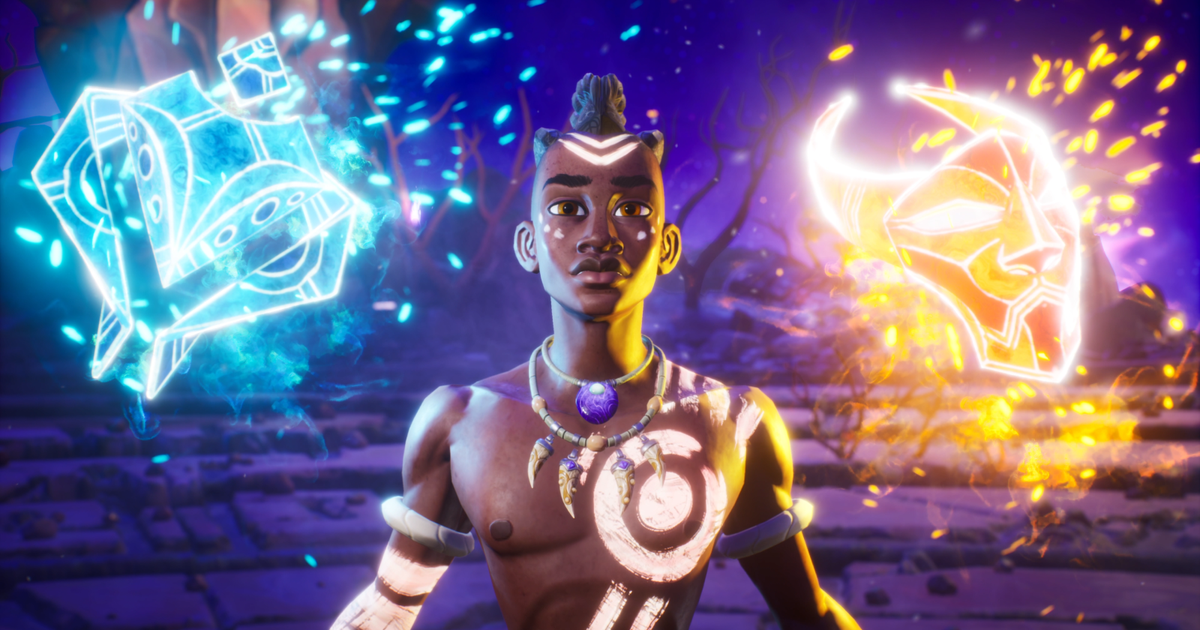
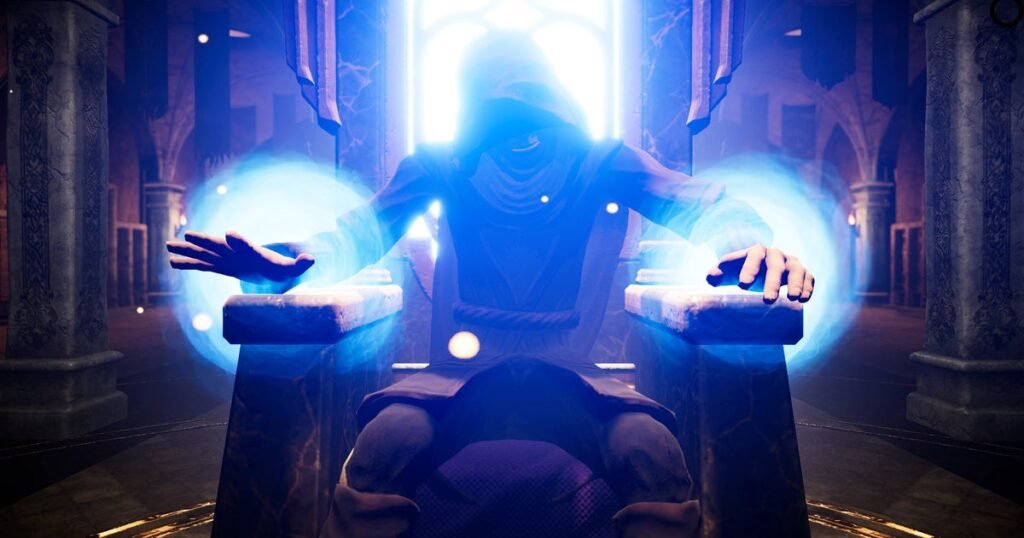
Amid all this, you are the chosen one; a hooded figure called to the abandoned village of Oakridge by a mysterious voice. Soon enough, your pre-destined buttocks plop onto a throne of unimaginable power – whereupon your hand flies off, swells to improbable proportions, and your omniscient godhood begins. Let’s stop and admire your giant disembodied appendage for just a moment though, as it’s arguably the star here. Building on some of the ideas in Molyneux’s 2001 game Black & White, it’s more than just a flashy cursor, bringing a wonderful sense of tactility and physicality to play as you use it to interact with the world on a more tangible level. You’ll lob rocks at monsters during combat, assemble pies on a production line, fling resources from one building to the next when your workers are being slow, shift NPCs around like chess pieces, or simply to knock stuff over.
It’s the five-fingered constant in a game built from three dovetailing modes of play, making the transition between Masters of Albion’s chaotic real-time tactics, its granular business management, and its third-person adventuring just a little more seamless. There’s a lot to get through here, though, and it’s perhaps best explained by working backwards from night.
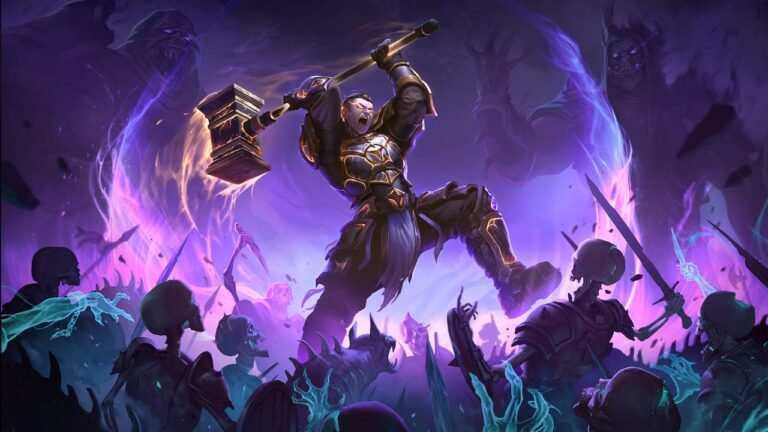
Once darkness falls at the end of each day (a transition you’ll trigger manually in the mode included at launch), Albion’s undead hordes attack. They’ll swarm toward one of your settlements from specific spawn points, and you’ll need to complete each night’s mandatory and optional objectives before dawn arrives, using a combination of real-time tactics and forward planning. During combat, you can hoist your tiny contingent of heroes around the battleground to deal with the undead masses; left alone, they’ll battle autonomously – freeing you up to hurl lightning bolts, sling fireballs, or lob chunks of scenery around – or you can possess them and fight at ground level in third-person. And if you’ve planned ahead properly, you’ll have turrets dotted around to deal with excess enemies, tower-defense-style. Victory means progress to the morning, failure means trying the night again.
But let’s rewind back a bit further. Before nightfall, you’ve got a whole day to do as you will, but ultimately it’s all in service of the next impending battle. At any time, you can view your next batch of victory conditions, what you’ll be fighting, and where they’ll be spawning from. That gives structure to your daylight hours as you prepare for what’s to come; crafting weapons and armour for your heroes, training them to unlock new abilities, setting their patrol routes, adjusting turret layouts to tackle expected choke points, and building perimeter walls to shore up your defenses. The trouble is, all this requires significant amounts of cash, so back we go again.
In order to keep your coffers full, Masters of Albion demands you spend a not-insubstantial amount of time behaving like a burgeoning industrialist, designing goods and managing simple production chains. Orders come in via hot air balloon and you’ll need to assemble a suitable prototype in your factory to satisfy that client’s specific, often slightly cryptic, demands. Perhaps they want a basic dish that’s wet, cheap, and green, so you’ll shove some rat meat into a bowl of flavoured water then toss a sad piece of lettuce on top. You then test it, and if it appears to fit the brief, you can start full production.
It’s a system – coupled with a market simulation that can be exploited to maximise profits – that appears to have started life in 22Cans’ 2023 blockchain business sim Legacy, and while I realise designing sandwiches one slice of bread at a time is perhaps a little jarring in a game that’s supposed to be a godly power fantasy, the tinkerer in me finds its puzzle-like assembly oddly engrossing. Final designs must then be produced, which is where your linear production chains come in. Food requires flour from your mill, for instance, which requires wheat from your farm, and each link in the chain is mandatory, meaning there’s no real strategy in what you build. Instead, efficiency gains are made through building placement – reducing walking distance between critical nodes – and you can speed up production with additional workers, all requiring their own accommodation. Money really is everything in Masters of Albion.
There’s one last bit to all this though, so let’s rewind one final time. Your big ol’ hands hold no sway in areas of Albion still shrouded in fog, which is a problem given you’ll eventually need to diversify your manufacturing into weapons, armour, and more, requiring a whole new chain of buildings and resources. So, to build new settlements, you’ll need to possess one of your heroes and explore the world from a Fable-style third-person perspective, meandering toward broken beacons you’ll need to reassemble and activate to clear the murk and assert control. And down on the ground, Masters of the Albion is wonderfully striking, conjuring colourful vistas of rolling hills, dense forests, flower fields, and strange stone circles. Tumbledown farms nuzzle babbling brooks in the shadow of vast stone cities; rugged cliffs lead to drab beaches and shimmering oceans pierced by ominous spires. But as pretty as the world is, it’s also limited; home to the occasional secluded cave, the odd enticing treasure chest to find, insult-spewing gargoyles to smash, and a couple of amusingly daft quests to mix things up: kick these chickens, say, or kill these wasps.
That, I realise, is a lot of explanation, but there’s a lot going on in Masters of Albion, and inevitably, not all of it works. It’s annoyingly woolly when it comes to feedback, often obfuscating valuable information – why do I have to open a secondary window to see how much an ingredient costs, for instance, or why is there no easy way to compare the strength of weapons? The world, meanwhile, is just too slight to make third-person adventuring feel like anything other than a cute novelty, and its one-button hero combat is rudimentary in the extreme. Nighttime incursions require enough tactical planning to feel rewarding but margins for error are small, so satisfaction can quickly give way to trial-and-error frustration. As for those production chains, they’re a whole different kind of problem. All thanks to a stingy economy that means you’ll spend an overwhelming amount of your time focused on production in order to do anything meaningful – I cannot tell you how long I’ve spent holding a button down to waggle my magic finger at a building and speed things up because, even with multiple workers, manufacturing is so glacially slow. This is not the godhood I was expecting.
But, I’d be lying if I said I wasn’t also absolutely captivated by the whole thing during the 15 or so hours I’ve played. Pie making mightn’t be very god-like, but there’s something enormously satisfying about sleuthing your way to making the perfect product based on enigmatic clues, then watching that exact dish trundle its way through the production chain. Nighttime segments can feel fearsomely unfair, but the sense of victory at the end of it all is immense. And there might not be much to see while adventuring, but it’s still a neat trick that helps up the emotional stakes.
And all these disparate bits wrap around each other in genuinely compelling ways. Masters of Albion’s campaign might feel like an extended tutorial, but it’s well-paced, witty, and wonderfully voiced, tossing in an imaginative new diversion whenever it feels like things might be getting stale – getting you to possess a dog and investigate a disappearance using your power of smell, say, or turning a night mission into a hectic escort quest involving a bunch of worshippers meandering behind you in a snaking conga line. Eventually, hints of a morality system start to emerge, and I haven’t even talked about the tactile building system, which lets you design your own structures by snapping together assorted decorative and functional blocks. Masters of Albion is full of these kinds of wonderfully playful touches.
I’ve genuinely had a good time with Masters of Albion, so far. It might borrow little bits of everything, but it’s a mish-mash that somehow works, shaping those disparate bits into a charming, compelling whole. I do worry that after 15 or so hours with the early access build, there’s a wisp of wearying repetition setting in as the excessive focus on manufacturing micro-management drowns out everything else around it, but that’s something a couple of balance passes could hopefully resolve.
What I’m not too sure about, though, is how much of the planned final game is actually here on day one. 22Cans says some of Albion will be inaccessible when early access starts, so there’s at least a chunk of its expected 20 to 40 hours of playtime still to come. Additionally, two more modes are planned: Master mode, which limits the amount of daytime available to complete takes, and a permadeath Rogue mode. That’s a fair bit still riding on a promise then, which brings us back to that question of trust, and whether a 22Cans early access release is a gamble you’re willing to take. But this is an encouraging start, and I’d love to see Masters of Albion reach its obvious potential – so let’s see where we’re at in a year’s time.