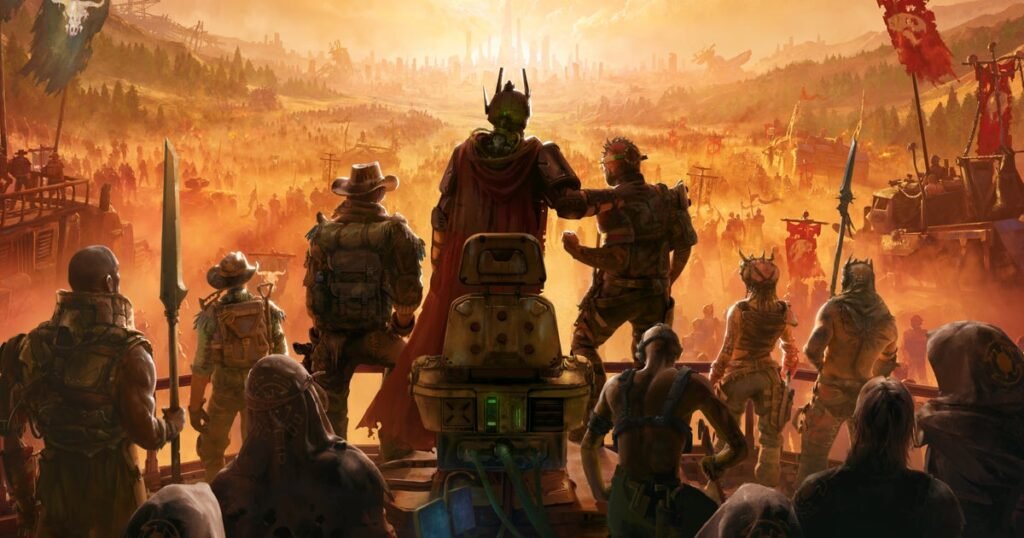
I’ve got a bit of a funny relationship with Paradox’s grand strategy games. I love the idea of them, of waging and flirting my way across history on the most granular of levels. But despite my enthusiasm, and despite my best efforts, I’ve never probably cracked one: it doesn’t take long before I’m feeling thoroughly overwhelmed and my attention quickly begins to wane. I bring this up, because my relatively brief hands-on time with Paradox’s new post-apocalyptic grand strategy game Afterworld suggests – thanks to some smart design decisions – it might finally be the one for me.
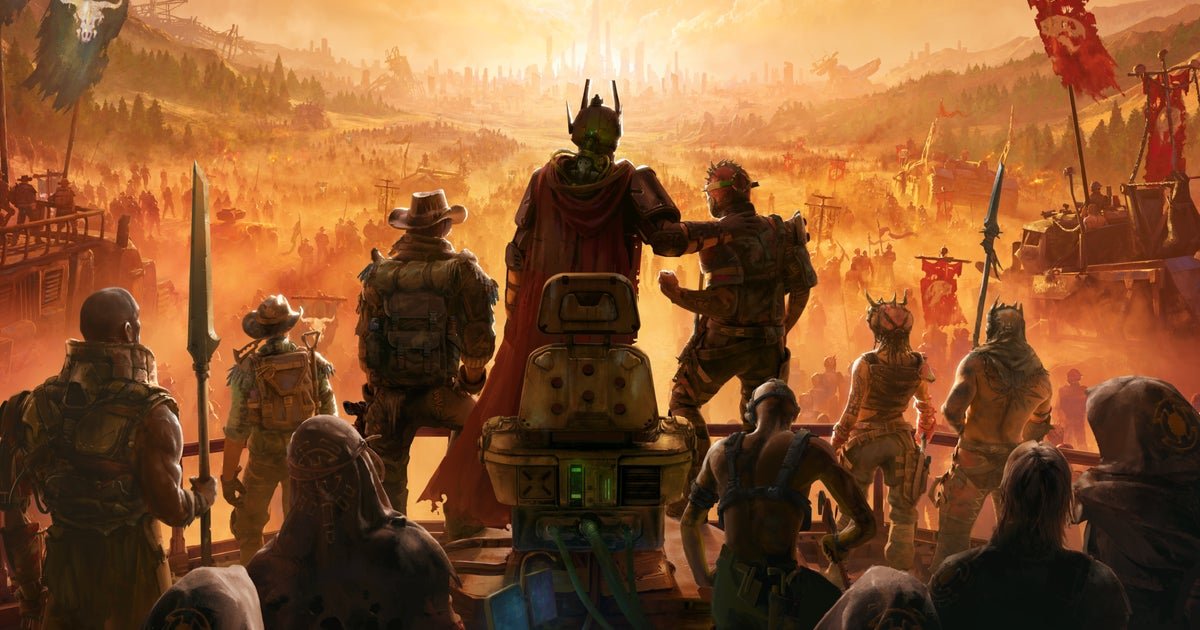
Like Paradox’s other in-house grand strategy games, Afterworld is looking to introduce its unique twist. So while Crusader Kings is very much the studio’s take on role-playing, Afterworld draws inspiration from survival and settlement building games, letting players loose in a post-apocalyptic version of North America blighted by hazardous terrain and dangerous old-world ruins. Here, they’re the guiding hand for a ragtag group of survivors, who they’ll grow from humble beginnings into a continent-spanning empire – perhaps by utilising ancient technology and inspiring fear, or perhaps by building a civilisation that takes care of its people.
And it all starts with a choice: who will your survivors be? In the build I played, Afterworld features three starting origins, each with its own narrative flavour (Paradox describes Afterworld as “story rich”, and most objectives, choice points, and discoveries come with art, story scraps, and flavour text, meaning that while you’re not role-playing in the same ways as Crusader Kings, there’s still the sense that you’re part of your own epic adventure). Origins, more specifically, are intended to help you lean into certain playstyles faster. You’ve got your vault dwellers – the Shelterborne – emerging into the world after generations spent underground, who are balanced for beginners. There’s a wandering group of fanatics who worship a powerful Ancient and lean into more religious, ideological styles of play. And finally for now, there’s a band of former wardens and prisoners, intended for more aggressively militaristic, war-focused players.
I played it safe, opting for the Shelterborne, but before I could hit the map, I had a couple more choices to make, further shaping the foundations of my tribe for the adventure to come. One meant my tribe would be naturally more frugal with food distribution, while another turned them into secret cannibals – more than happy to rely on, uh, alternative food sources in times of need. And with the groundwork complete, it was time to embark on my first objective: scout the surrounding land in search of a new place to call home before my shelter’s reactor went ‘boom’.
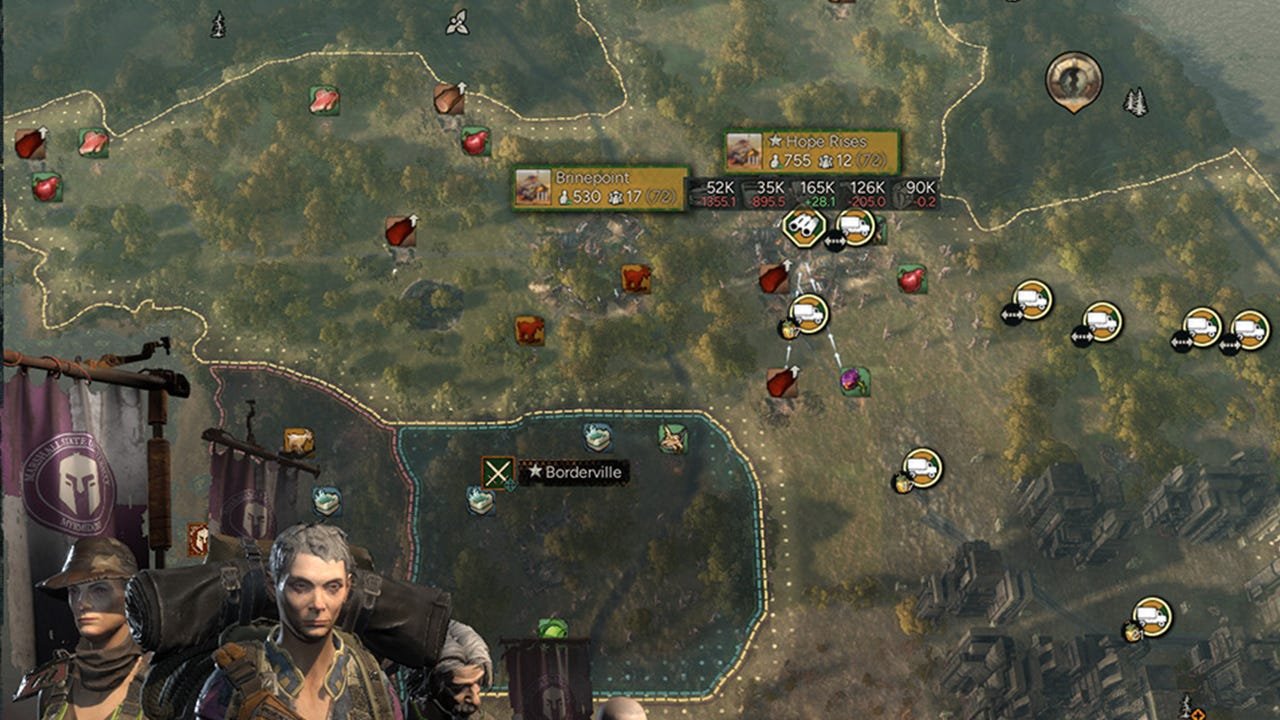
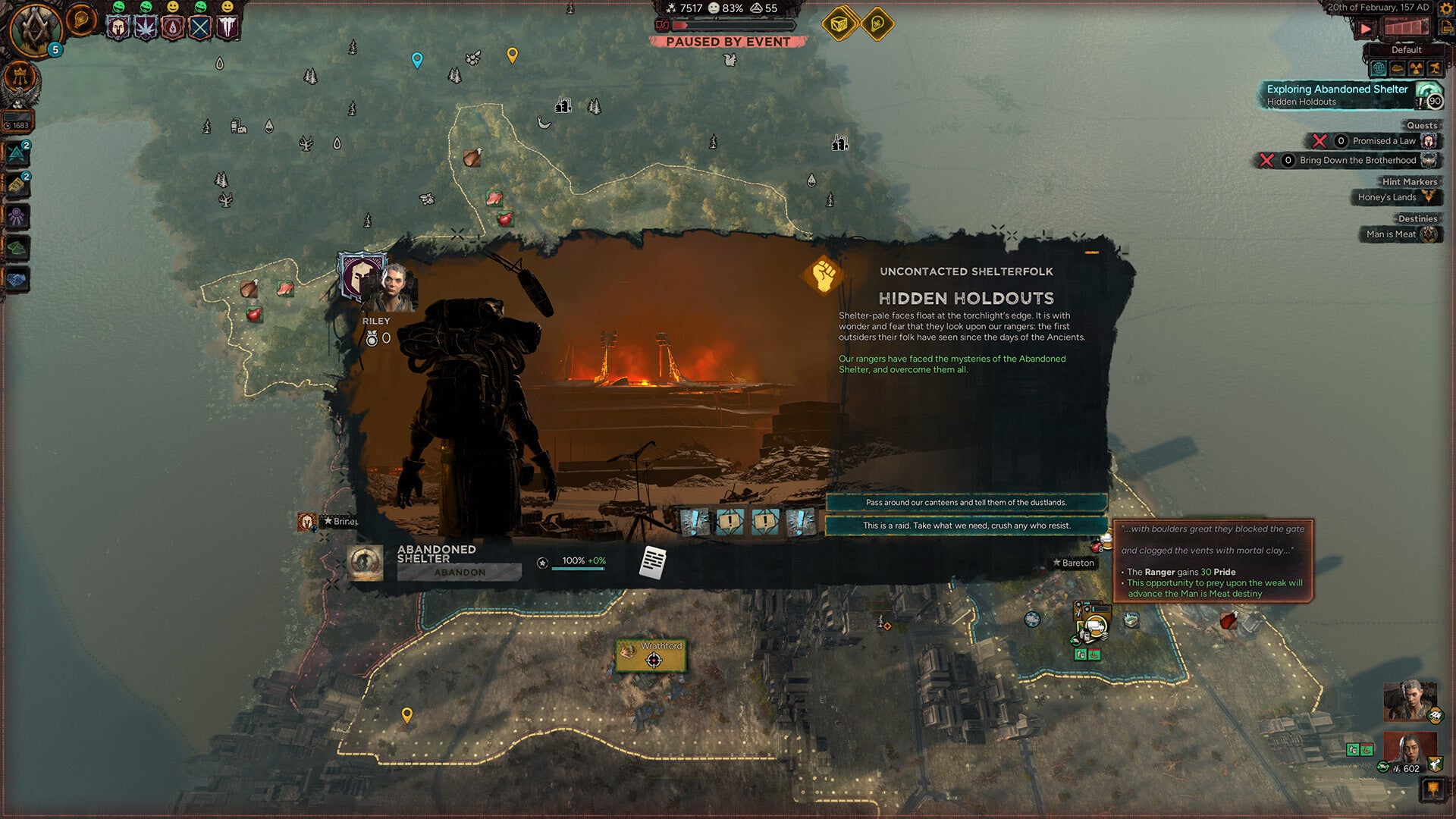
It’s a clear starting point, split into easily understandable steps, simply requiring you to direct your single unit – the Ranger – across five provinces (as the bordered areas on the procedurally generated map are known). And as he does, the fog of war lifts, revealing resource spots and ‘mysteries’ to investigate. The former are exactly what they sound like – you might stumble across squirrels to hunt when your group is finally settled, or water spots to claim as your own – while the latter are little surprises.
At one point, for instance, my unit comes across a small farm, and – after a bit of flavour text – I’m able to pick riding as my reward. This (I think) meant my unit could now travel further on its supplies without needing to return to base to refresh them – and, pleasingly, it also meant I could see my unit riding his own horse when using Afterworld’s unexpectedly striking zoomed-in map. But map discoveries can also spark new Ideas.
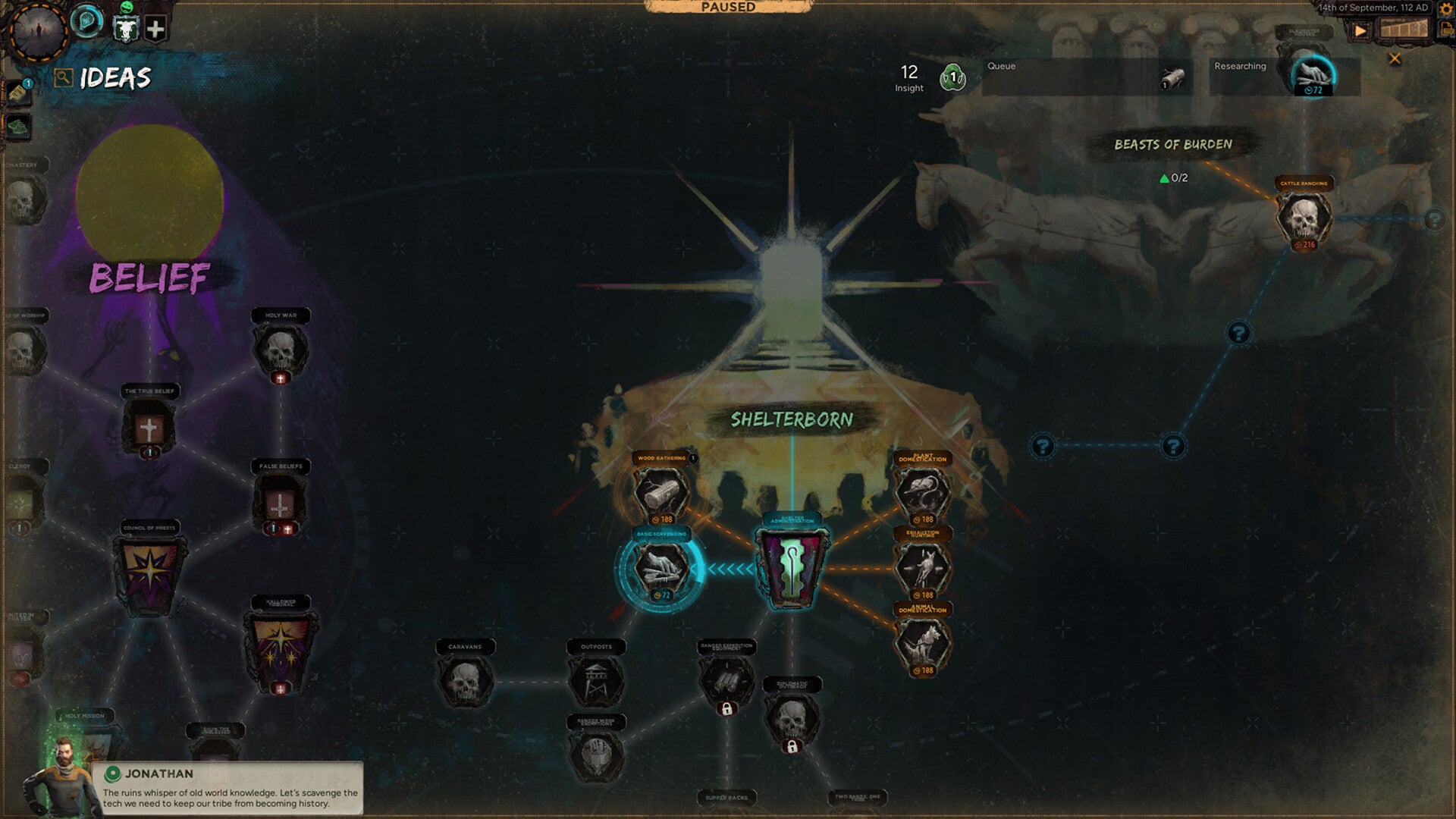
This is another clever bit. Afterworld already has the familiar early hours exploratory rhythms of a traditional 4X, so mechanically it’s easy enough to both explain and understand. And Ideas are Paradox’s way of keeping the information influx further under control. Unlike in, say, Crusader Kings, which is happy to throw endless terminology and gameplay concepts at you from the start, in Afterworld, key mechanics – and any explanations related to them – are kept hidden until you discover them. As game director Dan Lind explains to me, “This means we can kind of dripfeed you mechanics [at the same time] you’re exploring the lore of the world.”
Finding a river on the map might spark the idea of fishing, opening up related options to research. But combinations of Ideas can unlock new avenues too. During my travels, for instance, I come across a forest, a buggy, and some roads – apparently opening the possibility of fast mobile warfare. Diplomacy gameplay, meanwhile, requires that you’ve generated enough Survival Pride – essentially Afterworld’s version of levelling experience – and sufficient standing.
It’s a neat way of keeping knowledge in its own silo until it’s needed, so as not to overwhelm players, and seems to work well based on what I’ve played so far. But it also feeds into Paradox’s other goal for Afterworld: to create a grand strategy game with a different sort of rhythm where permanence is never guaranteed. “In this game,” explains Lind, “you’re going to be encouraged to move around, find better spots, and, where you can, make the most of it. And sometimes, [you might just need to] run away from someone – it’s a much more mobile, quite different experience in this sense.”
Soon enough, my Ranger has completed his initial objective, and almost immediately my shelter’s malfunctioning reactor goes boom. This gives me access to a new, migratory unit, which I can guide in search of a new home. Once selected, I’m able to see the fertility and radiation levels of each province tile – more of the former being good, more of the latter being bad. A short crosscountry trek reveals a bit of prime real estate for a new settlement (if discovered, units use the remnants of roads to travel faster, and as you eventually start to build your own trade routes, you’ll generate roads of your own). And satisfied with the prospect of potential food resources and accessible water, I decide this is where I want to settle down. And thus my first town – False Hope, as the random name generator encouragingly called us – is born.
This is the point I get a first proper look at Afterworld’s sprawling Ideas screen, where you’ll slowly learn new abilities to deploy in your quest for survival. Related ideas are split into thematic clusters, each unlocked as you encounter different concepts out in the wild, but despite some enticing options, my first priority was to research the means to create a sustainable camp – so Ideas like wood gathering, scavenging, and plant domestication (that’s farming to you and me) were the most fruitful. And with a fledgling civilisation to call my own, it was time to spend some Survival Pride, and level up my band of Shelterborne.
Bands are essentially groups of people with their own beliefs, and you can have numerous bands within your tribe. Each band has its core norms, which are essentially deeper-rooted parts of their background you can’t really change – in my band’s case, they were shelter-focused seed bankers, because of the choice I made at start. However, bands also have Customs, which you can more directly control – essentially, unlockable upgrades that affect your band’s values.
You might pick a custom that means your band opposes exploitation, but likes dark science (think super soldiers and nukes), for instance. And it’s here the first hints of Paradox’s more traditional grand strategy concerns begin to emerge. Values become important as you start crafting a society, given that bands assigned to your council will inevitably begin to pull society in the direction that aligns with their values. That means you might have to start picking favourites depending on how useful a band is to your build and the kind of story you want to tell.
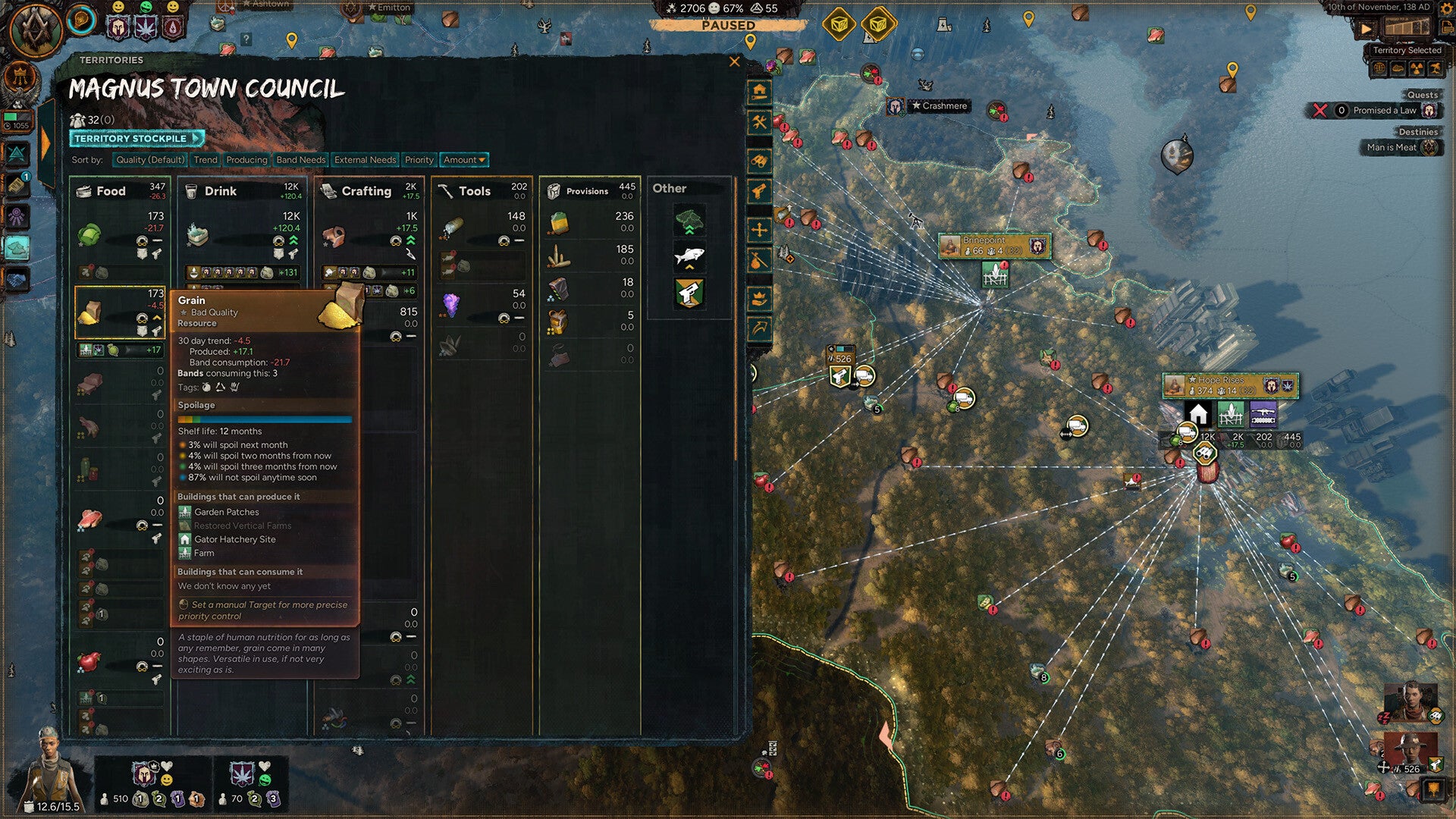
Bands notably also have health and motivation meters, which are influenced by the amount of access to essentials like food and water they have – access you can determine in the UI. Early on it might pay to be frugal and focus on your tribe’s survival, but as you explore and conquer more of the map, gaining access to more resources, you might prefer to improve the life of your bands. Likewise, bands also have their own Inspiration levels, based on their access to amenities and other quality of life improvements. And if Inspiration drops too low, you might have a revolt or a civil war on your hands – obviously not an ideal situation when you’re up against a hostile wasteland of unknowns too.
Slowly, Afterworld begins to reveal more depth and breadth. For now, though, my focus is on stabilisation: making sure I have enough food, enough water, enough resources, and that I’m researching ideas that’ll assist in my survival. With my camp built, I’ve already got a number of work groups who I’m able to assign to gather and stockpile wood from nearby resource points, but there’s a deficit to my food and water currently, which might be a problem in the longer-term.
And so it’s back to my Ranger to explore further afield. I almost immediately encounter another tribe – and unfortunately they’re not the friendliest bunch. They steal my meat but in return, I convince them to impart some local knowledge, learning of the resources within their area of control. As is, they’re not immediately useful, but if I manage to unlock diplomatic abilities, I’ll be able to initiate trades. Or, if I decide to pursue more aggressive paths, I might choose to send raiders into their territory and take them for my own.
My time is running out at this point, but I’m told good next steps would either be to explore further afield or start focusing on some military might in order to take care of my troublesome neighbours. I’m shown a couple of useful overlays to help – clearly highlighting the area’s fertility, its radiation levels, and more – and when I ask about the decimated cities punctuating the fog of war, I’m told they’re high in supplies and ripe for scavenging. Or if I was to focus on getting another town or two to my name, I’m told that’s the point the map starts to properly open up – the point where I’d need to start thinking about reforming my government, picking some laws to determine what’s allowed and what’s not, and thinking about the values my civilisation stands for. In other words, it’s the point Afterworld becomes more about society-crafting. And eventually, with the fates of thousands potentially in your hands, there might be some tough choices to make.
And beyond that, of course, there’s the whole of North America to explore. Paradox says the decision to focus on a single continent – or rather the chunk of it between the nuclear-winter blighted northern border and the grey “super weapon” goo blocking the route to Mexico – is beneficial for a number of reasons. The apocalypse needs a “more zoomed” in scale to serve its human-focused story and human-focused mechanics more effectively, suggests Lind, and the fact North America is so widely recognisable helps with “tangibility”, meaning that players should have at least a general understanding of the place they’re dealing with even before they begin, given the broad geography remains the same.
However, it’s also a version of North America with its own established lore and backstory, its own established factions, and Paradox – which is being intentionally vague about when Afterworld is set – has imagined an entire history between the cataclysmic event that ravaged the globe and the hundred years that have passed as the game begins. So while California and the Appalachian Mountains might be exactly where you’d expect them to be, the Great Lakes have been drained and missile strikes have scarred the landscape. And, of course, the procedural remixing of elements means games should be different each time too.
The idea, says Lind, is to mix the familiar with the unfamiliar, and it’s also an opportunity to create a game sitting at an intersection Paradox’s grand strategy audience is familiar with. For the historical strategy fans, Afterworld includes “the deep research about the people and the areas”. But it also leans into the more speculative side of Stellaris, as it twists a familiar history.
As for the speculative sci-fi stuff, it’s pushing things “pretty far”, albeit with the team trying to limit its science to what current smart people think will be possible in the future – rail guns, nanites, drones, and so on. Lind uses WW2 as an example; specifically the way it pushed technological advancement from wooded biplanes to jetfighters. “If you get a big war like [the one in Afterworld], it’s going to do the same thing. But it doesn’t mean everybody’s walking around like a cyborg … The regular Joe is still going to be wearing jeans and have a normal car, but we get a huge spread of effects. That’s why you’ll see more super hi-tech for certain aspects of life.”
I might only have spent 45 minutes or so with Paradox’s latest grand strategy game, but already I think I’m sold. It feels like a refreshing departure for the studio, and a fascinating balance of systems both new and old. Its colourful take on the apocalypse is enticing, as is the light narrative touch that gives the reawakening world a little more life and lends texture to your own adventure. But more than that it’s Paradox’s clear attempt to maintain that classic grand strategy depth and breadth while deeply integrating design choices that genuinely seem to create a game that’s both more manageable and approachable. As I said right back at the start, I’ve always loved the idea of Paradox’s grand strategies but I can never quite ride out the initial information overload. 45 minutes in, I already feel like I might actually get Afterworld, and I genuinely can’t wait to play more.