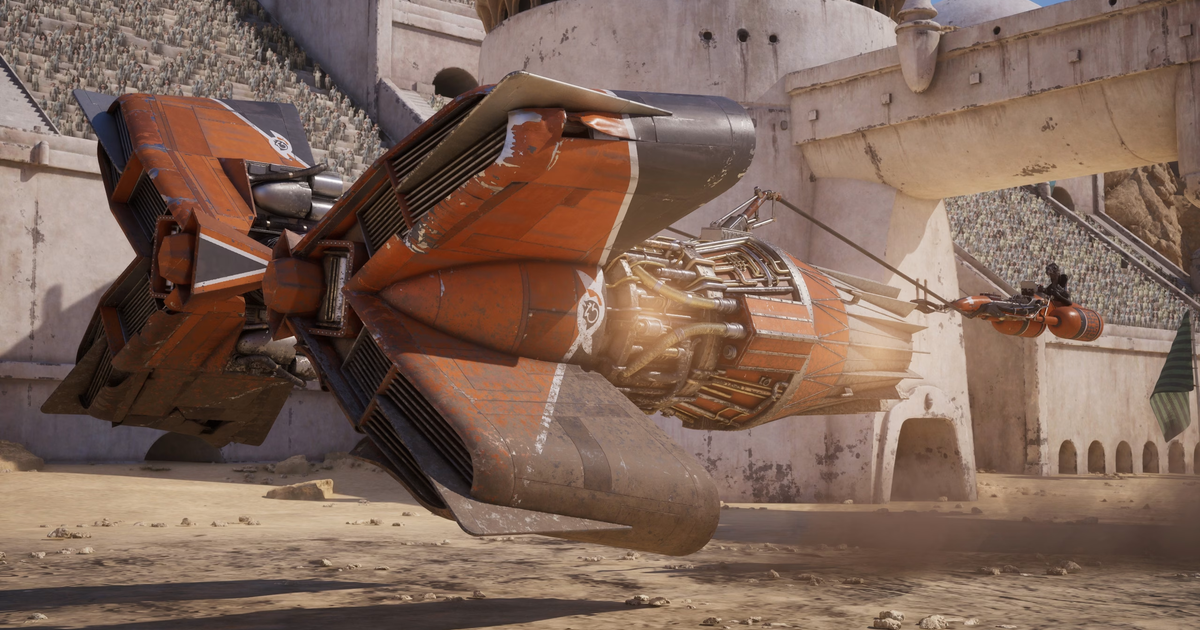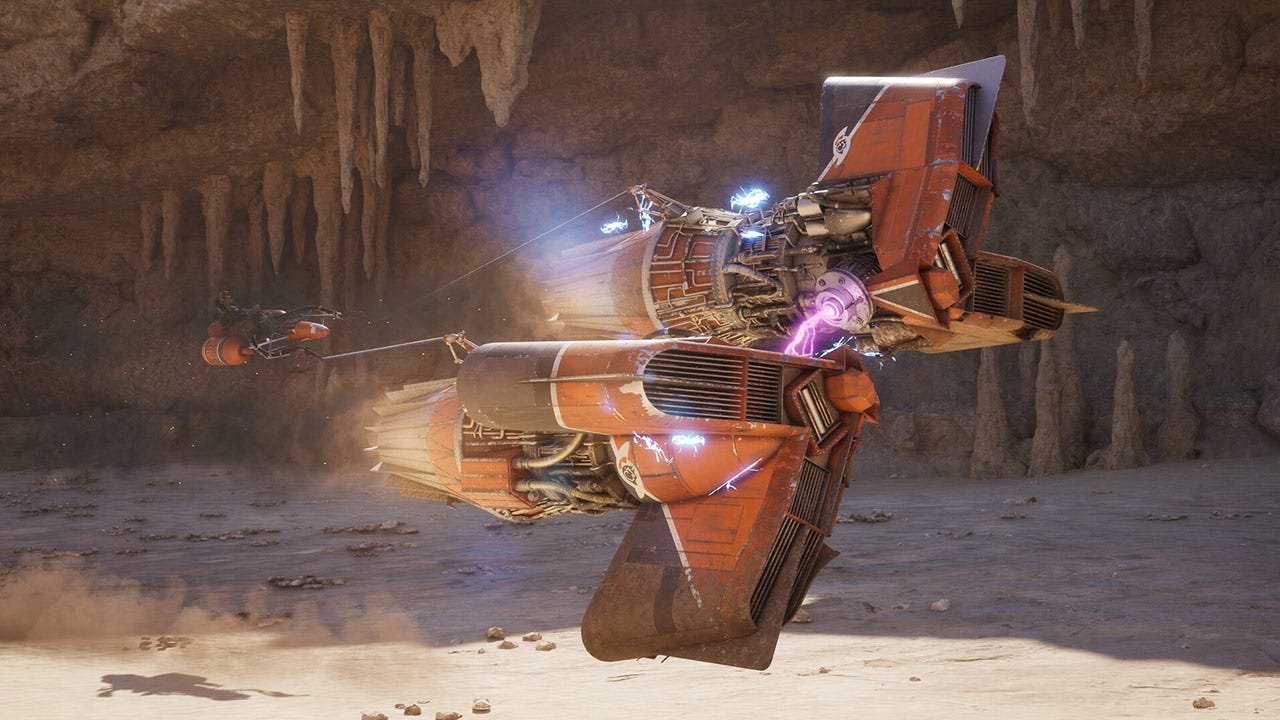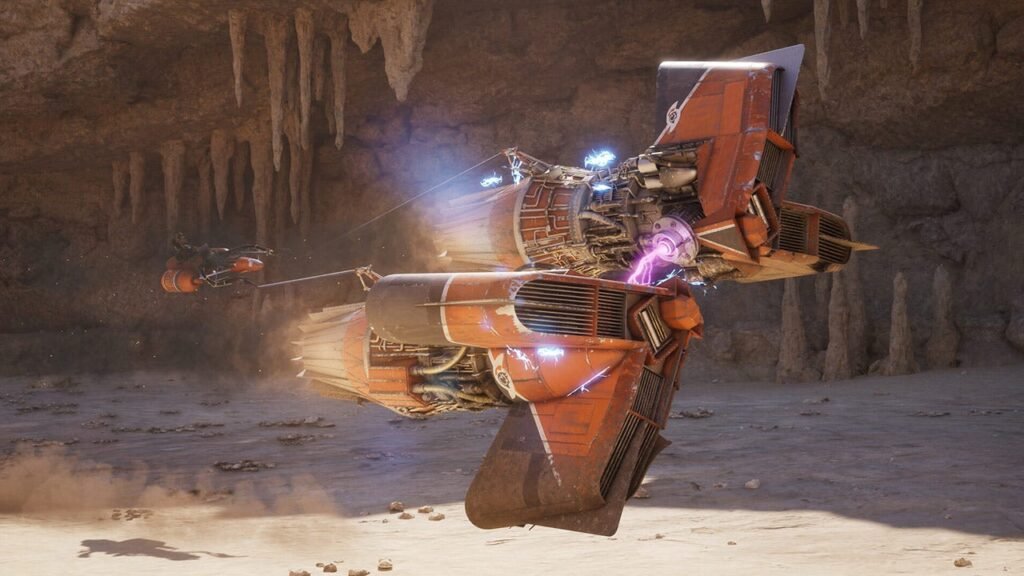
For a series as storied as Star Wars – one brimming with more spacecraft and speeders than George Lucas has beard bristles – it borders on baffling that developer Fuse Games’ Star Wars: Galactic Racer can arrive in 2026 as the first new game of its kind in over two decades. I blame Super Bombad Racing, if only because Gungan isn’t a real language and using a portmanteau of bomb and bad in the title was probably never the perfect pathway to sales success. Galactic Racer, on the other hand, has a range of impressively customisable vehicle classes that expands the hangar well beyond classic podracers, gorgeous course design, and an impressively credible and explorable world outside the on-track action. It’s an eye-catching and rich resurrection of Star Wars racing that’s as fast as it can be surprisingly unforgiving.
Galactic Racer’s main hook is its run-based, roguelite-inspired campaign, which comes with a strict philosophy of no mid-race restarts. It is an interesting and genuinely fresh approach that bakes a very real and logical feeling of risk and danger into the action – a feeling that is admittedly absent in racing games with any sort of rewind functionality or unlimited restarts. Yes, you can still pause and, yes, you can still save and come back later – but you otherwise need to live with the consequences of what happens out on the track. It’s a structure that makes the racing tense and meaningful, even if racing over the same landscapes over and over does grow repetitive.
Now This Isn’t Pod Racing
Whether by intent or not, the huge time gap between Galactic Racer and classic Star Wars games like Episode I: Racer and Racer Revenge feels almost mirrored in Fuse Games’ original story. That is, where those games were set in the prequel period, Galactic Racer is set in the aftermath of Return of the Jedi, where the art of podracing is a distant relic of a bygone era. Unsurprisingly, podracing does still feature here, and it’s represented incredibly; lightning quick, and with impeccably authentic sound design. However, I’m hesitant to describe specifically how or when it pops up outside of the quickplay modes. Just know that I feel like the Fuse Games crew were paying close attention when Maverick found an F-14 in the heart of enemy territory during the Top Gun sequel, or when Bond retrieved his DB5 in Skyfall. I may be a pretty casual Star Wars fan by most metrics, but I do love stuff that imbues vehicles with a sense of old soul – even fantasy ones. That’s my jam.
For clarity, the bulk of the Galactic Racing League garage consists of landspeeders, speeder bikes, and a new vehicle type called skim speeders. Bikes are fast but fragile, and skim speeders have a podracer-esque ability to bank completely vertically to slice through gaps and turn harder, but landspeeders have proven to be my favourite class. They’re essentially floating cars, and I enjoy their more predictable handling and added durability.
As the mysterious and faceless human racer called Shade, our ultimate goal is to beat the Galactic Racing League’s moaning, arrogant, and entitled heel Kestar Bool in the final head-to-head race. However, for that to happen, we need a suitably fast vehicle. In simple terms, building and piloting a quick one requires a combination of general stat upgrades, performance parts, and various additional perks – from gadgets that can be activated during races to specific bonuses granted to you by allies you accumulate over the course of the story. These are rationed out randomly, or earned, as we progress (and re-progress) through the championship “tours.” I’ve grown to be a particular fan of the autopilot gadget, which is regularly a lifesaver to tackle particularly treacherous stretches of track. The fact that these gadgets are primed just prior to race starts with a series of specific button presses, like pre-flight checks, is a very clever touch that gives waiting on the grid a tangible sense of occasion. The sequence always ends with the final go-ahead to fire your engines, which cough to life and glow harder as you squirt the throttle. It was important to somebody at Fuse Games that we should be able to rev our speeders like hotrodders at a red light, because it looks cool. I love little flourishes like that.
Now, speeders are scrapped between tours, so you’ll need to choose and set-up a new one each time. It’s not a solution I find I’m loving, considering I was never able to establish any real sense of ownership or attachment to a vehicle. Theoretically, you can build a replica of the same-looking vehicle every time – with the same add-on cosmetic parts and the same livery – but you will need to wave goodbye to specific upgrades you might’ve really enjoyed. The more heavily upgraded your previous speeder, the more points you’ll have to spend on pumping up its general stats before you start – but it won’t behave the same as your last one. Not unless you can pick up the same upgrades in your next run, whether by chance reward or spotting them in your mechanic Hibi’s randomised selection. As a roguelite rookie and a traditional racing game meathead, I have to admit I didn’t much like losing powerful upgrades that really suited my racing style to what’s essentially a dice roll, but I do appreciate the novelty of needing to come to grips with something not typical of the usual racers I play.
Tours unfold over three (and later five) planets before culminating in a final knockout event. Failing at any point means you’ll have to start a whole new one over again. This is quite elegantly and thoughtfully implemented, thanks to the racing paddock at each event you can fully explore in third-person. Not only does this build an authentic world around the Galactic Racing League – which in turn crafts a world I feel like I’m inhabiting, rather than just shuffling through menu screens – it lets Fuse Games fill it with characters that can acknowledge your previous failures as you return for another crack at the title. That is, you’re not actually restarting, or simply being scrubbed back in time until you get it right – time keeps moving forward and you just need to keep racing until you emerge victorious. The story is split into three distinct acts, so note that messing up in the third act means you’ll just need to take another run at the third act. That is, it doesn’t send us all the way back to the initial League qualification phase, and for that I’m grateful.
However, Galactic Racer’s core weakness is that it unfortunately doesn’t feature enough planets to avoid feeling overly repetitive. While I’m conscious a roguelite structure brings with it an expectation of a certain level of repetition, it does become fairly tedious slogging through its small list of repeating planets over successive attempts. The specific circuits used, the order of event types, and how they branch over the span of a championship are shuffled from tour to tour. There are reverse layouts for the tracks, too. However, the backdrops are nonetheless always the same. Having a couple more planets that could’ve been swapped in and out would’ve gone a long way in reducing the fatigue that quickly sets in after several runs through the same locations.
Intergalactic Planetary
It is a fantastically realised array of planets, though, and the details of the track environments are as excellent as they are varied. Jakku, for instance, has routes traced through its immense graveyard of war wreckage – swinging from wide open blasts across debris-covered dunes one moment, to cramped sections of makeshift tunnels formed by half-destroyed spacecraft the next. Crait is characterised by sprawling caves and its flat, salt-covered surface – which speeders whip up to expose the red mineral beneath. Lantaana is covered in dense forest linked by lava tubes, and Sentinel I is a toxic wasteland where racers must negotiate narrow causeways over acidic pools.
Each planet and track has its own set of properties that can help you or harm you, depending on how you race and the upgrades you’ve applied. Perhaps my favourite example of this dynamic is Ando Prime, an entirely frozen planet, where heating tubes have been dropped sporadically around the circuits. Passing through these will thaw out the frozen control surfaces that numb your steering inputs, but staying out of these hot boxes allows you to run your delicate ramjet for much longer before it catastrophically burns out. It’s a racer that essentially never stops asking you questions.
Star Wars: Galactic Racer – June 2026 Screenshots
On the topic of burning out, it’d be massively remiss of me not to mention how much I adore the Burnout-inspired takedowns that Galactic Racer actively encourages, with speeders on the wrong side of a hefty slam being speared into trackside obstacles and splintering into thousands of shards. Not only are they incentivised with a slow-motion takedown camera, which swings back to soak in the spectacle, but they can be factored into the upgrade system. Any time I spot it on a run, I always opt to grab the upgrade that replenishes my speeder’s battery for each successful takedown – since doing so gives me more bursts of my autopilot ability.
But while the Burnout connection is strong (and hardly surprising considering the roots of Fuse Games’ founders reach back to Burnout creator Criterion Games), perhaps what I love most of all is how much Galactic Racer surprisingly reminded me of a sci-fi MotorStorm. That is, the often wide tracks full of natural obstacles and multiple routes, the multi-class nature of the grid, and the fact that holding onto that ramjet boost a fraction too long results in a fiery and rapid unscheduled disassembly. Funnily enough, just like the original MotorStorm, Galactic Racer also has no splitscreen multiplayer. 12-player online racing (or eight, for podracers) has a six-event championship structure that works a little like a shortened version of the singleplayer tours (where your upgraded vehicle is discarded after the finale) – but that’s for a different sort of player than me.