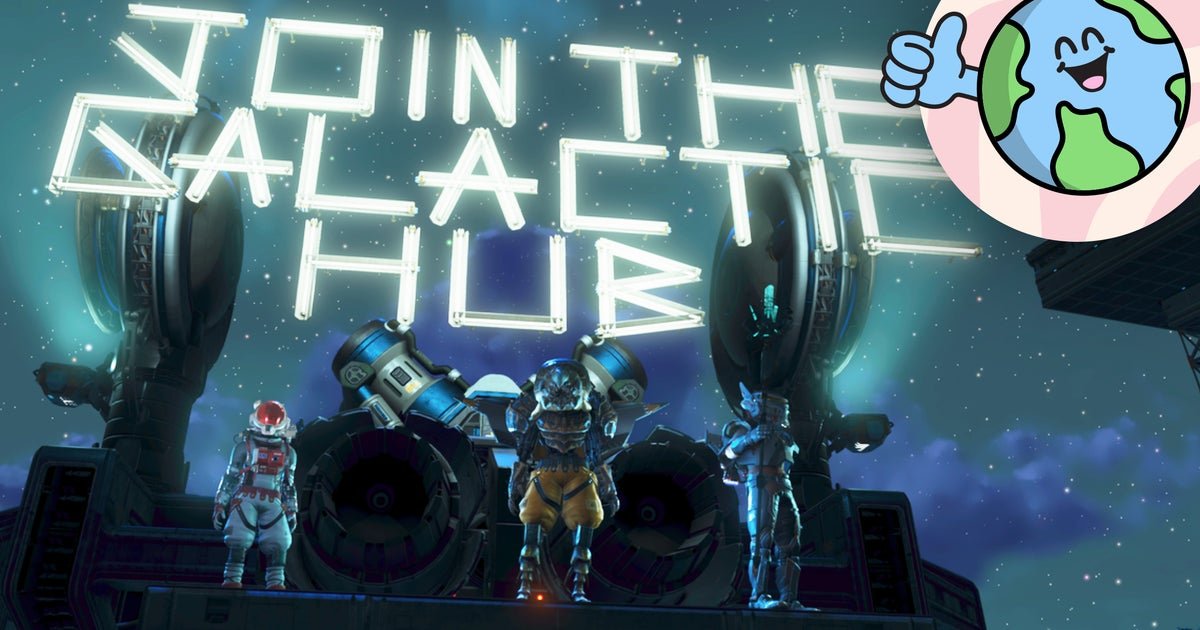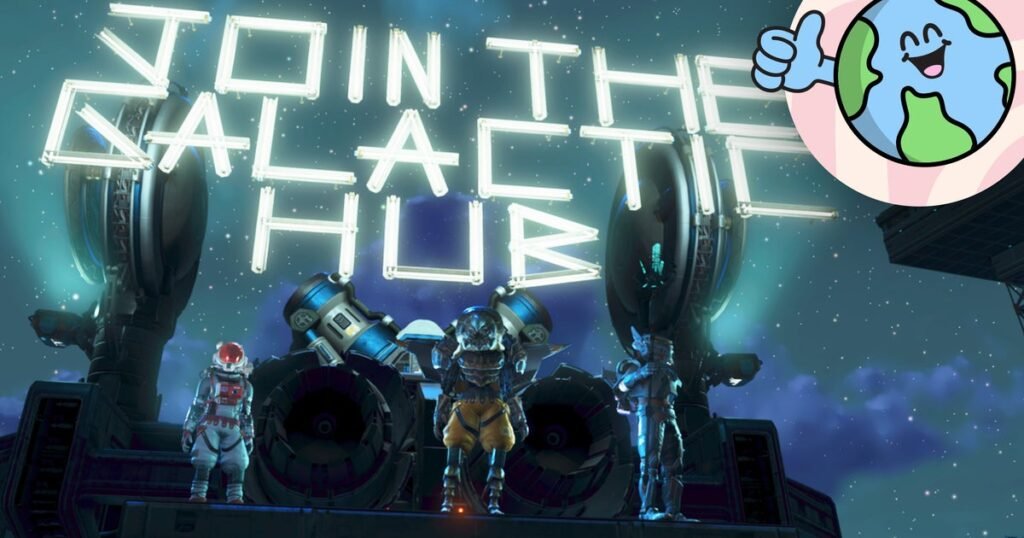
In the distant reaches of a doomed universe, perpetually 16 minutes from total destruction, something wonderful is happening. Across three galaxies and thousands star systems, a thriving community has formed. This is No Man’s Sky‘s Galactic Hub Project – part scientific endeavour, part social gathering – and in the ten years since its foundation, it’s continued to grow. It’s a story of collaboration and kindness, beginning at a time when positivity was low.
Ten years ago, the No Man’s Sky community was fractured. After a controversial launch in August 2016, there were those unhappy with the exploratory space sim, and still others had very much fallen for its procedural charms. Galactic Hub Project founder 7101334 – a now 30-year old Los Angeles resident who goes by the name Conor out in the real world – was one of those players who found themselves immediately drawn in by developer Hello Games’ simulated universe, and a shared map so vast it remained largely unknown even to the developers of the game. But those who loved it at launch felt like a minority at the time.
“Early in No Man’s Sky Launch, everyone was kind of hating on it for the most part,” recalls Conor. “But I was someone who had ordered it and loved it from the start. Maybe it wasn’t everything I expected, but I still loved what I got.” And as the negativity of launch began to overwhelm No Man’s Sky’s main subreddit, those like-minded enraptured by developer Hello Games’ universe-sized enigma found haven elsewhere.
No Man’s High started life as a subreddit for stoners fascinated by the potential of Hello Games’ space sim (official motto: “No Man’s Sky but high”). But after a difficult launch it became “a place for anyone to discuss the game without being shit on,” making it “sort of unique on the internet at that time.” And it was a combination of that welcoming community and a confluence of other events that would lead to the Galactic Hub’s formation. There was a fledgling industry of coordinate-sharing for one, where players would explore the universe then share the location of their discoveries so others could find them – an eye-catching planet, perhaps, a cool ship, or some unusual fauna. Simultaneously, one dedicated player, Steambot, famously spent two weeks circumnavigating an entire planet in September 2016.

“It was one of the earliest demonstrations of just the sheer scale of planets in this game,” Conor recalls, “and the fact that you really could walk all the way around them if you want to. So people started navigating to that location as a sort of pilgrimage site.” Which triggered a thought: what if everyone went to one location to explore for noteworthy content? “It seemed like an interesting idea,” remembers Conor, “it was just something fun to do with other players, that was really all there was to it.” And thus, on the 30th October 2016, the Galactic Hub was born; its ambitious goal to venture out into the cosmos and collectively document a single region of No Man’s Sky’s vast universe.
Around 35 members of the newly formed Galactic Hub joined that initial voyage of discovery, travelling to the Euclid galaxy’s Rentocniijik Expanse (later the Rentocnii Conflux following No Man’s Sky’s Atlas Rises update), and cataloguing all the star systems, planets, flora, fauna, and other notable sights within. The initiative was successful enough that it began to snowball, and amid the project’s ever-expanding scope, the Galactic Hub moved to its own subreddit, launched a wiki as an official repository for its activities and findings (later moved elsewhere), and eventually created a new social base on Discord. Ten years later, the Hub now spans almost 100 regions (99 to be precise) across three galaxies.
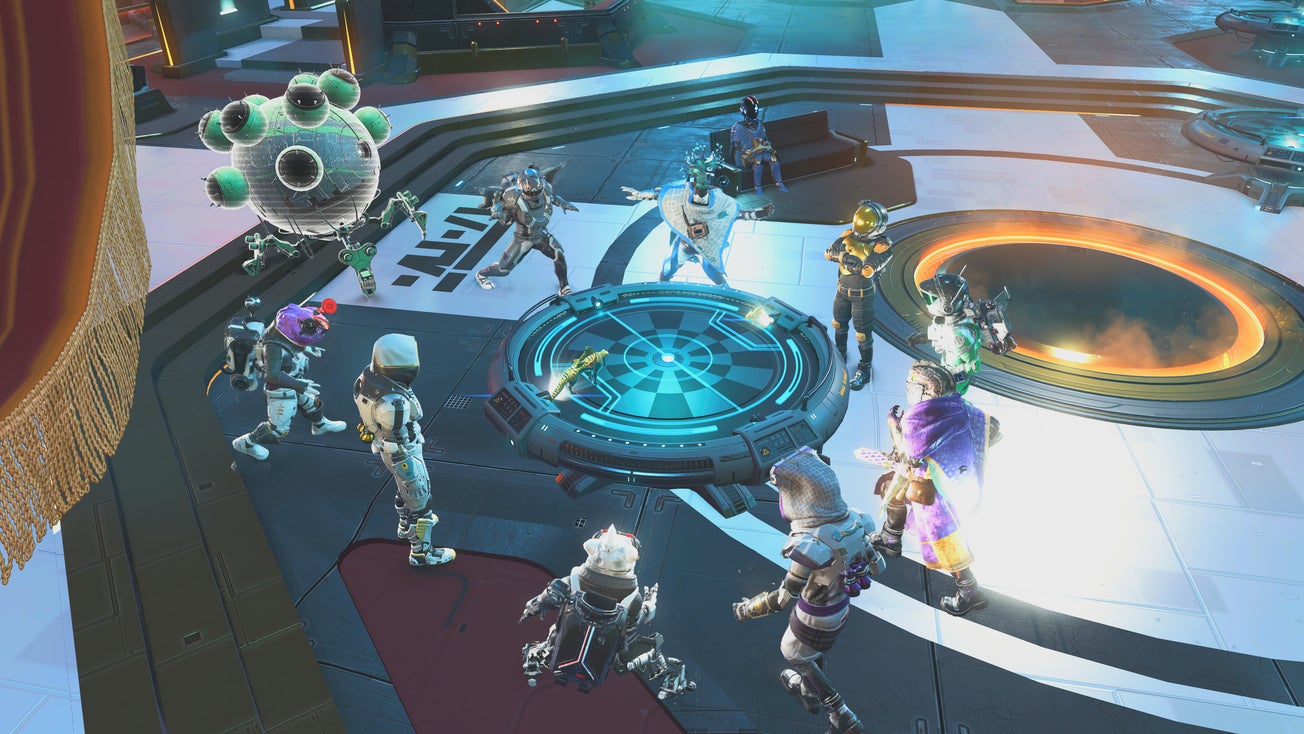
But the Hub wasn’t just a cataloguing project, it was a burgeoning in-game civilisation – albeit one only able to occupy the same centralised space rather than co-exist more meaningfully without multiplayer early on. Rentocniijik Expanse became the Galactic Hub’s capital region, and some serious dedication was required by players wanting to make the journey at a time when fast-travel Portals still weren’t a thing. But a community of Interlopers blossomed, one that would gain a fledgling physical presence when base building was introduced in December 2016.
And even back then, property disputes requiring a bit of conflict resolution were a thing, Conor recalls. “If one person uploaded their base on a planet, it immediately hid the other person’s base,” he explains. “So people would just flip back and forth uploading and getting into territorial quantum feuds… So that was the first sort of logistical stressor for the Hub, you might say, although it’s pretty much disappeared these days.”
Then, on 15th April 2017, the UN-inspired United Federation of Travelers was founded, bringing together multiple civilisations under a single banner in the spirit of cooperation. As Conor explains, two No Man’s Sky communities dominated at the time – the Galactic Hub and the similarly aligned but more decentralised Alliance of Galactic Traveler – and the Federation was envisaged as a way to not just standardise records, but to spotlight smaller communities and help them get started. “And it worked out pretty well,” says Conor, pointing to the large-scale Qitanian Empire, which arose through the Federation.
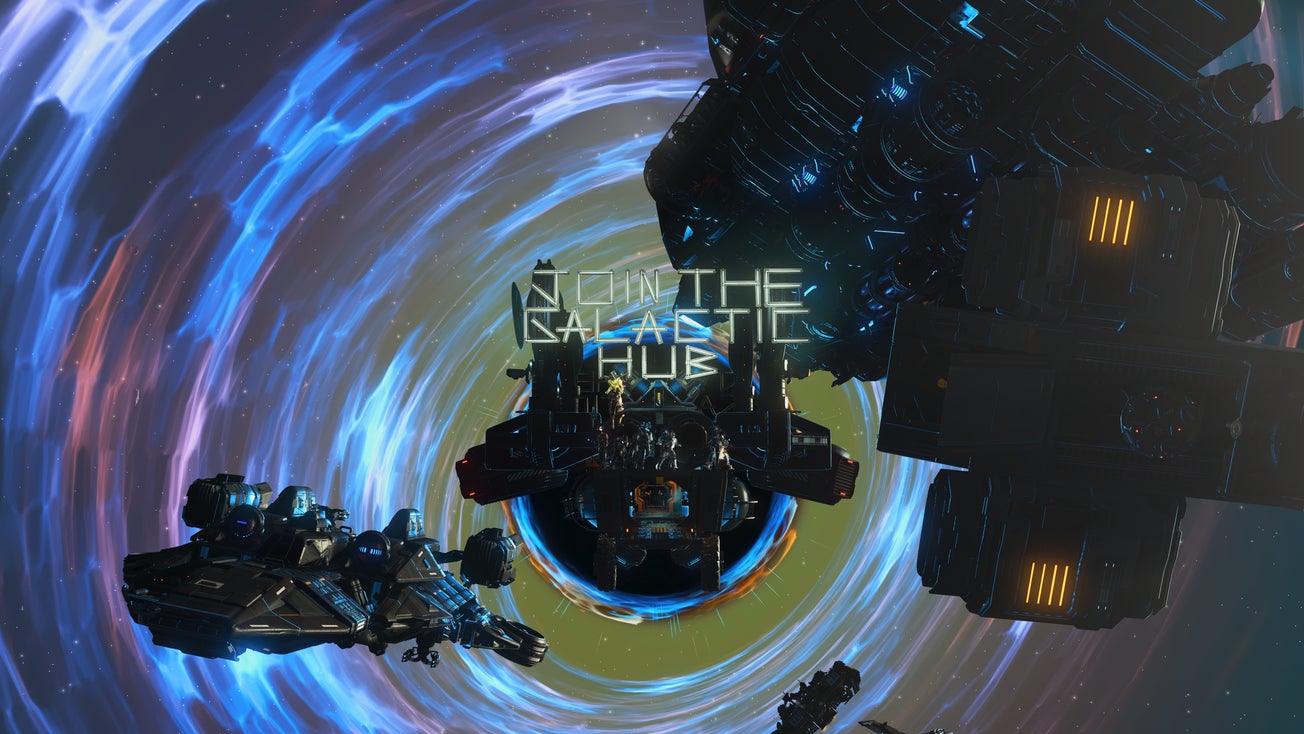
Among the Federation’s number – which included the Galactic Empire of HOVA, the Arcadian Republic, Chrisubidon, and the Yebdishtei Federation – interests were broad. Some were focused on documentation, others were focused on roleplay (the Hub, says Conor, is more “gameplay in a costume” than roleplay, given everything it does “has a functional game purpose”). Some of the Federation’s founding members had the goal of civilisational expansion, while others “never intended to grow beyond a single member…which maybe stretches the definition of civilisation”. Today, the Federation counts 19 groups among its number, spanning four galaxies and encompassing players from all over the world.
And so things continued; bases were built, UFT wars were “fought”, and new discoveries were made. There was even a spot of exocraft racing. But without a true way to interact with each other online, the Galactic Hub’s in-game activities were limited. But then came the announcement of No Man’s Sky’s Next update and everything changed. Anticipating the arrival of multiplayer, the Galactic Hub elected to form a Defense Force to protect the project against potential griefers, and once the update arrived in July 2018, it marked the point players could properly interact with each other for the first time. “Multiplayer added the most possibilities for what we do now and expanded it beyond just documentation,” explains Conor, “to the point where doing live multiplayer events is at least equally important now.”
But first, with the arrival of No Man’s Sky’s Next update, the Hub’s team of dedicated explorers and documenters faced a more immediate problem. Suddenly the universe changed, and all the information the Galactic Hub had painstakingly gathered over the years became irrelevant. Planetary naming conventions no longer accurately referenced the discoveries within, and with no way to change them at the time, it was “kind of a nightmare.”
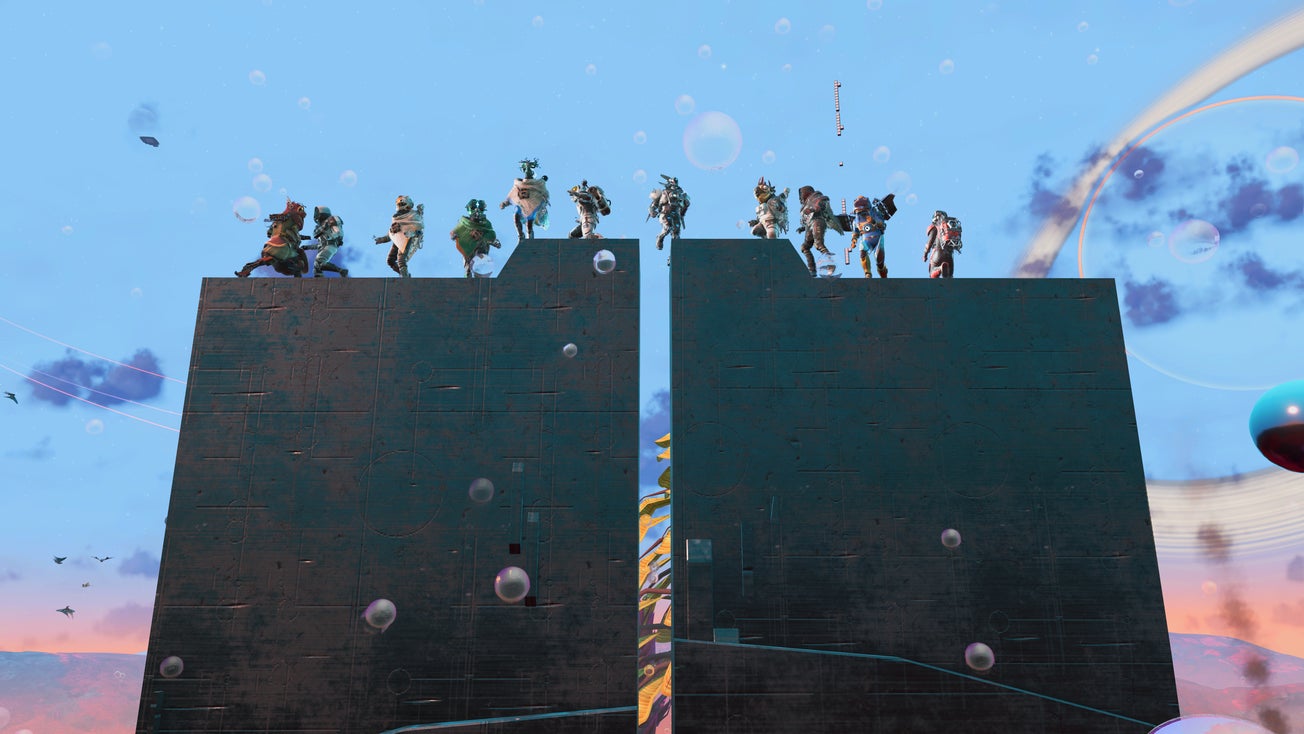
And so a bold decision was made: the Hub would up sticks and relocate its entire civilisation, marking the first stages of the Ark Project and the search for a new home. Over the course of a month, an advance party of Interlopers began the process of renaming over 500 systems and establishing new space claims, in what would become the Galactic Hub’s new HUB1 region, the Arm of Vezitinen.
New Lennon was designated the primary capital planet, and as the Hub began settling into new surroundings, it received some unexpected news. Dataminers had discovered the community’s emblem buried in No Man’s Sky itself, and not long after it was made available in-game. The Galactic Hub had been formally and prominently canonised as part of No Man’s Sky’s universe. “We’d already had some nods from Hello Games,” recalls Conor, “but getting something on that level was a huge honour to the community. And, everybody celebrated and started slapping it all over their bases.”
That official recognition has helped the Galactic Hub maintain a steady influx of new recruits since then; some are fascinated by its rigorous scientific attitude toward discovery, and others the novelty of in-game civilisation. “I think it’s different for everyone,” says Conor when I ask what seems to attract most people to the Hub. “There are the more casual players who just want to be around other people. They think it’s cool to see other people in-game and it doesn’t need to be any deeper than that. There are those who mostly come for the non-competitive or lightly competitive social events; the people who want to be here for the hardcore PvP-like events. And of the people who are mostly interested in documenting, I would say by far the strongest emphasis is on finding fauna. The Exobiology Corps is probably the most active of all of our documentation chapters, but ship and multi-tool hunters, and the geological surveyors, are consistently active too.”
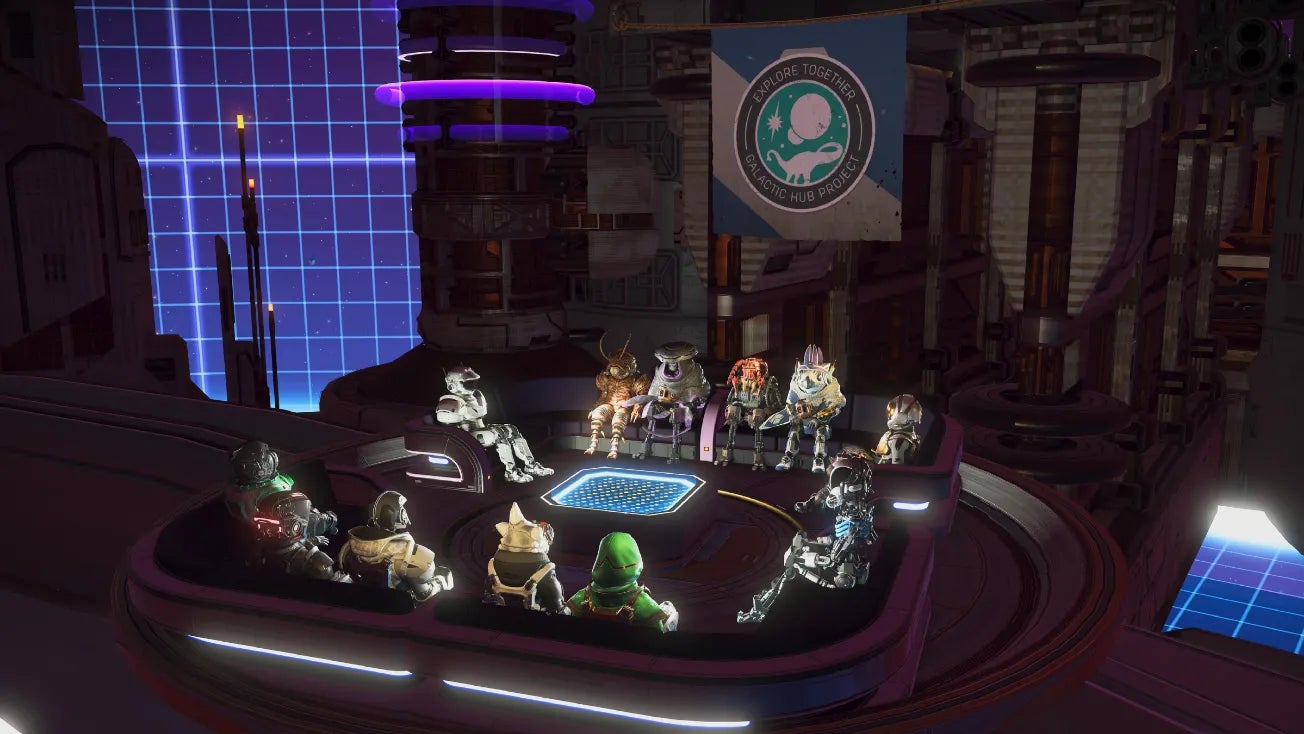
But always at the centre of it all, says Conor, is the “very kind, helpful” community: “The Interlopers have always been known for that, but I think probably even more so now as we do more multiplayer events, now we have an economy, and now we’ve really focused a lot more on the player interactions … And for some people, it’s even a way for them to interact in a way they might not really be able to in real-life for a wide variety of reasons.”
It is, however, tricky to accurately estimate how large the Galactic Hub community really is. The official Discord has 16,000 members, although many of them aren’t active. And in-game, one of the Hub’s senior members – ApexFatality, who oversees the group’s presence in the Calypso galaxy (the majority of the Hub’s activities take place in the Euclid space, but there’s a third sister hub in the Eissentam galaxy too) – built a bot capable of travelling from system to system in order to scan every planet and get a sense of the Hub’s population. Even that’s not an exact science given the way No Man’s Sky renders bases, but the results, according to Conor, suggests the Hub attracts around 2,000 unique people per year, although many of those won’t necessarily participate in the social aspects of the community.
However you count it, though, it’s a project that’s grown immensely in scale and scope over the years. From its documenting roots back in 2016, the Galactic Hub now incorporates social events, PVP, sports events, creative writing endeavours, construction projects, a meta-game economy, and more. And in Euclid at least, the Hub now encompasses 27 regions, spanning thousands of star systems, planets, and moons. And that’s not including the various “huburbs” that exist just outside the group’s official border.
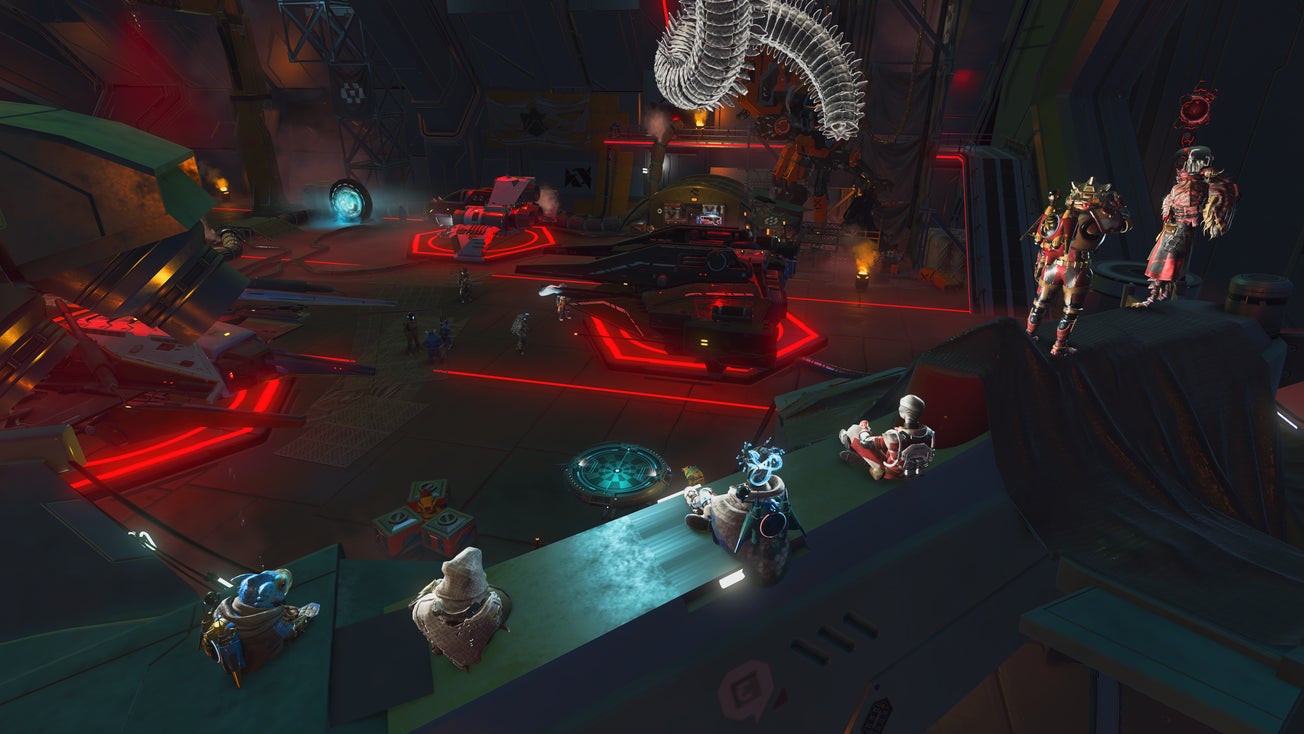
Conor is keen to stress, too, that he’s just a small part of a much bigger whole, and the Hub “only exists because of the people who are part of it.” As the Hub’s founder and director, he’s joined by a co-director, and the Hub’s independent sister galaxies have their own directors too (“Calypso is sort of like the Wild Frontier,” notes Conor, “They’re also big on their worm cult out there”, while Eissentam is “like the vacation destination hub, all beautiful and lush”.). There’s also the Hub’s advisory council, a treasury, numerous chapter directors, and a whole bunch of colonies, many with their own regional governors, mayors, and goals.
Tharakis, for instance, is a system-wide colony focused on dystopian city builds, while Logisto’s inhabitants build factories that are beneficial to other Hub players. The Lobrid Conclave is a sprawl of frozen ruins, and the Coalition of Dissonant Worlds has a focus on PvP. There are ungoverned colonies: the beautiful lakeside community of Adtown, for example, the cooking colony of Aedesian, Lofticries and its luxuriant waterfront homes, the permadeath-exclusive colony of Hecate, and the “micro-colony” of Old Sabeck, which challenges players to get creative with its mandatory 2×2 cuboid builds.
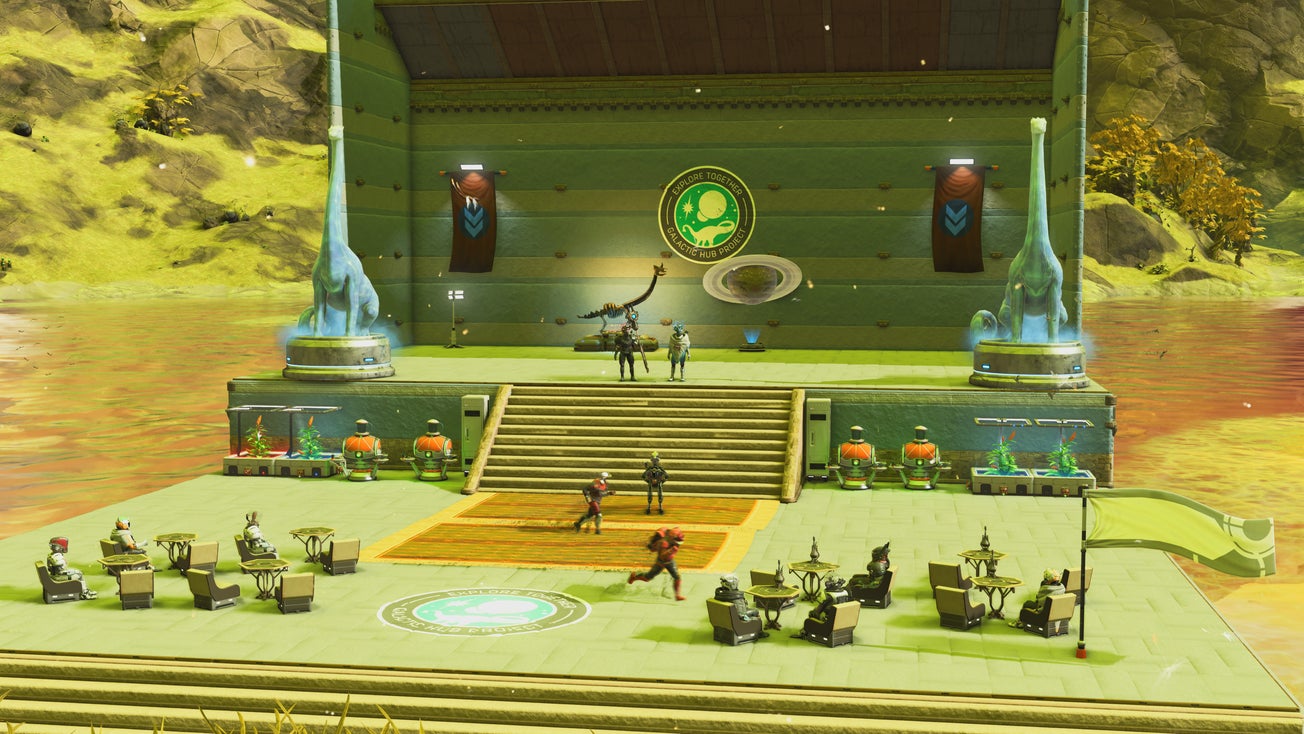
And as of last July, when the Galactic Hub embarked on its second Ark Project, spreading even further afield, it now has three capital cities to its name, albeit some of them now “unmaintained”. Capital cities are an idea the Hub has been thinking about and iterating on for almost as long as it has existed. Project Coruscant, for instance, was an ultimately failed attempt to replicate Star Wars’ famed planet-scale city. “It loaded poorly,” laughs Conor. “It definitely did not give the scale of a city.” But several increasingly successful attempts have followed. New Ziki City even incorporated apartments Interlopers could live in, although it’s an idea Euclid Hub’s new centrepiece, Aeon City, has abandoned. “People would usually move in and then not really do anything with them,” says Conor. “They wouldn’t really come back to it. They wouldn’t really show it off to friends … So [with Aeon] we’ve focused more on what actually brings people to a city, which is activities and stuff to do.”
And Aeon City is an impressively intimidating space, a sprawling, labyrinthine metropolis – the “largest city ever in the Galactic Hub”, says Conor – that took 11 months and roughly 15,000 parts to build. Its home is an unassuming grey planet with the kind of featureless landscape anyone would struggle to love in isolation. But as Aeon City’s mass of silhouetted spires spring into view, it makes for a strikingly rugged backdrop. We start our tour in the Honour Garden – a pretty mix of park, picnic area, basketball court – dotted with statues dedicated to the Interlopers who have contributed significantly to the Hub project throughout its history. And yes, the basketball game is functional – as I learn before eventually dragging myself away in order to visit the cavernous interior of Aeon’s art museum.
The museum’s vast hanging canvases are currently blank, but the goal is to host sessions where visitors can create art which will then be displayed on its walls (it’s a concept inspired by the Museum of Simulated Art, built by another Hub player). Additionally, some older art has been relocated from New Ziki City and is now being exhibited in Aeon’s History Museum, where visitors can learn more about the Hub’s past. It’s found in the Upper Aeon district alongside a little shopping district where players can trade or sell their wares. And there’s also the significantly larger Mall of Aeon, with space for a pop-up market and where shoppers and sellers alike can enjoy chiptune renditions of Alice Deejay’s dance masterpiece Better Off Alone (created by long-time Hub member SullyKiwi utilising No Man’s Sky’s ByteBeat music creation system). There are even special NPCs with number boards next to them. And by entering the digits on a third-party website, players get some of the over 400 lines of dialogue Conor has written to give the city some backstory.
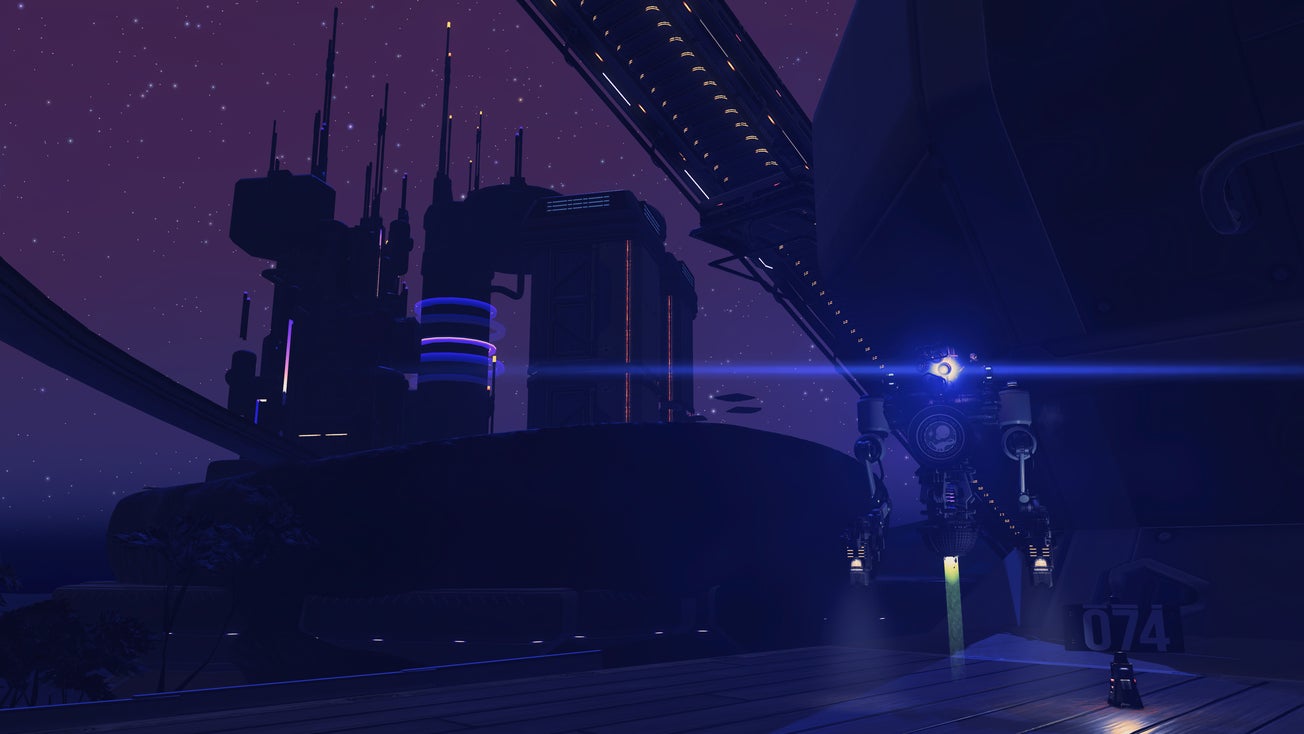
And the tour goes on; as we navigate underpasses and the kind of sweeping skybridge that would give F-Zero’s antigrav tracks a run for their money, we pass Aeon City’s PvP area, featuring fully functioning capture points, so competitors can play the likes of Domination or Search and Destroy. A casino, meanwhile, has its own selection of mini-games. There’s the Star League district, named after the Hub’s competitive sports chapter, with three types of functional ball games – a version of volley ball, a Hub favourite known as Blaster Ball, and a variation on hockey where teams try and shunt a player-puck into the goal.
There’s a swirly swooshing exocraft racetrack, complete with tube-y bits, which really is pure F-Zero, and the Tridium Carnival area with still more mini-games (I was decently successful at hoopla but catastrophically bad at Anomaly Darts, managing to overshoot my Pilgrim far enough that it involved a long walk back). A nearby platform gives glorious skyhigh views of the entire city, and is officially a viewing platform for flyby Starship shows. Down in the seedier part of town, the Underbridge District, visitors can find the NipNip dispensary and a goth club – where Conor has created a ByteBeat rendition of Bauhaus’ Bela Lugosi’s Dead. Over on the horizon, I spy the imposing hulk of Aeon City’s bumper-Nautilon dome (precisely as chaotic as it sounds). And our tour comes to an end in Ark Park, honoring the contributions of the Interlopers who participated in the Hub’s two Ark Project; each individual statue a tribute to someone who named at least one system as part of the advance party, Right at the top is ‘crpthnflrst’, who named a staggering 1,000+ systems during Ark number 2.
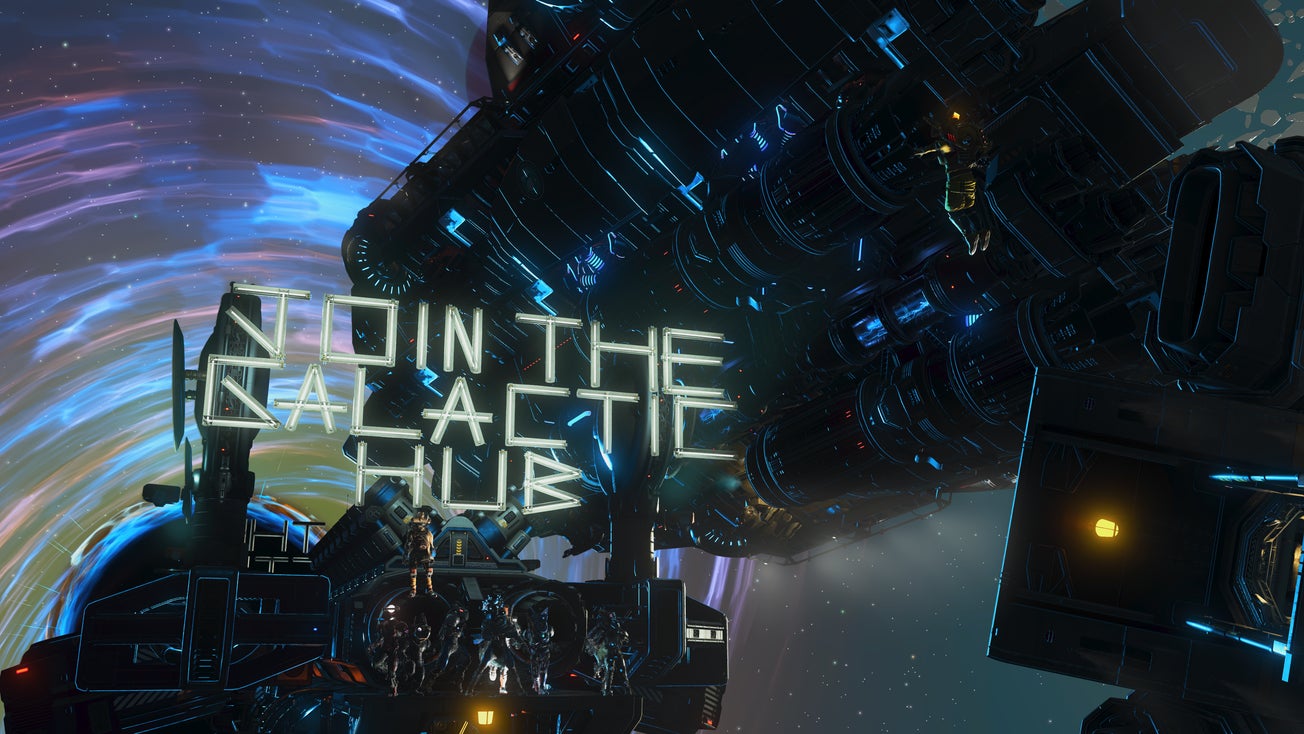
The scope of Aeon City really is something, and it’s obvious why Conor refers to it as the “crowning jewel” of the Hub’s new capital region, the Sea of Xionahui. Sadly, while open, its exact location is private for now and it’s currently only accessible to a limited few. “So many people came [to New Ziki City] and uploaded bases, it became inconsistently accessible to visitors. So, we’re much more restrictive about who can access Aeon City,” explains Conor. “We’d prefer not to be, but that’s just what we have to do”. He hopes Hello Games might one day implement a more persistent form of base building, perhaps in No Man’s Sky’s upcoming (but still-mysterious) Cosmos update, to resolve these kinds of problems. And having explored it myself, I can only imagine what Aeon might be like brought fully to life with busy streets and a vibrant population.
For now, though, it’s something of a city in waiting, and a quiet monument of sorts – to optimism, to collaboration, to community, resilience, and kindness. As for Conor, I wonder what it is about the Hub that’s kept him inspired a decade on. “First and foremost because it’s fun,” he says. “Fun for myself and fun for other people, and because it’s important to people who need it … I’ve had people reach out and, for various reasons, they’re either not comfortable with or not capable of going out in real-life, and this gives them an avenue – so that makes it a big sort of deal.” And there’s the sense that as a “demonstration of human nature in a post-scarcity environment”, it gets to a kind of truth, too: “In short, people want to help each other.”
For some players, the Galactic Hub has become a home of sorts, for others it’s just a place to visit every now and then. Either way, says Conor, “they’re both welcome here.”