This genre blend revels in its own sense of imagination and excess.
Protect the egg? Why not. Except the egg is a football, and this particular football is a playful and punishing presence. Keep the football alive – a football can die now? – and you’ll get a great reward of some kind. Let the football perish and you’ll have to forfeit more than you might be expecting. No wonder, really, that this singular opportunity for football ownership comes with a payment up-front. You’re paid in advance for the privilege and terror of looking after that football. And remember: the football itself is probably an egg. What to do?
Titanium Court is a vital and often thrilling piece of game design, because I think it shows you what it’s like to be in love. I mean that in a very specific way. The game’s not a romance and, in truth, its narrative and ever-growing cast can be hard to keep track of over even a single play session. Most emotional motivations can seem obscure from the off; most plot twists, like the arrival of the football, are distinctly arbitrary.
But I think the entire game is in love. It’s in love with its own creativity and imagination and phenomenal intricacy. It’s in love with the very energy it uses to conjure itself into being from one moment to the next. It’s in love with chucking you eggs all of a sudden and then claiming they’re footballs. Mostly, it’s in love with turning all this sweet work into yet another layer of mechanical ingenuity for you to pick through.
I see this most clearly in how unclear a lot of the game is for the first few hours. Titanium Court is eager to interrupt itself, to caveat and nuance or even fully undermine an idea it’s just introduced, or to throw in an unexpected left turn. I’ve played enough now that I could just about keep an overall description of things simple: at heart this is an ingenious and absurd exploration into the narrative potential of match-three games. But why keep it simple when Titanium Court never does?
Deep breath. I wake each morning and explore the rooms and gardens of a strange court. I think the place is run by faeries, and I think I may accidentally be some kind of big deal in the faery world myself. I have probably been told all this in the game’s early stages, but honestly mates, Titanium Court tells me so much, and on so many disparate subjects, that I struggle to keep it all in my memory.
And so I simply know this: I wake, I go for breakfast. I learn a little more about the game’s world during such simple interactions, much as I do when I drop by for a shower, which triggers a little match-three game involving soap and suds, or when I visit the library, or when I unlock a new room to explore, a new painting to look at, a new stranger to accost and engage in brisk, elliptical conversation. I even learn a little when I head off for my first magic lesson, only to be told that I’m going to have to teach the next magic lesson myself, despite the fact I’m pretty sure I don’t know any magic. What’s all that about?
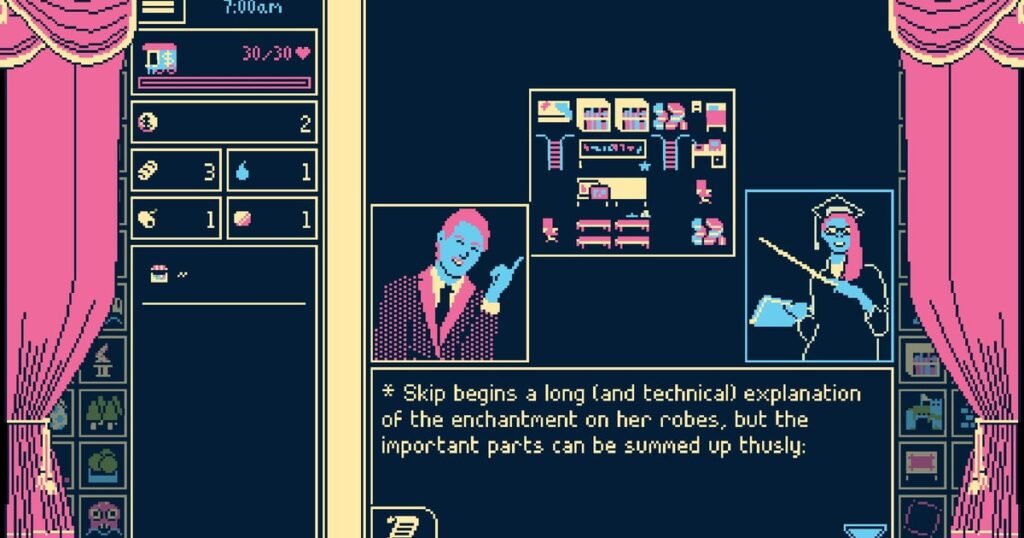
Most of this stuff contains boosts and perks and wrinkles to the overall design. And it’s all delivered with sly, mocking text and lovely little wibbling characters moving around tiny buildings. Big moments trigger pixel-drawn images that seem to work as metaphors – a home run! A cat with a mouse in its jaws! – and you also get portraits of some of the members of your court, who tend to look like 1980s stage magicians, thin ties and sharp suits with the cuffs pushed high. Nothing up these sleeves.
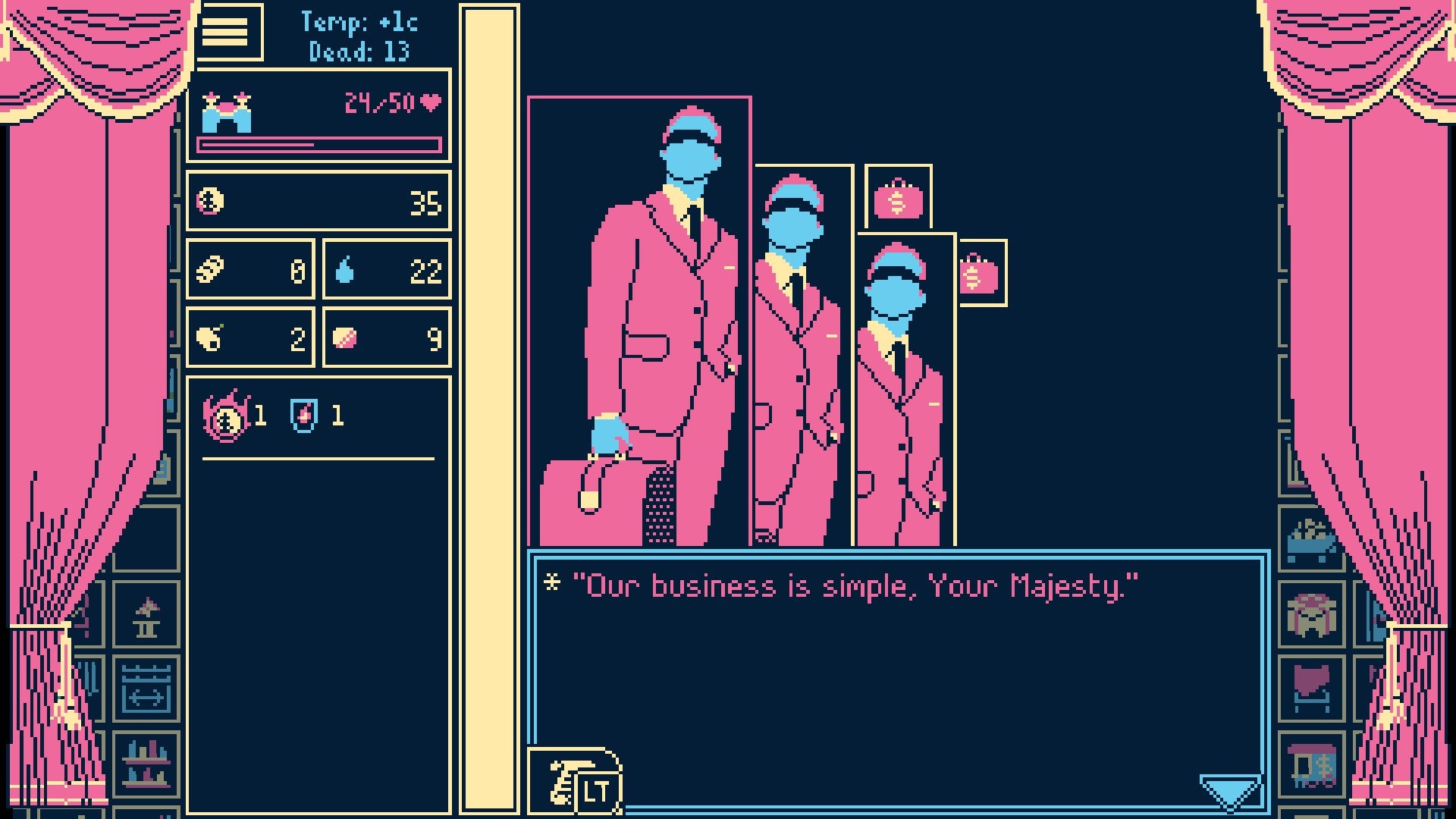
The strange nostalgia of it all! The deployment of these incidental artworks and portraits recalls the ways that the stacked playing cards used to spring out of the screen at the end of a round of Windows Solitaire. The colour scheme for the entire game suggests childhood ice cream with its pinks and soft beiges. And battling, when it inevitably arrives, plays out on a grid that brings to mind a tempting mega-slice of Battenberg cake. Delicious! Isn’t this entire game as charming and inconsequential as marzipan?
Battling: this is where the game switches from bizarre visual novel and Midsummer Night’s Dream riff to a proper match-three experience. I say proper because a lot of things you know about match-three carry across. Match from the bottom, for example, if you want the biggest chances of a cascade of good fortune from above. And talking of good fortune from above, Titanium Court has the same challenge that every game that tries to use match-three as an engine for combat eventually runs into. Namely: it doesn’t feel fair. Because you don’t know what’s stacked above the playing field that you can see. You don’t know what’s hanging overhead.
Lots of games have clever ways to counter this. Gyromancer, for example, sweet Gyromancer, made your own wasted moves into your enemy’s attacks, so you were punished not so much by randomness but by your own inelegance. I’m tempted to say Titanium Court’s solution is two-fold. Firstly, it never really takes itself too seriously. Secondly, it buries any questions of fairness under an avalanche of quirks and gimmicks and eggs and football, and also bird cages and strange jars and and and…
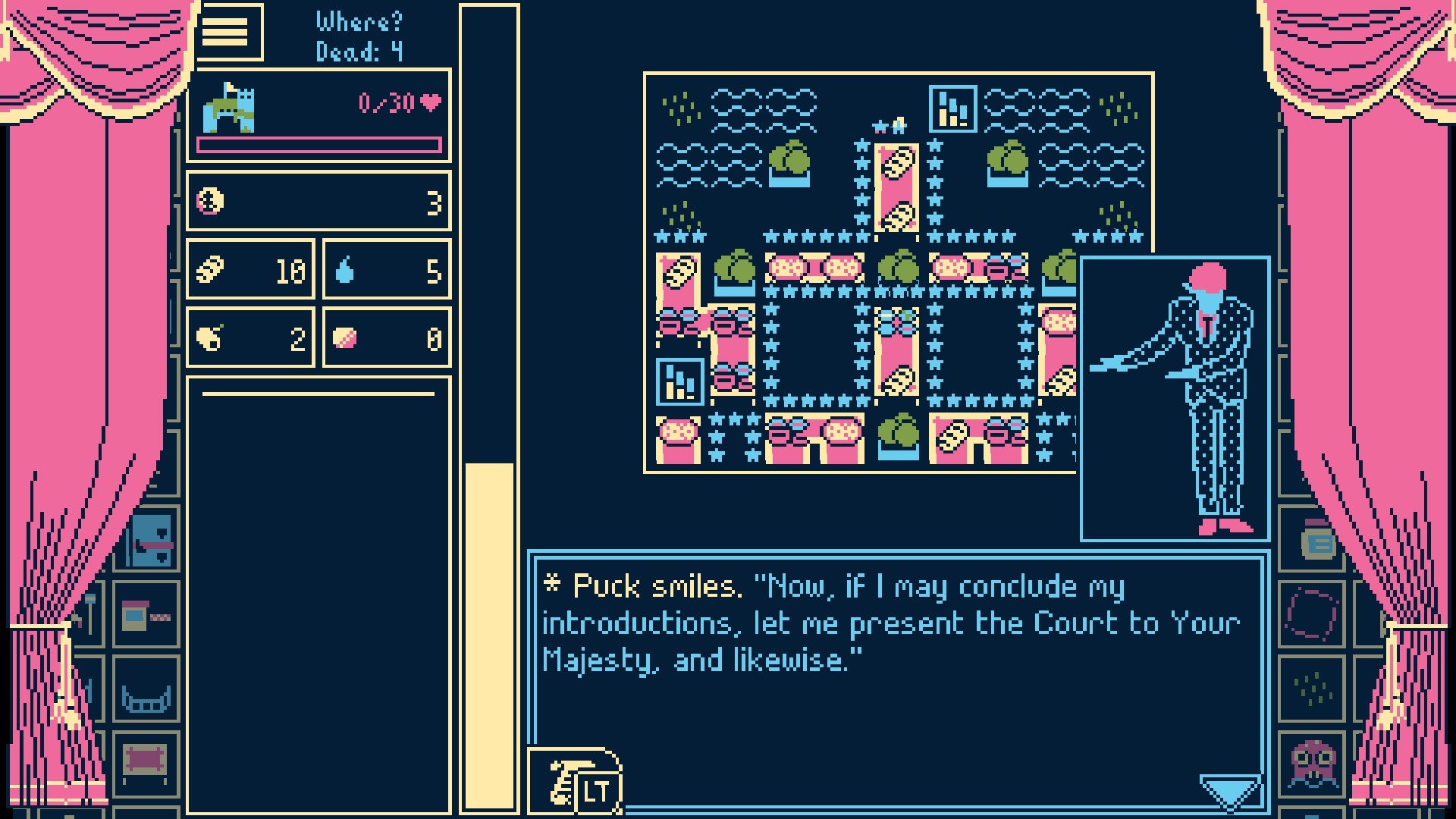
Let’s keep it simple here. Battles have two stages. At High Tide you prepare for battle by playing a game of match three on the tiles you’ve been given. The tiles display the terrain you’ll be battling over, which means that each tile pulls double duty. They give you resources and they also affect the eventual battle more directly.
Mountains give you stone and rivers give you water. But mountains also provide terrain that’s slow for troops to move over and water blocks troops who don’t have boats. And so, the first of each battle’s many things to think about turns up. Match water and mountains for resources, which you’ll soon be using to pay for units to deploy, or make sure your crucial court tile – the tile that will eventually take damage in battle – is protected by a moat and a mountain range?
This spirals outwards. Match crops for food or spend your limited matches matching enemy strongholds? If you get them all, you’ll end up fighting against nothing when the battling part comes around. But you’ll pass up on those vital resources, which matters because each battle is one of many.
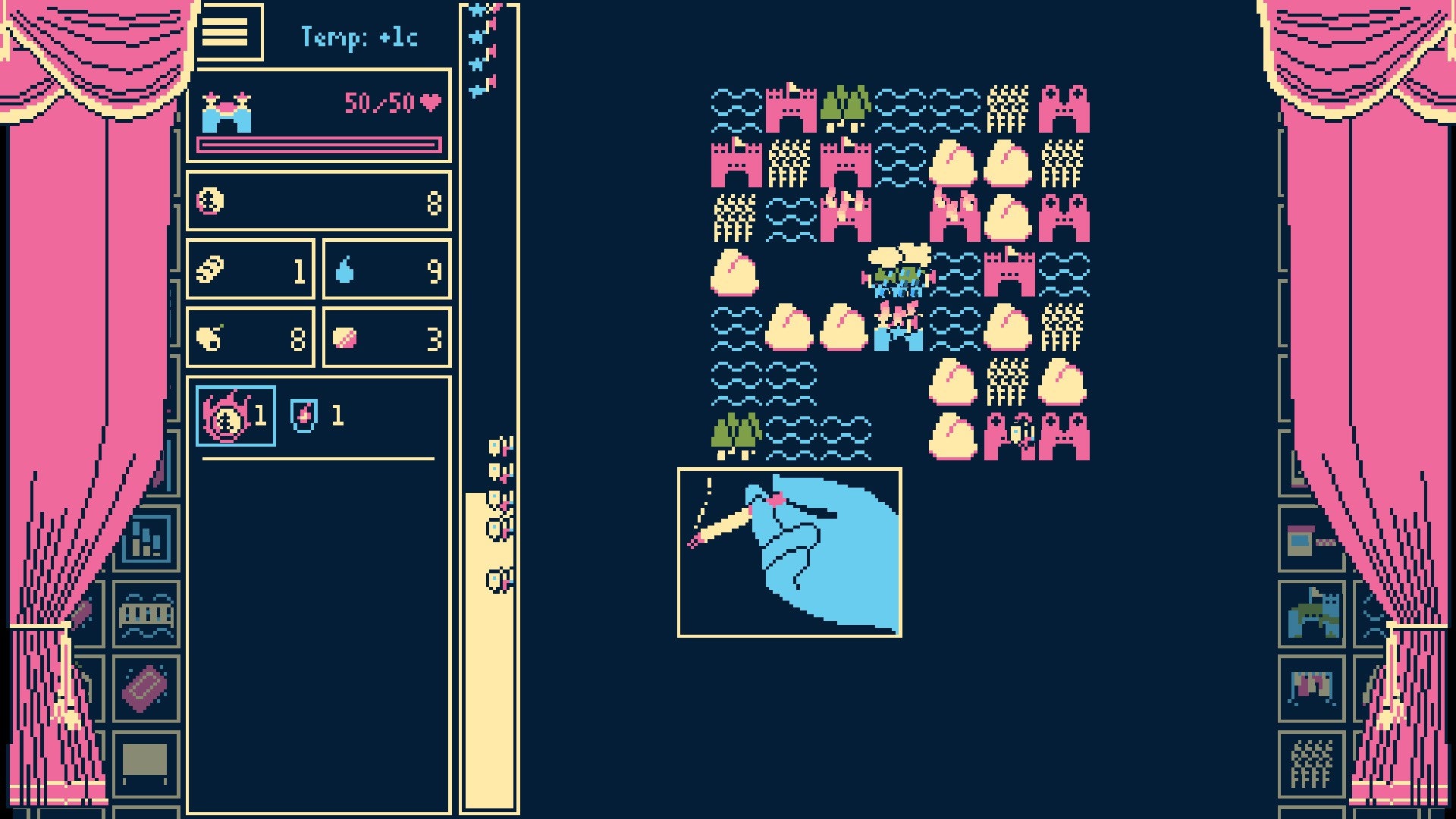
Onwards. Keep certain tiles in play – with chests and shops and whatnot – and you can open those chests and visit those shops once High Tide is over. The amount of things you’re doing in High Tide, in other words, is already slightly dizzying when the game is at its simplest. You’re arranging a battlefield, you’re gathering resources and protecting valuables, you’re moving your stronghold to a place of greatest safety and you’re thinning ranks of your opposition.
Trigger Low Tide! Now the match-three becomes an auto-battler. You place your units and see how they fare. Maybe you focus on units that gather more resources. Maybe you focus on units that defend your base. Maybe you’ve chosen a class – there are classes here, called jobs – that allows you to set fire to surrounding tiles.
Then there are your enemies, simple goons quickly giving way to centaurs, wormholes, catapults and warships. Each of these is a specific challenge to counter, and each of these makes the web of in-game choices. Watch the battle play out! How much health did you lose? How many resources did you use? Where on the in-game map do you want to go for the next battle, which means, in turn, which kinds of enemies are you least bothered about facing next? And this, remember, is the game at its simplest and least adorned.
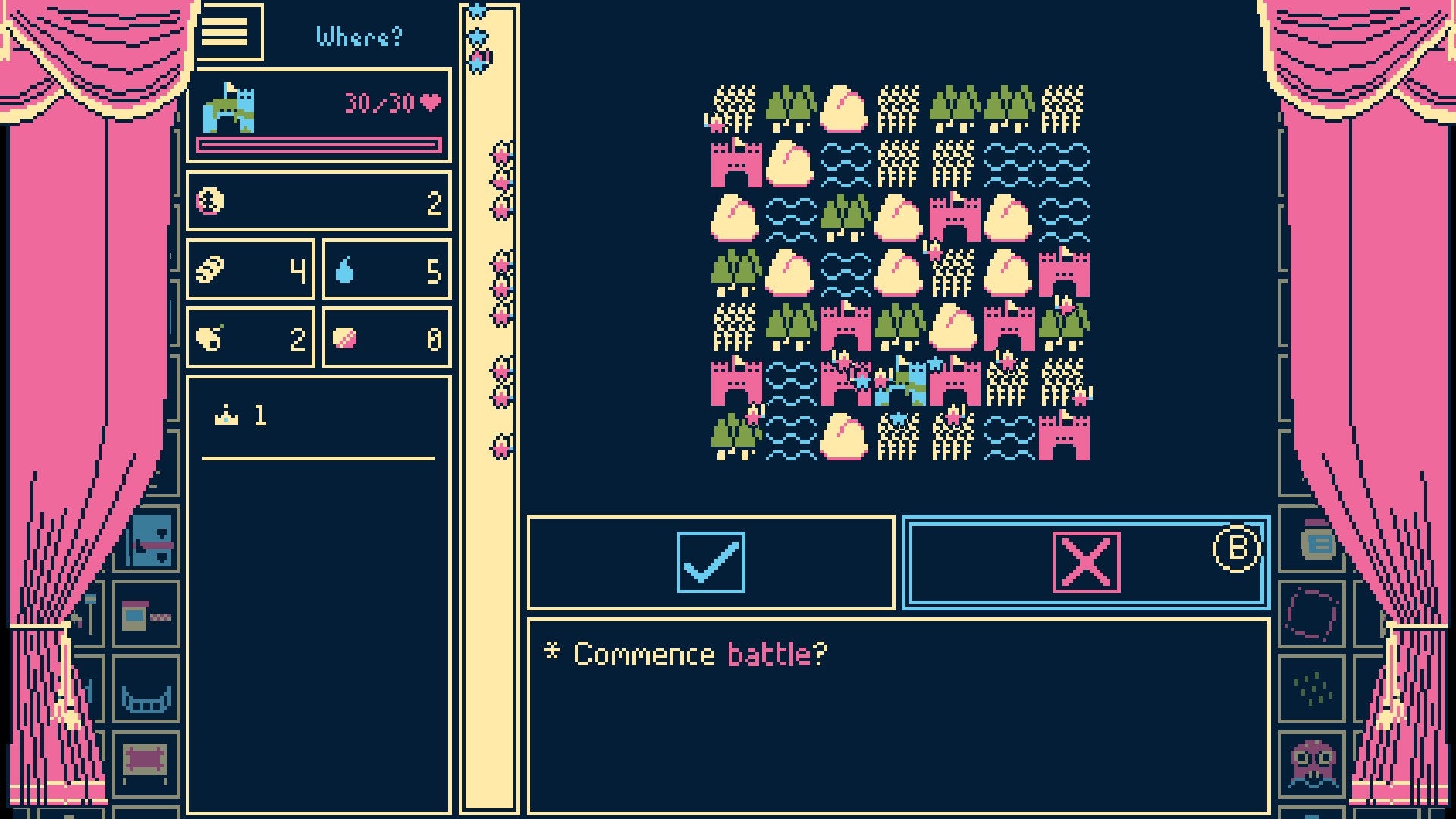
I initially thought that the battling was the heart of Titanium Court. In truth, I now think it’s just the most openly game-like aspect of the whole thing, and the true spirit of the entire project is spotted in the giddy interactions of absolutely all the moving parts and the zest with which the campaign piles on more and more and stranger and more. This should be overwhelming and exhausting, and at times, Titanium Court is. But it’s never just overwhelming and exhausting.
And that’s because of love. I’m no game designer, but I recognise some of this stuff, or I tell myself that I do. That’s because there’s sometimes a moment in the life of a piece of tricky writing where you’ve overcome basic hurdles – basic hurdles are always the hardest – and you find yourself suddenly enjoying the process of making sentences so much that you’re tempted to linger and add things and pile ideas on top of ideas.
I had a lecturer once who used to call this “plussing”, and plussing, like that cursed egg/football, is both a delight and a danger. It’s plussing where I generally absolutely ruin any piece of writing I’m working on, smothering it with the sheer addled love of the process. It’s a bit like ruining the lines of a piece of clothing by filling all the pockets with toy cars.
But that’s just me. And Titanium Court proves there’s so much potential in such a moment. From simple, if disparate, ingredients – visual novels, match-threes, the inevitable bit of roguelites – it adds and adds and adds. Characters. Dialogue. Lore. New ideas. Shower sequences. Weird musical interludes – I am at a loss to capture the spirit of the music in this game, other than to say it may once have been Surf-ish, and it feels delightfully hand-crafted – and bosses.
This is the love, I think. Whoever made this, I tell myself, reached a point at which the clouds dropped away and the horizon was suddenly limitless. Here lay a moment of joyful revelation. Whisper it: they suddenly realised that they could go on adding things forever.
A copy of Titanium Court was provided for this review by Fellow Traveller.