“This is the first time a box comes out and has my name on it, which is really cool.”
Magic: The Gathering’s head designer, Mark Rosewater, is very excited for his latest project. It’s also his longest one. He has been working on and championing a game that features another prolific game designer’s credit on every booster pack and pre-constructed deck for 31 years. For 28 of those years, Mark has been cooking up his own game, taking everything he’s learned designing cards and mechanics over his storied career to make the simplest trading card game possible. With the upcoming release of Mood Swings, a new TCG prototype coming soon from Wizards of the Coast, Rosewater finally has a product he can call his own. At MagicCon Vegas, we spoke with the long-time Magic developer about the emotions printed on the cards and the ones he wears on his sleeve about the journey getting Mood Swings out of his mind and into the hands of the public.

Magic: The Gathering is inherently complicated, sometimes to its detriment for new players. There’s a randomized resource system, intricate deck-building combinations, complicated math on any given turn, and over 30,000 game pieces to learn and play with. Rosewater’s focus with Mood Swings is distilling the trading card game concept to its sleekest, simplest form. He had the idea in 1998 to make a card game for people who Magic’s expansive nature might turn off. “I’m trying to boil down what I think is awesome about trading cards, but shave the complexity, and keep the essence of what it is,” says Rosewater. With Mood Swings, two to four players can play immediately with the contents of one box; zero deck-building is required to start, and any card can be played without worrying about casting costs.
After playing one round of Mood Swings with its creator, the simplicity shines through immediately. Mark shuffles up a deck we share for the game and deals five cards to each of us. We then take turns putting one card into play, and whoever has the most value among the cards on the table wins that turn. The board state is retained between turns, enabling strategic plays over the course of the game, and whoever wins three times is the victor of the match. The basic rules are straightforward, clean, and easy to understand. Matches are meant to last a handful of minutes rather than up to an hour like other card games. As Magic was created by Richard Garfield to be played between long Dungeons and Dragons sessions, Mood Swings was likewise designed to fit between games of Magic. However, like any card game built to keep players engaged, there has to be some complexity, and that comes with the effects written on the cards themselves.

Cards in Mood Swings are naturally called Moods, each representing a different emotion such as envy, joy, anxiety, indifference, and conviction. The flavor is inspired by Rosewater’s mother, who worked as a clinical psychologist. Moods, like the rest of the package, are streamlined significantly from the typical TCG. Each falls into one of five colors, matching the colors themselves and emulating the mechanical design space of Magic’s color pie. In the top-right corner lives a six-sided die that shows the numerical value of that Mood and is used to calculate your score for the turn. Most Moods also contain rules text that affects the board in various ways. Some cause players to swap cards in hand, allow a player to place extra Moods, or earn additional value by meeting certain criteria. In our game, Rosewater and I traded turn wins throughout. He wins the first turn with a white card called Complacency, beating out my lower-value Mood. He then goes first on the next turn for winning, playing a red Mood called Animosity, which increases in value due to the number of cards in an opponent’s hand. This move inadvertently caused my turn-one card, Happiness, to increase in value because it cares about red and white Moods being in play, which let me win turn two. The concept of playing with the cards you have from one purchase worked well in the short play session. The core throughline of a game is incredibly easy to grasp, but that doesn’t mean there isn’t a sandbox of effects to ponder each turn. Even after 28 years of playing Mood Swings, Rosewater was deeply contemplating his next move against someone who was touching the game for the first time and holding their own.
While Mood Swings contains everything needed to play in a singular package, it is a TCG at its heart. Upon opening a box of Mood Swings, a randomized collection of 45 Moods, dispersed at the usual Magic: The Gathering rarities of common, uncommon, rare, and mythic rare, allocated from a master list of 133 cards. The point is to make every deck play differently, offering a pick-up-and-play experience that can vary widely each time a new package of Mood Swings is opened. It also scratches the collection itch, allowing people to collect every card and build a bespoke deck. On that note, when it comes to deck building, there really aren’t any rules for what you can and can’t put together. “As long as you have enough cards to play with, you can have any card. You want duplicates? You want all rares? The game will handle it,” says Rosewater. The game also handles more than four players. For that, you’ll need to add more cards than what comes in one box. While you can sculpt the ideal deck or wacky concoctions, Rosewater emphasizes that the buy-and-play simplicity is the main goal of the final product.

It’s almost a miracle Mood Swings exists so long after its ideation. I could hear the emotion in Rosewater’s voice as he spoke about finally getting the game to the finish line. He likens the experience to Lucy repeatedly pulling the football away from Charlie Brown, and he didn’t quite believe the project was finally happening until he had a test print of Mood Swings in his hands. “My boss says my superpower is persistence and that I will stick with things forever,” Rosewater says. “One of the running jokes is that there’s mechanics in Magic that I just out-waited the people who didn’t want to do them.” Once again, thanks to an experimental team at Wizards of the Coast, Rosewater’s persistence and patience paid off.
Releasing this game through the Wizards of the Coast’s Secret Lair brand makes a lot of sense, given the shared DNA with the juggernaut Rosewater has helped shepherd for three decades. Secret Lair typically sells alternate-art or mechanically unique Magic cards directly to consumers. Risks are taken on outside properties like SpongeBob Squarepants, My Little Pony, and Jaws being introduced through this marketplace, or on new art treatments that are bold interpretations of what a Magic card can or should look like. The Secret Lair team was looking to do something different yet again and approached Rosewater a few years back to see if they could make printing Mood Swings a reality. Mark, whose hopes had been dashed many times over, found hope once more, and, of course, said yes.
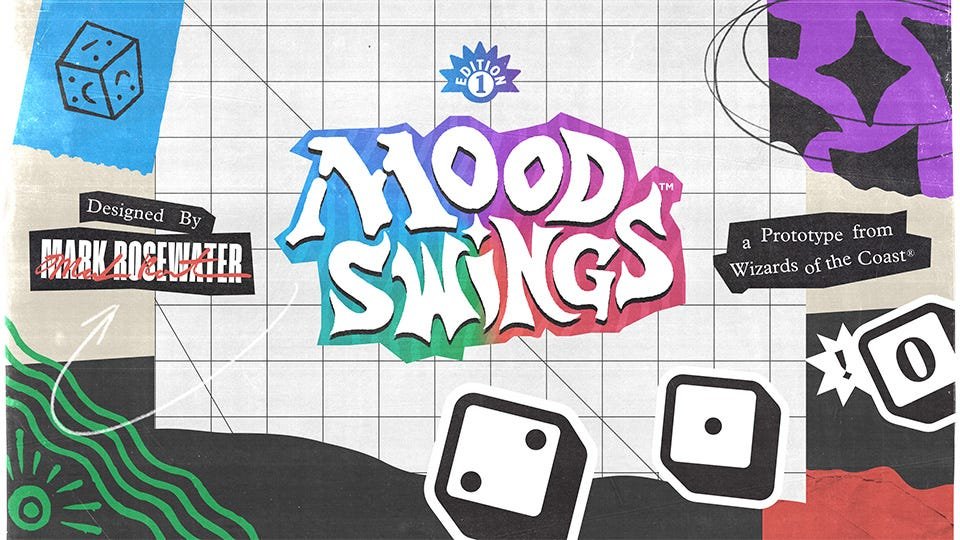
Obviously, the goal of releasing a new game is to make money for the company, but for Mark Rosewater, there’s more on the line. He’s been working on this project for 28 years, so according to him, making it to print in the first place is a success. Beyond that, he wants Mood Swings to sell enough so Wizards of the Coast will let him make more and eventually distribute it to retailers. The front of Mood Swings cards currently play up the prototype aspect of this release, with graph paper backgrounds and in-progress sketch art from existing Magic cards, giving it a decidedly placeholder look. What isn’t a placeholder, however, is the back of the card, which has been thoughtfully finalized in case of future releases. If that’s the case, Mark does have one lofty goal, beyond making more Moods available. Wizards of the Coast has a handful of pillars to its name, including Dungeons and Dragons, Magic: The Gathering, and the Japanese TCG Duel Masters. Why can’t his game join the pantheon if it sells well enough? “I’d love for this to become ‘Wizards of the Coast: home of Mood Swings,’” Rosewater exclaims.
Mood Swings is slated for release on June 1, 2026, through Wizards of the Coast’s Secret Lair website. Each box will retail for $25 and includes 45 randomized cards.