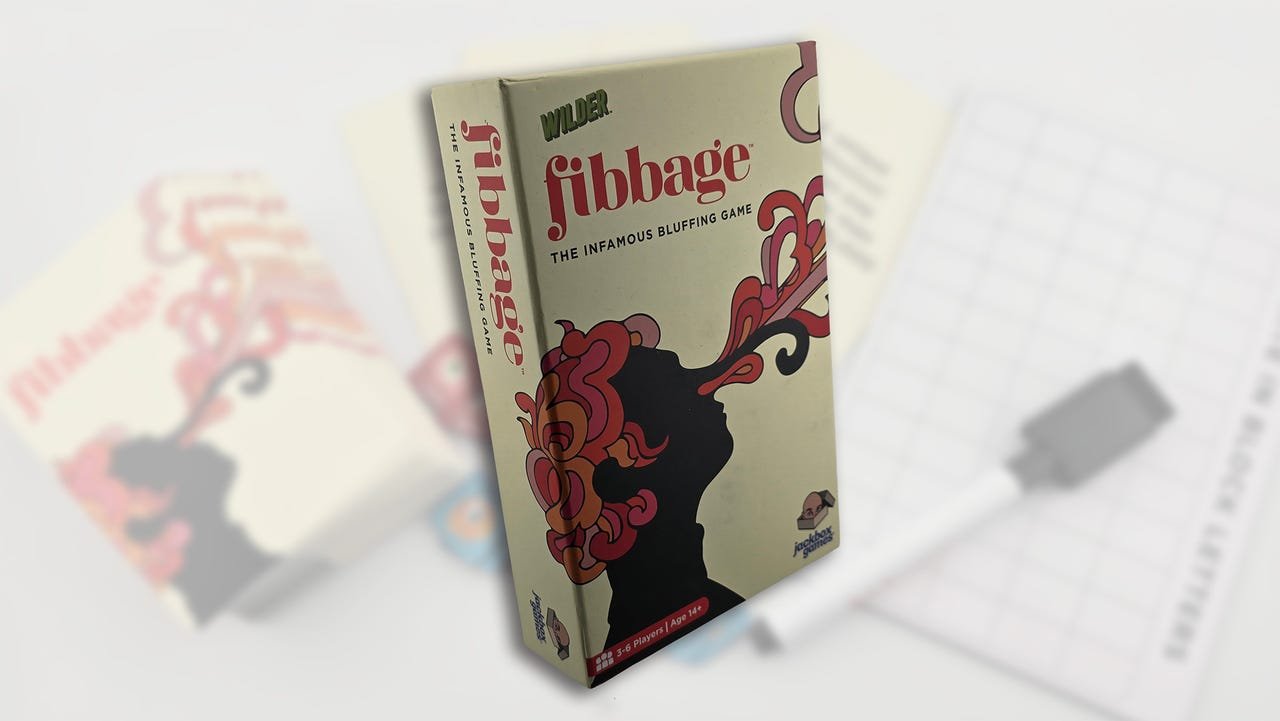
If you were attending parties in the mid 2010s, there is a pretty good chance that at least some of those gatherings you partook in the party game “Fibbage” from the folks behind Jackbox Games. This digital party game has gone on to spawn multiple iterations over the 12 years since the first was released back in 2014, and now Jackbox Games is cutting the cable and bringing this mainstay party game to the tabletop with a card-based version for your board game nights.

Fibbage Card Game
0
The Jackbox party game comes to tabletop.
All of the rules that have helped make this digital bluffing game have carried over to this new card game. As in the other iterations, in Fibbage one of the players will serve as a “revealer” who will draw a card and read aloud a prompt with a portion blanked out, and it is up to the other players to write down a plausible option to complete the prompt. However, the person who drew the prompt will have the correct answer and will write it down and add it as the correct answer. The players will all put in their answers, which will be shuffled, followed by a voting period where you vote for which you think is the right answer. From there, points are earned based on whether you guessed right and if others voted for your submission, and the person with the most points at the end of however many rounds you decide on (by default it’s six rounds) wins.
Inside the box, which is roughly the size of a standard hardcover book, the rules are on a single side of paper (the other side is an ad for Jackbox Party Pack 4), cardboard voting/point tokens (but strangely no bag to put them in), six dry-erase markers with boards, and 300 cards with prompts. The prompts themselves span an eclectic range of topics, from asking about chefs who cook ducks with hair dryers to Japan-exclusive flavors of Pepsi. The impressive number of cards means you will have a good number of games to get through before you start getting many repeats, which is great.
The Fibbage Card Game, just like the digital version, is ripe for expansion after expansion, and knowing Jackbox, I imagine it won’t be long until we start seeing packs of additional prompt cards, different themed prompts, and extra markers and boards to write on. There really isn’t any reason that you can’t expand the player count to as high as you want, so long as you have things to write with and on, and something to keep track of the points with.
Everything about Fibbage has made the jump to a physical game rather successfully, with one slight exception – the writing the answer part. Does it work? Sure. The issue is that considering the revealer knows that answer, unless your group has really similar handwriting, or at least writing box letters similarly (which the game suggests you use), before too long you will probably start recognizing the handwriting of the players. Especially in lower player count games. A situation I ran into.

A bit of homebrew magic I worked out was that I had the revealer gather the submissions, then, on a separate sheet of paper, copy down all the answers, and the group would vote on that list. It does add an extra step and a little more time, but this does manage to keep the votes tied to the answer as opposed to everyone pretending they are a forensic document examiner (I looked that one up; an FDE looks at and compares handwriting and signatures for the court – also may or may not be a question on one of the cards).
Regardless of how you play it, Fibbage ranks up there as one of my favorite purely party games out there. It’s one of those games that even ol’ grandma and grandpa can get in on and have a good time with. I’ve always appreciated the fact that Fibbage asks a bit more of its players, requiring you to be a bit more clever and creative without relying so much on “who has the funniest response” to score points. An outcome that I’ve found games of Cards Against Humanity and others tend to devolve into. This physical version of Fibbage is a really faithful adaptation of a game with a proven track record of being a hit at parties, and one I can see myself bringing out frequently.