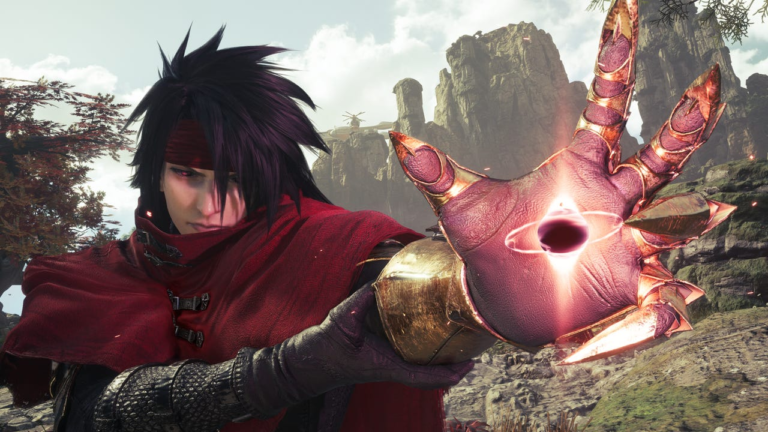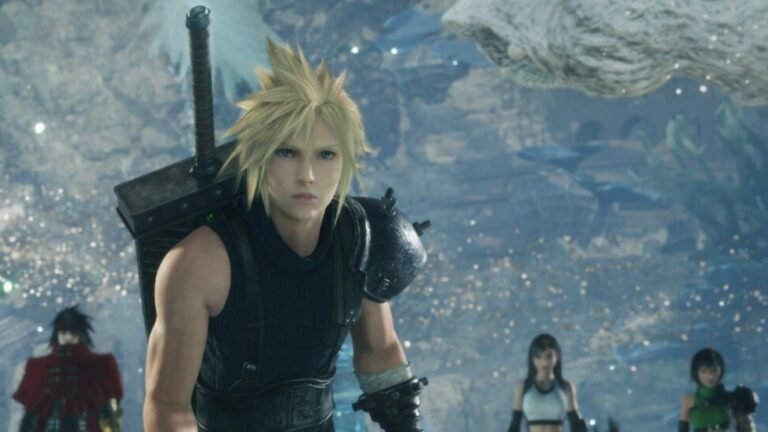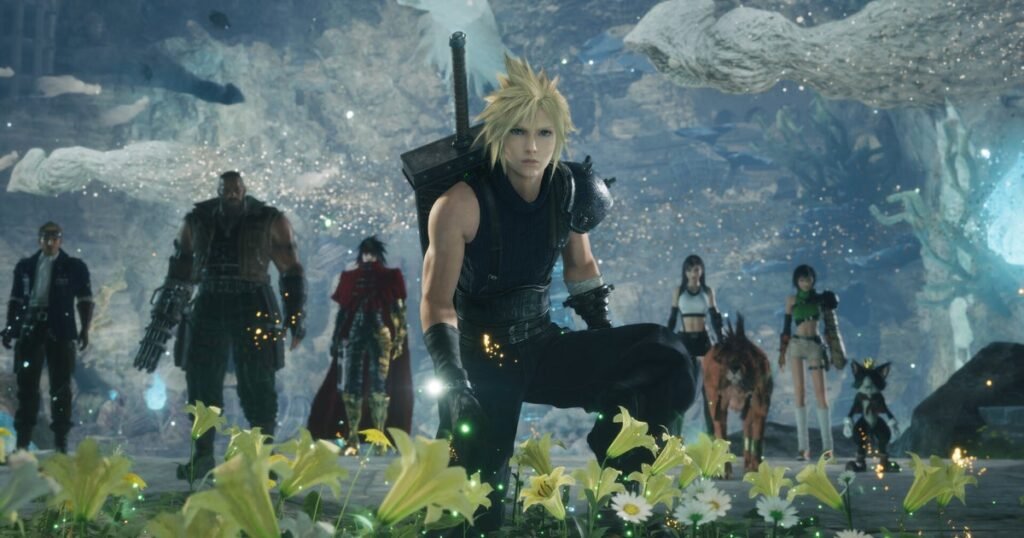
Settling into my demo of Final Fantasy 7 Revelation, I was slightly appalled by how many tutorial pop-ups I had to click through in order to just play the damn game. Granted, the slice I’m playing comes from ‘a few hours’ into the experience – our ragtag bunch of environmental terrorists-cum-saviours of the planet have just procured themselves an airship, and Square Enix needs to ensure we all understand the guide rails that keeping this wobbly demo in place. Fine.
But you’re giving me an hour to play, handing me a dossier about all the content available in it, patting me on the head and sending me out into the admittedly large open world that includes everything from Rebirth, and then some. In that hour, I must have spent at least 10 percent of my time – if not more! – dismissing menu pop-ups, fast-forwarding ‘tips’ from the infamous Chadley, and telling the Monster Assessment Instrument (or MAI) to shut up. Yes, she even asks if she’s being too annoying at one point. This is all symptomatic of Revelation’s open-world aspirations – something woven deeply and inexorably into its DNA.
When Square Enix’s internal development team, Creative Studio One, was in the final stretches of completing Final Fantasy 7 Rebirth, director Naoki Hamaguchi was already hard at work on the concluding chapter in the remake trilogy. In fact, for a full year before Rebirth’s launch, Hamaguchi was wrist-deep in the guts of Revelation – ideating, iterating, and improving. He’d take inspiration from games like The Witcher 3: Wild Hunt, Sony’s Horizon seriess, and Crimson Desert, name-checking these open-world behemoths in interviews when talking about Revelation before we even knew its name.
The thing is, Rebirth would launch to some discontented murmurs. Our own Ed Nightingale awarded the game four stars, calling it “an overstuffed but lovable re-imagining“, a more generous take. Some consumers would call it ‘bloated’, arguing the expansive side content was merely there to pad out a perfectly fine main story. Though Rebirth garnered plenty of very high scores, conversation post-launch became fixated on its open world nature, and Square Enix would eventually say the game failed to hit the publisher’s lofty expectations. So players responded: how much bonus content is too much? How far from the original Final Fantasy 7 is it okay to tread?
I fall quite happily into the camp that says “let Hamaguchi cook”. If I wanted the original Final Fantasy 7 experience, I own the game on enough platforms that I can go and play it. With the Remake series, I am excited for Hamaguchi and his team of FF devotees to experiment with the classic Final Fantasy formula and apply it to modern open-world sensibilities. I didn’t really care that there were ‘Ubisoft towers’ in Rebirth. I like mini-games like Queen’s Blood. I want to hunt down superbosses and grind my team. I grew up on classic RPGs, this stuff is catnip to me.

So, despite having to swat away menu after menu in Revelation, I enjoyed what (eventually) opened up in front of me. Gliding from the airship to literally anywhere in the world is a real show-off thing to do, and really demonstrates Hamaguchi and his team’s belief in this truly open world vision. Absolutely littering the map with icons says likewise. The combat – bigger, better, beefier than Rebirth’s – shows a team fine-tuning something nearly perfected in the preceding game. Traversal from one point to another has been improved once again – Chocobos are fast, reliable, and can even engage in combat to help thin out fodder enemies – and new tools help you navigate the world much more fluidly than before. It’s hard to believe this system has somehow evolved from the glacial, awkward pace of Remake back in 2020.
The thing is, every single time you get to a new point-of-interest, or step into a new challenge, or equip a new item, or investigate a new bit of the environment, you get a pop-up: either a text-based menu screen, or Chadley or MAI warbling at you. It stops any momentum in the moment-to-moment stone dead. Graciously, I could say that since this is a demo, there are hours and hours of tutorials distilled into one hour-long segment, but even then I have to wonder, is all this really necessary? And I say that as a fan of the open-world guff – heaven knows what a detractor of the maximalist approach will have to say about all this.
When Square Enix showed a gameplay deep dive of Revelation at last week’s State of Play, a quick sizzle on the ability to fast-forward dialogue began to stir the controversy machine. ‘Why would the developers sell the fact you can fast-forward dialogue as a feature?’, many asked. This is actually a feature the devs added to both Remake and Rebirth alongside the progression-helping boosters that arrived in post-launch updates (and something I find very useful when replaying the games for research). Why am I bringing this up here? Because I think more choice is better for us as consumers and people that want to engage with art. If we don’t want to fast-forward through side quest dialogue, we don’t have to! But if we’re just chewing the cud of side quests because we want to engage with the mechanics without necessarily engaging with the story, who cares? We are in charge of the buttons we press, we are in charge of how we engage with games. The more options, the better. Right?
I think this one tiny aspect of the game’s philosophy can be examined and drawn out to the entire game. You want to engage with the golden path and nothing else? Fine, go ahead. Want to complete every region to 100% like I did in Rebirth for some reason? More power to you; you’re going to get more from the game that way.
There are a lot of bad faith takes on what Hamaguchi is trying to achieve with Revelation, but I honestly think – as aggravating as one million tutorial slides can be – it’s a small price to pay for a game as ambitious and complicated and maximalist as Revelation is trying to be. Cloud’s story, I think, is going to go out with a bang – no matter how much the ‘bloat’ of his open world may try to muffle that.