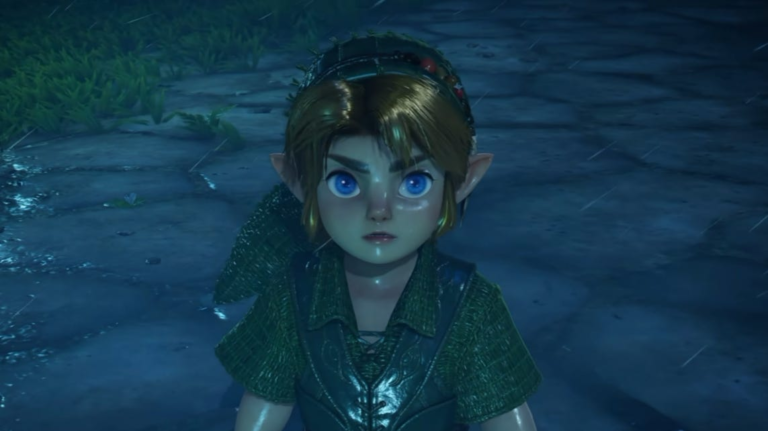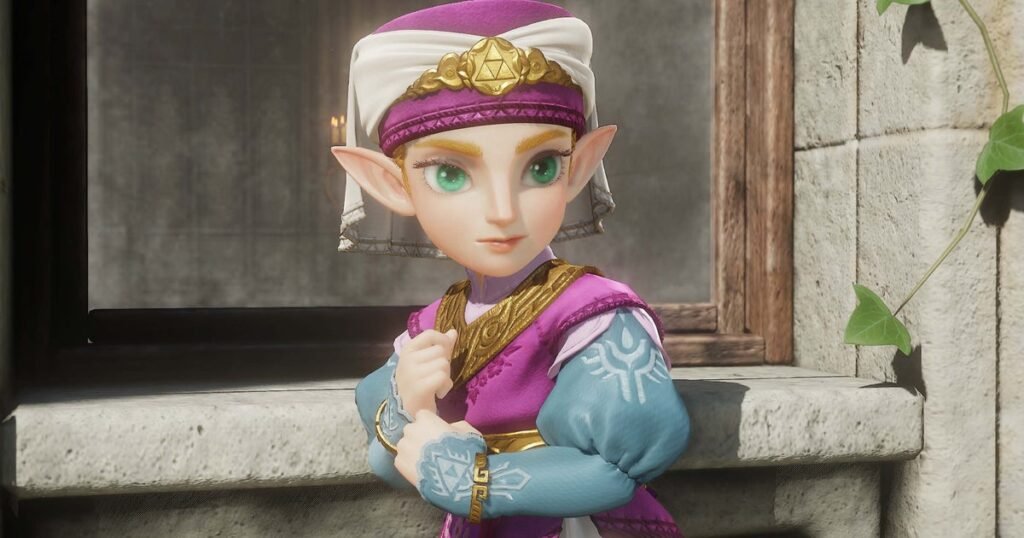
My first thought about the new art for The Legend of Zelda: Ocarina of Time remake was: Oh, we’re seeing too much. That was my first thought, but not my first reaction. My first reaction was pure emotional response. A familiar character turned around in the trailer and I literally recoiled, a move that I didn’t even know I had in my arsenal.
But, Oh, we’re seeing too much, quickly followed. Why does this look so weird, so wrong? I wondered. And then I thought about the original Ocarina and its landscape of visible triangles and pyramids, the way each character’s face is a pinched collection of polygons, reminding me of those folded paper fortune tellers people used to make when bored in class. I thought about how the classic game’s aesthetic could not really be separated from its wider design: this is how the game had to look on the available technology, if the developers were to do everything they wanted to do.
So maybe my response to the new Ocarina – weird! wrong! – had to do with that? The aesthetics had been separated from the technology, which meant that an N64 world was now being buried with Switch 2 graphical power. Too many details. Too much waving grass and rain on faces. Too much of a sense of the Rainforest Cafe to woodland scenes. We were suddenly seeing too much in general.
I am not an original thinker, and this line of reasoning was no doubt inspired by this brilliant piece by Gareth Damian Martin on the remake of Shadow of the Colossus. But here’s the thing: I rewatched the new Ocarina trailer again a few minutes after all this, and it didn’t feel quite as weird the second time around. The faces were still a bit odd, but everything else… is this really that strange?
Well. The second time I watched it, I was showing it to my wife, who is a massive fan of the original Ocarina of Time. Her initial reaction was a bit like my initial reaction. Asked to put it into words she said it was like watching Friends on a massive modern 4K TV screen: she doesn’t want to see these peoples’ faces in such detail. By now, though, I didn’t really understand my initial reaction anymore. I had asked a few people about the art and some of them quite liked it. It was weird, but weird could be good. Weird could be good for Zelda.

I’m tempted to argue that the important thing here is that my take on the art keeps changing – and I’m sure I’m not alone on this. Our feelings about the way any game looks seems quite mutable really. It’s based on where we are in the game, what we come to the game with, how long we’ve had time to adjust to it, all sorts of things.
And that question of how long we’ve had to adjust to a game is something I think about a lot these days in terms of art. The older I get, the more I have started to think of the experience of playing games as a sort of prompted hallucination. This is something to do with the way the act of playing blends with the memory of playing that it is helping to create. And it’s this memory of playing that ultimately lasts much longer. And if memory is anything, well, it’s changeable. It alters over time. Were the characters’ faces in the original Ocarina really pinched collections of polygons? Is it my memory rather than reality that has given N64 Link a kind of friendly beak instead of a nose?

I woke up this morning and watched the trailer again. I saw more of its vividness and less, I think, of its oddness. It already felt dimly familiar now, blending elements from Breath of the Wild and a few other Zeldas, all while restaging these sequences I knew intimately from Ocarina of Time. Now it felt…?
It felt, I think, like a description of a daydream I once had, except the daydream had been mine and the description was someone else’s.