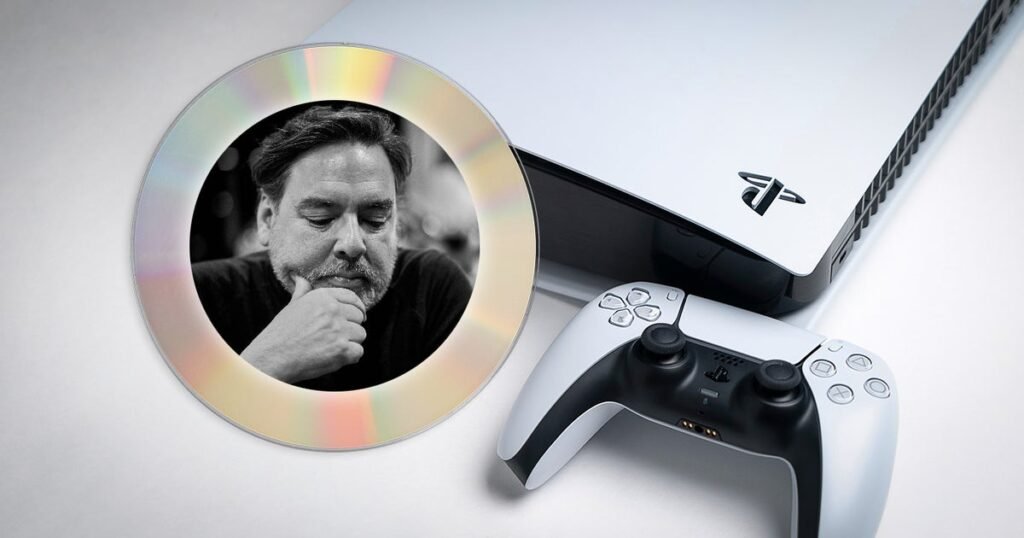
Former PlayStation Worldwide Studios leader and Sony veteran of 32 years, Shawn Layden, has described Sony’s surprise decision to end production of game discs as “fairly dramatic”. In an interview with me he called it a “spreadsheet” decision, outlined how he didn’t think second-hand sales were a deciding factor in it, and explained why Sony had always wrestled with this exact decision in the past.
Layden left Sony in 2019, and it’s important to note before I begin that he had no insider or prior knowledge of the events that have taken place this week. “I had no idea it was going to happen,” Layden told me. “I don’t necessarily agree with it but I don’t work in the business any more. Maybe it’s just too prohibitively expensive to stamp out discs.” Essentially, his guess is as good as ours.
But he said it could be no more complicated than some people looking at a spreadsheet and deciding the numbers don’t make sense to keep supporting disc sales any more. “If you look at any decision to discontinue a product or a feature or model or what have you, largely it’s a straight spreadsheet [decision],” Layden said. “What are disc sales compared to digital sales? And I’m old enough to remember when digital sales were like 10 percent – I’m old enough to remember when digital sales were zero percent because we didn’t have a digital market! And that number just grew over time.”
The Covid pandemic in particular rapidly accelerated the change, he said, both in how it got people used to the process of buying games online rather than in shops, and how that in turn sped the decline of bricks-and-mortar shops, therefore meaning there were fewer shops to buy games from. And so the vicious cycle spun.
Like us, Layden thinks Sony’s decision to end disc production probably means it’s making a PS6 console that doesn’t have a disc drive. It’s a move he said Sony toyed with for years while he was there. “I’ve been asked this question every year for the last 20 years,” he said. “When are you guys going to just give up on the disc drive? My feeling with that was always: well, when I get to a place where I’m comfortable enough to believe that worldwide, broadband throughput is good enough to support that download experience, good enough to reach the majority of customers.
“Majority does not mean entirety,” he clarified, “so there is a point, a tipping point, where if I have 80 percent of the opportunity, which represents 95 percent of the revenue source, what’s my incentive to keep the lights on for the other 20 percent if it’s effectively only 5 percent of the business? See what I’m saying? At some point it just becomes obvious that we can’t keep this whole thing running just for this very small slice of opportunity.”
Presumably that tipping point has been reached. But there’s always a danger in overestimating regional internet infrastructure somewhere – something he said Sony had always been “pretty good” at considering in the past, “because unlike Xbox, PlayStation had a wider global fanbase, and not just in the numbers, but in the reach, because Sony Corp had reach all over the world.”
But there are people who fall outside of the internet’s reach. For example, there were people on military bases playing PS4 who had no internet connectivity for security reasons, “and the idea that they could still buy a PlayStation 4 game, throw it in a machine and play was important. You don’t want to leave those people behind,” Layden said.
“I don’t know what went on in those conversations,” he summarised, “but it’s a fairly dramatic decision.”
“Second-hand gaming still occurs, obviously, but it’s not material any more to the business to worry about, I think” -Shawn Layden
When Rockstar announced last week that the physical editions of Grand Theft Auto 6 wouldn’t come with a disc but rather a download code, one of the suspected reasons why was to curb second-hand sales, because if you don’t own a transferrable version of the game, there’s nothing to resell. The code approach is one Microsoft famously tried to implement with Xbox One in 2013, but backtracked on following fierce fan backlash; the feature never actually made it through to launch. It’s a move Sony memorably lampooned in a video where executives Shuhei Yoshida and Adam Boyes demonstrated how hard (or rather how easy) it was to share games on PlayStation 4, simply handing a disc to each other. A lampooning that has since come back to haunt Sony.
But Layden said second-hand sales aren’t such a big thing any more. Even when he left Sony in 2019, their effect on the business was dwindling. “By the time I left, maybe we had some people looking in it, and physical piracy, that kind of stuff,” he said. “We used to do a lot – we had a lot of energy 20 years ago; you used to see those photos that we put out of bulldozers going over pirate discs in Hong Kong, crushing them. That concern is gone now.
“They used to be a huge factor,” he acknowledged. “The whole GameStop business model was driven around the used game, and then over time, the rise of digital kind of quashed that used-game business, and made it hard for folks who were making a nickel in the secondary market by selling them. I don’t think that reality necessarily drives this decision because this has been happening over time. I think right now we’ve reached some kind of homeostasis where it’s in a weird sort of balance. Second-hand gaming still occurs, obviously, but it’s not material any more to the business to worry about, I think.”
While the specific tipping for Sony’s recent decision remains unclear – Sony provocatively cited “consumer preferences” as the reason for discontinuing disc support – the ramifications of it are a little clearer. Microsoft and Nintendo will likely follow suit; indeed, there are already reports that Xbox is ditching discs for its next-gen console Project Helix, and that Microsoft is working on a way to let you convert discs to digital games in preparation for it. “Certainly this is an industry where if one company, particularly the leader of the industry, makes a decision of this magnitude, that’s going to heavily influence what the other ones do,” Layden said.
And if that’s true, it could mean the end of physical gaming media, because there’s no point making disc-based games if you’ve nothing to play them on. And maybe the apathy towards owning an effectively empty box will flatten any remaining desire for box-based games. Special editions may remain desirable, with their statues and art books and pack-in extras, but without the steady stream of standard boxed games to piggyback, their existence might be threatened too. However, the continued existence of physical movies and books offers some hope, Layden pointed out, but they are a slightly different proposition.
Since leaving PlayStation, Layden has spent time advising various companies, including Tencent, and is currently spinning up a new company in the games business to address the question – or rather problem, as he sees it – of variety in games. I’ll tell you more when I can.
Eurogamer previously spoke to Layden in 2024, in a wide-ranging interview about his many years at PlayStation and the many things he’d seen and done there. It’s well worth a read.