I’m a sucker for nostalgia, so I have yet to tire of the enhanced ports, remasters, and remakes that are all the rage these days. I love revisiting games from simpler times, sporting fresh graphics and handy new features, but I also enjoy completely new takes on them I would never have expected. Dragon Quest VII already got the latter treatment on 3DS a decade ago, and now Dragon Quest VII Reimagined is ringing in the 40th anniversary of the series with a fine third iteration, though it’s not one without sacrifices. This time around, there is a clear focus on improving the pacing of one of Dragon Quest’s most notorious entries, and Square Enix has succeeded in that regard – but some of the other adjustments Reimagined makes in an effort to appeal to newer players have come at the expense of longtime fans.
Alone on a small island in a vast ocean, Dragon Quest VII Reimagined tells the tale of a humble fisherman’s son (your main character) and his childhood friends, the outspoken Maribelle and the rebellious and brotherly Prince Keifer, as they seek out fragments of 17 magical tablets in an effort to restore the world. Their quest takes them to the pits of volcanoes, under the sea, high into the sky, and even through time itself, meeting new allies and uncovering dark secrets from history along the way. I’ve always thought Dragon Quest VII stands out among the series, approaching its storytelling in a different and engaging way thanks to those time-travel elements and how it reveals the overarching story over the course of the adventure.
Dragon Quest VII Reimagined Gameplay Screenshots
Instead of a single sprawling plot that grows increasingly complex, Dragon Quest VII weaves a tapestry from many seemingly independent strands into a final work of art – a grand story the Dragon Quest games are known for, but one that’s hidden at the start. That really helps drive home its themes of isolation, with the oddly disconnected nature of each island’s tale being lessened as you literally rebuild the world. Add in that you get to see how your actions in the past echo through into the present, and this still remains one of my favorite stories of the Dragon Quest series.
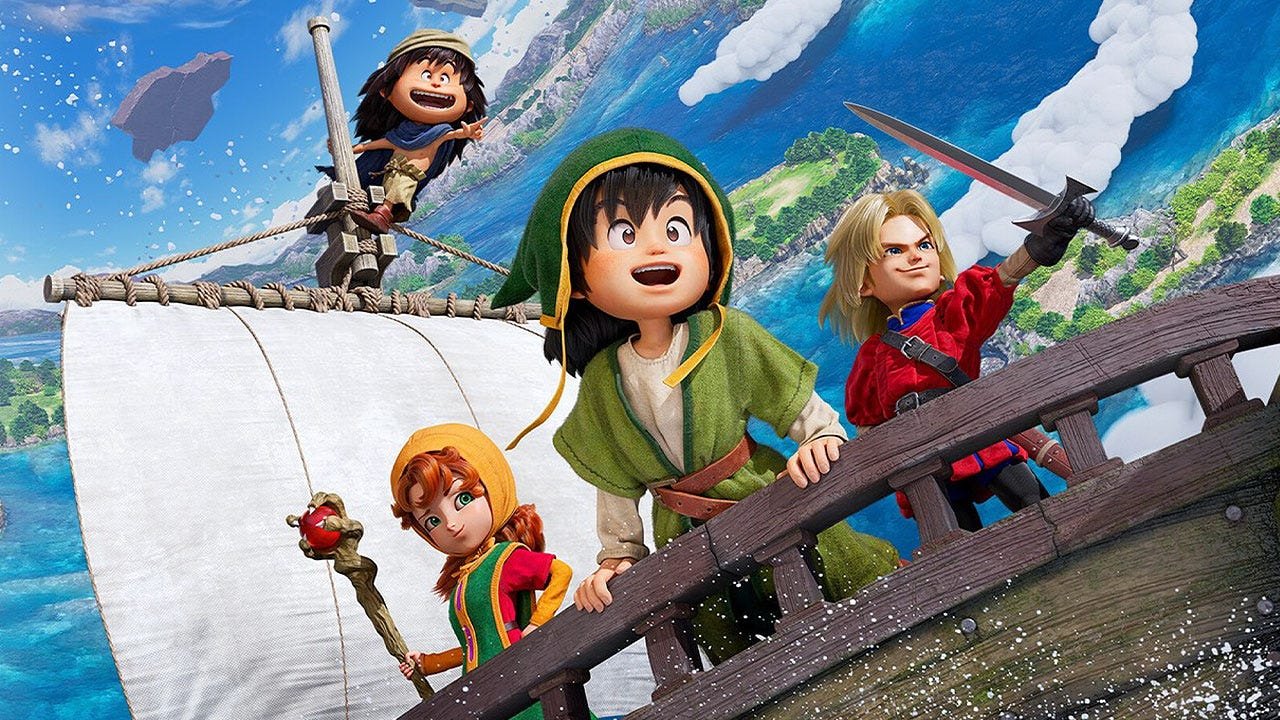
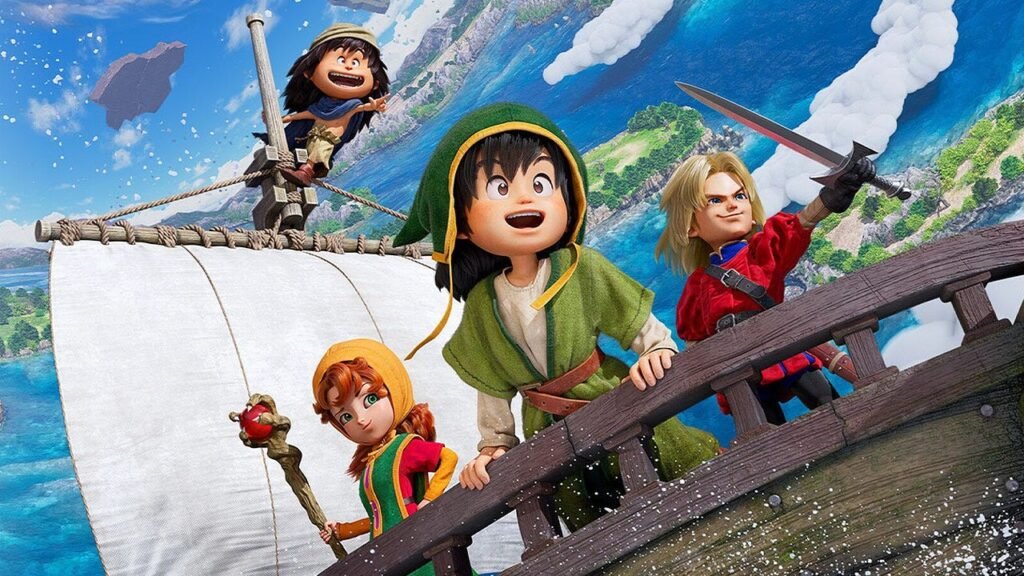
Bringing the world of Dragon Quest VII into the modern era of high-definition graphics, Reimagined sports a brand-new art style inspired by a puppet-and-diorama aesthetic that does a really good job of depicting Akira Toriyama’s original cast of characters. The proportions of these particular heroes have always been a bit more chibi compared to others in the franchise, but here muted tones and being able to see the fabric materials of hats and clothing have replaced the vivid colors and dramatic, anime-inspired outlines that I usually adore about Dragon Quest. The fact that Reimagined removed the 3DS version’s outfit changes for the different vocations saddens me as well. I admittedly found myself growing more accustomed to the puppet-y look as I went, and both my wife and my two-year-old loved to point out how cute everything was as I played, but I’d still be fine if this art style ended up being a “one and done” affair.
Thankfully, Reimagined retains much of the same classic RPG goodness that the Dragon Quest series has held onto these long decades, but it also introduces more goodies than just a facelift to mix up the adventure. New Monster Heart accessories impart unique aspects to the character they are equipped to, such as reducing your MP to zero but doubling your strength or increasing the damage you dish out with each subsequent attack. You can now take out weaker enemies in the field without ever entering combat as well, cutting them down from the world map itself. As nifty as both of these additions are, they are just the tip of the iceberg.
What I found more fun to mess around with and build my team around were the powerful Let Loose attacks, which are super moves that act as Reimagined’s take on the Square staple Limit Break concept, and the ability to have characters equip two vocations at a time. Both of these can result in some deliciously broken combos that feel great to pull off. Anyone currently equipped with the Priest vocation will be able to fully heal and revive the entire party with its Born Again action, while the Troubadour’s Encore ability will temporarily reduce the party’s MP costs to zero. My personal favorites were the Champion’s Divide and Monk’s Critical Stance, with the former causing three copies to appear and perform whatever action you pick that turn, and the latter guaranteeing your next physical attack to be a critical hit – a particularly devastating option when using the Monk’s Multifist attack that hits seven times.
It’s nice that the new Moonlighting feature that allows each party member to have two vocations at a time provides both their specific stat buffs and access to their toolkit of spells and abilities. Accessible a few hours after unlocking the vocation system itself, I appreciate the flexibility that Moonlighting offers in adjusting how you want your team to run. What I like even more is that there are no downsides or restrictions with whatever you pick for that Moonlighting spot – both vocations earn the same amount of experience points after combat, and it just speeds up the whole process of unlocking the especially good advanced vocations that require you to have mastered multiple other ones already. Keeping one of those mastered vocations equipped even gives the non-mastered role a boost with extra vocation experience.
The previous versions of Dragon Quest VII, especially the original PlayStation release, were known – almost notoriously so – for how long they could take to play through or get to the cool stuff, like combat or unlocking character classes for your party of heroes. Addressing those pacing issues was a core principle behind Dragon Quest VII Reimagined, and some of those changes are more welcome than others, but the pursuit has been a success overall. You’ll get to swing your sword (or sticks, in this case) at some monsters for the first time within 30 minutes of starting Reimagined, and I was able to get to Alltrades Abbey to unlock the vocation system, the crux of your party customization, around 11 hours later. To put the difference here into perspective, at one point I booted up a save from my 3DS version of Dragon Quest VII that was at roughly the same spot: not only was I five levels higher in Reimagined with twice as many vocations mastered, I had also done all that in half the time. When I rolled credits in Reimagined, I clocked in at just over 46 hours, with my party hovering right around level 50, which is much shorter than both previous versions – although that time doesn’t include either of the post-game dungeons or going for 100%, which will likely put you up to the 70+ hour mark.
It’s no secret that this adjusted pacing has come at the cost of some parts of the original game being removed, with producer Takeshi Ichikawa being transparent about how locations such as El Ciclo, Gröndal, and Providence were left on the cutting room floor. Certain areas and dungeons have been reduced in size, too, with the boat the main character’s father departs on right out of the gate now being only a single level instead of two. The Sunken Citadel in the Wetlock region is another such example, with the dungeon being basically removed altogether and replaced with a short, straight-shot corridor. Losses like that are certainly disappointing, but outside of the occasional dungeon feeling a bit small, I actually really enjoyed how the story flows now, and I never felt an obvious gap or awkward break caused by “missing” content.
What I think has had a more noticeable negative impact on the pacing, though, is how Reimagined has seemingly smoothed over nearly every aspect of the original that could potentially cause even the smallest bit of discomfort or aggravation. That may sound fine on the surface, but it has resulted in the removal of things that have traditionally helped define this series, taking away much of that crucial sense of discovery. When I boot up a Dragon Quest game, I expect that the journey will take me into some headwinds and that there will be points where I struggle with a challenge to overcome. In Reimagined, I found none of that.
In any other Dragon Quest, managing your resources – be it your HP, your MP, or your consumables – is something you always need to keep in mind. For example, you have to weigh the benefits of an encounter with whether or not you can spare the MP to end that fight quickly, at the expense of not being able to cast your biggest spells as many times in the eventual boss fight. In contrast, Reimagined bombards you with free healing statues, respawning items that refill both health and magic are all over the place, characters fully heal whenever they level up, and party members that die during a fight even respawn with a single hit point afterwards, doing away with that classic Dragon Quest imagery of seeing your lone character leading around a parade of colorful coffins in a dreary dungeon. And if you do find yourself in a situation where everyone dies, the penalty is so minimal, forcing you to lose only 1,000 gold as opposed to half of your total, that even that threat is far from scary. The first time I actually had to pay this fee was in the very last dungeon, playing on hard difficulty, and at that point I was more just curious to see what would happen.
Individual carrying bags have been done away with in favor of a single shared inventory as well, making it so you don’t have to worry about strategically divvying up your items. (And you have no need to worry about accidentally equipping a cursed item you can’t get off – those are gone now.) There are some difficulty options you can toggle and adjust, such as lowering or raising the amount of experience, vocation points, or gold you earn after a fight (though, unfortunately, you can’t set them to zero), but none of the other stuff I mentioned is included in those settings. In fact, you can choose to make things even easier for yourself by fully restoring your party after every encounter.
This handholding approach, where you almost can’t fail, even extends into the main questline. So much of the sense of exploration and discovery has been removed, with enough information being fed to you that quests almost turn into a simple matter of glancing over your screen to find where the big icon is. Is there a tablet fragment in your location? You’ll see a marker on your map letting you know one is somewhere nearby, which turns the hunt for them into an almost mundane task to check off a list rather than the epic, world-saving mission it’s made out to be. You don’t even have to try spells out on enemies anymore to know how they might affect them, as an icon over the monster’s head will show whether the one you have highlighted is weak or strong against it, or if they will resist it altogether.
Having recently played through last year’s spectacular HD-2D remakes of Dragon Quests I & II, all of this smoothing gave me whiplash. That package added some solid accessibility options to help newer players, but it still retained – and in many cases expanded – the challenge of the originals. Dragon Quest VII Reimagined feels like it goes in the complete opposite direction, with the only real challenge coming from the last hour of the story and the post-game grind.
That all said, the more I played this new version, the more I eventually came to accept it for what it was, even if that wasn’t exactly what I was expecting or looking for. Between its faster pacing, toy-like aesthetic, and insistence on reducing pain points, this really is a literal reimagining of Dragon Quest VII as a sort of “My First Dragon Quest” entry point for new players. Once that realization clicked, I just let myself enjoy the ride as I soaked in a story and characters I still adored – I just also had to come to grips with the fact that it wasn’t going to deliver the challenge and discovery that I usually play Dragon Quest games for.