I was not a natural parent. The love was there instantly, but with it came all this anxiety I had not expected. Having a baby was like opening the door to a hilariously overstacked closet, and all of a sudden my simple life was buried under endless new things, new worries and new sources of nightmares. Cutlery was suddenly a class of sharp objects. Plug sockets were suddenly electrocution hazards. A mid-day walk through the nearby woods was suddenly filled with uneven flooring, with deadly mushrooms one might accidentally eat.
Actually, forget the mushrooms. Maybe there were as-yet-undiscovered species of dangerous snakes in the area? Maybe some weird band of medieval brigands had somehow survived contact with the modern world up until now and were waiting to attack us all on a family picnic, and leave us with cloth-yard shafts through all our wishbones. (Nobody ever said of anxiety that it is short on imagination.)
Anyway, I was lucky enough not to be parenting alone, and my wife is wise and kind and brilliant. My daughter survived her early years and she survived my anxieties. And as for my anxieties themselves? Well, they didn’t disappear, but they did change. They became more refined, I guess, more nuanced. I gained access to the Business Class Lounge of worries, only available to frequent flyers.
And with all this, I now understood, my worries became more ridiculous. I got to the point where I was no longer worried about my daughter accidentally eating a deadly mushroom on a trip to the park. But I started to worry, instead, about all the sadness and frustration that is inevitable in any life. I think I wanted to protect her from any and all disasters, no matter how small, and no matter – this is hard to say as a parent, I think – no matter how necessary.
I feel stupid writing about this, but I had a lot of specific anxiety about her toys breaking. I know. Of all the big things happening in the world! But I hovered incessantly when she was playing Lego and I fretted over her doll’s house and all that jazz. (This isn’t entirely gone, by the way: I was helicoptering wildly the other day when my perfectly competent teenaged daughter was changing over a record in the back room.) I think I worried that my daughter would fall in love with a toy and then she would break it or lose it and her childhood would be forever scarred. Some kind of awful before and after would have been created, some kind of hinge in her life would have appeared.
And yes, I appreciate even as I type this, that this is clearly some anxiety about myself that I was transferring onto my poor kid. But that’s anxiety in general, isn’t it? It’s a poison gas creeping through the house, finding new spaces to fill regardless of the shape. (Great, now I’m fretting about gas leaks.)
Getting over all this took a long time and a lot of work. But, happily for the fact that I’m writing this on Eurogamer, a big part of it came down to games. Actually, it came down to one particular game, and I’m afraid it’s a game that I’ve gone on about so much in the past it’s probably a bit boring. Apologies! Indulge me one last time.
It came down to Grow Home.
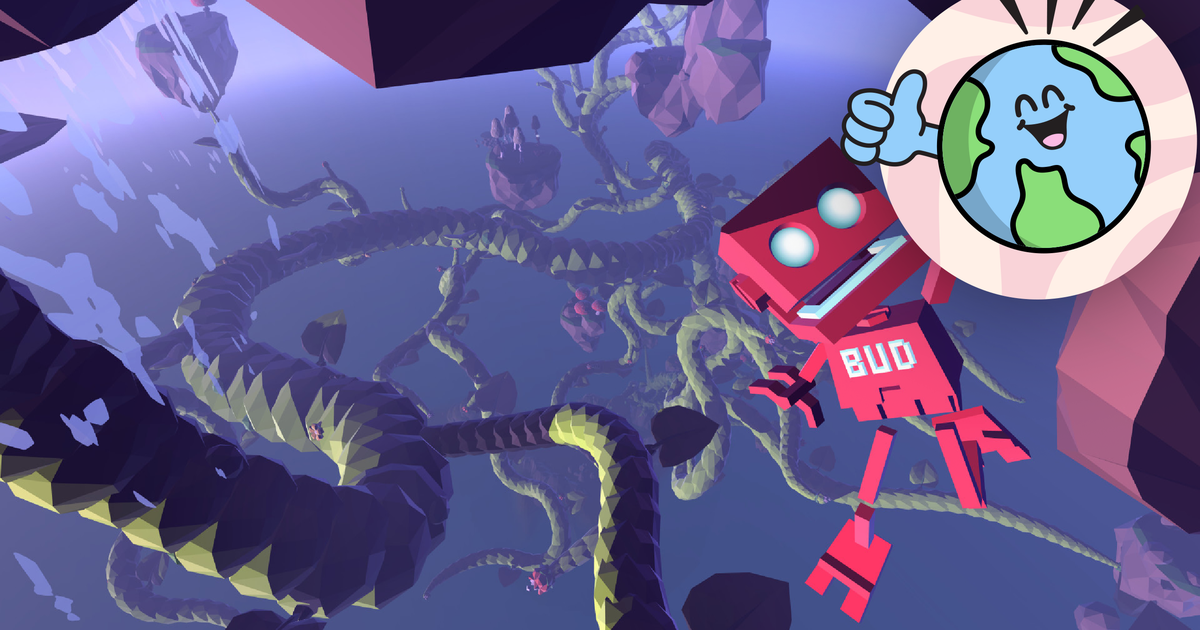
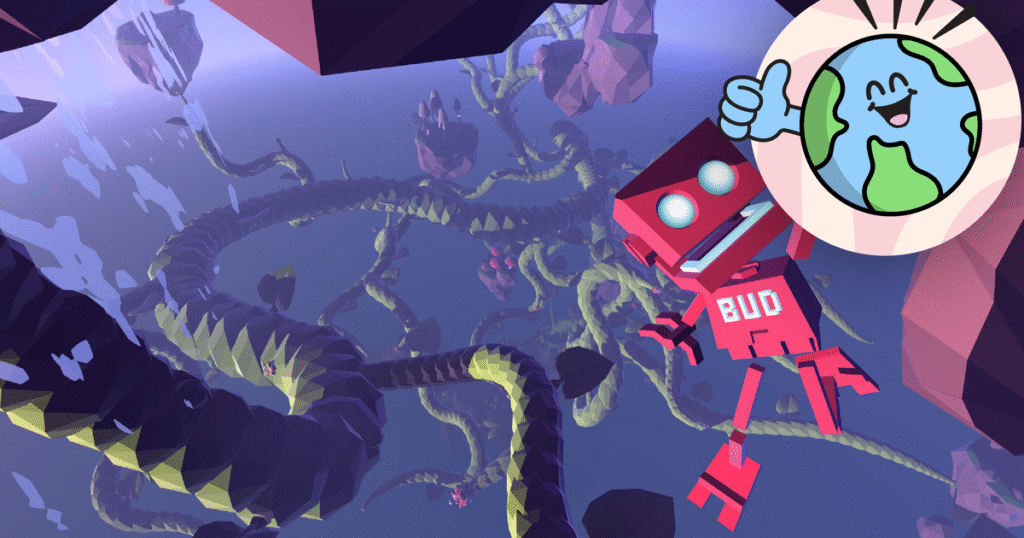
Grow Home is a platforming game about a little robot who’s crashlanded on an alien planet and has to climb a beanstalk all the way back to their spaceship where a friendly computer is waiting for them. It’s a game about parenting. BUD is a classic toddler/early walker and he’s into everything and exploring a world where there is plenty of potential for bumping his head on something. The player controls BUD, but in some weird bit of psychological video game magic I won’t even pretend to understand, they also identify with the computer back on the ship who wants him to be safe while he’s climbing that beanstalk. It’s an empathetic pincer movement.
But here is the genius of the thing: the game doesn’t just want you to keep BUD safe. It wants you to let BUD have a pretty wild adventure too. And what this means, I think, is that the game wants you to experiment with the boundaries of parenthood. How do you square keeping someone safe with letting them indulge their own curiosity? And isn’t safety at the expense of curiosity just another kind of trauma?
This all comes together for me in something the game does that is truly phenomenal. A lot of Grow Home involves collecting these special seeds that… Okay, at the moment I can’t actually remember what they do, but they’re absolutely essential to your mission. BUD can carry these seeds, but he also needs his hands to climb. And climbing in the game is a rickety, accident-prone business, which means in turn that you’ll often be climbing when you lose your balance. You’ll have to then choose between staying attached to the wall you’re on and dropping what you’re carrying, or falling into the abyss. And if you drop what you’re carrying, it may land in the sea surrounding the island you initially arrive on. And if that happens… it’s lost?
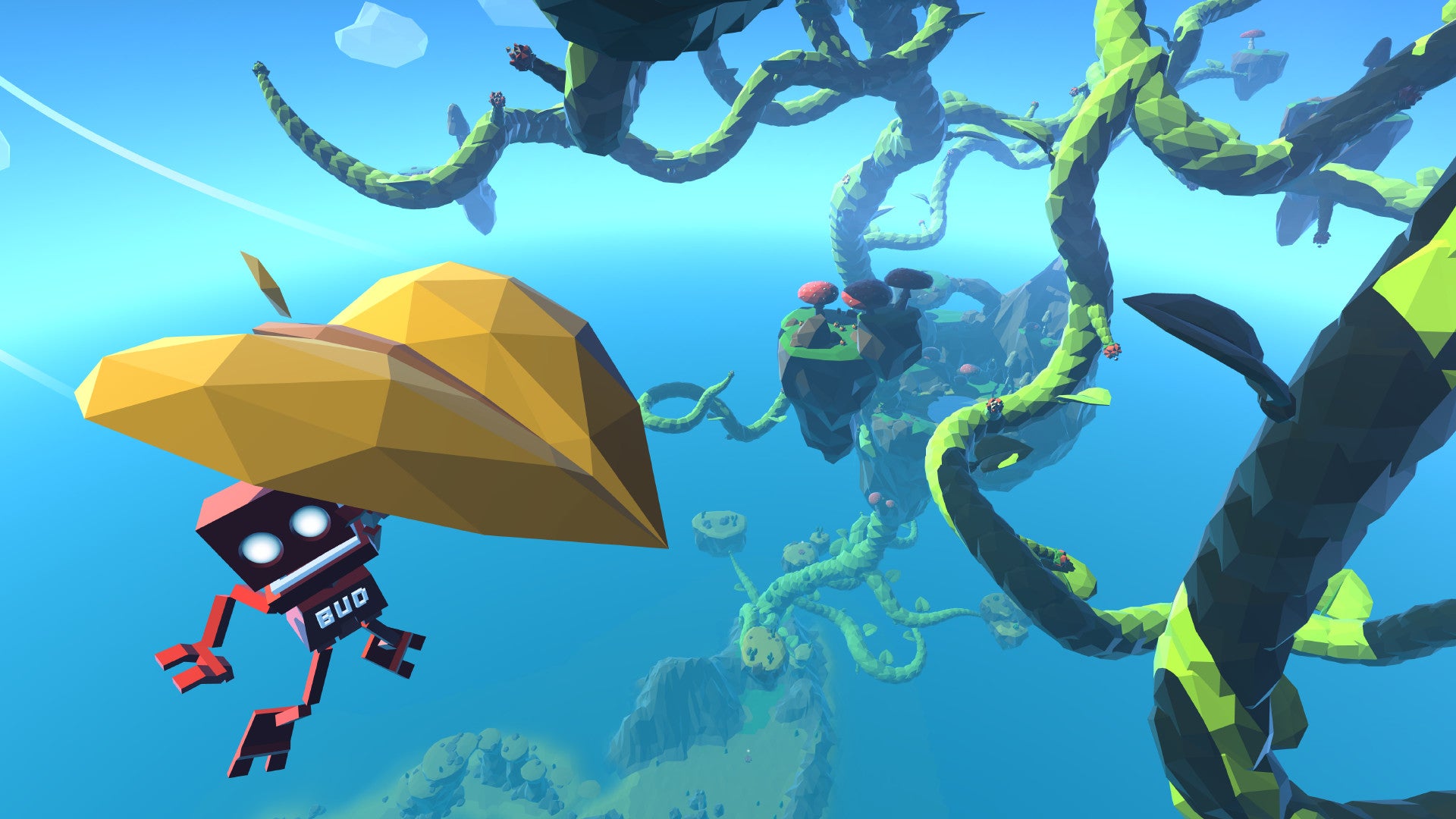
This is exactly the kind of scenario I struggled with my daughter facing. Okay, not exactly: I wasn’t worried about her dropping magical seeds in the ocean while climbing a beanstalk. But I was worried about her encountering permanence in such a negative way. Money rolling down a literal drain. An ice cream splatted on the pavement. A precious toy dropped out of an aeroplane (could happen, I guess? Somehow?).
I really wanted to play Grow Home with my daughter. There is so much magic in it that I wanted her to see. There are these moments when your beanstalk reaches a new floating island and you climb up through the inside of the rock itself, while water falls all around you. There are these sheep-things knocking about that I knew would delight her. There’s this moment near the end when you reach the boundary of space and push through it, and night descends and you’re suddenly climbing over asteroids. And I knew that this would make her go silent with awe.
But those seeds! What if she dropped them?
Luckily, at this point I remembered something that I had spoken to the developers about when Grow Home came out. I had realised, through the course of my own misadventures, that anything I dropped in the ocean in the game disappeared for a while, certainly, but then washed up again on the shores of the starter island, in a little cove perfect for the gathering of flotsam. (Just looked that word up to check it was the right term. I recommend looking it up! Also Jetsam is equally interesting.)
I’d spoken to the developers about this and they had explained that this was quite intentional. Internally they called this area the Magic Beach, and it was their solution for making sure that players didn’t lose anything that was critical to game progression. Even better, they found a way to do this that didn’t seem artificial, that actually made the world feel richer and more real. Of course things you lose to the ocean might wash up again!
The Magic Beach saved me. It allowed me to play Grow Home with my daughter, and show her this game and this world that I loved, and all this awe and beauty that I thought she would appreciate. A few years later when she finished the first game that she had played herself from the start, A Short Hike, I felt the spirit of BUD right there with her, urging her on.
But I look back at it all now and I see something different taking place. No doubt you’ve arrived here before me, but that’s the nature of personal revelation, isn’t it? I see now that the Magic Beach wasn’t for her. Because, despite my worst helicoptering, she has always been completely capable of dealing with the prospect of extremely mild digital disappointment. She would probably lose a seed in the ocean and find it hilarious, thrilling, repeatable.
Instead, the Magic Beach was for me. It allowed me to sidestep my anxieties and share something really important with my kid.
The wider message, here, is that it’s easy to think of games as things that often choose to simulate danger. But what they really do is simulate safety. We all know this. The bullets never leave a mark. You’re rarely dropped into your grave for very long. And while you’re alive, you get to swoop behind waterfalls, rail-grind up skyscrapers, and drop-kick comets into the heart of a black hole. Games give you life at its richest, in many ways, but it’s always life without the drowning.
This is important, I think. It’s a vital, life-changing part of what games do. And they never really stop doing it.
My daughter bounced off games. She found her own interests, which is all I ever really wanted anyway, and, besides, I suspect nothing is more boring than what your dad does for a living. As for me, the world is absolutely wild as I approach fifty. Elderly relatives need caring for, the three-in-the-morning maths of how old you are now, how long ago certain things happened, and how far in the future a decade gets you, is all quietly disquieting. But more than ever, games give me a chance to orient myself a little. They are one of a number of vital cherished things that do this. They offer worlds that have rules and also boundaries that the real world is suddenly lacking. They make me realise that I don’t actually want to escape from the real world, but that I sometimes want the little bubbles of safety that games give me in order to build up enough curiosity to head back out there.
I realise as I type this that I have written about some of this before. Back when I was first diagnosed with MS – cripes, how can that be 11 years ago already? Endless gratitude to the NHS and Dr Quill – I found solace in games like Spelunky and XCOM, because they allowed me to experiment with randomness and disaster in a safe way. But I think I’ve come to think of things slightly differently in the years since, or rather I want to rebalance that thought a little. It’s not the proximity to randomness and disaster that’s useful, it’s the safety that surrounds it in games, because this encourages a player to press on, to experiment, to take digital risks and, sometimes, see real beauty as a result of it. If you asked me today what games are – and if I was feeling spectacularly florid, I guess – I’d say they’re often bright cathedrals of error in which every kind of mistake, every strain of failure, is explored and celebrated and survived.
I appreciate that it feels odd to write about optimism in 2026, and I’m not just talking about the state of the games industry. Optimism can be taken as a form of wilful ignorance, of refusing to experience what others are going through. I absolutely agree with all that and it’s something I try to navigate respectfully. And part of it, I think, is realising that for me optimism always has gratefulness at its core. The world is complex and uncertain and frequently cruel. Yet my optimism comes out of gratitude for the people who have done things, big and small, that have helped me and that help others. It comes out of the awareness that people have frequently helped others simply because they are compelled to.
Sometimes this even means they have made games, and added things like the Magic Beach to them to allow me to escape my own stupid inane worries for a few moments. So yes, optimism is gratitude – and it’s my belief that this spirit of generosity and insight I’ve received from so many of the very best games is not going anywhere soon.