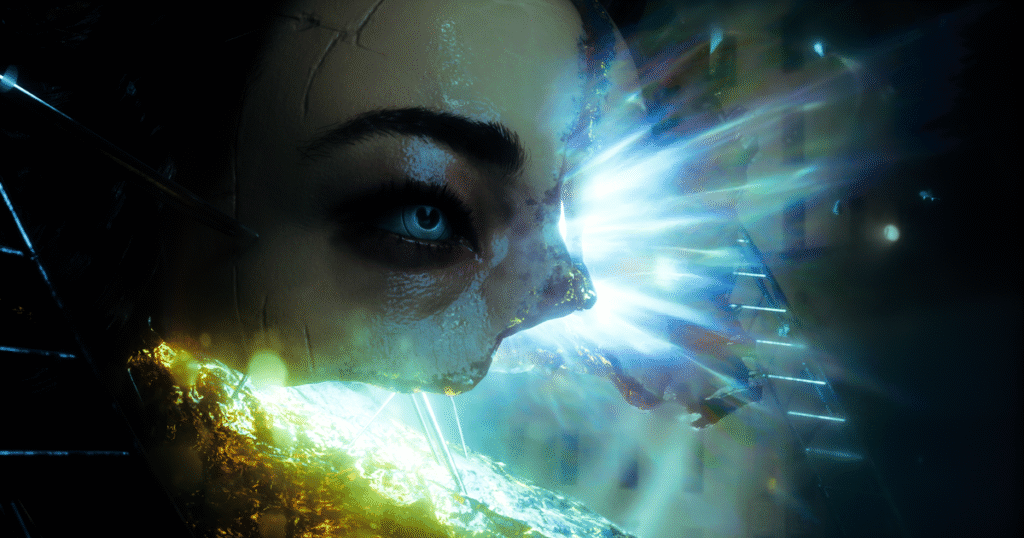
There are, after a good few hours playing it, quite a few games like Control Resonant. It’s an RPG with a kind of pseudo open-world – an “open-ended modern world” I believe was Remedy’s way of putting it in its presentation to the press earlier this week – and it has skill trees and some light resource-gathering and item-upgrading. It has some light platforming with a double-jump and a dash, and melee combat with perfect dodges and aerial combos.
But then also: there are not many games like Control Resonant at all. Because while it has plenty of familiar elements – and, on the surface at least, will seem particularly familiar to players of, say, Prototype or Infamous – it’s also been assembled in a signature Remedy way. There are parts of the demo I played that I don’t think would have made it into other triple-A games; creative decisions that would’ve either not been made or, maybe more likely, have been gradually whittled down and eroded over time. The result is something a little more rugged than even the first Control, that may not even always come together perfectly in the playing. But also something kind of fascinating.
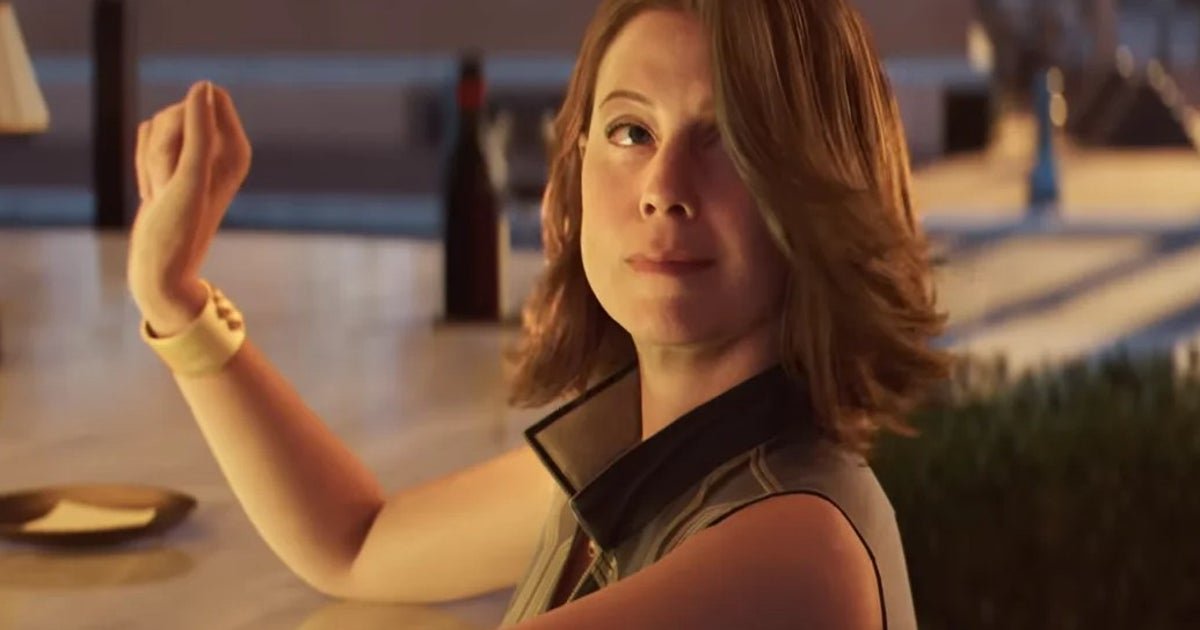
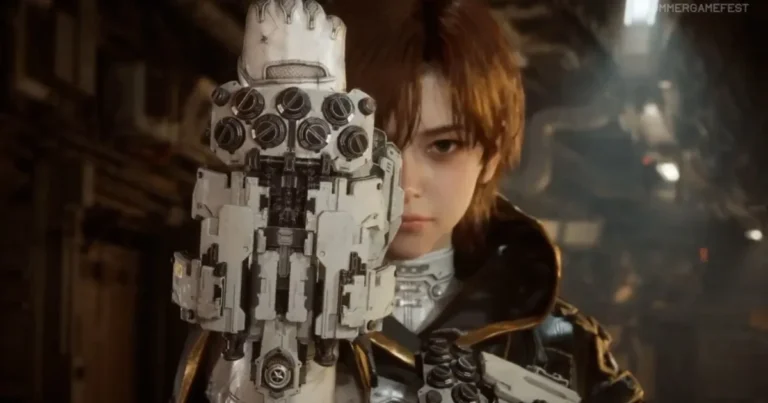
In Control: Resonant you play as Jesse’s infamous brother, Dylan Faden. Once a villain, Dylan here is more of an emo antihero, moping his way through a distorted, refracting New York, volunteering his specialist skills in bludgeoning and shanking the enemy Hiss almost apologetically. While he might seem, initially, like a supremely run-of-the-mill Video Game Dude, with his customisable weapon and brown mop of hair and five o’clock shadow, he’s really something slightly more novel. He’s sad and sorry and dare I say it a little pathetic. “He’s come out of being infected by the Hiss, having something take over his life, his trauma,” Dylan’s voice actor, Sean Durrie, put it to me during an interview after my time with the game. “And now he’s rediscovering his humanity. So it’s a new beginning.”
After a tutorialised escape from the Oldest House and a bit of light combat, there was room to glean a little more on the specifics of how Control Resonant plays. There’s essentially an overworld and what Remedy informally calls ‘dungeons’, as well as sidequests that can be picked up, and a very Remedy area you can visit to re-spec your build, upgrade abilities, or progress through a pretty hefty skill tree. The actual ‘build’ side of things, in terms of how far you can go with min-maxing buffs and the like, seems to have some moderate depth. Different combat options cause different debuffs to enemies – some stagger, for instance, others have chances to crit – and you can assign a small number of trinket items for buffs (some with significant trade-offs, like taking a lot more damage in exchange). Resources and rare items can be found from scavenging around the world or beating bosses.
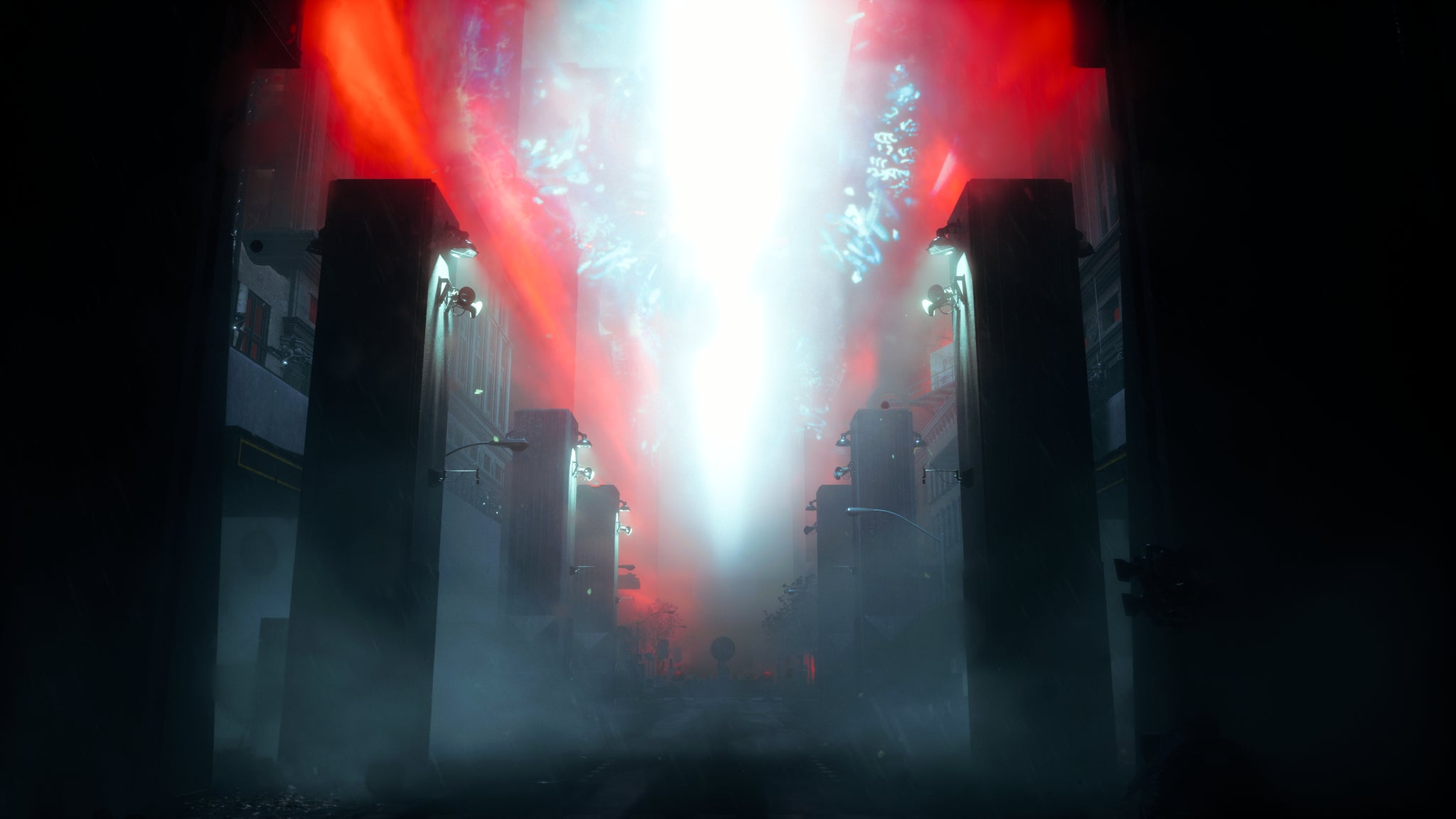
This side of things is not enormously interesting – beyond the fact that it’s a new approach from Remedy, which has typically taken only the lightest of touches to RPG mechanics with the likes of Control. “We were right at the edge of, like, action adventure versus action RPG,” was how Mikael Kasurinen, Control Resonant’s creative director, put it to me during our interview, referring to the first Control game. “Now we’re kind of taking the full leap into that realm.”
Much of the demo’s front half was quite standard Remedy fare: known concepts like the aforementioned double jumps, dodges, and so on, introduced with a bit of flair via visions and flashbacks, flickering TV screens, meta references and blink-and-you’ll miss it jokes, abstract platforming sequences, strange glitch-in-the-Matrix patterns and stranger obelisks. Where things got good was one of those dungeons.
The one featured here, called the Sinkhole, was an example from a few hours into the game, where Dylan, guided by a reluctant FBC agent over the radio, descends on a kind of probe platform, dangling like a loose lampshade, down into a cylindrical chasm that’s opened up in the city.
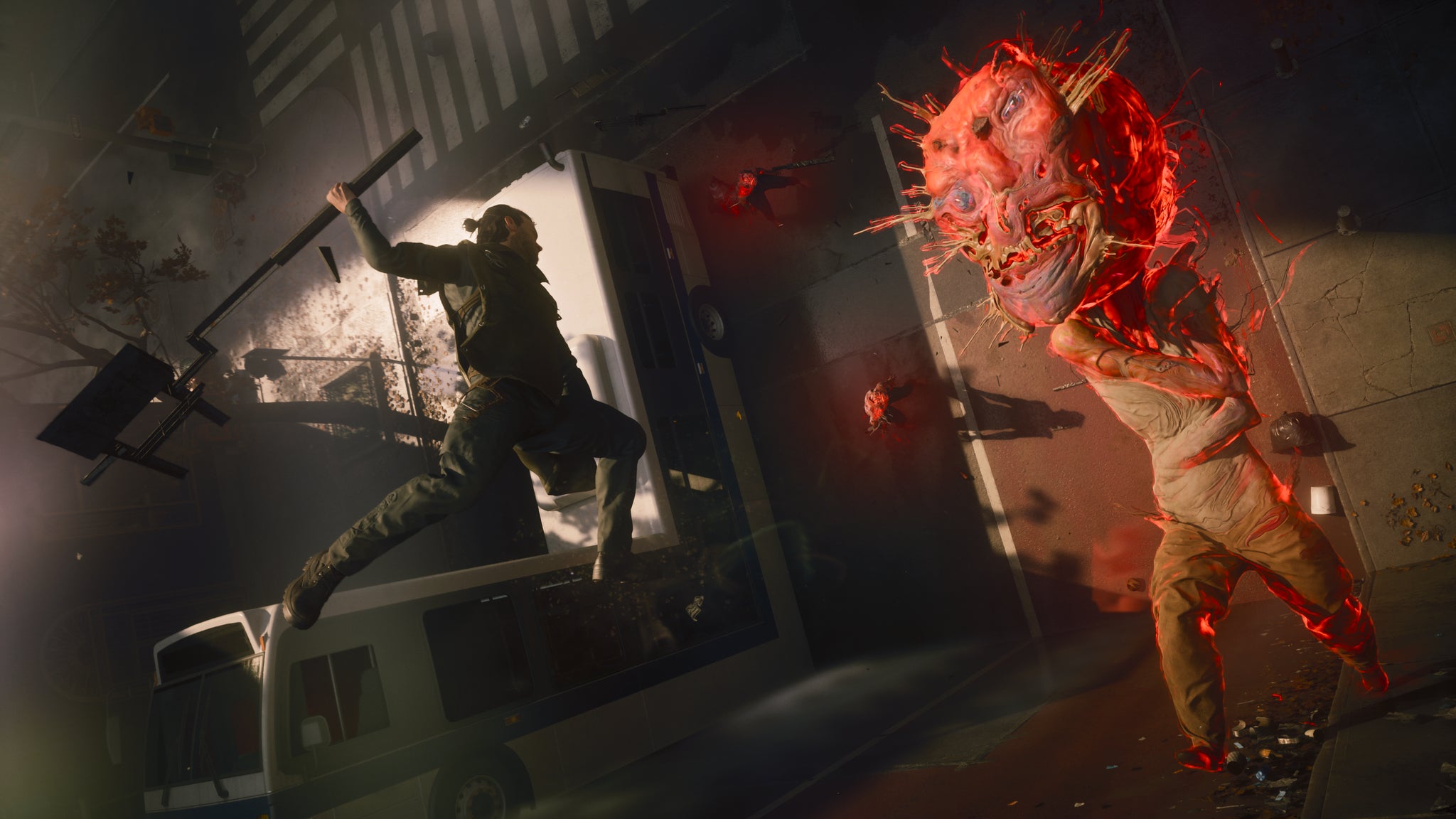
Down in the well, where the probe first stops and a load of enemies spawn, Remedy essentially has the chance to flex its Oldest House design chops in a contained environment. The overworld city itself is fine – it’s a video game city with nobody in it – but these more confined areas were excellent. The first stop saw waves of enemies, with a decent bit of variety between sniper-like ranged foes, tricky sub-bosses with odd names who disappear into puffs of red smoke, and plentiful grunts. But it also, crucially, featured an absolutely mind-melting combat arena in which to fight them: a series of rooms bundled together in three impossible dimensions, where you had the ability, with a lap of the left bumper, to run up or down walls and ceilings.
It’s difficult to explain, but imagine it like this: you are in a vast, beehive cube of midcentury office rooms, where running up a wall gravity boots-style essentially means you’re employing a kind of visual trick: you’re rotating the world around you as Dylan himself stays orientated in the centre. Enemies scuttle up and around ledges, you fall impossibly out the top of rooms and across chasms into others – like a figurine tipped out the front of a doll’s house into… another, upturned doll’s house. And all the while: snappy, frenetic combat around you.
It’s fantastic. Disorientating and I think also maybe a touch nauseating when you do it all too quickly – this is why I don’t think it’s the type of thing that would’ve stuck around in other triple-A games; it’s the type of thing that gets caught in a review and refined into something a little safer, a little less likely to risk annoying some players in order to wow others.

Combat itself, meanwhile, finds its groove as you find your own as a player. It’s the type of system that expands with your competency. You can dash and double-dash, double-jump, hover (for quite a while) in the air, and chain aerial combos, Devil May Cry-style, for lengthy periods of time, suspending you impossibly above the action. You also kit yourself out with several of a few relatively inventive options for weapons, too.
For me, that started with a couple of short, high crit-chance dagger-like weapons for my main attack – mash Square, basically – and a heavy weapon, which I first chose to be a whip that can be lashed for a bit of mid-range damage, or momentarily ‘charged’ for a brilliantly emphatic crack. Then there are special abilities that have a small cooldown – lob some big rocks, make a brief rock shield (a lot of signature Control brutalism finds its way in here, all concrete and metal), do a big ground-pound from the air, or shoot a kind of… fireball?
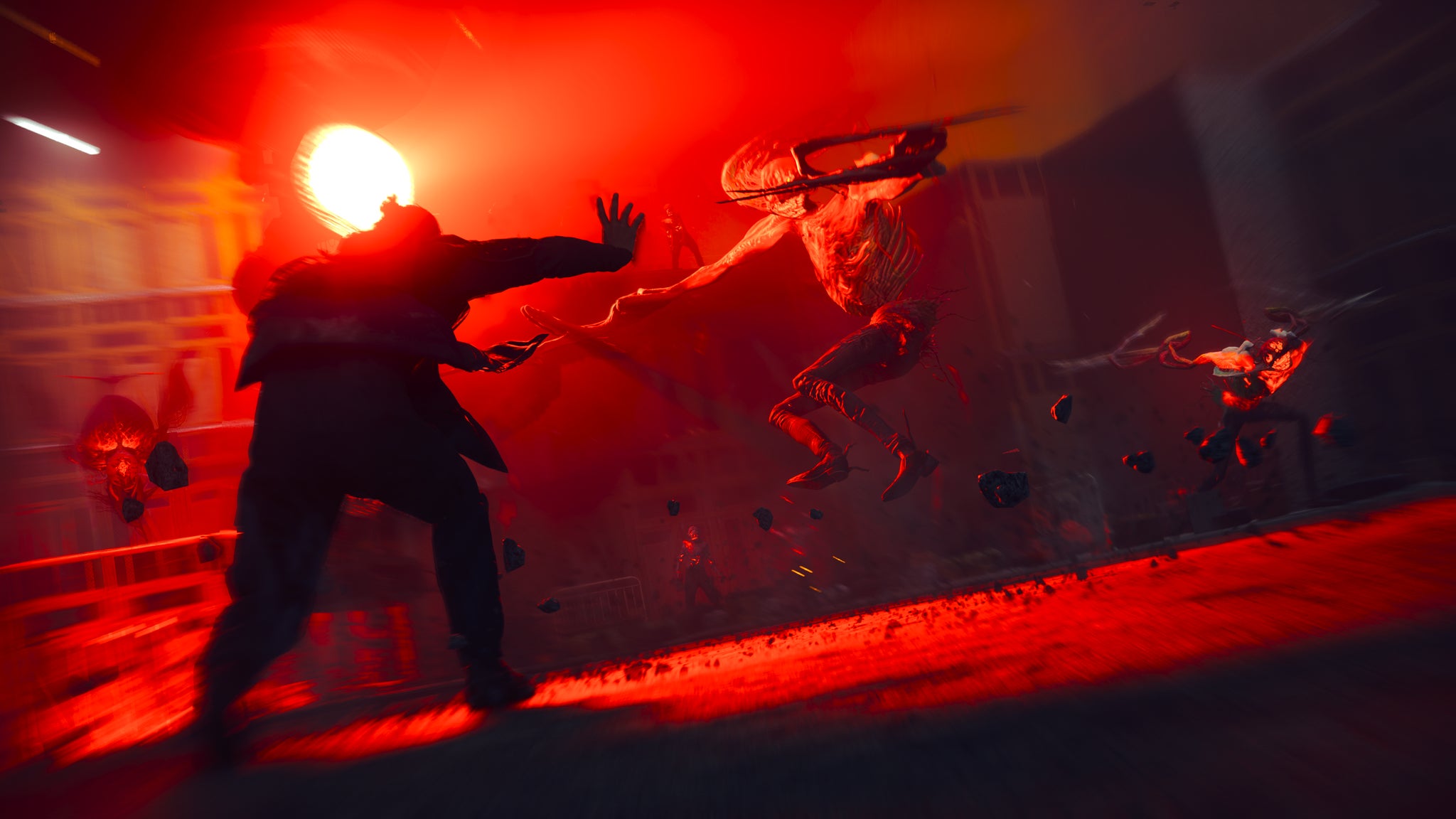
Where it starts to sing is in the tougher scenarios. The toughest boss fight at the end of the demo – and the bottom of this strange pit I’d dropped into – featured a large circular combat area surrounded by platformable buildings, an absolutely vast number of enemies, and a kind of glowing red devil that bombarded the area like a loitering jet plane. The trick became building up a bloodlust: fill an enemy’s stagger meter with certain attacks and you can zip over to them to perform a finisher. Finishers give you bloodlust, which causes more healing orbs to drop from enemies and lets you crit more often or otherwise do more damage. Perfect dodges also let me land a guaranteed crit of sorts, and so as the swarm of enemies gathered, it became a game of rolling buffs, dodging then attacking then executing, then attack-attack-attack to maximise the window of damage. A tooltip on the death screen sagely advises that offense is the best defence here. That is very much correct.
The escape, after all this, was a chance for more Remedy surrealism. More baffling, rotating environments and impossible physics. More antigravity platforming. More musical moments – though not a live-action dance number, at least in this instance. There was maybe the odd moment where Remedy seemed to have slightly overdone it – one sequence where you run through a seemingly neverending series of living rooms, kitchens, and bathrooms following the lights and sounds of TVs playing an appropriately emo needle-drop went on a little too long, to the point where a brilliant conceit started to slightly drag.
But again, this is what creative risk looks like. Control Resonant is out in a few months’ time, the build was inevitably, I’d assume, slightly dated by the time I played it, and so inevitably a few things will be tinkered with and tidied. There are a few small rough edges with sound and visual blips to be smoothed out. And more than that: the slight unevenness – the sequences that can be long, or occasionally hard to read; the combat that can be fantastic in its speed and freneticism also slipping into a little too much chaos in moments – is a result of trying these things, a studio pushing itself to do a somewhat typical, triple-A RPG in its own special way. There’s vast potential here, if Remedy can continue to find the balance. It’s a risk to try these things, that could backfire – and exactly the type of risk a game developer should be allowed to take.